
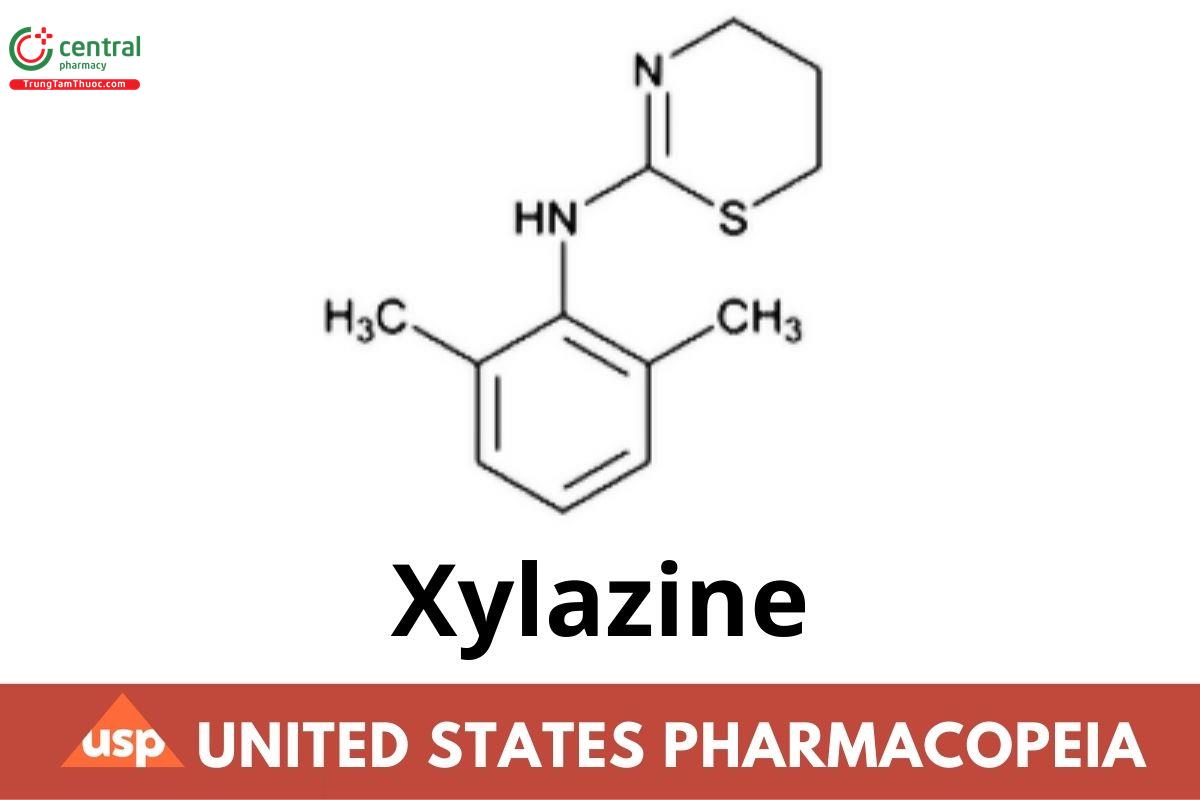
Xylazine
If you find any inaccurate information, please let us know by providing your feedback here

Tóm tắt nội dung
This article is compiled based on the United States Pharmacopeia (USP) – 2025 Edition
Issued and maintained by the United States Pharmacopeial Convention (USP)
C12H16N2S 220.33
4H-1,3-Thiazin-2-amine, N-(2,6-dimethylphenyl)-5,6-dihydro-; 5,6-Dihydro-2-(2,6-xylidino)-4H-1,3-thiazine CAS RN: 7361-61-7; UNII: 2KFG9TP5V8.
1 DEFINITION
Xylazine contains NLT 98.0% and NMT 102.0% of xylazine (C12H16N2S).
2 IDENTIFICATION
Change to read:
A. SPECTROSCOPIC IDENTIFICATION TESTS (197), Infrared Spectroscopy: 197A or 197K (CN 1-MAY-2020)
Change to read:
B.SPECTROSCOPIC IDENTIFICATION TESTS (197), Ultraviolet-Visible Spectroscopy: 197U (CN 1-MAY-2020)
Sample solution: 5 µg/mL in 0.1 N hydrochloric acid
Acceptance criteria: Meets the requirements
3 ASSAY
PROCEDURE
Solution A: Dissolve 3.03 g of sodium 1-heptanesulfonate in 800 mL of water, adjust with 2 N sulfuric acid to a pH of 3.0, and dilute with water to 1000 mL.
Pass through a filter of 0.5-µm or finer pore size.
Solution B: Acetonitrile
Diluent: Solution A and Solution B (50:50)
Mobile phase: See Table 1. Return to original conditions, and equilibrate the system.
Table 1
| Time (min) | Solution A (%) | Solution B (%) |
| 0 | 70 | 30 |
| 5 | 70 | 30 |
| 10 | 60 | 40 |
| 15 | 60 | 40 |
Standard solution: 0.4 mg/mL of USP Xylazine RS in Diluent
Sample solution: 0.4 mg/mL of Xylazine in Diluent
Chromatographic system
(See Chromatography 〈621〉, System Suitability.)
Mode: LC
Detector: UV 226 nm
Column: 3.9-mm × 30-cm; packing L1
Flow rate: 1 mL/min
Injection volume: 10 µL
System suitability
Sample: Standard solution
Suitability requirements
Tailing factor: NMT 2.0
Relative standard deviation: NMT 2.0%
Analysis
Samples: Standard solution and Sample solution
Calculate the percentage of xylazine (C12H16N2S) in the portion of Xylazine taken:
Result = (ru /rs ) × (Cs /Cu ) × 100
ru = peak response from the Sample solution
rs = peak response from the Standard solution
Cs = concentration of USP Xylazine RS in the Standard solution (mg/mL)
Cu = concentration of Xylazine in the Sample solution (mg/mL)
Acceptance criteria: 98.0%–102.0%
4 IMPURITIES
RESIDUE ON IGNITION (281): NMT 0.1%
4.1 LIMIT OF 3-AMINO-1-PROPANOL
Standard solution: 0.5 mg/mL of 3-amino-1-propanol in methanol
Sample solution: 100 mg/mL of Xylazine in methanol, Sonicate to dissolve.
Chromatographic system
(See Chromatography (621), General Procedures. Thin-Layer Chromatography.)
Mode: TLC
Adsorbent: 0.25-mm layer of chromatographic silica gel
Application volume: 5 µL
Developing solvent system: Alcohol and ammonium hydroxide (80:20)
Spray reagent: 2 mg/mL of ninhydrin in alcohol
Analysis
Samples: Standard solution and Sample solution
Develop the chromatogram in a saturated chromatographic chamber containing the Developing solvent system until the solvent front has moved three-fourths of the length of the plate. Remove the plate from the chromatographic chamber, mark the solvent front, and air-dry the plate. Spray the plate with the Spray reagent, and immediately heat the plate in an oven at 105". When the spots are visible, remove the plate from the oven, and allow to cool.
Acceptance criteria: The intensity of the spot for 3-amino-1-propanol from the Sample solution is not greater than that of the spot for 3-amino-1-propanol from the Standard solution (0.5%).
4.2 LIMIT OF ACETONE AND ISOPROPYL ALCOHOL
Proceed as directed in Residual Solvents (467).
Acceptance criteria
Acetone: NMT 0.02%.
Isopropyl alcohol: NMT 0.2%
4.3 ORGANIC IMPURITIES
Solution A, Solution B, and Diluent: Prepare as directed in the Assay.
Mobile phase: See Table 2. Return to original conditions, and equilibrate the system.
Table 2
| Time (min) | Solution A (%) | Solution B (%) |
| 0 | 75 | 25 |
| 8 | 75 | 25 |
| 35 | 30 | 70 |
| 40 | 30 | 70 |
Sample solution: Transfer 100 mg of Xylazine into a 10-mL volumetric ask, add 5.0 mL of Solution B, and swirl to dissolve. Add 4 mL of Solution A, and swirl. Dilute with Solution A to volume, and mix.
Chromatographic system
(See Chromatography 〈621〉, System Suitability.)
Mode: LC
Detector: UV 205 nm
Column: 4.6-mm × 25-cm; packing L7 (use a guard column)
Flow rate: 1 mL/min
Injection volume: 10 µL
System suitability
Sample: Standard solution
Suitability requirements
Tailing factor: NMT 1.5
Relative standard deviation: NMT 5.0%
Analysis
Samples: Standard solution and Sample solution
Calculate the percentage of each impurity in the portion of Xylazine taken:
Result = (ru /rs ) × (Cs /Cu ) × (1/F) × 100
ru = peak area of any individual impurity from the Sample solution that is not present in the chromatogram of the Diluent
rs = peak area of xylazine from the Standard solution
Cs = concentration of USP Xylazine RS in the Standard solution (mg/mL)
Cu = concentration of Xylazine in the Sample solution (mg/mL)
F = relative response factor (see Table 3)
Acceptance criteria: See Table 3.
Table 3
| Name | Relative Retention Time | Relative Response Factor | Acceptance Criteria, NMT (%) |
| 2,6-Dimethylaniline | 0.8 | 1.4 | 0.5 |
| Xylazine | 1.0 | - | - |
| Specied unknown | 1.3 | 2.8 | 0.5 |
| 2,6-Dimethylphenyl isothiocyanate | 2.0 | 2.7 | 0.5 |
| Any individual unspecied impurity | - | 1.0 | 0.5 |
| Total impurities | - | - | 1.0 |
5 SPECIFIC TESTS
Loss on Drying 〈731〉
Analysis: Dry under vacuum at 60° for 4 h.
Acceptance criteria: NMT 0.5%
6 ADDITIONAL REQUIREMENTS
Packaging and Storage: Preserve in tight containers. Store at 25°, excursions permitted between 15° and 30°.
Labeling: Where it is intended for veterinary use only, the label so states.
USP Reference Standards 〈11〉
USP Xylazine RS

