
WATER-FOR-PHARMACEUTICAL-PURPOSES-
If you find any inaccurate information, please let us know by providing your feedback here

Tóm tắt nội dung
- INTRODUCTION
- SOURCE WATER CONSIDERATIONS
- WATERS USED FOR PHARMACEUTICAL MANUFACTURING AND TESTING PURPOSES
- 4. VALIDATION AND QUALIFICATION OF WATER PURIFICATION, STORAGE, AND DISTRIBUTION SYSTEMS
- 5. DESIGN AND OPERATION OF PURIFIED WATER AND WATER FOR INJECTION SYSTEMS
- 6. SAMPLING
- CHEMICAL EVALUATIONS
- MICROBIAL EVALUATIONS
- 9. ALERT AND ACTION LEVELS AND SPECIFICATIONS
- REFERENCES
This article is compiled based on the United States Pharmacopeia (USP) – 2025 Edition
Issued and maintained by the United States Pharmacopeial Convention (USP)
1 INTRODUCTION
Water is widely used as a raw material, inactive ingredient, medicinal vehicle, and solvent in the processing, formulation, and manufacture of pharmaceutical products (dosage forms), active pharmaceutical ingredients (APIs), API intermediates, compendial articles, and analytical reagents as well as in cleaning applications.
This informational chapter on pharmaceutical water topics includes some of the chemical and microbiological concerns unique to water and its preparation and uses. The chapter provides information about water quality attributes (that may or may not be included within a water monograph) and processing techniques that can be used to improve water quality. It also discusses water system validation and gives a description of minimum water quality standards that should be considered when selecting a water source including sampling and system controls. It is equally important for water systems to be operated and maintained in a state of control to provide assurance of operational stability and therefore the capability to provide water that meets established water quality standards.
This chapter is intended to be educational, and the user should also refer to existing regulations or guidelines that cover US and international [International Council for Harmonisation of Technical Requirements for Pharmaceuticals for Human Use (ICH) or World Health Organization (WHO)] good manufacturing practice (GMP) issues, as well as operational and engineering guides and/or other regulatory guidance for water [e.g., from the US Food and Drug Administration (US FDA), US Environmental Protection Agency (EPA), or WHO]. This chapter is not, and should not be considered, an all-inclusive document on pharmaceutical waters. It contains basic information and points to be considered for the processing, holding, monitoring, and use of water. It is the user’s responsibility to ensure that:
The selection of the type and specifications of water is appropriate for its intended use.
Water production and quality meet applicable governmental regulations and guidance.
The pharmacopeial specifications for the types of water used in monographed articles are met.
Water used in the preparation of reagents for analysis or the performance of required tests meets USP requirements.
Control and monitoring of the chemical and endotoxin purity of waters are important for complying with the requirements of the monographs in this compendium. Attributes listed in USP monographs should be considered the “minimum” requirements. More stringent requirements may be needed for some applications to ensure suitability for particular uses. Basic guidance on the appropriate applications of waters can be found in the monographs and is also discussed further in this chapter.
Control of the microbiological quality of water is also important for many of its uses. This attribute is intentionally not specified in most water monographs. Microbiological control is discussed throughout this chapter, but especially in the following sections: 4. Validation and Qualification of Water Purification, Storage, and Distribution Systems; 5. Design and Operation of Purified Water and Water for Injection Systems; 6. Sampling; 8. Microbial Evaluations; and 9. Alert and Action Levels and Specifications.
This chapter contains various chemical, microbiological, processing, and engineering concepts of importance to users of water. Water system validation, process control (PC) levels, and specifications are also presented later in this chapter.
2 SOURCE WATER CONSIDERATIONS
Source water is the water that enters the facility. The origin of this source water can be from natural surface waters like rivers and reservoirs, deep-bed well waters, sea waters, or some combination of these, potentially including multiple locations of each type of source water. Thus, source water can be supplied from these various origins (public or private), from municipalities’ on-site water sourcing, or by external delivery such as a truck. It is possible that source water may not be potable and safe to drink. Such water may require pretreatment to ensure that it meets drinking water standards. It is the responsibility of the users of any source water to ensure that the water used in the production of drug substances (or API), as well as water for indirect drug product contact or for purification system feed water purposes meets, at a minimum, drinking (i.e., potable) water standards as defined by the requirements of the National Primary Drinking Water Regulations (NPDWR) (40 CFR 141) issued by the US EPA or the drinking water regulations of the European Union (EU) or Japan, or the WHO drinking water guidelines (see 3.4 Drinking Water). These regulations establish limits on the types and quantities of certain chemical and microbiological contaminants and ensure that the water will contain safe quantities of chemical and microbial species.
Where water supplies are from regulated water utility companies, less stringent monitoring may be possible because the attributes may be tested regularly and ensured by the supplier (see 9.4.5 Source Water Control). Water being withdrawn from a nonregulated supply should be sampled and tested appropriately at a suitable frequency that takes into account local environmental and seasonal changes and other quality fluctuations. Testing should ensure conformance with one of the drinking water standards discussed above.
The use of water complying with one of the designated drinking waters as a source water allows water pretreatment systems to only be challenged to remove small quantities of potentially difficult-to-remove chemicals. Control of objectionable chemical contaminants at the source water stage eliminates the need to specifically test for some of them [e.g., trihalomethanes and elemental impurities (see Elemental Impurities—Limits ⟨232⟩)] after the water has been further purified, assuming there is no opportunity for recontamination.
Source waters can be used for nonproduct contact purposes such as for non-contact cooling systems. Such water may not normally be required to meet drinking water standards. Under such circumstances, the quality standards for this water when used in a pharmaceutical facility should be subject to quality standards established by the user and defensible to regulatory agencies.
Change to read:
3 WATERS USED FOR PHARMACEUTICAL MANUFACTURING AND TESTING PURPOSES
There are many different grades of water used for pharmaceutical purposes. Several are described in USP monographs that specify uses, acceptable methods of preparation, and quality attributes. These waters can be divided into two general types: bulk waters, which are typically produced on-site where they are used; and sterile waters, which are produced, packaged, and sterilized to preserve microbial quality throughout their packaged shelf life. There are several specialized types of sterile waters that differ in their designated applications, packaging limitations, and other quality attributes. Monographed waters must meet the quality attributes as specified in the related monographs, and any Notes appearing in those monographs should be considered and addressed.
With the exception of Bacteriostatic Water for Injection, the monographed bulk and sterile waters have a statement indicating that there are no added substances, or no added antimicrobial agents. In the case of antimicrobial agents, the purpose is to ensure that the sterile water product is rendered sterile based solely on its preparation, packaging, and storage. In the case of the more general statement, “no added substances”, this requirement is intended to mean “no added substances that aren’t sufficiently removed”. Two specific examples support this intention, but there are many examples. First, the use of softeners is commonplace. A softener replaces calcium and magnesium ions (also known as hardness ions) with sodium, so technically two sodium ions are added for each Ca²⁺ hardness ion (USP 1-Dec-2021). The purpose of sodium displacement is to protect downstream equipment from the hard water. The sodium ions are eventually removed sufficiently, and this is proven when the water sample passes the test in Water Conductivity ⟨645⟩. Another specific example is the use of ozone as a sanitizing agent (USP 1-Dec-2021) that is added to the storage tank for microbial control. This could be considered an added substance, unless the ozone is destroyed before use, as is normally the case. Other notable examples include the addition of chlorine to kill bacteria in the pretreatment system, use of bisulfite to chemically reduce chlorine to chloride and protect downstream equipment, and use of a nitrogen blanket for protection from atmospheric contamination.
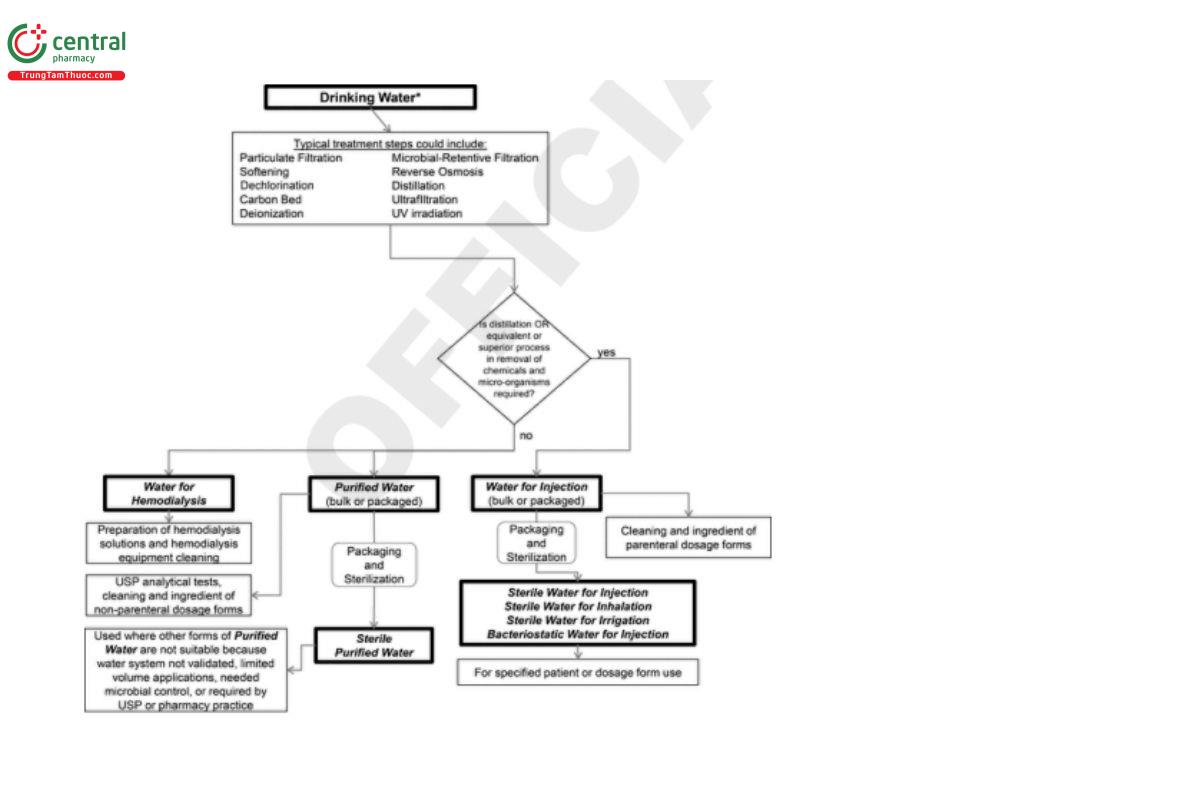
There are also other types of water for which there are no monographs. These are waters with names given for descriptive purposes only. Many of these waters are used in specific analytical methods. The descriptive titles may imply certain quality attributes or modes of preparation, but these non-monographed waters may not necessarily adhere strictly to the stated or implied modes of preparation or specified attributes. Waters produced by other means or controlled by other test attributes, or even a monographed water, may equally satisfy the intended uses for these waters. It is the user’s responsibility to ensure that such waters, even if produced and controlled exactly as stated, are suitable for their intended use. Wherever the term “water” is used within this compendium without other descriptive adjectives or clauses, the intent is that water of no less purity than USP Purified Water be used (see 3.1.1 Purified Water). A brief description of the various types of waters commonly associated with pharmaceutical applications and their significant uses or attributes follows. Figure 1 may be helpful in understanding some of the various types of waters, their preparation, and uses.
3.1 Bulk Monographed Waters and Steam
The following waters are generally produced in large volumes using a multiple-unit operation water system. These waters are typically distributed in a piping system for use at the same site.
3.1.1 PURIFIED WATER
Purified Water (see the USP monograph) is used as an excipient in the production of nonparenteral preparations and in other pharmaceutical applications, such as the cleaning of nonparenteral product-contact components and equipment. Unless otherwise specified, Purified Water also is to be used as the minimum water quality for all tests and assays in which “water” is indicated (see General Notices, 8.230.30 Water in a Compendial Procedure). This applies regardless of the font and letter case used in its spelling.
The minimal quality of source water for the production of Purified Water is drinking water whose attributes are prescribed by the US EPA, EU, Japan, or WHO. This source water may be purified using unit operations that include deionization, distillation, ion exchange, reverse osmosis, filtration, or other suitable purification procedures. Purified Water must meet the requirements for ionic and organic chemical purity and must be protected from microbial contamination. Purified Water systems must be validated to reliably and consistently produce and distribute water of acceptable chemical and microbiological quality. Purified Water systems that function under ambient conditions are particularly susceptible to the establishment of biofilms of microorganisms, which can be the source of undesirable levels of viable microorganisms or endotoxins in the water. These ambient Purified Water systems require frequent sanitization and microbiological monitoring to ensure that the water reaching the points of use has appropriate microbiological quality.
The Purified Water monograph also allows bulk packaging for commercial use elsewhere. In contrast to Sterile Purified Water, packaged Purified Water is not required to be sterile. Because there is potential for microbial contamination and other quality changes in this packaged nonsterile water, this form of Purified Water should be prepared and stored in a manner that limits microbial growth, and/or should be used in a timely fashion before microbial proliferation renders it unsuitable for its intended use. Also, depending on the material used for packaging, extractable compounds could be leaching into the water from the packaging. Although this article is required to meet the same chemical purity standards as the bulk water, extractables from the packaging will likely render the packaged water less chemically pure than the bulk water. The nature of these impurities may even render the water an inappropriate choice for some applications. It is the user’s responsibility to ensure fitness for use of this packaged article when it is used in manufacturing, clinical, or analytical applications where the purer bulk form of the water is indicated.
3.1.2 WATER FOR INJECTION
Water for Injection (see the USP monograph) is used as an excipient in the production of parenteral and other preparations where product endotoxin content must be controlled, and in other pharmaceutical applications, such as the cleaning of certain equipment and parenteral product-contact components.
The minimal quality of source water for the production of Water for Injection is drinking water whose attributes are prescribed by the US EPA, EU, Japan, or WHO. This source water may be treated to render it suitable for subsequent final purification steps, such as distillation (or whatever other validated process is used, according to the monograph). The finished water must meet all of the chemical requirements specified in the monograph, as well as an additional bacterial endotoxin specification. Because endotoxins are produced by the kinds of microorganisms that are prone to inhabit water systems, the equipment and procedures used by the system to purify, store, and distribute Water for Injection should be designed to control microbial contamination and must be designed to remove incoming endotoxins from the source water. Water for Injection systems must be validated to reliably and consistently produce and distribute this quality of water.
The Water for Injection monograph also allows bulk packaging for commercial use. In contrast to Sterile Water for Injection, packaged Water for Injection is not required to be sterile. However, to preclude significant changes in its microbial and endotoxins content during storage, this form of Water for Injection should be prepared and stored in a manner that limits microbial introduction and growth and/or should be used in a timely fashion before microbial proliferation renders it unsuitable for its intended use. Also, depending on the material used for packaging, extractable compounds could be leaching into the water from the packaging. Although this article is required to meet the same chemical purity standards as the bulk water, extractables from the packaging will likely render the packaged water less chemically pure than the bulk water. The nature of these impurities may even render the water an inappropriate choice for some applications. It is the user's responsibility to ensure fitness for use of this packaged article when it is used in manufacturing, clinical, or analytical applications where the purer bulk form of the water is indicated.
3.1.3 WATER FOR HEMODIALYSIS
Water for Hemodialysis (see the USP monograph) is used for hemodialysis applications, primarily the dilution of hemodialysis concentrate solutions. The minimal quality of source water for the production of Water for Hemodialysis is drinking water whose attributes are prescribed by the US EPA, EU, Japan, or WHO. Water for Hemodialysis has been further purified to reduce chemical and microbiological components, and it is produced and used on site. This water contains no added antimicrobial agents, and it is not intended for injection. Water for Hemodialysis must meet all of the chemical requirements specified in the monograph as well as an additional bacterial endotoxin specification. The microbial limits attribute for this water is unique among the “bulk” water monographs but is justified on the basis of this water's specific application, which has microbial content requirements related to its safe use. The bacterial endotoxins attribute is likewise established at a level related to its safe use.
3.1.4 PURE STEAM
Pure Steam (see the USP monograph) is also sometimes referred to as “clean steam”. It is used where the steam or its condensate would directly contact official articles or article-contact surfaces, such as during their preparation, sterilization, or cleaning where no subsequent processing step is used to remove any impurity residues. These Pure Steam applications include, but are not limited to, porous load sterilization processes, product or cleaning solutions heated by direct steam injection, or humidification of processes where steam injection is used to control the humidity inside processing vessels where the official articles or their in-process forms are exposed. The primary intent of using this quality of steam is to ensure that official articles or article-contact surfaces exposed to it are not contaminated by residues within the steam.
The minimal quality of source water for the production of Pure Steam is drinking water whose attributes are prescribed by the US EPA, EU, Japan, or WHO, and which has been suitably treated. The water is then vaporized with suitable mist elimination and distributed under pressure. The sources of undesirable contaminants with Pure Steam could arise from entrained source water droplets, anticorrosion steam additives, or residues from the steam production and distribution system itself. The chemical tests in the Pure Steam monograph should detect most of the contaminants that could arise from these sources. If an official article is exposed to Pure Steam and it is intended for parenteral use or other applications where the pyrogenic content must be controlled, the Pure Steam must additionally meet the specification for Bacterial Endotoxins Test ⟨85⟩.
These purity attributes are measured in the condensate of the article, rather than the article itself. This, of course, imparts great importance to the cleanliness of the process for Pure Steam condensate generation and collection, because it must not adversely impact the quality of the resulting condensed fluid.
Other steam attributes not detailed in the monograph, particularly the presence of even small quantities of noncondensable gases or the existence of a superheated or dry state, also may be important for applications such as sterilization. The large release of energy (latent heat of condensation) as water changes from the gaseous to the liquid state is the key to steam's sterilization efficacy and its efficiency, in general, as a heat transfer agent. If this phase change (condensation) is not allowed to happen because the steam is extremely hot and is in a persistent superheated, dry state, then its usefulness could be seriously compromised. Noncondensable gases in steam tend to stratify or collect in certain areas of a steam sterilization chamber or its load. These surfaces thereby would be at least partially insulated from the steam condensation phenomenon, preventing them from experiencing the full energy of the sterilizing conditions. Therefore, control of these kinds of steam attributes, in addition to its chemical purity, also may be important for certain Pure Steam applications. However, because these additional attributes are use-specific, they are not mentioned in the Pure Steam monograph.
Note that lower-purity “plant steam” may be used in the following applications: 1) for steam sterilization of nonproduct-contact nonporous loads, 2) for general cleaning of nonproduct-contact equipment, 3) as a nonproduct-contact heat-exchange medium, and 4) in all compatible applications involved in bulk pharmaceutical chemical and API manufacture.
Finally, because Pure Steam is lethal to microbes, monitoring of microbial control within a steam system is unnecessary, as is microbial analysis of the steam condensate.
3.2 Sterile Monographed Waters
The following monographed waters are packaged forms of either Purified Water or Water for Injection that have been sterilized to preserve their microbiological properties. These waters may have specific intended uses as indicated by their names and may also have restrictions on the packaging configurations related to those uses. In general, these sterile waters may be used in a variety of applications in lieu of the bulk forms of water from which they were derived. However, a substantial difference exists between the acceptance criteria for the chemical impurities of these bulk waters versus sterile waters. The specifications for sterile waters differ from those of bulk waters to accommodate a wide variety of packaging types, properties, volumes, and uses. As a result, the inorganic and organic impurity specifications are not equivalent for bulk and packaged waters. The packaging materials and elastomeric closures are the primary sources of these impurities, which tend to increase over the shelf life of these packaged articles. Therefore, due consideration must be given to the chemical purity suitability at the time the sterile forms of water are used, when they are used in manufacturing, analytical, and cleaning applications in lieu of the bulk waters from which they were derived. It is the user's responsibility to ensure the fitness for use of these sterile packaged waters in these applications. Nevertheless, for the applications for each sterile water discussed below, their respective purities and packaging restrictions generally render them suitable by definition.
3.2.1 STERILE PURIFIED WATER
Sterile Purified Water (see the USP monograph) is Purified Water packaged and rendered sterile. It can be used in the preparation of nonparenteral compendial dosage forms or in analytical applications requiring Purified Water where 1) access to a validated Purified Water system is not practical; 2) only a relatively small quantity is needed; 3) Sterile Purified Water is required by specific monograph or pharmacy practice; or 4) bulk-packaged Purified Water is not suitably controlled for the microbiological quality for its intended use.
3.2.2 STERILE WATER FOR INJECTION
Sterile Water for Injection (see the USP monograph) is Water for Injection packaged and rendered sterile. It is used for extemporaneous prescription compounding and as a sterile diluent for parenteral products. ▲Water used for dilution or reconstitution of parenteral drug products must meet the requirements of Sterile Water for Injection (see 3.2.3 Bacteriostatic Water for Injection for similar uses). This water at times is also called “Sterile Water for Dilution”, “Sterile Water for Reconstitution”, and similar terms.▲ (USP 1-Dec-2021) It also may be used for other applications where bulk Water for Injection or Purified Water is indicated but access to a validated water system is not practical, or where only a relatively small quantity is needed. Sterile Water for Injection is packaged in single-dose containers not larger than 1 L.
3.2.3 BACTERIOSTATIC WATER FOR INJECTION
Bacteriostatic Water for Injection (see the USP monograph) is Water for Injection packaged and rendered sterile, to which has been added one or more suitable antimicrobial preservatives. It is intended to be used as a diluent in the preparation of parenteral products, most typically for multiple-dose products that require repeated content withdrawals. It may be packaged in single-dose or multiple-dose containers not larger than 30 mL.
3.2.4 STERILE WATER FOR IRRIGATION
Sterile Water for Irrigation (see the USP monograph) is Water for Injection packaged and sterilized in single-dose containers that may be larger than 1 L and allow rapid delivery of their contents. Because of its usage, Sterile Water for Irrigation is not required to meet Particulate Matter in Injections ⟨788⟩. It also may be used in other applications that do not have particulate matter specifications, where bulk Water for Injection or Purified Water is indicated but where access to a validated water system is not practical, or where somewhat larger quantities are needed than are provided as Sterile Water for Injection.
3.2.5 STERILE WATER FOR INHALATION
Sterile Water for Inhalation (see the USP monograph) is Water for Injection that is packaged and rendered sterile and is intended for use in inhalators and in the preparation of inhalation solutions. This monograph has no requirement to meet ⟨788⟩; it carries a less stringent specification for bacterial endotoxins than Sterile Water for Injection, and therefore is not suitable for parenteral applications.
3.3 Drinking Water
In addition to the bulk monographed waters described above, non-monographed waters also can be used in pharmaceutical processing steps such as cleaning and synthetic steps, and also as a starting material for further purification or testing purposes. Unless otherwise specified in the compendium, the minimum quality of water is Purified Water. [NOTE—The information in this chapter is not an all-inclusive discussion of all non-monographed waters identified in the USP–NF.]
Drinking water is a non-monographed water that can be referred to as "potable water" (meaning drinkable or fit to drink), "National Primary Drinking Water", "primary drinking water", or "US EPA Drinking Water". Except where a singular drinking water specification is stated (such as the US EPA NPDWR, as cited in 40 CFR Part 141), this water must comply with the quality attributes of either the NPDWR or the drinking water regulations of the EU or Japan, or the WHO Guidelines for Drinking-Water Quality. Drinking water may originate from a variety of sources including a public water supply, a private water supply (e.g., a well), or a combination of these sources (see 2. Source Water Considerations).
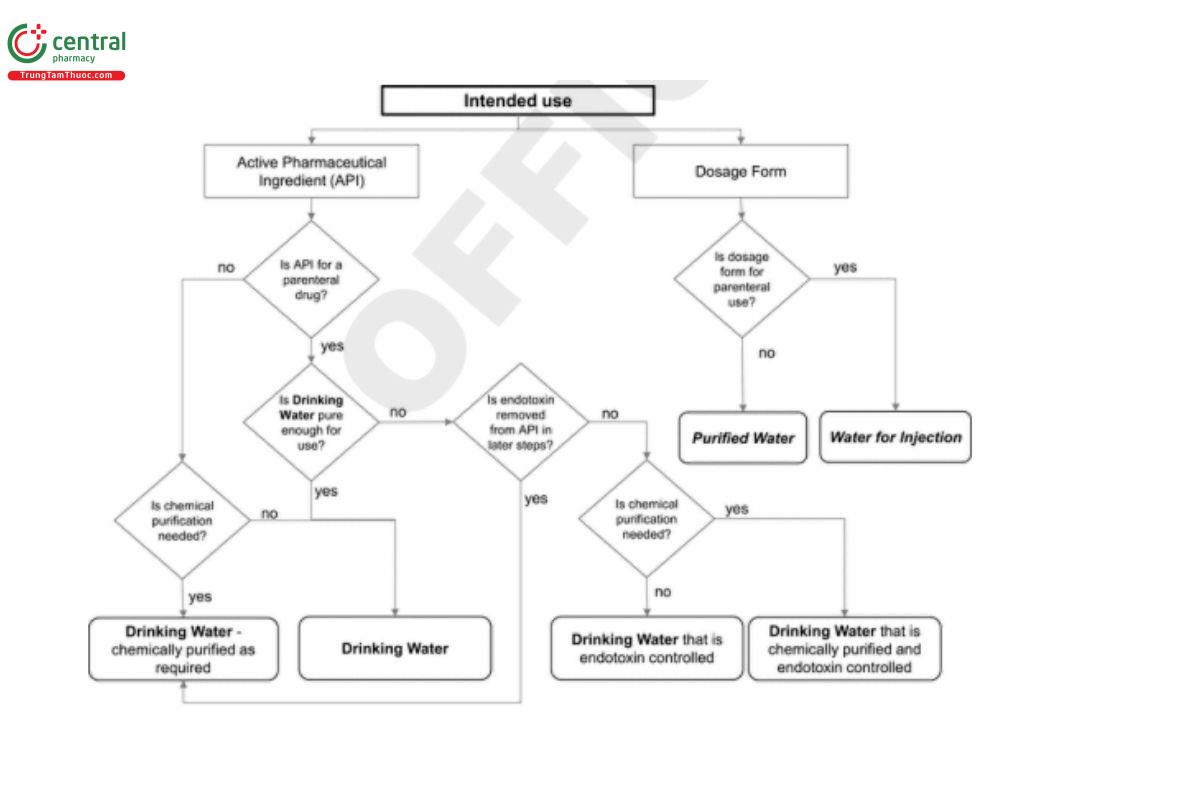
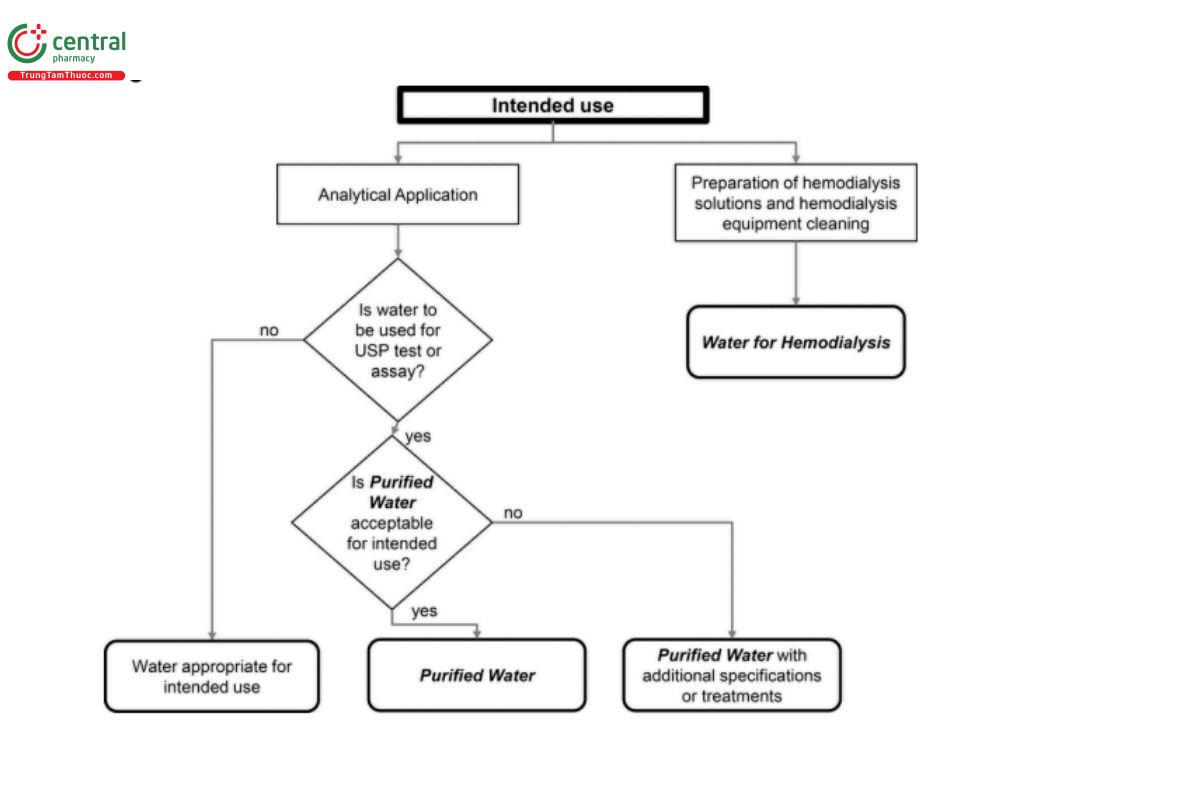
Drinking water may be used in the early stages of cleaning pharmaceutical manufacturing equipment and product-contact components. Drinking water is also the minimum quality of water that should be used for the preparation of official substances and other bulk pharmaceutical ingredients. Where compatible with the processes, the contaminant levels allowed in drinking water are generally considered safe for use in preparing official substances and other drug substances. However, where required by the processing of the materials to achieve their required final purity, higher qualities of water may be needed for these manufacturing steps, perhaps even water as pure as Water for Injection or Purified Water. Such higher-purity waters, however, might require only selected attributes to be of higher purity than drinking water (see Figure 2a and Figure 2b). Drinking water is the prescribed source or feed water for the production of bulk monographed pharmaceutical waters. The use of drinking water specifications establishes a reasonable set of maximum allowable levels of chemical and microbiological contaminants with which a water purification system will be challenged. Because seasonal variations in the quality attributes of the drinking water supply can occur, it is important to give due consideration to its uses. The processing steps in the production of pharmaceutical waters must be designed to accommodate this variability.
3.4 Other Non-Monographed Waters
In addition to drinking water, this compendium discusses non-monographed waters with various other designations. These include waters of various quality levels for special uses such as, but not limited to, cleaning and testing purposes.
Both General Notices (see General Notices, 8.230.30 Water in a Compendial Procedure) and Reagents, Indicators, and Solutions clearly state that where the term “water” is indicated for use in analyses without grammatical qualification or other specification, the quality of the water must be Purified Water. However, numerous ▲ (USP 1-Dec-2021) qualifications do exist. Some of these qualifications involve adjectives describing methods of preparation, ranging from specifying the primary purification step to specifying additional purification. Other qualifications call for specific attribute “absences” to be met that might otherwise interfere with analytical processes. In most of these cases, the required attribute absences are not specifically tested. Sometimes, a further “purification process” is specified that ostensibly allows the water to adequately meet this required “absence attribute”.
However, preparation instructions for many reagents were carried forward from the innovator's laboratories to the originally introduced monograph for a particular USP–NF article or general test chapter. The quality of the reagent water described in these tests may reflect the water quality designation of the innovator's laboratory. These specific water designations may have originated without the innovator's awareness of the requirement for Purified Water in USP–NF tests. Regardless of the original reason for the creation of these numerous special analytical waters, it is possible that the attributes of these special waters now could be met by the basic preparation steps and current specifications of Purified Water. In some cases, however, some of the cited post-processing steps are still necessary to reliably achieve the required attributes.
Users are not obligated to utilize specific and perhaps archaically generated forms of analytical water where alternatives with equal or better quality, availability, or analytical performance may exist. The consistency and reliability of operations for producing these alternative analytical waters should be verified so that the desired attributes are produced. In addition, any alternative analytical water must be evaluated on an application-by-application basis by the user to ensure its suitability. The following is a summary of the various types of non-monographed analytical waters that are cited in the USP–NF. This is not an exhaustive listing. Those listed are used in multiple locations. Several non-monographed analytical waters are not included below because they are only found in one or perhaps two locations within this compendium.
Note that the names of many of the waters listed imply a very low chemical impurity level. For example, “deionized water” implies that all the ions have been removed. However, in most cases discussed below, exposure of the water to air will result in the ingress of carbon dioxide (CO₂), leading to the formation of bicarbonate and hydrogen ions. Therefore, the removal of ions cannot be completely maintained for most analytical applications.
3.4.1 AMMONIA-FREE WATER
From a functional standpoint, ammonia-free water must have a negligible ammonia concentration to avoid interference in tests sensitive for or to ammonia. Due to the nature of the uses of this water, Purified Water could be a reasonable alternative for these applications.
3.4.2 CARBON DIOXIDE-FREE WATER
Carbon dioxide-free water is a reagent defined in the USP–NF as Purified Water that has been vigorously boiled for NLT 5 min, and then cooled and protected from absorption of atmospheric carbon dioxide. Alternatively, this could be Purified Water that has a resistivity of NLT 18 Mohm·cm at 25°.
Because the absorption of atmospheric carbon dioxide lowers the pH of high-purity waters, most of the uses of carbon dioxide-free water are either associated as a solvent in pH-related or pH-sensitive determinations or as a solvent in bicarbonate-sensitive reagents or determinations.
The term “carbon dioxide-free water” is sometimes used improperly. Besides its use for pH or acidity/alkalinity tests, the purpose for using this water is not always clear. The intention could be to use water that was deaerated (free of dissolved air) or deionized (free of extraneous ions), or even Purified Water with an additional boiling step. Although boiling is highly effective for removing carbon dioxide as well as all other dissolved gasses, these gasses are readily re-absorbed unless the water is protected. Even with protection, such as use of a stoppered container, re-absorption will occur over time as air will readily transmit through seals and diffuse through most materials.
Deionization is also an efficient process for removing dissolved carbon dioxide. Carbon dioxide forms ionic bicarbonate in water and will be subsequently removed by ion-exchange resins. However, the same problem of carbon dioxide re-absorption will occur after the deionized water is exposed to air. Also, the deionization approach for creating carbon dioxide-free water does not deaerate the water or remove other dissolved gases such as oxygen (O₂); it only removes carbon dioxide and other ions.
Depending on the application, Purified Water may meet the requirements where carbon dioxide-free water is called for. This could also include pH or acidity or alkalinity tests. The pH of a sample of pure deionized water is, by definition, 7.0. When that same sample is exposed to typical environmental atmospheric conditions, the water sample will absorb carbon dioxide and result in a pH range of approximately 5.4–6.2 ([H⁺] is in the range of 4.0 × 10⁻⁶ M to 6.3 × 10⁻⁷ M). The added acidity caused by carbon dioxide absorption may be insignificant compared to the material being analyzed.
3.4.3 DISTILLED WATER
Distilled water is produced by vaporizing drinking water or a higher quality of water and condensing it into a purer state. It is used primarily as a solvent for reagent preparation, and it is also specified in the execution of other aspects of tests, such as for rinsing an analyte, transferring a test material as a slurry, as a calibration standard or analytical blank, and for test apparatus cleaning. Distilled water is also cited as the starting water to be used for making high-purity water (see 3.4.8 High-Purity Water). Because none of the cited uses of this water imply a need for a particular purity attribute that can only be derived by distillation, water meeting the requirements for Purified Water derived by other means of purification or Water for Injection could be equally suitable where distilled water is specified. It is the user's responsibility to verify the suitability of Purified Water or Water for Injection.
3.4.4 FRESHLY DISTILLED WATER
Freshly distilled water or “recently distilled water” is produced in the same manner as distilled water and should be used soon after its generation. This implies the need to avoid endotoxin contamination, as well as any other forms of contamination from the air or containers, that could arise with prolonged storage. Freshly distilled water is used for preparing solutions for subcutaneous test-animal injections and for a reagent solvent in tests for which there appears to be no particular high-water purity needed that could be ascribable to being “freshly distilled”. In the test-animal application, the term “freshly distilled” and its testing use imply a chemical, endotoxin, and microbiological purity that could be equally satisfied by Water for Injection (although no reference is made to these chemical, endotoxin, or microbial attributes or specific protection from recontamination). For non-animal uses, water meeting the requirements for Purified Water derived by other means of purification and/or storage periods could be equally suitable where “recently distilled water” or freshly distilled water is specified. It is the user's responsibility to verify the suitability of Purified Water or Water for Injection.
3.4.5 DEIONIZED WATER
Deionized water can be produced by starting with either drinking water or Purified Water, depending upon monograph or testing procedures defined in the compendia. Deionized water is produced by an ion-exchange process in which the cations and anions are replaced with H⁺ and OH⁻ ions by use of ion-exchange resins. Similar to distilled water, deionized water is used primarily as a solvent for reagent preparation, but it is also specified in the execution of other aspects of tests, such as for transferring an analyte within a test procedure, as a calibration standard or analytical blank, and for test apparatus cleaning. Also, none of the cited uses of this water imply any needed purity attribute that can only be achieved by deionization. Therefore, water meeting the requirements for Purified Water that is derived by other means of purification could be equally suitable where deionized water is specified. It is the user's responsibility to verify the suitability of Purified Water.
3.4.6 DEIONIZED DISTILLED WATER
Deionized distilled water is produced by deionizing distilled water (see 3.4.5 Deionized Water). This water is used as a reagent in a liquid chromatography test that requires a low ionic or organic impurity level. Because of the importance of this high purity, water that meets the requirements for Purified Water may not be acceptable. High-purity water (see 3.4.8 High-Purity Water) could be a reasonable alternative to this water. It is the user's responsibility to verify the suitability of the alternative water used.
3.4.7 FILTERED WATER
Filtered water is Purified Water that has been filtered to remove particles that could interfere with the analysis where this water is specified. The term is sometimes used synonymously with “particle-free water” and “ultra-filtered water” and is cited in some monographs and general chapters as well as in Reagents, Indicators, and Solutions. Depending on its referenced location in USP–NF, it is variously defined as water that has been passed through filters rated as 1.2, 1.0, 2.0, or 0.22 µm, or filters with an unspecified porosity rating. Even though the water names and the filter ratings used to produce these waters are defined inconsistently, the use of 0.2-µm or 0.22-µm filtered Purified Water should be universally acceptable for all applications where particle-free water, filtered water, or ultra-filtered water is specified.
3.4.8 HIGH-PURITY WATER
▲High-purity water is used as a reagent, as a solvent for reagent preparation, and for test apparatus cleaning in which less stringent water purity would not be considered acceptable. However, if a user's routinely available Purified Water meets or exceeds the conductivity parameters described in the following two paragraphs for high-purity water, it could be used in lieu of high-purity water. High-purity water is typically prepared by deionization (see 3.4.5 Deionized Water) and protected from atmospheric contamination. Use water that is freshly prepared and is not stored as this may introduce contaminants.
For assays that require low-conductivity water (e.g., Ion Chromatography ⟨1065⟩ and Plasma Spectrochemistry—Theory and Practice ⟨1730⟩), a conductivity value of NMT 0.0556 µS/cm (NLT 18.0 Mohm·cm) may be appropriate. If the water of this purity makes contact with the atmosphere even briefly as it is being used or drawn from its purification system, its conductivity will immediately increase by as much as about 1.0 µS/cm at 25° as atmospheric carbon dioxide dissolves into the water and immediately dissociates and equilibrates to form hydrogen (H⁺) and bicarbonate (HCO₃⁻) ions. Therefore, if the analytical use requires that water conductivity remains as low as possible or the bicarbonate/carbon dioxide levels be as low as possible, the water should be protected from atmospheric exposure. If high-purity water is used for Elemental Impurities—Procedures ⟨233⟩, exposure to carbon dioxide does not affect the analysis and a higher conductivity may be acceptable.
If the water is used for ⟨233⟩, transport it in containers that do not leach elemental impurities. To definitely ensure that this water does not contain elemental impurities, an in-line conductivity of NMT 0.0571 µS/cm (NLT 17.5 Mohm·cm) at 25° is needed. However, dependent upon the impurity that will be analyzed, the presence of contaminating ions from other non-elemental impurity sources may result in a higher conductivity being observed that does not affect the performance of ⟨233⟩. ▲ (USP 1-Dec-2021)
3.4.9 DEAERATED WATER
Deaerated water or “degassed water” is Purified Water that has been treated to reduce the content of dissolved air by “suitable means” such as boiling, sonication, and/or stirring during the application of a partial vacuum, followed by immediate use or protection from air re-absorption.
3.4.10 OXYGEN-FREE WATER
Oxygen-free water is Purified Water that has been treated to remove or reduce dissolved oxygen. Such treatment could involve deaerating by boiling or sparging with an inert gas such as nitrogen or helium, followed by inert gas blanketing to prevent oxygen re-absorption. Any procedure used for removing oxygen should be verified as reliably producing water that is fit for use.
3.4.11 WATER FOR BACTERIAL ENDOTOXINS TEST
Water for Bacterial Endotoxins Test (BET) is also referred to as Limulus Amebocyte Lysate (LAL) Reagent Water. This type of water is often Water for Injection, which may have been sterilized. It is free from a level of endotoxin that would yield any detectable reaction or interference with the LAL reagent used in the BET (see ⟨85⟩).
4 4. VALIDATION AND QUALIFICATION OF WATER PURIFICATION, STORAGE, AND DISTRIBUTION SYSTEMS
4.1 Validation Requirement
Establishing the reliability of pharmaceutical water purification, storage, and distribution systems requires demonstrating control of the process through an appropriate period of monitoring and observation. Finished water is typically continuously produced and used, while product and process attributes may only be periodically assessed. The quality of bulk finished water cannot be established by only testing monograph attributes. The unit operations in the pharmaceutical water system need to demonstrate that they are in control through monitoring of the process parameters and water quality. The advent of using conductivity and total organic carbon (TOC) to define chemical purity allows the user to more quantitatively assess the water’s chemical purity and its variability as a function of routine treatment system maintenance and regeneration. Treatment processes must also demonstrate control of microbial attributes within the overall system. Some unit operations that are needed for chemical treatment may significantly increase microbial and bacterial endotoxin levels. These are later controlled by downstream unit operations. Knowledge of the treatment system processes and the effectiveness of control measures is needed to ensure that the pharmaceutical waters are acceptable for use.
Efficacy of the design, operation, sanitization, and control of the pharmaceutical water system is demonstrated through the monitoring of chemical and microbial attributes. A typical water system validation program involves an initial increased frequency of monitoring of the treatment system process parameters and sampling and testing of major process points to demonstrate the ability to produce the acceptable water and to characterize the operation of the system. This is followed by a life cycle approach of validation maintenance and monitoring.
4.2 Validation Approach
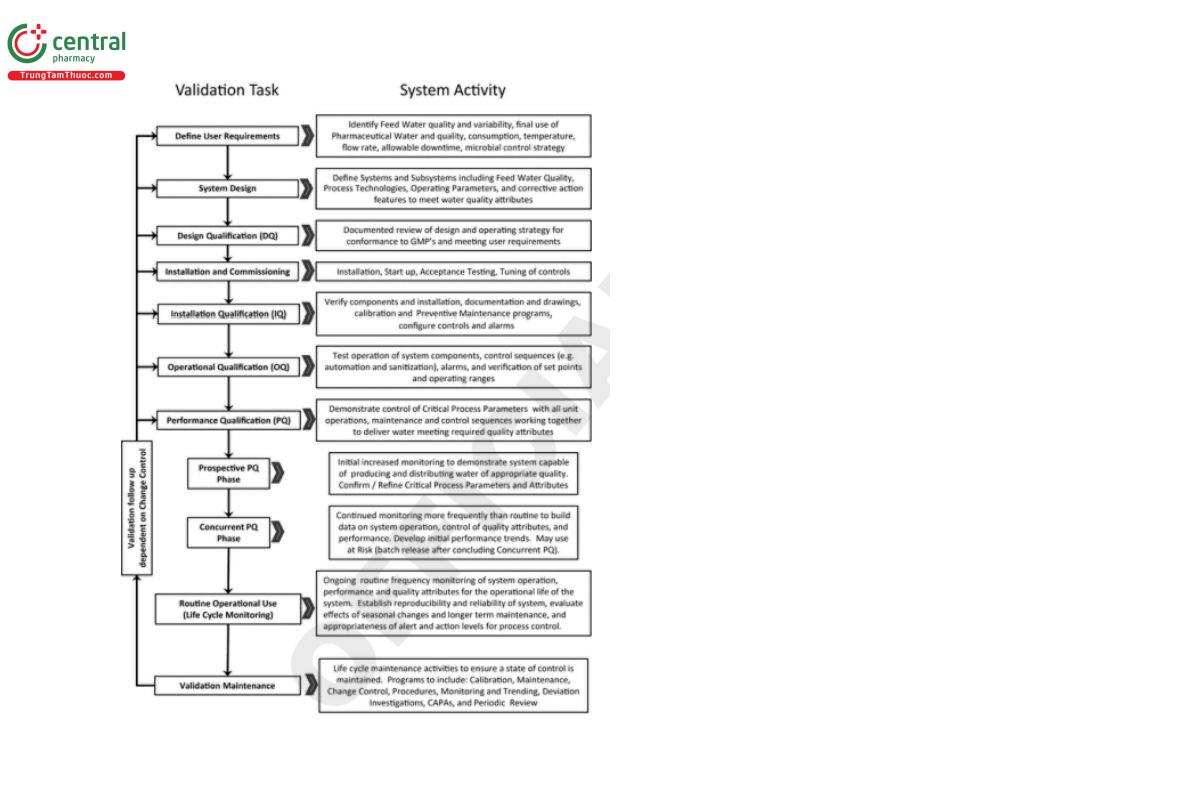
Validation is the program of documenting, to a high level of assurance, that a specific process is capable of consistently delivering product conforming to an established set of quality attributes. A validation program qualifies and documents the design, installation, operation, and
performance of the system. A graphical representation of a typical water system validation life cycle is shown in Figure 3.
The validation protocol should be based on the boundaries of the water system and the critical water quality and process attributes needed to maintain consistent performance. The system boundary may stop at the point of use or may include the water transfer process. If the transfer process from the distribution system outlets to the water use locations (typically either with hoses or hard-piped equipment connections) is defined as outside the water system boundary, then this transfer process still needs to be validated to not adversely affect the quality of the water as it is delivered for use. Because routine quality control (QC) microbial monitoring is performed for the same transfer process and components (e.g., hoses and heat exchangers) as that of routine water use (see 6.1.2 Quality Control Sampling), there is some logic to include this water transfer process within the distribution system validation.
4.2.1 VALIDATION ELEMENTS
Validation is accomplished through the use of a structured, documented process. The phases of this process include Design Qualification (DQ), Installation Qualification (IQ), Operational Qualification (OQ), Performance Qualification (PQ), and Validation Maintenance. The process is documented in a validation protocol. The elements may be in individual protocols for each phase or integrated into variations of a DQ/IQ/OQ/PQ combined document format. The protocols are formally approved quality documents. Factory Acceptance Testing (FAT), Site Acceptance Testing (SAT), and commissioning testing of the system may supplement qualifications tests for IQ or OQ provided that they are properly documented and reviewed, and if the system functionality is shown as unaffected by the transport and installation.
4.2.2 USER REQUIREMENTS SPECIFICATION AND DESIGN QUALIFICATION
The user requirements for the water system should identify the design, operation, maintenance, and quality elements needed to produce the desired water type from the available source water, including its anticipated attribute variability. The essential elements of quality need to be built in at this stage and any GMP risks mitigated to an acceptable level.
The review of the specifications, system design, components, functions, and operation should be performed to demonstrate that the system complies with GMPs and verify that the design meets the user requirements. This documented review may be performed as part of the overall design process or as a separate DQ.
4.2.3 INSTALLATION QUALIFICATION
An IQ protocol for a water system confirms that the system has been properly installed and documented. This may include verification of components, piping, installation, and weld quality; documentation of the specifications for all system components present; inspections to verify that the drawings accurately depict the final configuration of the water system; and, where necessary, special tests to verify that the installation meets design requirements. Additionally, the water system is readied for operational testing, including calibration of instruments, configuration of alarm levels, and adjustment of operating parameters (e.g., flow rate, pressure).
4.2.4 OPERATIONAL QUALIFICATION
The OQ phase consisting of tests and inspections to verify that the equipment, system alerts, and controls are operating reliably and that appropriate Alert and Action Levels are established (this phase of qualification may overlap with aspects of IQ and PQ). During this phase of validation specific tests are performed for alarms, verifying control sequences, equipment functional checks, and verification of operating ranges. Standard operating procedures (SOPs) for all aspects of water system operation, maintenance, water use, water sampling, and testing, and other requirements should be in place and operator training completed. At the completion of the OQ, the water system has demonstrated that the components are operational and the system is producing suitable water.
4.2.5 PERFORMANCE QUALIFICATION
The prospective PQ stage considers two aspects of the water system: critical process parameters and critical water attribute parameters. These are evaluated in parallel by monitoring the water quality and demonstrating acceptable quality attributes while demonstrating control of the process parameters (see 6.3 Validation Sampling Plans). The initial PQ stage may result in refinement of process parameters to yield appropriate water quality. This PQ stage includes an increased frequency of monitoring for approximately 2–4 weeks, or sufficient time to generate adequate data to demonstrate that water meeting the appropriate quality attributes is produced and distributed. One of the reasons for this duration is that biofilm, the source of planktonic organisms in water samples, takes time to develop and to determine if the sanitization unit operations and processes are adequate to control microbial proliferation. The chemical control program adequacy is typically apparent in less time than it takes to see microbial control adequacy. However, chemical purification can be compromised by poor microbial control and, to a lesser degree, vice versa.
Once a level of control of microbial and chemical attributes has been demonstrated, the next phase of PQ is to continue the frequency of monitoring for approximately 2–4 weeks at a somewhat reduced level that will still give adequate data on system performance while using the pharmaceutical water. The water may be used for manufacturing at risk, and the associated products may be released only after water quality attributes have been determined to be acceptable and this validation phase has been completed. At the completion of the second phase, the data should be formally reviewed and the system approved for operational use.
4.3 Operational Use
When the water system has been placed into operational use, monitoring of the water quality attributes and the system process parameters is performed at a routine frequency (see 6.4 Routine Sampling Plans) to ensure that they remain within a state of control during long-term variability from seasonal variations in source water quality, unit operation maintenance, system sanitization processes, and earlier-established Alert and Action Levels.
The water system should continue to be monitored and evaluated on an on-going basis following a life cycle approach using online instruments or samples for laboratory-based testing. The use of online instruments and process automation technology, such as conductivity, TOC, temperature, flow rate, and pressure can facilitate improved operational control of the attributes and parameters and for process release. Manual observation of operating parameters and laboratory-based testing is also appropriate and acceptable for monitoring and trend evaluation.
4.3.1 MONITORING
The frequency of routine monitoring should be based on the criticality of the finished water, capabilities of the process, and ability to maintain product water quality trends. Monitoring may be adjusted from the initial validation monitoring program when there is sufficient data to support a change (see 6.4 Routine Sampling Plans).
4.3.2 VALIDATION MAINTENANCE
Maintaining the validated state of control requires a life cycle approach. After the completion of the PQ and release of the water system for use, ongoing activities and programs have to be in place to maintain the validated state of control after the system has been validated and placed into service (see 5.4 Operation, Maintenance, and Control). This includes unit operation, calibration, corrective maintenance, preventive maintenance, procedures, manuals and drawings, standardization of instruments, process parameter and quality attribute trending, change control, deviations, corrective and preventive actions (CAPA), training, records retention, and maintaining logbooks.
4.3.3 CHANGE CONTROL
Identification and control of changes made to unit operations and other system components, operation parameters, system sanitization, and laboratory processes or procedures need to be established. Not all changes will require validation follow up, but even minor ones, such as gasket elastomer changes could have an effect on quality attributes. The impact of the change on process parameters and quality attributes must be identified, evaluated and remediated. This may result in a selective validation activity to demonstrate the ongoing state of control for the system and ability to maintain water quality attributes.
Certain calibration and preventive maintenance activities may be considered routine tasks if they do not affect on system operation or water quality. Replacement of components needs to be carefully evaluated. Replacement of components using exact parts generally does not affect system operation or control. Replacement of components with ones that are not exact parts but have similar functional specifications can be performed at risk with the critical specifications (e.g., material of construction, dimensions, flow rate, response factors) having been evaluated and the differences determined to be acceptable and documented within the change control system.
4.3.4 PERIODIC REVIEW
The water system qualification, maintenance history, calibration records, quality and process data, issues with the unit operations and any process variability, change control, and other validation maintenance data should be assessed periodically to determine impact on the state of control.
The review may result in adjustments to operating or sanitization processes, calibration or maintenance plans, or monitoring plans. This may also result in additional testing or repeating certain qualification tasks (e.g., re-qualification).
Change to read:
5 5. DESIGN AND OPERATION OF PURIFIED WATER AND WATER FOR INJECTION SYSTEMS
The design, installation, and operation of systems to produce Purified Water and Water for Injection include similar components, control techniques, and procedures. The quality attributes of the two waters differ in their bioburden expectation, the presence of a bacterial endotoxin requirement for Water for Injection, and in their methods of preparation. The similarities in the quality attributes provide considerable common ground in the design of water systems to meet either requirement. The critical difference is the degree of control of the system and the final purification steps needed to ensure removal of bacteria and bacterial endotoxins and reductions in opportunities for biofilm re-development within those purification steps that could become in situ sources of bacteria and endotoxin in the finished water. Many aspects of system design and operation relate to control and elimination of biofilm. Unit operations can cause the deterioration of water microbial attributes and the formation of biofilm on unit operation surfaces, even when properly maintained (see 8.2 Biofilm Formation in Water Systems).
Production of pharmaceutical water involves sequential unit operations (processing steps) that address specific water quality attributes and protect the operation of subsequent treatment steps. A typical evaluation process for selecting an appropriate water quality for a particular pharmaceutical purpose is shown in the decision trees in Figure 2a and Figure 2b. These diagrams may be used to assist in defining requirements for specific water uses and in the selection of unit operations. The final unit operation used to produce Water for Injection is limited to distillation or other processes equivalent or superior to distillation in the removal of chemical impurities as well as microorganisms and their components, such as bacterial endotoxins. Distillation coupled with suitable pretreatment technologies has a long history of generally reliable performance (though not completely infallible) and can be validated as a unit operation for the production of Water for Injection. Other combinations of purification technologies also may be suitable in the production of Water for Injection if they can be shown through validation to be as effective and reliable as distillation in the removal of chemicals and microorganisms. The development of new designs and materials of construction for other technologies (e.g., reverse osmosis, electrodeionization, and ultrafiltration) that allow intermittent or continuous operation at hot bactericidal conditions show promise for a valid use in producing Water for Injection.
5.1 Unit Operations Considerations
To achieve the quality attributes for pharmaceutical waters, multiple-unit operations are required. The design of the water purification system needs to take into consideration different aspects, including the source water quality, sanitization, pharmaceutical water quality attributes, uses of the water, and maintenance programs. Each unit operation contributes specific purification attributes associated with chemical and microbiological parameters.
The following sections briefly describe selected unit operations and the design, installation, operation, maintenance, and monitoring parameter considerations associated with them. Not all unit operations are discussed, nor are all potential shortcomings addressed.
5.1.1 PREFILTRATION
The purpose of prefiltration—also referred to as initial, coarse, particulate, or depth filtration—is to remove solid contaminants from the incoming source water supply and protect downstream system components from particulates that can inhibit equipment performance and shorten their effective life. This coarse filtration technology primarily uses sieving effects for particle capture and a depth of filtration medium that has a high “dirt load” capacity. Such filtration units are available in a wide range of designs and for various applications. Removal efficiencies and capacities differ significantly, from granular bed filters such as multimedia or sand for larger water systems, to depth cartridges for smaller water systems. Unit and system configurations vary widely in the type of filtering media and the location in the process. Granular or cartridge prefilters are often situated at the beginning of the water purification system prior to unit operations designed to remove the source water disinfectants. Cartridge-type coarse filters also may be used to capture fines released from granular beds such as activated carbon and deionization beds. These locations, however, do not preclude the need for periodic microbial evaluation.
Design and operational issues that may affect the performance of depth filters include channeling of the filtering media, blockage from silt, microbial growth, and filtering-media loss during improper backwashing. Control methods involve pressure and flow monitoring during use and backwashing, sanitizing, and replacing filtering media. An important design concern is sizing the filter to prevent channeling or media loss resulting from inappropriate water flow rates as well as proper sizing to minimize excessively frequent or infrequent backwashing or cartridge filter replacement.
5.1.2 ACTIVATED CARBON
Activated carbon beds, depending on the type and placement, are used to adsorb low-molecular-weight organic material, bacterial endotoxins, and oxidizing additives such as chlorine and chloramine compounds, removing them from the water. They are used to achieve certain quality attributes and to protect against reactions with downstream unit operations, stainless steel surfaces, resins, and membranes.
The chief operating concerns regarding activated carbon beds include the propensity to support bacterial growth, the potential for hydraulic channeling, the organic adsorption capacity, and insufficient contact time. Operation deficiencies may result in the release of bacteria, endotoxins, organic chemicals, and fine carbon particles.
Control measures may involve monitoring water flow rates and differential pressures, sanitizing with hot water or steam, backwashing, testing for adsorption capacity, and frequent replacement of the carbon bed. Monitoring of carbon bed unit operation may also include microbial loading, disinfectant chemical reduction, and TOC if used for TOC reduction. The use of hot water or steam for carbon bed sanitization is ineffective if there is channeling rather than even permeation through the bed. Channeling can be mitigated through design and proper flow rates during sanitization.
Microbial biofilm development on the surface of the granular carbon particles can cause adjacent bed granules to agglomerate. This may result in ineffective removal of trapped debris and fragile biofilm during backwashing, and ineffective sanitization.
Alternative technologies to activated carbon beds can be used to avoid their microbial challenges. These include disinfectant-neutralizing chemical additives and intense ultraviolet (UV) light for removal of chlorine, and regenerable organic scavenging deionizing resins for removal of organics.
5.1.3 ADDITIVES
Chemical additives are used in water systems to 1) control microorganisms by use of sanitizing agents, such as chlorine compounds and ozone; 2) enhance the removal of suspended solids by use of flocculating agents; 3) remove chlorine compounds; 4) avoid scaling on reverse osmosis membranes; and 5) adjust pH for more effective removal of carbonate and ammonia compounds by reverse osmosis. These additives do not constitute “added substances” as long as they are either removed by subsequent processing steps or are otherwise absent from the finished water. Control of additives to ensure a continuously effective concentration and subsequent monitoring to ensure their removal should be designed into the system and included in the monitoring program.
5.1.4 ORGANIC SCAVENGERS
Organic scavenging devices use macroreticular, weakly basic anion-exchange resins capable of removing negatively charged organic material and endotoxins from the water. Organic scavenger resins can be regenerated with appropriate biocidal caustic brine solutions.
Operating concerns are associated with organic scavenging capacity; particulate, chemical, and microbiological fouling of the reactive resin surface; flow rate; regeneration frequency; and shedding of fines from the fragile resins. Control measures include TOC testing of influent and effluent, backwashing, monitoring hydraulic performance, and using downstream filters to remove resin fines.
5.1.5 SOFTENERS
Water softeners may be located either upstream or downstream of disinfectant removal units. They utilize sodium-based cation-exchange resins to remove water-hardness ions, such as calcium and magnesium, that could foul or interfere with the performance of downstream processing equipment such as reverse osmosis membranes, deionization devices, and distillation units. Water softeners also can be used to remove other lower affinity cations, such as the ammonium ion, that may be released from chloramine disinfectants commonly used in drinking water. If ammonium removal is one of its purposes, the softener must be located downstream of the disinfectant removal operation. Water softener resin beds are regenerated with concentrated sodium chloride solution (brine).
Concerns include microorganism proliferation, channeling, appropriate water flow rates and contact time, ion-exchange capacity, organic and particulate resin fouling, organic leaching from new resins, fracture of the resin beads, resin degradation by excessively chlorinated water, and contamination from the brine solution used for regeneration.
Control measures involve recirculation of water during periods of low water use, periodic sanitization of the resin and brine system, use of microbial control devices (e.g., UV light and chlorine), locating the unit upstream of the disinfectant removal step (if used only for softening), appropriate regeneration frequency, effluent chemical monitoring (e.g., hardness ions and possibly ammonium), and downstream filtration to remove resin fines. If a softener is used for ammonium removal from chloramine-containing source water, then the capacity, contact time, resin surface fouling, pH, and regeneration frequency are very important.
5.1.6 DEIONIZATION
Deionization and continuous electrodeionization (CEDI) are effective methods of improving the chemical quality attributes of water by removing cations and anions. Deionization systems have charged resins that require periodic regeneration with an acid and base. Typically, cation resins are regenerated with either hydrochloric or sulfuric acid, which replace the captured positive ions with hydrogen ions. Anion resins are regenerated with sodium hydroxide or potassium hydroxide, which replace captured negative ions with hydroxide ions. Because free endotoxin is negatively charged, some removal of endotoxin is achieved by the anion resin. The system can be designed so that the cation and anion resins are in separate or “twin” beds, or they can be blended together to form a “mixed” bed.
The CEDI system uses a combination of ion-exchange materials such as resins or grafted material, selectively permeable membranes, and an electric charge, providing continuous flow (of product and waste concentrate) and continuous regeneration. Water enters both the resin section and the waste (concentrate) section. The resin acts as a conductor, enabling the electrical potential to drive the captured cations and anions through the resin and appropriate membranes for concentration and removal in the waste water stream. As the water passes through the resin, it is deionized to become product water. The electrical potential also separates the water in the resin (product) section into hydrogen and hydroxide ions. This permits continuous regeneration of the resin without the need for regenerant additives. However, unlike conventional deionization, CEDI units must start with water that is already partially purified because they generally cannot achieve the conductivity attribute of Purified Water when starting with the heavier ion load of source water.
Concerns for all forms of deionization units include microbial and endotoxin control, chemical additive impact on resins and membranes, and loss, degradation, and fouling of resin. Issues of concern specific to deionization units include regeneration frequency and completeness, channeling caused by biofilm agglomeration of resin particles, organic leaching from new resins, complete resin separation for mixed bed regeneration, and bed fluidization air contamination (mixed beds).
Control measures may include continuous recirculation loops, effluent microbial control by UV light, conductivity monitoring, resin testing, microporous filtration of bed fluidization air, microbial monitoring, frequent regeneration to minimize and control microorganism growth, sizing the equipment for suitable water flow and contact time, and use of elevated temperatures. Internal distributor and regeneration piping for deionization bed units should be configured to ensure that regeneration chemicals contact all internal bed and piping surfaces and resins.
Rechargeable canisters can be the source of contamination and should be carefully monitored. Full knowledge of previous resin use, minimum storage time between regeneration and use, and appropriate sanitizing procedures are critical factors for ensuring proper performance.
5.1.7 REVERSE OSMOSIS
Reverse osmosis units use semipermeable membranes. The “pores” of reverse osmosis membranes are intersegmental spaces among the polymer molecules. They are big enough for permeation of water molecules, but they limit the passage of hydrated chemical ions, organic compounds, and microorganisms. Reverse osmosis membranes can achieve chemical, microbial, and endotoxin quality improvement. Many factors, including pH, temperature, source water hardness, permeate and reject flow rate, and differential pressure across the membrane, affect the selectivity and effectiveness of this permeation. The process streams consist of supply water, product water (permeate), and waste water (reject). Depending on the source water, pretreatment and system configuration variations and chemical additives may be necessary to achieve the desired performance and reliability. For most source waters, a single stage of reverse osmosis filtration is usually not enough to meet Purified Water conductivity specifications. A second pass of this permeate water through another reverse osmosis stage usually achieves the necessary permeate purity if other factors such as pH and temperature have been appropriately adjusted and the ammonia from source water that has been previously treated with chloramines is removed.
Concerns associated with the design and operation of reverse osmosis units include membrane materials that are sensitive to sanitizing agents and to particulate, chemical, and microbial membrane fouling; membrane and seal integrity; and the passage of dissolved gases, such as carbon dioxide and ammonia. Failure of membrane or seal integrity will result in product water contamination. Methods of control involve suitable pretreatment of the influent water stream; appropriate membrane material selection; membrane design and heat tolerance; periodic sanitization; and monitoring of differential pressures, conductivity, microbial levels, and TOC.
The development of reverse osmosis units that can tolerate sanitizing water temperatures and also operate efficiently and continuously at elevated temperatures has added greatly to their microbial control ability and to the avoidance of biofouling. Reverse osmosis units can be used alone or in combination with deionization and CEDI units, as well as ultrafiltration, for operational and quality enhancements.
5.1.8 ULTRAFILTRATION
Ultrafiltration is a technology that is often used near the end of a pharmaceutical water purification system for removing endotoxins from a water stream though upstream uses are possible. Ultrafiltration can use semipermeable membranes, but unlike reverse osmosis units, these typically use polysulfone with intersegmental “pores” that have been purposefully enlarged. Membranes with differing molecular weight “cutoffs” can be created to preferentially reject molecules with molecular weights above these ratings.
Ceramic ultrafilters are another molecular sieving technology. Ceramic ultrafilters are self-supporting and extremely durable; they can be backwashed, chemically cleaned, and steam sterilized. However, they may require higher operating pressures than do membrane-type ultrafilters.
All ultrafiltration devices work primarily by a molecular sieving principle. Ultrafilters with molecular weight cutoff ratings in the range of 10,000–20,000 Da are typically used in water systems for removing endotoxins. This technology may be appropriate as an intermediate or final purification step. As with reverse osmosis, successful performance is dependent upon pretreatment of the water by upstream unit operations.
Issues of concern for ultrafilters include compatibility of membrane material with heat and sanitizing agents, membrane integrity, fouling by particles and microorganisms, and seal integrity. Control measures involve filter membrane composition, sanitization, flow design (dead end versus tangential), cartridge replacement, elevated feed water temperature, and monitoring TOC and differential pressure.
5.1.9 MICROBIAL-RETENTIVE FILTRATION
Microbial-retentive membrane filters have a larger effective “pore size” than ultrafilters and are intended to prevent the passage of microorganisms and similarly sized particles without unduly restricting flow. This type of filtration is widely employed within water systems for filtering the bacteria out of both water and compressed gases as well as for vent filters on tanks and stills and other unit operations.
In water systems, a filter’s microbial retention characteristics exhibit different phenomena than in other aseptic filtration applications. The following factors interact to create the retention phenomena for water system microorganisms: the variability in the range and average pore sizes created by the various membrane fabrication processes; the variability of the surface chemistry and three-dimensional structure related to the different polymers used in these filter matrices; and the size and surface properties of the microorganism intended to be retained by the filters. In some situations, the appearance of water system microorganisms on the downstream sides of some 0.2- to 0.22-µm rated filters after a period of use (days to weeks) seems to support the idea that water-borne microorganisms can penetrate the 0.2- to 0.22-µm rated filters. It is not known whether this downstream appearance is caused by exceeding the retention capabilities of the filters due to high prefiltration bioburden levels of water-borne microorganisms and extended filtration times. These conditions can lead to a “pass-through” phenomenon resulting from tiny cells or less cell “stickiness”, or perhaps by a “grow-through” phenomenon in which cells hypothetically replicate their way through the pores to the downstream side. Whatever the penetration mechanism, 0.2- to 0.22-µm rated membranes may not be the best choice for some water system uses (see Sterility Assurance ⟨1211⟩).
Nevertheless, microbial retention success in water systems has been reported with the use of filters rated as 0.2 or 0.1 µm. There is general agreement that, for a given manufacturer, 0.1-µm rated filters are tighter than its 0.2- to 0.22-µm rated filters. However, comparably rated filters from different manufacturers may not have equivalent performance in water filtration applications because of the different filter materials, different fabrication processes, and nonstandardized microbial retention challenge processes currently used for defining the 0.1-µm filter rating. It should be noted that filters with a 0.1-µm rating may result in a lower flow rate compared to 0.2- to 0.22-µm filters, so whatever filters are chosen for a water system application, the user must verify that they are suitable for their intended application, use period, and use process, including flow rate.
For microbial retentive gas filtrations, the same sieving and adsorptive retention phenomena are at work as in liquid filtration, but the adsorptive phenomenon is enhanced by additional electrostatic interactions between the particles and filter matrix. These electrostatic interactions are so strong, particle retention for a given filter rating is significantly more efficient in gas filtration than in water or product-solution filtrations. These additional adsorptive interactions render filters rated at 0.2–0.22 µm unquestionably suitable for microbial retentive gas filtrations. When microbial retentive filters are used in these applications, the membrane surface is typically hydrophobic (non-wettable by water). A significant area of concern for gas filtration is blockage of tank vents by condensed water vapor, which can cause mechanical damage to the tank. Control measures include electrical or steam tracing and a self-draining orientation of vent filter housings to prevent accumulation of vapor condensate. However, a continuously high filter temperature will take an oxidative toll on polypropylene components of the filter, so sterilization of the unit prior to initial use and periodically thereafter, as well as regular visual inspections, integrity tests, and filter cartridge changes, are recommended control methods.
In water applications, microbial retentive filters may be used downstream of unit operations that tend to release microorganisms or upstream of unit operations that are sensitive to microorganisms. Microbial retentive filters also may be used to filter water feeding the distribution system. It should be noted that regulatory authorities allow the use of microbial retentive filters within distribution systems or even at use points if they have been properly validated and are appropriately maintained. A point-of-use filter should only be intended to “polish” the microbial quality of an otherwise well-maintained system and not to serve as the primary microbial control device. The efficacy of system microbial control measures can only be assessed by sampling the water upstream of the filters. As an added measure of protection, in-line UV lamps, appropriately sized for the flow rate (see 5.3 Sanitization), may be used just upstream of microbial retentive filters to inactivate microorganisms prior to their capture by the filter. This tandem approach tends to greatly delay potential microbial penetration phenomena and can substantially extend filter service life.
5.1.10 ULTRAVIOLET LIGHT
The use of low-pressure UV lights that emit a 254-nm wavelength for microbial control is discussed in 5.3 Sanitization, but the application of UV light in chemical purification is also emerging. This 254-nm wavelength is also useful in the destruction of ozone. At wavelengths around 185 nm (as well as at 254 nm), medium-pressure UV lights have demonstrated utility in the destruction of chlorine-containing disinfectants used in source water as well as for interim stages of water pretreatment. High intensities of 185 nm alone or 254 nm in combination with other oxidizing sanitizing agents (USP 1-Dec-2021) such as hydrogen peroxide, have been used to lower TOC levels in recirculating distribution systems. The organics are typically converted to carbon dioxide, which equilibrates to bicarbonate, and incompletely oxidized carboxylic acids, both of which can easily be removed by polishing ion-exchange resins.
Areas of concern include inadequate UV intensity and residence time, gradual loss of UV emissivity with bulb age, gradual formation of a UV-absorbing film at the water contact surface, incomplete photodegradation during unforeseen source water hyperchlorination, release of ammonia from chloramine photodegradation, unapparent UV bulb failure, and conductivity degradation in distribution systems using 185-nm UV lights.
Control measures include regular inspection or emissivity alarms to detect bulb failures or film occlusions, regular UV bulb sleeve cleaning and wiping, downstream chlorine detectors (when used for dechlorination), downstream polishing deionizers (when used for TOC reduction), and regular (approximately yearly) bulb replacement. UV lamps generate heat during operation, which can cause failure of the lamps or increase the temperature of the water. Precautions should be in place to ensure that water flow is present to control excessive temperature increase.
5.1.11 DISTILLATION
Distillation units provide chemical and microbial purification via thermal vaporization, mist elimination, and water vapor condensation. A variety of designs is available, including single effect, multiple effect, and vapor compression. The latter two configurations are normally used in larger systems because of their generating capacity and efficiency. Source water controls must provide for the removal of hardness and silica impurities that may foul or corrode the heat transfer surfaces, as well as the removal of those impurities that could volatilize and condense along with the water vapor. In spite of general perceptions, even the best distillation process does not ensure absolute removal of contaminating ions, organics, and endotoxins. Most stills are recognized as being able to accomplish at least a 3–4 log reduction in these impurity concentrations. They are highly effective in sterilizing the feed water.
Areas of concern include carryover of volatile organic impurities such as trihalomethanes (see 2. Source Water Considerations) and gaseous impurities such as ammonia and carbon dioxide, faulty mist elimination, evaporator flooding, inadequate blow down, stagnant water in condensers and evaporators, pump and compressor seal design, pinhole evaporator and condenser leaks, and conductivity (quality) variations during start-up and operation.
Methods of control may involve the following: preliminary steps to remove both dissolved carbon dioxide and other volatile or noncondensable impurities; reliable mist elimination to minimize feed water droplet entrainment; visual or automated high-water-level indication to detect boiler flooding and boil over; use of sanitary pumps and compressors to minimize microbial and lubricant contamination of feed water and condensate; proper drainage during inactive periods to minimize microbial growth and accumulation of associated endotoxin in boiler water; blow down control to limit the impurity concentration effect in the boiler to manageable levels; on-line conductivity sensing with automated diversion to waste to prevent unacceptable water upon still start-up or still malfunction from getting into the finished water distribution system; and periodic testing for pinhole leaks to routinely ensure that condensate is not compromised by nonvolatilized source water contaminants.
5.1.12 STORAGE TANKS
Storage tanks are included in water distribution systems to optimize processing equipment capacity. Storage also allows for routine maintenance within the purification system while maintaining continuous supply to meet manufacturing needs. Design and operation considerations are needed to prevent or minimize the development of biofilm, to minimize corrosion, to aid in the use of chemical sanitization of the tanks, and to safeguard mechanical integrity.
Areas of concern include microbial growth or corrosion due to irregular or incomplete sanitization and microbial contamination from unalarmed rupture disk failures caused by condensate-occluded vent filters.
Control considerations may include the use of closed tanks with smooth interiors, the ability to spray the tank headspace using spray balls on recirculating loop returns, and the use of heated, jacketed/insulated tanks. ▲These minimize▲ (USP 1-Dec-2021) corrosion and biofilm development and ▲aid▲ (USP 1-Dec-2021) in thermal or chemical sanitization. Storage tanks require venting to compensate for the dynamics of changing water levels. This can be accomplished with a properly oriented and heat-traced filter housing fitted with a hydrophobic microbial retentive membrane filter affixed to an atmospheric vent. Alternatively, an automatic membrane-filtered compressed gas blanketing system may be used. In both cases, rupture disks equipped with a rupture alarm device should be used as a further safeguard for the mechanical integrity of the tank.
5.1.13 DISTRIBUTION SYSTEMS
Distribution system configuration should allow for the continuous flow of water in the piping by means of recirculation. Use of no recirculating, dead-end, or one-way systems or system segments should be avoided whenever possible. If not possible, these systems should be flushed periodically and monitored more closely. Experience has shown that continuously recirculated systems are easier to maintain. Pumps should be designed to deliver fully turbulent flow conditions to facilitate thorough heat distribution (for hot-water sanitized systems) as well as thorough chemical ▲sanitizing agent▲ (USP 1-Dec-2021) distribution. Turbulent flow also appears to either retard the development of biofilms or reduce the tendency of those biofilms to shed bacteria into the water. If redundant components, such as pumps or filters, are used, they should be configured and used to avoid microbial contamination of the system.
Components and distribution lines should be sloped and fitted with drain points so that the system can be completely drained. In distribution systems, dead legs and low-flow conditions should be avoided, and valved tie-in points should have length-to-diameter ratios of six or less. In systems that operate at self-sanitizing temperatures, precautions should be taken to avoid cool points where biofilm development could occur. If drainage of components or distribution lines is intended as a microbial control strategy, they also should be configured to be dried completely using dry compressed gas because drained but still-moist surfaces will still support microbial proliferation. Water exiting from the distribution system should not be returned to the system without first passing through all or a portion of the purification system.
The distribution design should include the placement of sampling valves in the storage tank and at other locations, such as in the return line of the recirculating water system. Direct connections to processes or auxiliary equipment should be designed to prevent reverse flow into the controlled water system. Hoses and heat exchangers that are attached to points of use to deliver water must not chemically or microbiologically degrade the water quality. The distribution system should permit sanitization for microorganism control. The system may be continuously operated at sanitizing conditions or sanitized periodically.
5.1.14 NOVEL/EMERGING TECHNOLOGIES
New water treatment technologies are being developed continuously. Before these technologies are utilized in pharmaceutical water systems, they should be evaluated for acceptable use in a GMP environment. Other considerations should include the treatment process, reliability and robustness, use of added substances, materials of construction, and ability to validate. Consideration should be given to recognize the areas of concern during the evaluation and to identify control measures for the technology. This should include impact on chemical and microbial attributes.
5.2 Installation, Materials of Construction, and Component Selection
Installation techniques are important because they can affect the mechanical, corrosive, and sanitary integrity of the system. Valve installation should promote gravity drainage. Pipe supports should provide appropriate slopes for drainage and should be designed to support the piping adequately under worst-case thermal and flow conditions. The methods of connecting system components—including units of operation, tanks, and distribution piping—require careful attention to preclude potential operational and microbial problems.
Stainless steel welds should provide reliable joints that are internally smooth and corrosion-free. Low-carbon stainless steel, compatible wire filler where necessary, inert gas, automatic welding machines, and regular inspection and documentation help to ensure acceptable weld quality. Follow-up cleaning and passivation of metal surfaces after installation are important for removing contamination and corrosion products and to re-establish the passive corrosion-resistant surface.
Plastic materials can be fused (welded) in some cases, and also require smooth, uniform internal surfaces. Adhesive glues and solvents should be avoided due to the potential for voids and organic extractables. Mechanical methods of joining, such as flange fittings, require care to avoid the creation of offsets, gaps, penetrations, and voids. Use of plastic materials may contribute to TOC levels.
Control measures include good alignment, properly sized gaskets, appropriate spacing, uniform sealing force, and the avoidance of threaded fittings.
Materials of construction should be selected to be compatible with control measures such as sanitizing, cleaning, or passivation. Temperature rating is a critical factor in choosing appropriate materials because surfaces may be required to handle elevated operating and sanitization temperatures. If chemicals or additives will be used to clean, passivate, or sanitize the system, materials resistant to these chemicals or additives must be utilized. Materials should be capable of handling turbulent flow and elevated velocities without erosion of the corrosion-resistant film (e.g., the passive chromium oxide surface of stainless steel) or reduction in wall thickness for plastics. The finish on metallic materials such as stainless steel, whether it is a refined mill finish, polished to a specific grit, or an electropolished treatment, should complement the system design and provide satisfactory corrosion and microbial activity resistance. The finish also should be a material that can be chemically sanitized. Auxiliary equipment and fittings that require seals, gaskets, diaphragms, filter media, and membranes should exclude materials that permit the possibility of extractables, shedding, and microbial activity. Insulating materials exposed to stainless steel surfaces should be free of chlorides to avoid the phenomenon of stress corrosion cracking that can lead to system contamination and the destruction of tanks and critical system components.
Specifications are important to ensure proper selection of materials and to serve as a reference for system qualification and maintenance. Information such as the manufacturer’s metallurgical reports for stainless steel and reports of composition, ratings, and material-handling capabilities for nonmetallic substances should be reviewed for suitability and retained for reference. Component (auxiliary equipment) selection should be made with assurance that it does not create a source of contamination intrusion. Heat exchangers should be constructed to prevent leakage of heat transfer medium into the pharmaceutical water and, for heat exchanger designs where prevention may fail, there should be a means to detect leakage. Pumps should be of sanitary design with seals that prevent contamination of the water. Valves should have smooth internal surfaces with the seat and closing device exposed to the flushing action of water, such as occurs in diaphragm valves. Valves with pocket areas or closing devices (e.g., ball, plug, gate, globe) that move into and out of the flow area should be avoided.
5.3 Sanitization
Microbial control in water systems is achieved primarily through sanitization practices. Systems can be sanitized using either thermal chemical or photochemical means.
5.3.1 THERMAL SANITIZATION
Thermal approaches to system sanitization include periodic or continuously circulating hot water and the use of steam. Temperatures of 65°–80° are most commonly used for thermal sanitization. Continuously recirculating water of at least 65° at the coldest location in the distribution system also has been used effectively in stainless steel distribution systems when attention is paid to uniformity and distribution of such self-sanitizing temperatures. These techniques are limited to systems that are compatible with the higher temperatures needed to achieve sanitization. Frequent use of thermal sanitization at appropriate temperatures should eliminate the need for other sanitization methods.
The use of thermal methods at temperatures above 80° is contraindicated because it does not add to microbial control of the system or reduction of biofilm. Some methods (e.g., steam sanitizing, hot water circulation at temperatures ≥100°) can be less effective or even destructive because of the need to eliminate condensate or manipulate system components, stress materials of construction, deform filters, and its adverse impact on instrumentation.
Although thermal methods control biofilm development by either continuously inhibiting its growth or, in intermittent applications, by killing the microorganisms within developing biofilms, they are not effective in removing established biofilms. Killed but intact biofilms can become a nutrient source for rapid biofilm regrowth after the sanitizing conditions are removed or halted. In cases of infrequent thermal sanitizations that allow biofilm development between treatments, a combination of routine thermal treatment and periodic supplementation with chemical sanitization may be more effective. The more frequent the thermal sanitization, the more likely it is that biofilm redevelopment can be eliminated.
5.3.2 CHEMICAL SANITIZATION
Chemical methods, where compatible, can be used on a wider variety of construction materials. These methods typically use oxidizing agents such as ozone, hydrogen peroxide, peracetic acid, or combinations thereof. Halogenated compounds can be effective sanitizers but are less aggressive oxidizing agents and may be difficult to flush from the system. Chemical agents may not penetrate the full biofilm matrix or extend into all biofilm locations (e.g., crevices at gasketed fittings) and may leave biofilms incompletely inactivated. Compounds such as ozone, hydrogen peroxide, and peracetic acid oxidize bacteria and biofilms with reactive peroxides and by forming very reactive free radicals (notably hydroxyl radicals). The short half-life of ozone in particular, and its limitation on achievable concentrations, require that it be added continuously during the sanitization process. Hydrogen peroxide and ozone rapidly degrade to water and/or oxygen, and peracetic acid degrades to oxygen and acetic acid. The ease of degradation of ozone to oxygen using 254-nm UV lights in circulating loops allows it to be used effectively on a continuously sanitizing basis in holding tanks and on an intermittent basis (e.g., daily or weekly) in the distribution loops. The highly reactive nature of ozone requires the use of system materials and components that are even more oxidation resistant than those typically used with the other oxidizing agents.
It is important to note that microorganisms in a well-developed biofilm can be extremely difficult to kill, even by using aggressive oxidizing chemicals. The less developed and therefore thinner the biofilm, the more effective the biofilm inactivation. Therefore, optimal microbial control is achieved by using oxidizing chemicals at a frequency that does not permit significant biofilm development between treatments.
Validation of chemical sanitization requires demonstration of adequate chemical concentrations throughout the system, exposure to all wetted surfaces including the body of use point valves, and complete removal of the ▲sanitizing agent▲ (USP 1-Dec-2021) from the system at the completion of treatment. Methods validation for the detection and quantification of residues of the ▲sanitizing agent▲ (USP 1-Dec-2021) or its objectionable degradants is an essential part of the validation program.
5.3.3 UV SANITIZATION
In-line UV light at a wavelength of 254 nm also can be used to continuously “sanitize” only the water circulating in the system, but these devices must be properly sized for the water flow. Such devices inactivate a high percentage (but not 100%) of microorganisms that flow through the device but cannot be used to directly control existing biofilm upstream or downstream of the device. However, when coupled with conventional thermal or chemical sanitization technologies or located immediately upstream of a microbially retentive filter, UV light is most effective and can prolong the interval between needed system re-sanitizations.
5.3.4 SANITIZATION PROCEDURES
Sanitization steps require validation to demonstrate the ability to reduce and hold microbial contamination at acceptable levels. Validation of thermal methods should include a heat distribution study to demonstrate that sanitization temperatures are achieved throughout the system, including the body of use point valves; sampling ports; instrument side branches; and fittings, couplings, and adapters, relying on water convection and thermal conduction through system materials for heat transfer to wetted surfaces.
The routine frequency of sanitization should be supported by the results of system microbial monitoring. Conclusions derived from trend analysis of the microbiological data should be used as the alert mechanism for the need for extraordinary maintenance. The routine frequency of sanitization should be established in such a way that the system operates in a state of microbiological control and does not regularly exceed Alert and Action Levels (see 9.4 Defining Alert and Action Levels and Specifications).
5.4 Operation, Maintenance, and Control
A preventive maintenance program should be established to ensure that the water system remains in a state of control. The program should include 1) procedures for operating the system, 2) monitoring programs for critical quality attributes and operating conditions including calibration of critical instruments, 3) schedule for periodic sanitization, 4) preventive maintenance of components, and 5) control of changes to the mechanical system and to operating conditions.
5.4.1 OPERATING PROCEDURES
Operating procedures for the water system and for performing routine maintenance and corrective action should be written, and they should also define the point when action is required. The procedures should be well documented and should detail the function of each job, assign who is responsible for performing the work, describe how the job is to be done, and identify acceptable operating parameters. The effectiveness of these procedures should be assessed during water system validation.
5.4.2 PROCESS MONITORING PROGRAM
A process-monitoring program should establish the critical quality attributes and operating parameters that are documented and monitored. The program may include a combination of in-line sensors and/or automated instruments (e.g., for temperature, TOC conductivity, hardness, and chlorine), automated or manual documentation of operational parameters (e.g., flow rates or pressure drop across a carbon bed, filter, or reverse osmosis unit), and laboratory tests (e.g., total microbial counts). The frequency of sampling, the requirement for evaluating test results, and the necessity of initiating corrective action should be included.
5.4.3 ROUTINE MICROBIAL CONTROL
Sanitization may be integral to operation and maintenance, and necessary on a routine basis, depending on system design and the selected units of operation, to maintain the system in a state of microbial control. Technologies for sanitization are described above in more detail in 5.3 Sanitization.
5.4.4 PREVENTIVE MAINTENANCE
A preventive maintenance program should be in effect. The program should establish what preventive maintenance is to be performed, the frequency of maintenance work, and how the work should be documented.
5.4.5 CHANGE CONTROL
The mechanical configuration, operating conditions, and maintenance activities of the water system must be controlled. Proposed changes should be evaluated for their impact on the whole system. The need to requalify the system after changes are made should be determined. After a decision is made to modify a water system, the affected drawings, manuals, and procedures should be revised. Portions or operations of the water system that are affected by the modification should be tested to demonstrate a continued state of control. The extent and duration of testing should be related to the risk impact of the change to the system.
6 6. SAMPLING
The testing of water samples from a water system is critical to the ongoing control of the system and assessment of the quality of the water being used. If improperly collected, a sample could yield a test result that is unrepresentative of the sample's purpose. This could lead to inaction when remediation is needed or to unnecessary remediation when none is necessary. It could also lead to misinterpretations of product impact. Therefore, properly collecting water samples, understanding their purpose, and establishing appropriate water system sampling plans are essential to water QC and system control.
6.1 Purposes and Procedures
To assess a particular water attribute, a sample of the water usually must be removed from a water system for specific attribute testing. The sample needs to be obtained from specific locations that are representative for the purpose being monitored. This sample may be analyzed by in-line/on-line instruments or it may be completely removed from the system as a “grab sample” in a container for off-line testing. In-line/on-line testing avoids the exogenous contamination potential of grab samples that could lead to artifactually variable data trends and incorrect decisions on system performance, maintenance, and utilized water, as well as initiating fruitless causative investigations. Grab samples may be appropriate where the water in the system is not homogeneous for certain attributes.
The data from water testing are generally used for one of two purposes: for PC of the water purification and distribution system or for release or QC of the water being drawn from the system for some application or use. In many cases, depending on the sampling location and sampling process, the resulting data can be used for both PC and QC purposes.
6.1.1 PROCESS CONTROL SAMPLING
Because PC sampling is intended to reflect the quality of the water behind the valve and within the distribution system, coming from the purification system, or between its purification steps, efforts should be made to avoid contaminating the water as it is drawn from the system so that its test results accurately reflect the water quality within the system at that location. This may require the use of strategically located sampling ports, in addition to points of use.
If microbial testing is needed for PC purposes, the sampling valve should have a properly installed, sanitary design that uses vigorous pre-sampling flushing. This flushing shears off fragile biofilm structures growing on surfaces within the valve and water path before the sample is collected. This avoids biasing the microbial count of perhaps pristine water in the system behind that valve. A fully open valve flush (at >8 ft/s velocity within the valve and connector) for at least 30 s typically provides sufficient shear forces to adequately remove any fragile biofilm structures. Additional control measures for preventing sample contamination could also include stringent pre- and post-sampling outlet sanitation, the use of sterile hoses and gaskets or other connectors to direct the water flow, and other measures.
The data from PC sampling indicate how well the system is maintaining the water quality at that sampling location. These data are subsequently used to signal when some extraordinary intervention might be needed, in addition to normal maintenance and system sanitization operations, to restore the system to the expected level of purity.
PC sampling can only be used to indicate the quality of the water being delivered to the points of use (for QC purposes) if it has been shown to be representative of that point-of-use quality. This may be possible with chemical attributes that are typically not affected by the fluid path of the water delivery process, but is generally not possible with microbial attributes, which can be greatly affected by localized biofilms along that fluid path. If this fluid path is not utilized for PC sampling, then the resulting data typically cannot be used for QC purposes.
6.1.2 QUALITY CONTROL SAMPLING
QC sampling is intended to reflect the quality of water that is being used. These samples should be collected at the true point of use; that is, where the water is delivered for use, not where it leaves the water system. QC sampling must utilize that same delivery path and components utilized for a water transfer during actual water use. This includes the same valves, hoses, heat exchangers, flow totalizers, hard-piped connections, and other components utilized during water use.
In addition to the water transfer components, QC sampling must also use the same water transfer process employed during water use, including the same pre-use outlet and delivery path flushing procedure and the same outlet, fitting, and hose sanitization practices employed during actual water use. The water delivery process and components used for QC sampling must be identical to manufacturing practices at every system outlet for the QC sample to mimic the quality of water being used by accumulating the same chemical and microbial contaminant levels it would during actual use from that outlet location.
Where permanent connections from the water system to equipment are present, accommodation should be made in the design to collect samples from locations as close to the equipment as possible. For example, samples can be collected from special sample ports or other valves near the equipment connection that allow the collected water sample to accurately reflect the water quality that is used. Where the water transfer conduit is designed and/or definitively treated to eliminate all contaminating influences prior to water transfer through that conduit, PC sampling locations within the distribution system can reflect the quality of the water that is actually used for QC purposes at those permanent connections. However, the success of the design and treatments intended to eliminate these contaminating influences must be verified. This is typically done during water system validation.
Where routine water use practices involve contamination-prone activities, such as no pre-use flushing or poor hose storage/sanitization/replacement practices, these water use practices should be improved to reduce the potential for delivering contaminated water from the water system and for unacceptable QC sample testing results that reflect that same contamination.
6.2 Attributes and Sampling Locations
The tests being performed on the samples are relevant to the sampling location and purpose of the sample. In-process monitoring of non-monograph attributes may be indicated for specific unit operations. For instance, before and after a softener, it may be important to determine water hardness to verify softener efficacy. Before and after an activated carbon bed/filter, it may be important to verify chlorine or TOC removal and/or reduction or test for an increase in microbial count. Before a distillation unit, it may be important to quantitate the incoming bacterial endotoxin level to ensure that the still is not being over-challenged beyond its typical 3–4 log purification capability.
However, once the water is in the distribution system, the compendial attributes of importance typically include at least conductivity, TOC, and microbial count. In Water for Injection systems and other systems or system locations where bacterial endotoxin control is important, endotoxin is also assayed. Other tests may be necessary depending on the intended uses of the water.
6.2.1 CHEMICAL ATTRIBUTES
Dissolved chemical contaminants detected by conductivity or TOC testing tend to be uniformly distributed in the water throughout the water system. However, there are exceptions where localized chemical contamination sources can occur, such as from a coolant-leaking heat exchanger in a sub-loop, or at a point of use, or within a dead leg. These chemical contaminants may only be seen at the associated outlets and not systemically. However, in the absence of localized contamination influences, chemical attributes are candidates for on-line testing at fixed strategic locations within the distribution system, such as near a circulating loop return, and are generally reflective of the same chemical quality at all locations and points of use within the distribution system. Nevertheless, the suitability of the on-line locations of these instruments for QC release purposes must be verified as being representative of the use-point water quality. This is usually done during water system validation.
6.2.2 MICROBIAL ATTRIBUTES
The same uniformity scenario cannot be assumed for microbial attributes. Planktonic organisms in a water sample could have originated from biofilms in the purification or distribution systems releasing more or less uniform levels of planktonic organisms into the circulating water, as detectable in samples from all outlets. However, a local biofilm developing within a water delivery conduit (e.g., a use-point outlet valve and transfer hose) in an otherwise pristine biofilm-free water system could release planktonic organisms detectable only in water delivered through that conduit. Therefore, QC release samples for assessing the quality of water that is delivered by the system during water use must be collected after the water has traversed the same fluid conduit (including the same preparatory activities such as outlet sanitization and pre-flushing) from the water distribution system to the specific locations where the water is used.
On-line microbial water sampling/testing has value in pharmaceutical water systems only for PC purposes unless the water is taken from the point of use in the same manner as routine water usage, in which case the data can also have a QC release purpose. Microbial counts detected from strategic sampling ports continue to have PC and investigational value, but generally cannot be substituted for QC release testing except in certain scenarios, as described in 6.1.2 QC Sampling.
6.3 Validation Sampling Plans
The initial sampling plan for a pharmaceutical water system is usually developed for a validation program (see 4. Validation and Qualification of Water Purification, Storage, and Distribution Systems). This strategy is for characterization of the system’s ability to purify, distribute, and deliver pharmaceutical water. Typically, the initial validation sampling is of short duration (e.g., at least 2–4 weeks) at a high sampling frequency to generate a significant body of data that will allow detection of short-term or localized chemical or microbial quality deviations from all outlets. These data provide an initial assessment of system performance to guide decisions about using the water for operational purposes.
The initial validation sampling plan is re-evaluated when the pharmaceutical water is placed into operation, typically to reduce the amount of data being generated while not compromising the ability to identify anomalous operations/events, especially during the early life cycle of the water system. In the absence of such quality deviations during the initial sampling period, the sampling frequency can be lessened for a period of time (e.g., at least 2–4 additional weeks) to ensure that somewhat longer-term adverse quality trends are not apparent. During this second period of time, the water may be considered for at-risk routine use, pending the acceptable completion of the second validation sampling period. After successful completion, monitoring can be eventually lessened again to what will become the routine sampling plan.
Periodic review of the water system operation and monitoring needs to be performed to assess seasonal source water variability, effectiveness of sanitization, and routine maintenance events. Periodic review should be performed during the complete life cycle of the water system, typically annually, for evidence of longer-term data trends and quality deviations.
The routine sampling plan should be re-evaluated periodically based on the available data to determine the appropriate frequency and sample locations. This review offers an opportunity to improve data evaluation and reduce workloads based on what that data indicate relative to process and QC. The routine sampling plan should have a rationale for the frequency and locations that are selected to justify how the resulting data will be used to characterize the overall operation of the system and the release of the water for use.
6.4 Routine Sampling Plans
6.4.1 SOURCE WATER SAMPLING
As mentioned in earlier sections, the source water for pharmaceutical water systems must comply with the standards for one of the drinking waters listed in the associated compendial water monographs or in General Notices. When a municipality or other water authority is providing this drinking water, they are required to comply with the local drinking water regulations for the water supplied to a drinking or potable water distribution piping grid for that region. The quality of that water by the time it reaches the pharmaceutical user is dependent on a number of factors, including distance from the input source, duration of travel within the piping, and condition of the piping in that potable water distribution grid, any of which could have adversely affected some of its initial chemical and/or microbial attributes. Based on a risk assessment, it may be prudent to verify full compliance with regulations using water collected from sample ports prior to the pretreatment system, or other equivalent drinking water outlets within the facility. If the water complies, then continued assurance of compliance could be verified using drinking water regulation test results provided by the water authority or by periodic retesting of selected or all the drinking water attributes by the user or by both the user and the water authority. If private sourced water is utilized, it is the user's responsibility to demonstrate full drinking water regulation compliance, using water samples from such sampling ports on a periodic basis as determined by a risk analysis.
These pre-pretreatment sampling ports could be used, at the user's discretion, to periodically monitor other source water attributes that could affect specific pretreatment or purification unit operations. Depending on the user's source water quality consistency and a risk assessment of its potential impact on the purification process, the periodically monitored attributes could include microbial count, absence of coliforms, bacterial endotoxin levels, conductivity, TOC, pH, hardness, chlorine, silica, turbidity or silt density index, and others. These data could be useful in investigations and for operational adjustments to critical unit operation parameters and maintenance procedures, or for feedback to the potable water provider if unusual trends are observed.
6.4.2 PRETREATMENT AND PURIFICATION SYSTEM SAMPLING
The location and frequency of sampling from ports within the pretreatment and purification systems may be selected based on a risk analysis of unit operation purpose. For example, the purpose of this sampling for PC is primarily to ensure maintenance of acceptable unit operation performance, to assess maintenance procedure efficacy, and to investigate the need for remedial action. Quality deviations in the early portions of the purification process can affect unit operation efficiency but usually do not affect the finished water quality or acceptable use.
6.4.3 PURIFIED WATER DISTRIBUTION SYSTEM SAMPLING
Purified Water distribution system sampling is intended to provide continuing assurance of ongoing PC and compliance with the user's finished water chemical and microbiological requirements. Generally, the locations for that sampling and the frequency of testing the specific attributes are a matter of process and QC consistency, as well as risk tolerance in the event of a deviation.
Depending on the water system design, the chemical attributes of a water system tend to be relatively constant and more uniformly distributed than the microbiological attributes. Therefore, less frequent sampling at only selected locations could be justified for chemical testing based on familiarity with system design and the existence of historically consistent operational data. However, with some purification system designs, the chemical quality could change dramatically in a short period of time (e.g., from the exhaustion of deionization beds), so frequent or even continuous in-line/on-line monitoring of the chemical attributes would be advisable to be able to recognize and correct the cause of the problem before non-compliant water is produced and used.
For microbial testing, all use points and critical sample ports in a distribution system are typically sampled routinely, including those that are infrequently used by manufacturing. There is no prescribed sampling frequency for Purified Water system outlets, so typical outlet sampling frequencies vary from daily to monthly, with sampling occurring somewhere in the system at least at weekly intervals.
A risk analysis is suggested for determining the sampling plan for a Purified Water system. Factors in this analysis could include (but are not limited to) the test result history for the entire water system as well as specific outlets, the criticality of specific outlets to manufacturing, the usefulness of selected sample ports as indicators of ongoing system control, and the scope of impact on products and activities should an unfavorable test result occur. For the scope of impact, the less frequent the sampling, the more products and processes will be affected by an unfavorable test result.
6.4.4 WATER FOR INJECTION DISTRIBUTION SYSTEM SAMPLING
The sampling plans for Water for Injection distribution systems (as well as any water system where some level of bacterial endotoxin control is needed) utilize the same general sampling approaches as do Purified Water systems. However, the regulatory expectations for Water for Injection distribution system sampling plans are more prescriptive because microbial control must be much more stringent as it is related to the bacterial endotoxin attribute. In general, water sampling for microbial and bacterial endotoxin testing is expected to occur daily somewhere in the system, with each outlet being sampled periodically, based on a risk assessment, to characterize the quality of the water.
6.5 Non-Routine Sampling
Non-routine sampling also can be performed on the water system for episodic events or reasons for which the routine sampling plans are insufficient to capture the needed information. Examples include change control purposes such as evaluating potential changes to sampling, testing, maintenance procedures, or system design; data or event excursion investigation purposes; or simply for long-term informational purposes and establishing baselines for future investigational value. The purpose of the non-routine sampling dictates the sampling procedures to be used, the attributes to be tested, and the location and repeating occurrence (if any) of that testing. It also should be noted that such non-routine sampling may be done from sampling ports that may or may not be routinely tested. Sampling ports can be positioned in a water system purely for investigational, non-routine sampling, and as such, they do not need to be part of a routine sampling plan.
Change to read:
7 CHEMICAL EVALUATIONS
7.1 Chemical Tests for Bulk Waters
The chemical attributes of Purified Water and Water for Injection that were in effect prior to USP 23 were specified by a series of chemistry tests for various specific and nonspecific attributes with the intent of detecting chemical species indicative of incomplete or inadequate purification. Although these methods could have been considered barely adequate to control the quality of these waters, they nevertheless stood the test of time. This was partly because the operation of water systems was, and still is, based on on-line conductivity measurements and specifications generally thought to preclude the failure of these archaic chemistry attribute tests.
In 1996, USP moved away from these chemical attribute tests, switching to contemporary analytical technologies for the bulk waters Purified Water and Water for Injection. The intent was to upgrade the analytical technologies without tightening the quality requirements. The two contemporary analytical technologies employed were TOC and conductivity. The TOC test replaced the test for Oxidizable Substances that primarily targeted organic contaminants. A multi-staged conductivity test that detects ionic (mostly inorganic) contaminants replaced, with the exception of the test for Heavy Metals, all of the inorganic chemical tests (i.e., Ammonia, Calcium, Carbon Dioxide, Chloride, Sulfate).
Replacing the heavy metals attribute was considered unnecessary because 1) the source water specifications (found in the US EPA NPWR) for individual heavy metals were tighter than the approximate limit of detection of the Heavy Metals test for USP XXII Water for Injection and Purified Water (approximately 0.1 ppm), 2) contemporary water system construction materials do not leach heavy metal contaminants, and 3) test results for this attribute have uniformly been negative. There has not been a confirmed occurrence of a singular test failure (failure of only the Heavy Metals test with all other attributes passing) since the current heavy metal drinking water standards have been in place.
Total Solids and pH were the only tests not covered by conductivity testing. The test for Total Solids was considered redundant because the nonselective tests of conductivity and TOC could detect most chemical species other than silica, which could remain undetected in its colloidal form. Colloidal silica in Purified Water and Water for Injection is easily removed by most water pretreatment steps, and even if present in the water, it constitutes no medical or functional hazard except in extreme and rare situations. In such extreme situations, other attribute extremes are also likely to be detected. It is, however, the user's responsibility to ensure fitness for use. If silica is a significant component in the source water, the purification unit operations could fail and selectively allow silica to be released into the finished water (in the absence of co-contaminants detectable by conductivity); therefore, either silica-specific testing or a total-solids type testing should be utilized to monitor for and control this rare problem.
The pH attribute was eventually recognized to be redundant to the conductivity test (which included pH as an aspect of the test and specification); therefore, pH was discontinued as a separate attribute test.
The rationale used by USP to establish its Purified Water and Water for Injection conductivity specifications took into consideration the conductivity contributed by the two least-conductive former attributes of Chloride and Ammonia, thereby precluding their failure had those wet chemistry tests been performed. In essence, the Stage 3 conductivity specifications (see ⟨645⟩, Bulk Water, Procedure, Stage 3) were established from the sum of the conductivities of the limit concentrations of chloride ions (from pH 5.0 to 6.2) and ammonia ions (from pH 6.3 to 7.0), plus the unavoidable contribution of other conductivity-contributing ions from water (H⁺ and OH⁻), dissolved atmospheric carbon dioxide as bicarbonate (HCO₃⁻), and an electro-balancing quantity of either sodium (Na⁺) or chlorine (Cl⁻), depending on the pH-induced ionic imbalance (see Table 1). The Stage 2 conductivity specification is the lowest value in this table, 2.1 μS/cm. The Stage 1 specifications, designed primarily for on-line measurements, were derived by essentially summing the lowest values in individual (H⁺, OH⁻, HCO₃⁻) and group (Cl⁻, Na⁺, NH₄⁺) contributing ion columns for each of a series of tables similar to Table 1, created for each 5° increment between 0° and 100°. For purpose of an example, the italicized values in Table 1, the conductivity data table for 25°, were summed to yield a conservative value of 1.3 μS/cm, the Stage 1 specification for a nontemperature-compensated, nonatmosphere-equilibrated water sample that actually had a measured temperature of 25°–29°. Each 5° increment in the table was similarly treated to yield the individual values listed in the Stage 1 specifications (see ⟨645⟩, Table 1).
▲Although Stage 1 is intended for on-line measurement, it can be used off-line provided it is understood that the sample is subject to contamination by absorption of atmospheric carbon dioxide (CO₂), which will result in higher conductivities than on-line measurements. This absorption results in the formation of conductive ions, hydrogen (H⁺) and bicarbonate (HCO₃⁻). The quantity of the increase is dependent on the temperature, surface exposure, ambient carbon dioxide concentration, and amount of time the water sample is exposed to air, but the absorption begins immediately upon contact with air. The conductivity will vary with time unless a steady state is achieved. These higher conductivities may not pass the Stage 1 test requirements, which in turn would require the performance of Stage 2 and possibly Stage 3 testing to achieve a passing result. If the off-line tested sample passes Stage 1, no further work is needed because Stage 1 is not subject to false negatives—only false positives. Consequently, because of the variable influence of atmospheric carbon dioxide from sample to sample, these off-line Stage 1 test results should not be used for trending purposes because they do not accurately reflect water system performance.▲ (USP 1-Dec-2021)
Table 1. Contributing Ion Conductivities of the Chloride-Ammonia Model as a Function of pH (in atmosphere-equilibrated water at 25°)
| pH | H⁺ | OH⁻ | HCO₃⁻ | Cl⁻ | Na⁺ | NH₄⁺ | Combined Conductivities | Stage 3 Limit |
|---|---|---|---|---|---|---|---|---|
| 5.0 | 3.49 | 0 | 0.02 | 1.01 | 0.19 | 0 | 4.71 | 4.7 |
| 5.1 | 2.77 | 0 | 0.02 | 1.01 | 0.29 | 0 | 4.09 | 4.1 |
| 5.2 | 2.20 | 0 | 0.03 | 1.01 | 0.38 | 0 | 3.62 | 3.6 |
| 5.3 | 1.75 | 0 | 0.04 | 1.01 | 0.46 | 0 | 3.26 | 3.3 |
| 5.4 | 1.39 | 0 | 0.05 | 1.01 | 0.52 | 0 | 2.97 | 3.0 |
| 5.5 | 1.10 | 0 | 0.06 | 1.01 | 0.58 | 0 | 2.75 | 2.8 |
| 5.6 | 0.88 | 0 | 0.08 | 1.01 | 0.63 | 0 | 2.60 | 2.6 |
| 5.7 | 0.70 | 0 | 0.10 | 1.01 | 0.68 | 0 | 2.49 | 2.5 |
| 5.8 | 0.55 | 0 | 0.12 | 1.01 | 0.73 | 0 | 2.41 | 2.4 |
| 5.9 | 0.44 | 0 | 0.16 | 1.01 | 0.78 | 0 | 2.39 | 2.4 |
| 6.0 | 0.35 | 0 | 0.20 | 1.01 | 0.84 | 0 | 2.40 | 2.4 |
| 6.1 | 0.28 | 0 | 0.25 | 1.01 | 0.90 | 0 | 2.44 | 2.4 |
| 6.2 | 0.22 | 0 | 0.31 | 1.01 | 0.99 | 0 | 2.53 | 2.5 |
| 6.3 | 0.18 | 0 | 0.39 | 0.63 | 0 | 1.22 | 2.42 | 2.4 |
| 6.4 | 0.14 | 0.01 | 0.49 | 0.45 | 0 | 1.22 | 2.31 | 2.3 |
| 6.5 | 0.11 | 0.01 | 0.62 | 0.22 | 0 | 1.22 | 2.18 | 2.2 |
| 6.6 | 0.09 | 0.01 | 0.78 | 0 | 0.04 | 1.22 | 2.14 | 2.1 |
| 6.7 | 0.07 | 0.01 | 0.99 | 0 | 0.27 | 1.22 | 2.56 | 2.6 |
| 6.8 | 0.06 | 0.01 | 1.24 | 0 | 0.56 | 1.22 | 3.09 | 3.1 |
| 6.9 | 0.04 | 0.02 | 1.56 | 0 | 0.93 | 1.22 | 3.77 | 3.8 |
| 7 | 0.03 | 0.02 | 1.97 | 0 | 1.39 | 1.22 | 4.63 | 4.6 |
As stated above, this rather radical change to utilizing a conductivity attribute as well as the inclusion of a TOC attribute allowed for on-line measurements. This was a major philosophical change and allowed industry to realize substantial savings. The TOC and conductivity tests also can be performed off-line in laboratories using collected samples, although sample collection tends to introduce opportunities for adventitious contamination that can cause false high readings. The collection of on-line data is not, however, without challenges. The continuous readings tend to create voluminous amounts of data, where previously only a single data point was available. As stated in 6. Sampling, continuous in-process data are excellent for understanding how a water system performs during all of its various usage and maintenance events in real time, but this is too much data for QC purposes. Instead, one can use a justifiable portion of the data (at a designated daily time or at the time of batch manufacturing) or the highest value in a given period as a worst case representation of the overall water quality for that period. Data averaging is generally discouraged because of its ability to obscure short-lived extreme quality events.
7.2 Chemical Tests for Sterile Waters
Packaged/sterile waters present a particular dilemma relative to the attributes of conductivity and TOC. The package itself is the major source of chemicals (inorganics and organics) that leach over time into the packaged water and can easily be detected by the conductivity and TOC tests. The ▲historic test for▲ (USP 1-Dec-2021) “organic purity” ▲in▲ (USP 1-Dec-2021) bulk and packaged ▲waters▲ was the Oxidizable Substances test.
Substances test. The ▲ (USP 1-Dec-2021) insensitivity of that test to many of the organic leachables from plastic and elastomeric packaging materials was largely unrecognized, allowing organic levels in ▲ some ▲ (USP 1-Dec-2021) packaged/sterile waters to be ▲ historically ▲ (USP 1-Dec-2021) quite high (possibly ▲ as much ▲ as 10- to 100-fold higher than ▲ (USP 1-Dec-2021) the TOC specification for bulk water). Similarly, glass containers can also leach inorganics, such as sodium, which are easily detected by conductivity ▲ and not ▲ (USP 1-Dec-2021) detected by the former wet chemistry attribute tests. Most of these ▲ inorganic ▲ (USP 1-Dec-2021) leachables are considered harmless based on current perceptions and standards at the ▲ low ▲ (USP 1-Dec-2021) concentrations present. Nevertheless, ▲ both organic and inorganic leachables ▲ (USP 1-Dec-2021) degrade the quality of the high-purity waters placed into these packaging systems. Some packaging materials contain more leachables than others and may not be as suitable for ▲ some applications as other packaging systems. Not all packaging materials are suitable for holding bulk water.
Because Sterile Water for Injection is Water for Injection that has already met its monographed requirements for low conductivity and TOC, the Sterile Water for Injection ▲ (USP 1-Dec-2021) attributes of conductivity and TOC ▲ (USP 1-Dec-2021) reveal more about the packaging leachables than they do about the water's original purity. ▲ The historically ▲ (USP 1-Dec-2021) “allowed” ▲ leachables ▲ (USP 1-Dec-2021) due to the insensitivity and selective reactivity of the historic water purity tests ▲ (USP 1-Dec-2021) could render these sterile packaged ▲ waters ▲ unsuitable for many uses where the bulk waters are perfectly adequate. ▲ Therefore, usage of these packaged waters for analytical, manufacturing, and cleaning applications should be only exercised after the purity of the water for the application has been confirmed and documented as suitable for its intended use.
7.2.1 CONDUCTIVITY FOR STERILE WATERS
To better control the ionic packaging leachables, ⟨645⟩ is divided into two sections. The first, ⟨645⟩, Bulk Water, applies to Purified Water, Water for Injection, Water for Hemodialysis, and Pure Steam, and includes the three-stage conductivity testing instructions and specifications. The second, ⟨645⟩, Sterile Water, applies to Sterile Purified Water, Sterile Water for Injection, Sterile Water for Inhalation, and Sterile Water for Irrigation. The Sterile Water section includes a conductivity testing approach similar to ⟨645⟩, Bulk Water, Procedure, Stage 2 because it is intended as a laboratory test. Because these sterile waters were made from bulk water that already complied with the 3-stage conductivity test, the packaging leachables are the primary target analytes of the conductivity specifications in ⟨645⟩, Sterile Water. The effect on potential leachables concentrations as a function of surface area-to-volume ratio differences of different container sizes is the rationale for having two different specifications: one for small packages containing nominal volumes of 10 mL or less and another for larger packages. These conductivity specifications are harmonized with the European Pharmacopoeia conductivity specifications for Sterile Water for Injections. All USP monographed waters, except Bacteriostatic Water for Injection, have a conductivity specification that directs the user to either ⟨645⟩, Bulk Water or ⟨645⟩, Sterile Water. For the sterile packaged water monographs, this water conductivity specification replaces the previous wet chemistry limit tests intended for inorganic contaminants that had been previously specified in these monographs prior to USP 32 (May 1, 2009).
7.2.2 TOTAL ORGANIC CARBON FOR STERILE WATERS
Controlling the organic purity of these sterile packaged waters, particularly those in plastic packaging, is more challenging. The TOC test can better detect these impurities and therefore can be better used to monitor and control these impurities than the previous Oxidizable Substances test prior to USP 23 Supplement 5.
Therefore, to better control the organic packaging leachables, Total Organic Carbon ⟨643⟩ is divided into two sections, similar to ⟨645⟩. The first section, ⟨643⟩, Procedures, 1. Bulk Water, applies to Purified Water, Water for Injection, Water for Hemodialysis, and condensate from Pure Steam. The second section, ⟨643⟩, Procedures, 2. Sterile Water, applies to Sterile Purified Water, Sterile Water for Injection, Sterile Water for Inhalation, and Sterile Water for Irrigation.
The effect on potential leachables concentrations as a function of surface area-to-volume ratio differences of different container sizes is the rationale for having different container volume–based specifications for TOC. Low volume containers (<5 mL) that are intended for single administration (e.g., syringes) have a higher surface area-to-volume ratio than large volume packages (e.g., intravenous packages). This results in potentially high concentrations of leachables appearing in the smaller doses/packages. Additionally, packages like prefilled syringes may have innocuous organic silicone-based plunger lubricants contributing to the water TOC. A volume breakpoint was also created for intermediate-sized containers at 100 mL (for containers between 5 and 100 mL as one group and then for large volume parenteral (LVP) containers larger than 100 mL. Therefore, there are three TOC specifications that are related to the volume of the container and created by the volume ranges for breakpoints at 5 mL and again at 100 mL.
The rationale for establishing staged limits for organic carbon concentration from low to high volume containers is based on the smaller patient doses being administered from the smaller containers. (Dose is proportional to the container size.) The actual dose of leachables administered to a patient would be higher from the large volume containers.
The specification for each nominal container volume has two limit response levels. This is to limit the maximal potential leachables for a particular packaging type and volume that could be considered acceptable. If the TOC response is NMT limit response 1, the sample meets the test requirements with no further justification of acceptability needed. If the TOC response exceeds limit response 1, it is compared to limit response 2. If the response exceeds limit response 2, the sample does not meet the test requirements, the test is ended, and the sample fails.
If the response is more than limit response 1 and less than limit response 2, then a further justification of suitability is needed. That justification requires the identification and quantification of each individual organic impurity whose carbon composition exceeds a concentration of 0.20 mg/L of carbon. If no individual impurities exceed 0.20 mg/L of carbon, the water sample meets the test requirements.
For individual impurities that exceed 0.20 mg/L of carbon, their dose to the patient must be evaluated for its impact on patient safety based on toxicological studies whose publications must be cited. The water sample meets the test requirements if all such impurities are identified and quantified and their patient doses are deemed safe and documented. The water sample does not meet the test requirements if one of the following two results occur:
1. Any of the impurities at greater than 0.20 mg/L of carbon are not identified or quantified
2. Any of such impurities do not have referenced toxicological/safety documentation for the patient doses received
These test requirements apply to individual batches of product. They cannot be broadly applied to a given product or container type or grandfathered as acceptable by previously approved packaging configurations. The rationale for this requirement lies in the composition of the leachables that can be variable from batch to batch and even unit to unit of a given batch of product, depending on the PC used for the packaging fabrication and component assembly processes. In addition, there can be variability in the polymeric resin raw material composition used in some of the packaging components based on batch-to-batch variability or variability between suppliers of the same raw material. Therefore, product batch sampling plan must be able to detect these potential variabilities, if present.
The system suitability for the TOC testing must be performed using the concentration that corresponds to the highest TOC concentration for the container volume that could be considered acceptable for a given batch of product. This corresponds to limit response 2 for the corresponding nominal container volume.
Additional testing considerations include the following:
1. Vigorous shaking of the container is needed prior to withdrawing a sample in order to release superficial organic residues from the internal surfaces of the containers.
2. Each sampled container must be individually tested and compared to the specification.
3. Pooling of container contents may be needed only when individual containers do not contain enough volume to be tested individually. In such cases, the lowest number of containers needed to achieve the minimal pooled volume required by the testing apparatus should be used. ▲ (USP 1-Dec-2021)
7.3 Storage and Hold Times for Chemical Tests
Because of the homogeneous nature of chemical impurities in water, the storage requirements and impact of holding times are very practically determined, unlike the challenges of microbial impurities. In general, the chemical purity of high-purity water samples can only degrade over time, possibly generating a failed result of the sample that would have passed if it were tested immediately or on-line. The general fact is that the longer samples are stored, the greater the potential to be adversely affected by containers or conditions.
For off-line chemical tests ▲ for ▲ (USP 1-Dec-2021) waters, there are no compendial requirements for storage time and conditions. However, the general recommendation is to perform testing as soon as practical to avoid false adverse results. Where possible, store ▲ water samples ▲ in ▲ (USP 1-Dec-2021) cool ▲ conditions ▲ (USP 1-Dec-2021) and measure as quickly as practical. This reduces the chances that a water sample gets contaminated over time, and this would reduce unwarranted and unnecessary investigations of false positives.
7.3.1 CONTAINERS
When sampling water for off-line analysis, the selection and cleanliness of the container play a significant part in obtaining accurate data. For samples to be tested for chemical impurities according to ⟨643⟩ and ⟨645⟩, the proper container should be one that does not contaminate the sample during the storage/hold time. For example, the use and preparation of glass containers could be very acceptable for storing samples for TOC testing, but some glass containers do leach ions over time (hours and days), and they can adversely affect a conductivity test by creating a false positive result—if the storage time is too long. Likewise, there are some polymer materials that can adversely affect the TOC chemical impurity in water. However, many polymer materials are very inert.
In any case, cleanliness of the container is crucial because trace quantities of soaps and fingerprints will adversely affect the chemical purity of the water. Properly cleaned containers are acceptable because chemical impurities are easily rinsed away. Extensive chemical cleaning methods such as acid or caustic rinsing should never be needed. If they are needed, consider replacing the containers.
7.3.2 STORAGE TIME AND CONDITIONS
There are no specific recommendations for storage of samples for water analyses. If there is some trace interaction of the container and water, then generally colder and shorter storage times are better than warmer and longer storage times. Chemical dissolution and reactivity are usually enhanced by increased temperature. Furthermore, time is always an element because the water sample can only get worse in a container, and it never gets better with time.
7.4 Elemental Impurities in Pharmaceutical Waters
Elemental impurities (EI) have the most restrictive limits for Water for Injection used in manufacturing parenterals, in particular large-volume injections (see *Injections and Implanted Drug Products* ⟨1⟩ for a definition of large-volume injections) because of the large dose. The most restrictive permissible daily exposure (PDE) of EI resides with lead, mercury, cadmium, and arsenic. Other EI listed in ⟨232⟩ permit a substantially higher PDE, and are therefore less restrictive.
Water that meets US EPA NPDWR or WHO Drinking Water Guidelines that has been purified by conventional technologies used to produce Water for Injection can comply with ⟨232⟩ for parenterals.
Table 2 shows that source water that meets US EPA NPDWR or WHO Drinking Water Guidelines has maximum contaminant levels (concentration) for lead, mercury, cadmium, and arsenic that are NMT 10 times (1-log) higher than the EI limits for parenterals, based on a daily dose of 2000 mL. For a smaller volume injection, the allowed parenteral daily dose of EI is correspondingly higher. The purification technologies needed to produce Water for Injection that reduce the impurities by a factor of 100 to 1000 will assure compliance with ⟨232⟩, provided no elemental impurities are added during processing, packaging, delivery, or storage.
Table 2. Elemental Impurity Limits for Drug Products and Their Water Components per ⟨232⟩
| Element | Parenteral PDE (µg/day) | Parenteral Daily Dose (µg/mLᵃ) | US EPA National Primary Drinking Water Regulations (µg/mLᵇ) | WHO Drinking Water Guidelines (µg/mLᵇ) | Result of 2-Log Reduction of EI Concentration for Water for Injection (µg/mLᶜ) |
|---|---|---|---|---|---|
| Cadmium | 2 | 0.001 | 0.005 | 0.003 | 0.00005 |
| Lead | 5 | 0.0025 | 0.015 | 0.01 | 0.00015 |
| Inorganic arsenic | 15 | 0.0075 | 0.01 | 0.01 | 0.0001 |
| Inorganic mercury | 3 | 0.0015 | 0.002 | 0.006 | 0.00006 |
a Concentration based on a daily dose of 2000 mL, and all drug product elemental impurities coming from the water component.
b Drinking Water regulations state these Maximum Contaminant Levels (MCLs) as mg/L, which equals µg/mL, or ppm.
c Determined from the greater of the US EPA regulations column and WHO guidelines column for each element, and then divided by 100 (2-log).
Chemical purification technologies for Purified Water are similarly efficient in removing EI as those for Water for Injection production. Because all sterile waters are prepared from Purified Water or Water for Injection, the assurance of compliance to ⟨232⟩ extends to sterile waters, provided no elemental impurities are added during processing, packaging, delivery, or storage.
Further discussion can be found in Pharmacopeial Forum (1).
Change to read:
8 MICROBIAL EVALUATIONS
This section presents a discussion about the types and sources of microorganisms and whether certain microbes are prone to colonize pharmaceutical water systems. This section also addresses microbiological examination of water samples, including a discussion on recovery methods.
8.1 Microorganism Types
Microorganisms are ubiquitous and their natural habitats are extremely diverse. Based on comparative ribosomal RNA sequencing, the phylogenetic tree of life consists of three domains: Bacteria and Archaea (both prokaryotes), and Eukarya (eukaryotes). Most microorganisms that contaminate pharmaceutical products are prokaryotic bacteria and eukaryotic fungi (yeasts and molds). These microbes are typical isolates from pharmaceutical environments, including the associated personnel, and a few are frank or opportunistic pathogens. Contamination with viruses is a concern in bioprocessing that uses animal cells.
8.1.1 ARCHAEANS
Microbes from the domain Archaea are phylogenetically related to prokaryotes but are distinct from bacteria. Many are extremophiles, with some species capable of growing at very high temperatures (hyperthermophiles) or in other extreme environments beyond the tolerance of any other life form. In general, most extremophiles are anaerobic or chemoautotrophs. Because of their unique habitats, metabolism, and nutritional requirements, Archaea are not known to be frank or opportunistic pathogens, and they are not capable of colonizing a pharmaceutical water system.
8.1.2 BACTERIA
Bacteria are of immense importance because of their rapid growth, mutation rates, and ability to exist under diverse and adverse conditions; some of them are human pathogens. Some are very small and can pass through 0.2-µm rated filters. Others form spores, which are not part of their reproductive cycle. Bacterial spore formation is a complex developmental process that allows the organisms to produce a dormant and highly resistant cell in times of extreme stress. Bacterial endospores can survive high temperatures, strong UV irradiation, desiccation, chemical damage, and enzymatic destruction, which would normally kill vegetative bacteria.
Using a traditional cellular staining technique based on cell wall compositional differences, bacteria are categorized into gram positive and gram negative, although many sub-groups exist within each category based on genomic similarities and differences.
8.1.2.1 Gram-positive bacteria: Gram-positive bacteria are common in a pharmaceutical manufacturing environment but not in water systems. This is because they are generally not suited to surviving in a liquid environment that has the chemical purity of a pharmaceutical-grade water system. Gram-positive bacteria include the spore-forming bacteria from the genus Bacillus, which are common soil and dust microorganisms, and the non-sporulating bacteria from the genera Staphylococcus, Streptococcus, and Micrococcus, which normally colonize human skin and mucous membranes. Other types of gram-positive bacterial microorganisms include organisms from the genera Corynebacterium, Mycobacterium, Arthrobacter, Propionibacterium, Streptomyces, and Actinomyces. This latter group of microbes can be found in various natural habitats including the human skin and soil.
Although gram-positive bacteria can be detected in pharmaceutical water samples, their recovery is often associated with faulty aseptic technique during sampling or testing, or associated with exogenous contamination sources. Although these non-aquatic microorganisms could be present in source water and could, in rare circumstances, make their way into the early stages of a water purification unit operation, gram-positive bacteria are not known to colonize water systems. In addition, these microbes will likely be removed by one or more of the purification unit operations prior to the ultimate creation of the pharmaceutical-grade water.
8.1.2.2 Gram-negative bacteria: These types of bacteria are found in soil, water, plants, and animals. Gram-negative bacteria are relevant to pharmaceutical manufacturers, primarily due to their production of endotoxins as well as their ability to populate water systems, a topic discussed in 8.4 Endotoxin. Some gram-negative bacteria prefer aquatic habitats and tend to colonize water systems and other wet environments as biofilms, a topic discussed in 8.2 Biofilm Formation in Water Systems.
8.1.2.3 Mycoplasma: Organisms from the genus Mycoplasma are the smallest of the bacteria. Unlike other bacteria, these organisms do not have a cell wall and many exist as intracellular or animal/plant parasites. Mycoplasmas also may require specific nutrients for survival, including sterols, and they cannot survive in a hypotonic environment such as pure water. Based on these facts, this type of bacteria is not a concern for pharmaceutical-grade water systems.
8.1.3 FUNGI
Fungi are mainly aerobic mesophilic microbes. They exist as unicellular (yeast) and multicellular filamentous (mold) organisms. Molds are often found in wet/moist ▲ environments ▲ (USP 1-Dec-2021) but usually in non-aquatic environments, such as soil and decaying vegetation. Yeasts are often associated with humans and vegetation, and both yeasts and molds also can be found in pharmaceutical environments.
As mold matures it develops spores, which, unlike bacterial spores, are part of its reproductive cycle and are less resistant to adverse conditions. Mold spores are easily spread through air and materials, and could contaminate water samples.
Neither yeasts nor molds are suited to colonization or survival in pharmaceutical water systems. Their recovery is often associated with faulty aseptic technique during sampling or testing, or associated with exogenous contamination sources. These non-aquatic microorganisms, if present in source water, could make their way into the early stages of a water purification system; however, they will likely be removed by one or more of the purification unit operations.
8.1.4 VIRUSES
A virus is a small infectious agent unlike eukaryotes and prokaryotes. This is because viruses have no metabolic abilities of their own. Viruses are genetic elements containing either DNA or RNA that replicate within host cells. Human pathogenic viruses, especially those of fecal origin, could be present in source water. However, they are easily neutralized by typical water purification treatments, such as chlorination. Therefore, it is unlikely that human pathogenic viruses will be present or will proliferate (due to the absence of host cells) in pharmaceutical-grade waters.
8.1.5 THERMOPHILES
Thermophiles are heat-loving organisms and can be either bacteria or molds. Thermophilic and hyperthermophilic aquatic microorganisms (see 8.1.1 Archaea) require unique environmental and nutritional conditions to survive (e.g., presence of specific inorganic or organic nutrients and their concentrations, extreme pH, presence or absence of oxygen). These conditions do not exist in the high-purity water of pharmaceutical water systems, whether ambient or hot, to support their growth. Bacteria that are able to inhabit hot pharmaceutical water systems are invariably found in much cooler locations within these hot systems (e.g., within infrequently used outlets, ambient subloops off hot loops, use-point and sub-loop cooling heat exchangers, transfer hoses and connecting pipes, or dead legs). These bacterial contaminants are the same mesophilic (moderate temperature-loving) types found in ambient water systems and are not thermophiles. Based on these facts, thermophilic bacteria are not a concern for hot pharmaceutical-grade water systems.
8.2 Biofilm Formation in Water Systems
A biofilm is a three-dimensional structured community of sessile microbial cells embedded in a matrix of extracellular polymeric substances (EPS). Biofilms form when bacteria attach to surfaces in moist environments and produce a slimy, glue-like substance, the EPS matrix, while proliferating at that location. This slimy matrix facilitates biofilm adhesion to surfaces as well as the attachment of additional planktonic cells to form a microbial community.
The EPS matrix of biofilms that colonize water systems also facilitates adsorption and concentration of nutrients from the water and retains the metabolites and waste products produced by the embedded biofilm cells, which can serve as nutrients for other biofilm community members.
This EPS matrix is also largely responsible for biofilm’s resistance to chemical sanitizers, which must penetrate completely through the matrix to contact and kill the biofilm cells within the matrix. Heat sanitization approaches do not generally have these EPS matrix penetration difficulties, so they are usually considered superior to chemicals in killing biofilms where materials of construction allow.
The three-dimensional structure of a well-developed biofilm, as well as the biofilm’s creation and release of small, motile “pioneer cells” for further colonization, are facilitated through gene expression modulating “quorum sensing” chemicals released in tiny amounts by individual biofilm cells and concentrated to a functional level within this same EPS matrix. So, the EPS matrix of biofilms is primarily responsible for the biofilm’s success in colonizing and proliferating in very low nutrient-containing high-purity water systems. The EPS matrix also explains the difficulty in killing and/or removing biofilms from water purification and distribution system surfaces.
8.2.1 BIOFILM-FORMING BACTERIA IN WATER SYSTEMS
Common microorganisms recovered from water system samples include gram-negative bacteria from the genera Pseudomonas, Ralstonia, Burkholderia, Stenotrophomonas, Comamonas, Methylobacterium, and many other types of *Pseudomonas-*like organisms known collectively as pseudomonads (members of the family Pseudomonadaceae). These types of microbes, found in soil and source water, tend to colonize all water system distribution and purification system surfaces including activated carbon beds, deionizing resin beds, reverse osmosis systems, membrane filtration modules, connecting piping, hoses, and valves. If not controlled, they can compromise the functionality of purification steps in the system and spread downstream, possibly forming biofilms on distribution system surfaces (e.g., tanks, piping, valves, and hoses), from where they can be sheared or otherwise released into the finished water used in processes and products.
Some of the biofilm pseudomonads are opportunistic human pathogens and may possess resistance to commonly used pharmaceutical product preservatives, particularly when embedded in EPS matrix flocs sheared from water system biofilms. Several pseudomonads are also capable of utilizing a wide variety of carbon sources as nutrients, allowing them to colonize austere, adventitious nutrient environments such as water systems. This nutritional diversity also makes them capable of growing to very high numbers in some pharmaceutical products and raw materials, leading to product adulteration and potential risk to patient health. Given that these bacteria are commonly found in aqueous environments, endotoxin control for Water for Injection systems (and some Purified Water systems) through biofilm control becomes critical.
8.2.2 NON-BIOFILM-FORMING BACTERIA IN WATER SYSTEMS
Other types of non-pseudomonad gram-negative bacteria, such as the genera Escherichia, Salmonella, Shigella, Serratia, Proteus, Enterobacter, and Klebsiella, are used as indicators of fecal contamination. Although some of these bacteria are also plant pathogens, others can be human enteric pathogens and can contaminate potable water supplies. These non-pseudomonads are not suited to colonizing or surviving in pharmaceutical water systems owing to the water’s chemical purity. In fact, non-pseudomonad enteric bacteria are extremely unlikely contaminants of pharmaceutical water systems unless local sewage and source water controls are not in place. Such controls are required in order to comply with the source water requirements for making USP-grade waters as described in their respective monographs.
8.3 Microorganism Sources
8.3.1 EXOGENOUS CONTAMINATION
Exogenous microbial contamination of bulk pharmaceutical water comes from numerous possible sources, including source water. At a minimum, source water should meet the microbial quality attributes of drinking water, which is the absence of fecal coliforms (Escherichia coli). A wide variety of other types of microorganisms, chiefly gram-negative bacteria, may be present in the incoming water. If appropriate steps are not taken to reduce their numbers or eliminate them, these microorganisms may compromise subsequent water purification steps.
Exogenous microbial contamination can also arise from maintenance operations, equipment design, and the process of monitoring, including the following:
• Unprotected, faulty, or absent vent filters or rupture disks
• Backflow from interconnected equipment
• Non-sanitized distribution system openings for component replacements, inspections, repairs, and expansions
• Inadequate drain air-breaks
• Innate bioburden of activated carbon, ion-exchange resins, regenerant chemicals, and chlorine-neutralizing chemicals
• Inappropriate rinsing water quality after regeneration or sanitization
• Poor sanitization of use points, hard-piped equipment connectors, and other water transfer devices such as hoses
• Deficient techniques for use, sampling, and operation
The exogenous contaminants may not be normal aquatic bacteria but rather microorganisms of soil, air, or even human origin. The detection of non-aquatic microorganisms may be an indication of sampling or testing contamination or a system component failure, which should trigger investigation and remediation. Sufficient care should be given to sampling, testing, system design, and maintenance to minimize microbial contamination from exogenous sources.
8.3.2 ENDOGENOUS CONTAMINATION
Endogenous sources of microbial contamination can arise from unit operations in a water purification system that is not properly maintained and operated. Microorganisms present in source water may adsorb to carbon bed media, ion-exchange resins, filter membranes, and other equipment surfaces, and initiate the formation of biofilms.
Downstream colonization can occur when microorganisms are shed from existing biofilm-colonized surfaces and carried to other areas of the water system. Microorganisms may also attach to suspended particles such as carbon bed fines or fractured resin particles. When
the microorganisms become planktonic, they serve as a source of contamination to subsequent purification equipment and to distribution systems.
Another source of endogenous microbial contamination is the distribution system itself. Microorganisms can colonize pipe surfaces, rough welds, misaligned flanges, valves, and dead legs, where they proliferate and form biofilms. Once formed, biofilms can become a continuous source of microbial contamination, which is very difficult to eradicate. Therefore, biofilm development must be managed by methods such as frequent cleaning and sanitization, as well as process and equipment design.
8.4 Endotoxin
Bacterial endotoxin is a lipopolysaccharide (LPS) that is a component of the outer cell membrane of gram-negative bacteria. Endotoxins may occur as collections of LPS molecules associated with living microorganisms, fragments of dead microorganisms, the EPS matrix surrounding biofilm bacteria, or free molecular clusters or micelles containing many lipopolysaccharide molecules. The monomeric form of the endotoxin molecule does not exist in high-purity water because of the molecule’s amphipathic nature. Some grades of pharmaceutical waters, such as those used in parenteral applications (e.g., Water for Injection, Water for Hemodialysis, and the sterilized packaged waters made from Water for Injection) strictly limit the amount of endotoxins that may be present because these compounds are pyrogenic.
8.4.1 SOURCES
Endotoxins may be introduced into the system from the source water or may be released from cell surfaces of bacteria in water system biofilms. For example, a spike in endotoxin may occur following sanitization as a result of endotoxin release from killed cells. Endotoxin quantitation in water samples is not a good indicator of the level of biofilm development in a water system because of the multiplicity of endotoxin sources.
8.4.2 REMOVAL AND CONTROL
To control endotoxin levels in water systems, it is important to control all potential sources of contamination with gram-negative bacteria as well as free endotoxin in the water. Contamination control includes the use of upstream unit operations to reduce bioburden from incoming water, as well as engineering controls (e.g., heat sanitization, equipment design, UV sanitizers, filters, material surface, and flow velocity) to minimize biofilm development on piping surfaces and to reduce re-inoculation of the system with free-floating bacteria.
Endotoxin remediation may be accomplished through the normal exclusion or removal action afforded by various unit operations within the treatment system. Examples of endotoxin removal steps in a water purification train include reverse osmosis, deionization, ultrafilters, distillation, and endotoxin-adsorptive filters.
8.5 Test Methods
Microbes in water systems can be detected as exemplified in this section or by methods adapted from Microbial Enumeration Tests ⟨61⟩, Tests for Specified Microorganisms ⟨62⟩, or the current edition of Standard Methods for the Examination of Water and Wastewater from the American Public Health Association. This section describes classical culture approaches to bioburden testing, with a brief discussion on rapid microbiological methods.
Every water system has a unique microbiome. It is the user’s responsibility to perform method validation studies to demonstrate the suitability of the chosen test media and incubation conditions for bioburden recovery. In general, users should select the method that recovers the highest planktonic microbial counts in the shortest time, thus allowing for timely investigations and remediation. Such studies are usually performed before or during system validation.
The steady state condition can take months or even years to be achieved, and can be affected by a change in source water quality, changes in finished water purity by using modified or increasingly inefficient purification processes, changes in finished water use patterns and volumes, changes in routine and preventative maintenance or sanitization procedures and frequencies, or any type of system intrusion (e.g., component replacement, removal, or addition).
8.5.1 MICROBIAL ENUMERATION CONSIDERATIONS
Most microbial contaminants in water systems are found primarily as biofilms on surfaces, with only a very small percentage of the microbiome suspended in the water, or planktonic, at any given time. Although it would seem logical to directly monitor biofilm development on surfaces, current technology for surface evaluations in an operating water system makes this impractical in a GMP environment. Therefore, an indirect approach must be used: the detection and enumeration of planktonic microorganisms that have been released from biofilms. This planktonic microbiome will affect the processes or products where the water is used.
The detection and enumeration of the planktonic microbiome can be accomplished by collecting samples from water system outlets. Planktonic organisms are associated with the presence of biofilms as well as free-floating bacteria introduced into the system (pioneer cells), which may eventually form new biofilms. Therefore, by enumerating the microorganisms in water samples, the overall state of control over biofilm development can be assessed. This assessment has historically been accomplished with classical cultural techniques, which are viewed as the traditional method. However, nutritional limitations of the growth media may not satisfy growth requirements of organisms present in the water system that originated from a biofilm. As a result, traditional cultural methods may only detect a fraction of the biofilm bacteria present in the water sample. Other options are available, such as rapid microbiological methods.
There is no ideal cultural enumeration method that will detect all microorganisms in a water sample, although some media or incubation temperatures may be better than others. However, from a PC perspective, this limitation is acceptable because it is the relative changes in the trends for water sample microbial counts that indicate the state of PC.
Consideration also should be given to the timeliness of microbial testing after sample collection. The number of detectable organisms in a sample collected in a sterile, scrupulously clean sample container will usually decrease as time passes. The organisms within the sample may die or adhere to the container walls, reducing the number that can be withdrawn from the sample for testing. The opposite effect can also occur if the sample container is not scrupulously clean and contains a low concentration of nutrients that could promote microbial growth. Because the number of organisms in the water can change over time after sample collection, it is best to test the samples as soon as possible. If it is not possible to test the sample within 2 h of collection, the sample should be held at refrigerated temperatures (2°–8°) and tested within 24 h. In situations where 24 h is not possible (such as when using off-site contract laboratories), it is particularly important to qualify the microbiological sample hold times and storage conditions to avoid significant changes in the microbial population during sample storage.
8.5.2 THE CLASSICAL CULTURAL APPROACH
Classical cultural approaches for microbial testing of water include but are not limited to pour plates, spread plates, membrane filtration, and most probable number (MPN) tests. These methods are generally easy to perform, and provide excellent sample processing throughput. Method sensitivity can be increased via the use of larger sample sizes. This strategy is used in the membrane filtration method. Cultural approaches are further defined by the type of medium used in combination with the incubation temperature and duration. This combination should be selected according to the monitoring needs of a specific water system and its ability to recover the microorganisms of interest; that is, those that could have a detrimental effect on the products manufactured or process use, as well as those that reflect the microbial control status of the system.
8.5.2.1 Growth media: The traditional categorization is that there are two basic forms of media available: “high nutrient” and “low nutrient”. Those media traditionally categorized as high-nutrient include Plate Count Agar (TGYA), Soybean Casein Digest Agar (SCDA or TSA), and m-HPC Agar (formerly m-SPC Agar). These media are intended for the general isolation and enumeration of heterotrophic or copiotrophic bacteria. Low-nutrient media, such as R2A Agar and NWRI Agar (HPCA), have a larger variety of nutrients than the high-nutrient media. These low-nutrient media were developed for use with potable water due to their ability to recover a more nutritionally diverse population of microorganisms found in these environments. The use of R2A may not be the best choice for high-purity water systems. Even though high-purity water creates an oligotrophic environment, it has been shown empirically that in many high-purity compendial waters, the microbial count disparity between low- and high-nutrient media is dramatically less to nil, as compared to potable water. Nevertheless, using the medium that has been demonstrated as acceptable through comparative media analysis is recommended.
8.5.2.2 Incubation conditions: Duration and temperature of incubation are also critical aspects of microbiological testing. Classical compendial methods (e.g., ⟨61⟩) specify the use of high-nutrient media, typically incubated at 30°–35° for 48 h. Given the types of microbes found in many water systems, incubation at lower temperatures (e.g., ranges of 20°–25° or 25°–30°) for longer periods (at least 4 days) could recover higher microbial counts than classical compendial methods. Low-nutrient media typically require longer incubation conditions (at least 5 days) because the lower nutrient concentrations promote slower growth. Even high-nutrient media can sometimes yield higher microbial recovery with longer and cooler incubation conditions.
8.5.2.3 Selection of method conditions: The decision to test a particular system using high- or low-nutrient media, higher or lower incubation temperatures, and longer or shorter incubation times should be based on comparative cultivation studies using the native microbiome of the water system. The decision to use media requiring longer incubation periods to recover higher counts also should be balanced with the timeliness of results. Detection of marginally higher counts at the expense of a significantly longer incubation period may not be the best approach for monitoring water systems, particularly when the slow growers are not new species but the same as those recovered within shorter incubation times. Some cultural conditions using low-nutrient media lead to the development of microbial colonies that are much less differentiated in colonial appearance, an attribute microbiologists rely on when selecting representative microbial types for further characterization. The nature of some of the slow growers and the extended incubation times needed for their development into visible colonies also may lead to those colonies becoming dysgonic and difficult to subculture. That could limit their further characterization, depending on the microbial identification technology used. The selection of method parameters should provide conditions that adequately recover microorganisms from the water system, including those that are objectionable for the intended water use.
8.5.3 SUGGESTED CLASSICAL CULTURAL METHODS
Example methods are presented in Table 3.
Table 3. Example Culture Methods
| Type of Water | Method |
|---|---|
| Drinking water | Pour plate method or membrane filtration methodᵃ |
| Suggested sample volume: 1.0 mLᵇ | |
| Growth medium: Plate Count Agarᶜ | |
| Incubation time: 48–72 hᵈ | |
| Incubation temperature: 30°–35°ᵉ | |
| Purified Water | Pour plate method or membrane filtration methodᵃ▲ (USP 1-Dec-2021) |
| Suggested sample volume: 1.0 mL for pour plate or up to 100 mL for membrane filtrationᵇ | |
| Growth medium: Plate Count Agarᶜ | |
| Incubation time: 48–72 hᵈ | |
| Incubation temperature: 30°–35°ᵉ | |
| Water for Injection | Membrane filtration methodᵃ |
| Suggested sample volume: 200 mLᵇ | |
| Growth medium: Plate Count Agarᶜ | |
| Incubation time: 48–72 hᵈ | |
| Incubation temperature: 30°–35°ᵉ |
a A membrane filter with a rating of 0.45 µm is generally considered preferable to smaller porosity membranes.
b Sample size must be appropriate for the expected microbial count of the water in order to derive statistically valid colony counts.
c For optimum recovery, an alternative medium may be more appropriate (e.g., m-HPC, TSA/SCDA, R2A).
d For optimum recovery, alternative incubation times may be needed.
e For optimum recovery, alternative incubation temperatures may be needed.
For media growth promotion, use at a minimum Pseudomonas aeruginosa ATCC 9027 and Bacillus subtilis ATCC 6633. Additional organisms should be used to represent those that are considered objectionable and/or typically isolated from the water system (house isolates).
8.5.4 MICROBIAL IDENTIFICATION
In addition to the enumeration of the bioburden in the water, there is a need to identify and/or select certain microbial species that could be detrimental to products or processes. Some bacteria also may be resistant to preservatives and other antimicrobial chemicals used in nonsterile liquid and semi-solid products, thus leading to potential product spoilage. For example, Pseudomonas aeruginosa and Burkholderia cepacia, as well as some other pseudomonads, are known opportunistic pathogens under certain conditions. As such, it may be appropriate to consider these species as objectionable microorganisms for the type of water used to manufacture nonsterile liquid and semi-solid products. There is a higher risk of infection if these organisms are found in products targeted for susceptible patient populations (e.g., the very young, the very old, and the immunocompromised) or products contacting highly susceptible tissues (e.g., inhaled products or some topical products). However, if the product where the water is used carries an absence specification for a particular pathogenic species that is not capable of living in a high-purity water system (e.g., Staphylococcus aureus or E. coli), then these non-aquatic species should not be candidates for routine recovery testing from water samples. For more information, see Microbiological Examination of Nonsterile Products: Acceptance Criteria for Pharmaceutical Preparations and Substances for Pharmaceutical Use ⟨1111⟩, Microbial Characterization, Identification, and Strain Typing ⟨1113⟩, and Microbiological Best Laboratory Practices ⟨1117⟩.
For PC and QC, it is valuable to know the microbial species present in the normal microbiome of a water system, even if they are not specifically objectionable. If a new species is detected, it may be an indication of a subtle process change or an exogenous intrusion. The identity of the microorganism may be a clue as to its origin and can help with implementation of corrective or preventive action. Therefore, it is industry practice to identify the microorganisms in samples that yield results exceeding established Alert and Action Levels. It is also of value to periodically identify the normal microbiome in a water system, even if counts are below established Alert Levels. This information can provide perspective on the species recoveries from Alert and Action Level excursion samples, indicating whether they are new species or just higher levels of the normal microbiome. Water system isolates may be incorporated into a company culture collection for use in tests such as antimicrobial effectiveness tests, microbial method validation/suitability testing, and media growth promotion. The decision to use water isolates in these studies should be risk-based because many such isolates may not grow well on the high-nutrient media required. And because once adapted to laboratory media, they may not perform like their wild type progenitors.
8.5.5 RAPID MICROBIOLOGICAL METHODS
In recent years, new technologies that enhance microbial detection and the timeliness of test results have been adopted by pharmaceutical QC testing labs. Rapid microbiological methods (RMM) are divided into four categories: growth-based, viability-based, metabolite-based, and nucleic acid-based. Examples of RMM used for the evaluation of microbial quality of water systems include the following:
• Microscopic visual epifluorescence membrane counting techniques
• Automated laser scanning membrane counting approaches
• Early colony detection methods based on autofluorescence, Adenosine triphosphate (ATP) bioluminescence, or vital staining
• Genetic-based detection/quantitation
See *Validation of Alternative Microbiological Methods* ⟨1223⟩ for further information on rapid microbiological methods.
9 9. ALERT AND ACTION LEVELS AND SPECIFICATIONS
9.1 Introduction
Establishment of Alert and Action Levels for any manufacturing process facilitates appropriate and timely control. In the case of a pharmaceutical water system, the key PC parameters can be specific chemical, physical, and microbiological attributes of the water produced. Typically, most chemical attributes can be determined in real time or in the lab within a few minutes after sample collection. Physical attributes such as the pressure drop across a filter, temperature, and flow rate—which are sometimes considered critical for operation or sanitization of the water system—must be measured in situ during operation. Obtaining timely microbial data is more challenging compared to chemical and physical attributes, often taking several days. This limits the ability to control microbial attributes in a timely manner, and therefore requires a more challenging evaluation of the test results and conservative implementation of PC levels. This section provides guidance on the establishment and use of Alert and Action Levels, as well as Specifications to assess the suitability of the water and the water system for use in production.
9.2 Examples of Critical Parameter Measurements
Examples of measurements and parameters that are important to water system processes and products are described below. The list, which is not intended to be exhaustive or required, contains some examples of parameters that could be measured to demonstrate that the system is in a state of control.
Examples of measurements that could be critical to the purification or sanitization process include the following:
• Temperature, for thermally sanitized systems
• Percent rejection of a reverse osmosis system
• Endotoxin levels of feed water to a distillation system
• Chlorine presence immediately prior to a reverse osmosis system
Examples of measurements that could be critical to the water distribution process include the following:
• Return/end-of-loop line pressure, to forewarn of the potential to aspirate air or fluids because of simultaneous use of too many outlets
• Temperature to assure the self-sanitizing conditions are maintained for a hot water system
• Flow rate, to ensure that sufficient water is available for operations
Examples of measurements that could be critical to final water quality include the following:
• Conductivity
• TOC
• Endotoxin—for Water for Injection systems
• Bioburden
• Ozone or other chemicals—for chemically sanitized systems
9.3 Purpose of the Measurements
Although the purpose of each measurement varies, the results can be used to provide system performance feedback, often immediately, serving as ongoing PC and product quality indicators. At the same time, the results provide information necessary for making decisions regarding the immediate processing and usability of the water (see 6.1 *Purposes and Procedures*). However, some attributes may not be monitored continuously or may have a long delay in data availability (e.g., microbial data). Regardless, both real-time data and data with longer cycle times can be used to properly establish Alert and Action Levels, which can serve as an early warning or indication of a potentially approaching quality shift.
As PC indicators, Alert and Action Levels are trigger points for the potential need for investigation and/or remedial action, to prevent a system from deviating from normal conditions and producing water unsuitable for its intended use. This “intended use” minimum quality is sometimes referred to as a “Specification” or “Limit”, and may include limits for conductivity and TOC listed in water monographs, or other specifications required for these waters that have been defined by the user internally.
In all cases, the validity of the data should be verified to ensure that the data are accurate and consistently representative of the water quality in the system, regardless of whether the sample was collected from a sampling port or use point. The resulting data must not be unduly biased, positively or negatively, because of the sampling method, the environment in the vicinity of the sampling location, the test procedure, instrumentation, or other artifacts that could obscure or misrepresent the true quality of the water intended by the purpose of the sampling (i.e., for PC or for QC).
9.4 Defining Alert and Action Levels and Specifications
Data generated from routine water system monitoring should be trended to ensure that the system operates in a state of chemical and microbiological control. To assist with the evaluation of system performance, companies should establish in-process control levels based on historical data or a fraction of the water Specifications (as long as this latter approach yields values with relevance to process performance).
When establishing Alert and Action Levels and Specifications, a two- or three-tier approach is typically used. In a three-tier approach, the typical structure is to establish in-process controls using “Alert Level”, “Action Level”, and “Specifications”. Alert and Action Levels are used as proactive approaches to system management prior to exceeding Specifications. The criteria for defining and reacting to adverse trends should be set by the user. These levels should be set at values that allow companies to take action to prevent the system from producing water that is unfit for use. Water Specifications or Limits represent the suitability for use of the water.
In a two-tier approach, a combination of the above terminology is used, depending on the parameter to be monitored. For example, if the attribute does have a monograph specification, the two tiers are Alert Level (or Action Level) and Specification. If the attribute does not have a limit or specification, the two tiers are usually Alert Level and Action Level.
A single-tier approach is possible, but this is risky and difficult to manage. With this approach, where the water/system is either acceptable or not acceptable, the single-tier method does not allow for any adjustment, correction, or investigation prior to stopping production.
However, certain sampling locations, such as sampling ports that are not used for manufacturing products or processes, do not represent the finished water quality where a Specification could be applied. In these locations, a two-tier approach (Alert and Action Levels only) could be applied. In some sampling locations, a single PC level might possibly be appropriate, depending on the attribute.
9.4.1 ALERT LEVEL
An Alert Level for a measurement or parameter should be derived from the normal operating range of the water system. Specifically, Alert Levels are based on the historical operating performance under production conditions, and then are established at levels that are just beyond the majority of the normal historical data. The Alert Level for a parameter is often a single value or a range of values, such as the following:
• Higher than typical conductivity or TOC
• Higher than typical microbial count
• Higher than typical endotoxin level
• Low temperature during thermal sanitization
• pH range control prior to a reverse osmosis
• Ozone concentration in a storage tank
Various methods, tools, and statistical approaches are available for establishing Alert Levels, and the user needs to determine the approaches that work for their application. Some numerical examples are two or three standard deviations (or more) in excess of the mean value, or some percentage above the mean value but below a Specification. An event-based example could be the appearance of a new microorganism or a non-zero microbial count where zero is the norm.
When an Alert Level is exceeded, it indicates that a process or product may have drifted from its normal operating condition or range. Alert Level excursions represent a warning and do not necessarily require a corrective action. However, Alert Level excursions may warrant notification of personnel involved in water system operation, as well as the quality assurance (QA) personnel. Alert Level excursions may also lead to additional monitoring, with more intense scrutiny of the resulting and neighboring data as well as other process indicators.
9.4.2 ACTION LEVEL
An Action Level is also based on the same historical data, but the levels are established at values (or ranges) that exceed the Alert Levels. The values/ranges are determined using the same types of numerical or event-based tools as the Alert Levels, but at different values/ranges.
In a three-tier approach, it is good practice to select an Action Level that is more than the Alert Level, but less than the Specification to allow the user to make corrective actions before the water would go out of compliance.
Exceeding a quantitative Action Level indicates that the process has allowed the product quality or other critical parameter to drift outside of its normal operating range. An Action Level also can be event-based. In addition to exceeding quantitative Action Levels, some examples of event-based Action Level excursions include, but are not limited to, the following:
• Exceeding an Alert Level repeatedly
• Exceeding an Alert Level in multiple locations simultaneously
• The recovery of specific objectionable microorganisms
• A repeating non-zero microbial count where zero is the norm
An Action Level being exceeded should prompt immediate notification of both QA staff and the personnel involved in water system operations and use so that corrective actions can be taken to restore the system back to its normal operating range. Such remedial actions should also include investigative efforts to understand what happened and eliminate or reduce the probability of recurrence. Depending on the nature of the Action Level excursion, it may be necessary to evaluate its impact on the water uses during the period between the previous acceptable test result and the next acceptable test result.
9.4.3 SPECIAL ALERT AND ACTION LEVEL SITUATIONS
In new or significantly altered water systems, where there is limited or no historical data from which to derive trends, it is common to establish initial Alert and Action Levels based on equipment design capabilities. These initial levels should be within the process and product Specifications where water is used. It is also common for new water systems, especially ambient water systems, to undergo changes, both chemically and microbiologically, over time as various unit operations (e.g., reverse osmosis membranes) exhibit the effects of aging. This type of system aging effect is most common during the first year of use. As the system ages, a steady state microbiome (microorganism types and levels) may develop due to the collective effects of system design, source water, maintenance, and operation, including the frequency of re-bedding, backwashing, regeneration, and sanitization. This established or mature microbiome may be higher than the one detected when the water system was new. Therefore, there is cause for the impurity levels to increase over this maturation period and eventually stabilize.
Some water systems are so well controlled microbially—such as continuously or intermittently hot Water for Injection distribution systems—that microbial counts and endotoxin levels are essentially nil or below the limit of reasonable detectability. This common scenario often coincides with a very low Specification that is poorly quantifiable due to imprecision (as much as two-fold variability) of the test methods that may be near their limits of detection. In such systems, quantitative data trending has little value, and therefore, quantitative PC levels also have little value. The non-zero values in such systems could be due to sporadic sampling issues and not indicative of a water system PC deviation; however, if these non-zero values occur repeatedly, they could be indicative of process problems. So, an alternative approach for establishing Alert and Action Levels with these data could be the use of the incident rate of non-zero values, with the occasional single non-zero “hit” perhaps being an Alert Level (regardless of its quantitative value), and multiple or sequential “hits” being an Action Level. Depending on the attribute, perhaps single hits may not even warrant being considered an Alert Level, so only a multiple-hit situation would be considered actionable. It is up to the user to decide on their approach for system control (i.e., whether to use one, two, or three levels of controls for a given water system and sampling location, and whether to establish Alert and Action Levels as quantitative or qualitative hit-frequency values).
9.4.4 SPECIFICATIONS
Water Specifications or Limits are set based on direct potential product and/or process impact and they represent the suitability for use of the water. The various bulk water monographs contain tests for Conductivity, TOC, and Bacterial Endotoxins (for Water for Injection). Aside from the monographs for Water for Hemodialysis and multiple sterile waters, microbial specifications for the bulk waters are intentionally not included in their monograph tests.
The need for microbial specifications for bulk waters (Purified Water and Water for Injection) depends on the water use(s), some of which may require strict control (e.g., very low bioburden, absence of objectionable organisms, or low ionic strength) while others may require no specification due to the lack of impact. For example, microbial specifications are appropriate and typically expected for water that is used in product formulations and final equipment rinses. Where the water is used for analytical reagent preparations and the analytical method is not affected by microbial contaminants, or for cleaning processes that conclude with a final antimicrobial heat drying or solvent rinsing step, the microbial quality of the water is likely less of a concern. The decision to establish microbial Specifications for bulk pharmaceutical waters should be based on a formal risk assessment of its uses and justified by scientific rationale.
It is very important to understand the chemical and microbial quality of the water in its final form as it is delivered from a water system to the locations where it is used in manufacturing activities and other points of use. The quality of the water within the water system could be compromised if it picks up chemical or microbial contaminants during its delivery from the system to the points of use. These points of use, where cumulative contamination could be present, are the locations where compliance with all the water Specifications is mandated.
As discussed above, compliance with chemical Specifications can be confirmed periodically between uses, immediately prior to use, or even while the water is being utilized in product manufacturing. Although the use of RMM may provide for timely microbial data, the use of conventional cultivative microbiological tests usually delays confirmation of microbial compliance until after the water has been used. However, for some applications, this logistical limitation should not eliminate the need for establishing microbial Specifications for this very important raw material.
The manufacturing risk imposed by these logistics accentuates the value of validated microbial control for a water system. It also emphasizes the value of unbiased sampling for microbial monitoring (e.g., influences from technique, hoses, flushing) of samples collected from pertinent locations, with evaluation of the resulting data against well-chosen and preferably trend-derived Alert and Action Levels, which can facilitate remedial PC to preclude Specification excursions.
Users should establish their own quantitative microbial Specifications suited to their water uses. But these values should not be greater than 100 cfu/mL for Purified Water or 10 cfu/100 mL for Water for Injection unless specifically justified, because these values generally represent the highest microbial levels for pharmaceutical water that are still suitable for manufacturing use.
A Specification excursion should prompt an out-of-specification (OOS) investigation. The investigation is performed to determine 1) the root cause of the excursion so that CAPA may be taken for remediation purposes, and 2) assess the impact on affected processes and finished products where the water was used. Product disposition decisions must be made and are dependent on factors that could include the following:
• Role of water in the product or in-process material
• Chemical or microbial nature of the attribute whose Specification value was exceeded
• Level of product contamination by the water
• Presence of objectionable microorganisms
• Any downstream processing of affected in-process materials that could mitigate the OOS attribute
• Physical and chemical properties of the finished product where the water was used that could mitigate the OOS attribute
• Product administration routes and potentially sensitive/susceptible users
9.4.5 SOURCE WATER CONTROL
The chemical and microbial attributes of the starting source water are important to the ability of the water system to remove or reduce these impurities to meet the finished water Specifications (see 2. Source Water Considerations). Using the example microbial enumeration methods in Table 3 a reasonable maximum bacterial Action Level for source water is 500 cfu/mL. This number is derived from US EPA NPDWR where it is used as an Action Level for the water authority indicating the need for improving disinfection and water filtration to avoid the penetration of viral, bacterial, and protozoal pathogens into the finished drinking water. It is not, however, a US EPA heterotrophic plate count Specification or Maximum Contaminant Level (MCL) for Drinking Water.
Nevertheless, of particular importance could be the microbial and chemical quality of this starting water because the water is often delivered to the facility at a great distance from its source and in a condition over which the user has little or no control. High microbial and chemical levels in source water may indicate a municipal potable water system upset, a change in the supply or original water source, a broken water main, or inadequate disinfection, and thus potentially contaminated water with objectionable or new microorganisms or coincidental chemical contaminants may be present.
Considering the potential concern about objectionable microorganisms and chemical contaminants in the source water, contacting the water provider about the problem should be an immediate first step. In-house remedial actions also could be needed, including performance of additional testing on the incoming water (as well as the finished water in some cases) or pretreating the water with additional microbial and chemical purification operations (see 5.1 Unit Operations Considerations).
10 REFERENCES
1. Bevilacqua A, Soli TC, USP Chemical Analysis Expert Committee. Elemental impurities in pharmaceutical waters. *Pharm Forum.* 2013;39(1).
a Complying with US EPA NPDWR or the Drinking Water regulations of EU, Japan, or WHO.

