
Viscosity—Rolling Ball Method
If you find any inaccurate information, please let us know by providing your feedback here


Tóm tắt nội dung
This article is compiled based on the United States Pharmacopeia (USP) – 2025 Edition
Issued and maintained by the United States Pharmacopeial Convention (USP)
The following procedure is used to determine the viscosity of a Newtonian uid, i.e., a uid having a viscosity that is independent of the shearing stress or rate of shear.
[Note—For additional information, see Rheometry 〈1911〉.]
1 APPARATUS
See Figure 1.
The basic design of a rolling ball viscometer consists of a tube (or capillary) that contains the sample liquid under test and a ball chosen so that it will require a minimum rolling time of 20 s at the measuring angle in the sample liquid.
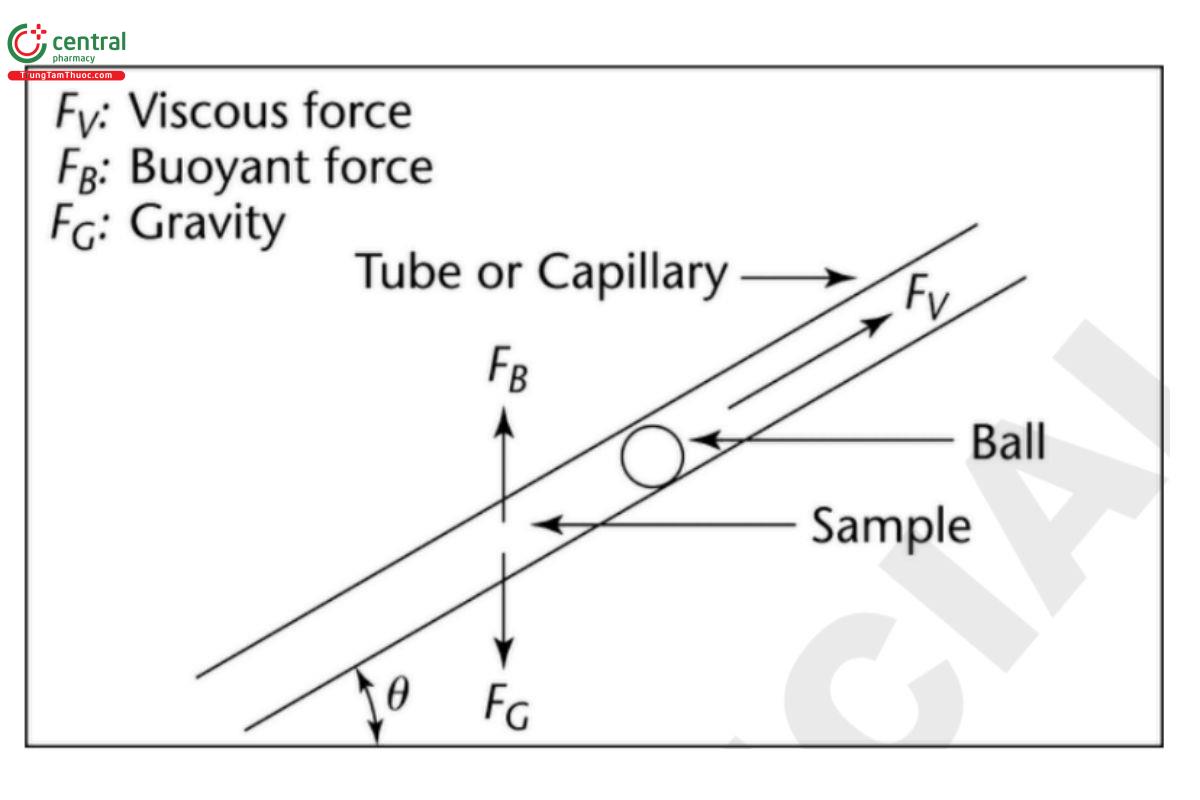
MEASURING PRINCIPLE
The rolling ball measurement is based on Stokes’s Law, as influenced by the angle of inclination of the tube (or capillary). Calculate the Newtonian viscosity, η, in mPa · s:
η = [(ρ1 − ρ2 ) × g × r2 × sinθ]/v∞
ρ1 = density of the ball used (g/mL)
ρ2 = density of the sample liquid (g/mL)
g = gravitational constant (mm/s2)
r = radius of the ball (mm)
θ = angle of inclination of the tube (or capillary)
v∞ = terminal velocity of the ball (mm/s)
Determine the viscosity of a liquid by observing the rolling time of a solid sphere (ball) under the influence of gravity in an inclined cylindrical tube filled with the sample liquid. Measure the time taken by the ball to travel the fixed distance between two ring marks or measuring sensors. For each single measured rolling time, the resulting viscosity can be expressed as dynamic viscosity (mPa · s) as well as kinematic viscosity (mm2/s) for a sample of known density.
2 PROCEDURE
Select a measuring system [tube (or capillary) and ball combination] within the anticipated range of viscosity of the sample liquid. As necessary, heat the clean and dry tube and ball of the viscometer to the temperature specified in the individual monograph, and control the temperature to ±0.1°, unless otherwise specified in the individual monograph. Select a measuring angle to obtain a minimum rolling time of 20 s. Fill the tube with the sample liquid, being careful to avoid bubble formation. Close the tube, and insert it in the instrument. Allow to equilibrate at the specified temperature for NLT 15 min for a rolling ball viscometer with a tube of large diameter. For a micro rolling ball viscometer, follow the instrument manufacturer’s instructions regarding temperature equilibration. Release the ball, and record the time required for the ball to roll from the upper to the lower ring mark (or measuring sensor). Repeat the test run at least four times.
The rolling time in the uid under examination is the mean of NLT four consecutive determinations. The result is valid if the percent relative standard deviation (%RSD) for the four readings is NMT 2.0%.
3 CALCULATION AND CALIBRATION
Calculate the Newtonian viscosity, η, in mPa · s:
η = k × (ρ1 − ρ2 ) × t
k = calibration constant of the instrument (mm2/s2) at a specified measuring angle and temperature
ρ1 = density of the ball used (g/mL)
ρ2 = density of the sample liquid (g/mL)
t = rolling time of the ball (s)
Calibrate each tube (or capillary) and ball combination at the test temperature and test angle using uids of known viscosities and densities (viscosity standards) to determine the measuring system constant, k.
[Note—Some automated viscometers use a polynomial function to determine the calibration for different angles and temperatures.] The viscosity values of the calibration standards should bracket the expected viscosity value of the sample liquid.
Calibrations are specific to the ball radius, ball density, temperature, and test angle. Recalibration is necessary when any of these parameters is changed.
Where no reference values at the required test temperature are available, follow the manufacturer’s instructions for mathematical corrections to the calibration function. When the materials of the ball and tube are dissimilar, apply corrections calculated using the linear thermal expansion coefficients of the materials.

