
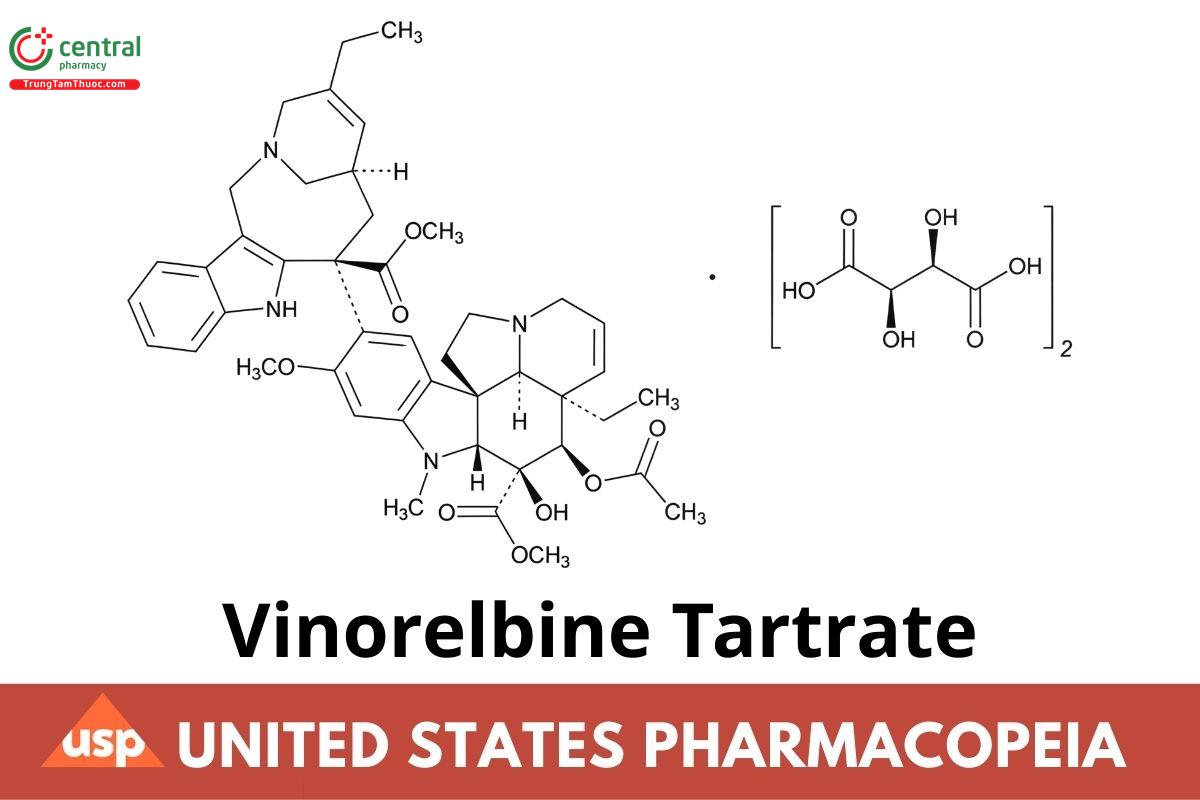
Vinorelbine Tartrate
If you find any inaccurate information, please let us know by providing your feedback here

Tóm tắt nội dung
This article is compiled based on the United States Pharmacopeia (USP) – 2025 Edition
Issued and maintained by the United States Pharmacopeial Convention (USP)
C45H54N4O8 · 2C4H6O6 1079.11
8'-Norvincaleukoblastine, 3',4'-didehydro-4'-deoxy-[R-(R*,R*)]-2,3-dihydroxybutanedioate (1:2) (salt);
3',4'-Didehydro-4'-deoxy-8'-norvincaleukoblastine L-(+)-tartrate (1:2) (salt) CAS RN®: 125317-39-7; UNII: 253GQW851Q.
1 DEFINITION
Vinorelbine Tartrate contains NLT 98.0% and NMT 102.0% of C45H54N4O8 · 2C4H6O6 calculated on the anhydrous basis.
CAUTION-Vinorelbine Tartrate is cytotoxic. Great care should be taken to prevent inhaling particles and exposing the skin to it.]
2 IDENTIFICATION
Change to read:
A. ▲SPECTROSCOPIC IDENTIFICATION TESTS (197), Infrared Spectroscopy: 197K▲(CN 1-MAY-2020)
Sample: Dissolve 10 mg in 5 mL of water, add 0.5 mL of 5 N sodium hydroxide, and extract with 5 mL of methylene chloride. Filter the organic extract through anhydrous sodium sulfate, and evaporate the organic extract to a volume of about 0.5 mL.
Acceptance criteria: Meets the requirements
B. The retention time of the major peak of the Sample solution corresponds to that of the Standard solution, as obtained in the Assay.
C.
Sample solution: Equivalent to 15 mg/mL of tartaric acid in water
Analysis: Το 0.1 mL of the Sample solution add 0.1 mL of 100 mg/mL of potassium bromide, 0.1 mL of 20 mg/mL of Resorcinol, and 3 mL of sulfuric acid. Heat on a hot water bath for 5-10 min until a dark blue color develops. Allow to cool, and pour the solution into water.
Acceptance criteria: The color changes to red (presence of tartrate).
3 ASSAY
PROCEDURE
Buffer: Dissolve 6.9 g of monobasic sodium phosphate in 900 mL of water. Adjust with phosphoric acid to a pH of 4.2, and dilute with water to 1000 mL.
Mobile phase: Dissolve 1.22 g of sodium 1-decanesulfonate in 620 mL of methanol, and add 380 mL of Buffer.
System suitability solution: Prepare a solution containing 1.4 mg/mL of USP Vinorelbine Tartrate RS and 0.01 mg/mL of USP Vinorelbine Related Compound A RS in water. Expose a portion of this solution in a suitable xenon lamp apparatus capable of supplying a dose of 1600 KJ/m² between 310 and 800 nm at a power of 500 W/m² for 1 h to generate an additional photodegradation product, 3,6-epoxy vinorelbine.
Standard solution: 1.4 mg/mL of USP Vinorelbine Tartrate RS in Mobile phase
Sample solution: 1.4 mg/mL of Vinorelbine Tartrate in Mobile phase
Chromatographic system
(See Chromatography (621), System Suitability.)
Mode: LC
Detector: UV 267 nm
Column: 3.9-mm x 15-cm; 5-µm packing L1
Column temperature: 40°
Flow rate: 1 mL/min
Injection size: 20 µL
System suitability
Samples: System suitability solution and Standard solution
Suitability requirements
Resolution: NLT 1.5 between vinorelbine and vinorelbine related compound A, System suitability solution
Tailing factor: NMT 2.0, Standard solution
Relative standard deviation: NMT 2.0%, Standard solution
Analysis
Samples: Standard solution and Sample solution
Calculate the percentage of vinorelbine tartrate (C45H54N4O8 · 2C4H6O6) in the portion of Vinorelbine Tartrate taken:
Result = (rU/rS) × (CS/CU) × 100
rU = peak response of vinorelbine from the Sample solution
rS = peak response of vinorelbine from the Standard solution
CS = concentration of USP Vinorelbine Tartrate RS in the Standard solution (mg/mL)
CU = concentration of Vinorelbine Tartrate in the Sample solution (mg/mL)
Acceptance criteria: 98.0%-102.0% on the anhydrous basis
4 IMPURITIES
4.1 RESIDUE ON IGNITION (281)
NMT 0.1%
4.2 ORGANIC IMPURITIES
Buffer, Mobile phase, System suitability solution, Sample solution, and System suitability: Proceed as directed in the Assay.
Standard stock solution: Use the Standard solution as prepared in the Assay.
Standard solution: 0.28 µg/mL of vinorelbine tartrate in Mobile phase, from Standard stock solution
Chromatographic system: Proceed as directed in the Assay, except use a run time of NLT three times the retention time of vinorelbine.
Analysis
Samples: Standard solution and Sample solution
Calculate the percentage of each impurity in the portion of Vinorelbine Tartrate taken:
Result = (rU/rT) x 100
rU = peak response for each impurity from the Sample solution
rT = sum of the responses of all the peaks from the Sample solution
Acceptance criteria: See Table 1.
[NOTE-Disregard any peaks with an area less than or equal to one-half of the area of the peak for vinorelbine in the Standard solution.]
Table 1
| Name | Relative Retention Time | Acceptance Criteria, NMT (%) |
| 3,6-Epoxy vinorelbinea | 0.8 | 0.3 |
| Vinorelbine | 1.0 | — |
| Vinorelbine related compound Ab | 1.2 | 0.2 |
| Any unspecified impurityc | — | 0.2 |
| Total impuritiesd | — | 0.7 |
a 3',4',7,8-Tetradehydro-3,4'-dideoxy-3,6-epoxy-6,7-dihydro-8'-norvincaleukoblastine.
b 4-O-Deacetylvinorelbine.
c Any individual impurity or coeluted impurities comprising an individual peak.
d Excluding 3,6-epoxy vinorelbine.
5 SPECIFIC TESTS
5.1 CLARITY OF SOLUTION
Sample solution: Equivalent to 10 mg/mL of anhydrous vinorelbine in water from Vinorelbine Tartrate
Acceptance criteria: The solution is clear.
5.2 COLOR OF SOLUTION
Sample solution: Equivalent to 10 mg/ml. of anhydrous vinorelbine in water from Vinorelbine Tartrate
Analysis: Determine the absorbance of the Sample solution in a 1-cm cell at 420 nm in a suitable spectrophotometer, using water as the blank.
Acceptance criteria: NMT 0.03
5.3 pH (791)
3.3-3.8, in a 10-mg/mL solution
5.4 WATER DETERMINATION, Method la(921)
NMT 4.0%
6 ADDITIONAL REQUIREMENTS
PACKAGING AND STORAGE: Preserve in tight, light-resistant containers. Store in a freezer.
USP REFERENCE STANDARDS (11)
USP Vinorelbine Related Compound A RS
4-0-Deacetylvinorelbine tartrate.
C43H52N4O7 · 2C4H6O6 1037.07
USP Vinorelbine Tartrate RS

