
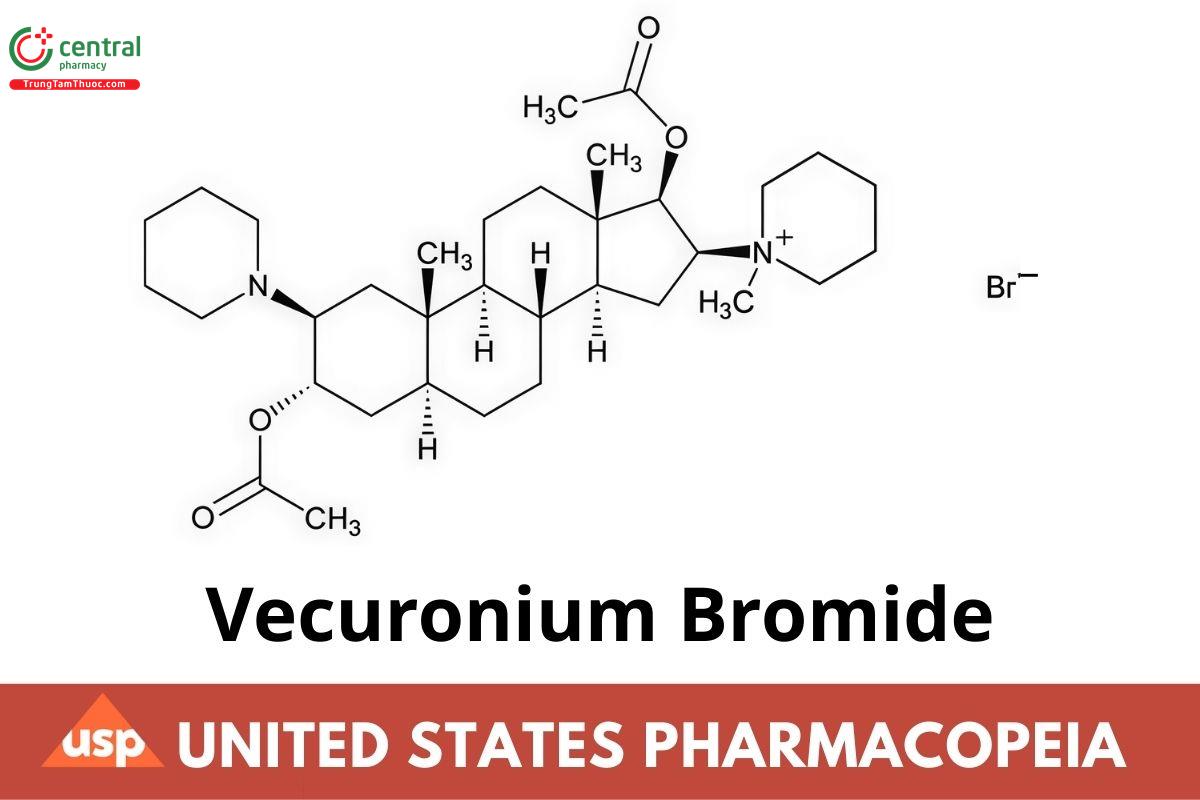
Vecuronium Bromide
If you find any inaccurate information, please let us know by providing your feedback here

Tóm tắt nội dung
This article is compiled based on the United States Pharmacopeia (USP) – 2025 Edition
Issued and maintained by the United States Pharmacopeial Convention (USP)
C34H57BrN2O4 ▲637.74▲(USP 1-May-2021)
Piperidinium, 1-[(2β,3α,5α,16β,17β)-3,17-bis(acetyloxy)-2-(1-piperidinyl)androstan-16-yl]-1-methyl-, bromide;
▲1-(30,17β-Dihydroxy-2β-piperidino-5α-androstan-16β-yl)-1-methylpiperidinium bromide, diacetate; 1-[3α,17β-Bis(acetyloxy)-2β-(piperidin-1-yl)-5α-androstan-16β-yl]-1-methylpiperidin-1-ium bromide ▲(USP 1-May-2021) CAS RN®: 50700-72-6; UNII: 7E4PHP5N1D.
1 DEFINITION
Vecuronium Bromide contains NLT 98.0% and NMT 102.0% of vecuronium bromide (C34H57BrN2O4), calculated on the dried basis.
2 IDENTIFICATION
A. SPECTROSCOPIC IDENTIFICATION TESTS (197), Infrared Spectroscopy: 197K
B. The retention time of the major peak of the Sample solution corresponds to that of the Standard solution, as obtained in the Assay.
3 ASSAY
Change to read:
PROCEDURE
Solution A: Dissolve 8.0 g of sodium perchlorate in 6.0 mL of water, and dilute with acetonitrile to 1 L.
Solution B: Dissolve 1.6 g of ammonium chloride in 8 mL of ammonium hydroxide, and dilute with methanol to 1 L. [NOTE-Avoid excessive degassing to prevent the loss of ammonium hydroxide.]
Mobile phase: Solution A and Solution B (60:40)
Diluent: Transfer 1.0 mL of 1 N hydrochloric acid VS into a 1000-mL volumetric flask, and dilute with acetonitrile to volume.
Standard solution: 0.5 mg/mL of USP Vecuronium Bromide RS in Diluent
Sample solution: 0.5 mg/mL of Vecuronium Bromide in Diluent
Chromatographic system
(See Chromatography (621), System Suitability.)
Mode: LC
Detector: UV 215 nm
Column: 4.6-mm x 25-cm; 5-µm packing L3
Column temperature: 40°
Flow rate: 0.5 mL/min
Injection volume: 20 µL
▲Run time: NLT 2.5 times the retention time of vecuronium bromide▲(USP 1-May-2021)
System suitability
Sample: Standard solution
Suitability requirements
▲Tailing factor: NMT 1.5▲(USP 1-May-2021)
Relative standard deviation: NMT ▲0.73%▲(USP 1-May-2021)
Analysis
Samples: Standard solution and Sample solution
Calculate the percentage of vecuronium bromide (C34H57BrN2O4) in the portion of Vecuronium Bromide taken:
Result = (rU/rS) × (CS/CU) × 100
rU = peak response from the Sample solution
rS = peak response from the Standard solution
CS = concentration of USP Vecuronium Bromide RS in the Standard solution (mg/mL)
CU = concentration of Vecuronium Bromide in the Sample solution (mg/mL)
Acceptance criteria: 98.0%-102.0% on the dried basis
4 IMPURITIES
Change to read:
ORGANIC IMPURITIES
Cation suppressor regeneration solution: 0.02 M tetrabutylammonium hydroxide
Mobile phase: [NOTE-Filter components before combining. Avoid evaporation of tetrahydrofuran during degassing.] Combine methanol, water. and bydrochloric acid (250:1500:1). Leave at room temperature for a few minutes. Add 45 mL of tetrahydrofuran, and then dilute with water to 2 L.
▲Diluent: 2.5 mM hydrochloric acid▲(USP 1-May-2021)
[NOTE-This applies to all of the solution preparations. The addition, with sonication of a small amount of acetonitrile (NMT 0.5 mL per 25 mg) to the weighed quantity of the samples may be used to aid in dissolution. Shaking and sonication may also be used after the addition of the required amount of ▲Diluent▲(USP 1-May-2021)]
System suitability solution: 5 µg/mL each of USP Vecuronium Bromide RS, USP Pancuronium Bromide RS, USP Vecuronium Bromide Related Compound A RS, USP Vecuronium Bromide Related Compound B RS. USP Vecuronium Bromide Related Compound C RS, and USP Vecuronium Bromide Related Compound F.RS in ▲Diluent▲(USP 1-May-2021)
Standard solution: 0.005 mg/ml. of USP Vecuronium Bromide RS in ▲Diluent▲(USP 1-May-2021)
Sample solution: 1 mg/mL of Vecuronium Bromide prepared as follows. To 25 mg of Vecuronium Bromide in a 25-mL volumetric flask add 0.5 mL of acetonitrile, sonicate, and rapidly dilute with Diluent.
Blank: ▲Diluent▲(USP 1-May-2021)
Chromatographic system
(See Chromatography (621), System Suitability.)
Mode: LC
Detector: Conductivity with 4-mm cation suppressor
Column: 4.6-mm x 25-cm; 5-µm packing L1
Flow rates
Column: 1.5 mL/min
Cation suppressor: 2 mL/min
Injection volume: 25 µL
System suitability
Samples: System suitability solution and Standard solution
[NOTE-The system may need equilibration for 4 h. Rinse and store the column in acetonitrile and water (50:50).]
Suitability requirements
Peak-to-valley ratio: NLT 2.0 between the vecuronium bromide related compound F peak and the height of the trough between the vecuronium bromide related compound F and pancuronium peaks, System suitability solution
Relative standard deviation: NMT 10.0% for 3 replicate injections, Standard solution
Analysis
Samples: Standard solution and Sample solution
Calculate the percentage of each impurity in the portion of Vecuronium Bromide taken:
Result = (rU/rS) × (CS/CU) × (1/F) x 100
rU = peak response of each impurity from the Sample solution
rS = peak response of USP Vecuronium Bromide RS from the Standard solution
CS = concentration of USP Vecuronium Bromide RS in the Standard solution (mg/mL)
CU = concentration of Vecuronium Bromide in the Sample solution (mg/mL)
F = relative response factor ▲▲(USP 1-May-2021) (see Table 1)
Acceptance criteria: See Table 1.
Table 1
| Name | Relative Retention Time | Relative Response Factor | Acceptance Criteria, NMT (%) |
| Pancuronium bromide | 0.5 | 1.1 | 0.5 |
Vecuronium bromide | 0.6 | 1.3 | 0.5 |
Vecuronium bromide | 0.9 | 1.4 | 0.5 |
| Vecuronium bromide | 1.0 | — | — |
Vecuronium bromide | 1.8 | 0.4 | 0.3 |
Vecuronium | 2.2 | 1.0 | 0.5 |
| Any other individual unspecified impurity | — | 1.0 | 0.1 |
| Total impurities | — | — | 1.0 |
5 SPECIFIC TESTS
Change to read:
5.1 OPTICAL ROTATION (781S), Procedures. Specific Rotation
Sample solution: 10 mg/mL ▲of Vecuronium Bromide▲(USP 1-May-2021) in dehydrated alcohol
Acceptance criteria: -16° to -20° at 20°
Change to read:
5.2 BACTERIAL, ENDOTOXINS TEST (85)
▲Where the label states that vecuronium bromide must be subjected to further processing during the preparation of injectable dosage forms, the level of bacterial endotoxin is such that the requirement under the relevant dosage form monograph(s) in which vecuronium bromide is used can be met.▲(USP 1-May-2021)
5.3 LOSS ON DRYING (731)
Analysis: Dry at 105° for 2 h..
Acceptance criteria: NMT 2.5%
6 ADDITIONAL REQUIREMENTS
PACKAGING AND STORAGE: Preserve in tight containers, and store at room temperature.
Add the following:
LABELING: Where Vecuronium Bromide must be subjected to further processing during the preparation of injectable dosage forms, the label states that it is sterile or must be subjected to further processing, to ensure acceptable levels of bacterial endotoxins, it is so labeled.▲ (USP 1-May-2021)
Change to read:
USP REFERENCE STANDARDS (11)
USP Pancuronium Bromide RS
▲▲(USP 1-May-2021)
USP Vecuronium Bromide RS
USP Vecuronium Bromide Related Compound A. RS
3α,17β-diacetyl-oxy-23,16β-bispiperidinyl-5α-androstan;
▲Also known as 2β,16β-Di(piperidin-1-yl)-50-androstane-3α,17β-diyl diacetate.▲(USP 1-May-2021)
C33H54N2O4 ▲542.81▲(USP 1-May-2021)
USP Vecuronium Bromide Related Compound B RS
Piperidinium, 1-[(2β,3α, 5α, 16β,17β)-3-acetyloxy-17-hydroxy-2-(1-piperidinyl) androstan-16-yl]-1-methyl bromide;
▲Also known as 1-[3α-(Acetyloxy)-17β-hydroxy-2β-(piperidin-1-yl)-5α-androstan-16β-yl]-1-methylpiperidin-1-ium bromide▲(USP 1-May-2021)
C32H55BrN2O3 ▲595.71▲(USP 1-May-2021)
USP Vecuronium Bromide Related Compound C RS
Piperidinium, 1-[(2β,3α,5α,16β,17β)-3,17-dihydroxy-2-(1-piperidinyl) androstan-16-yl]-1-methyl bromide;
▲Also known as 1-[3a,17ẞ-Dihydroxy-23-(piperidin-1-yl)-5a-androstan-16ẞ-yl]-1-methylpiperidin-1-ium bromide▲(USP 1-May-2021)
C30H53BrN2O2 ▲553.67▲(USP 1-May-2021)
USP Vecuronium Bromide Related Compound F. RS
Piperidinium, 1-[(2β,3α, 5α,16β,17β)-17-acetyloxy-3-hydroxy-2-(1-piperidinyl) androstan-16-yl]-1-methyl bromide;
▲Also known as 1-[17α-(Acetyloxy)-3β-hydroxy-2β-(piperidin-1-yl)-5α-androstan-16β-yl]-1-methylpiperidin-1-ium bromide.▲(USP 1-May-2021)
C32H53BrN2O3 ▲595.71▲(USP 1-May-2021)

