
Tyloxapol
If you find any inaccurate information, please let us know by providing your feedback here

Tóm tắt nội dung
This article is compiled based on the United States Pharmacopeia (USP) – 2025 Edition
Issued and maintained by the United States Pharmacopeial Convention (USP)
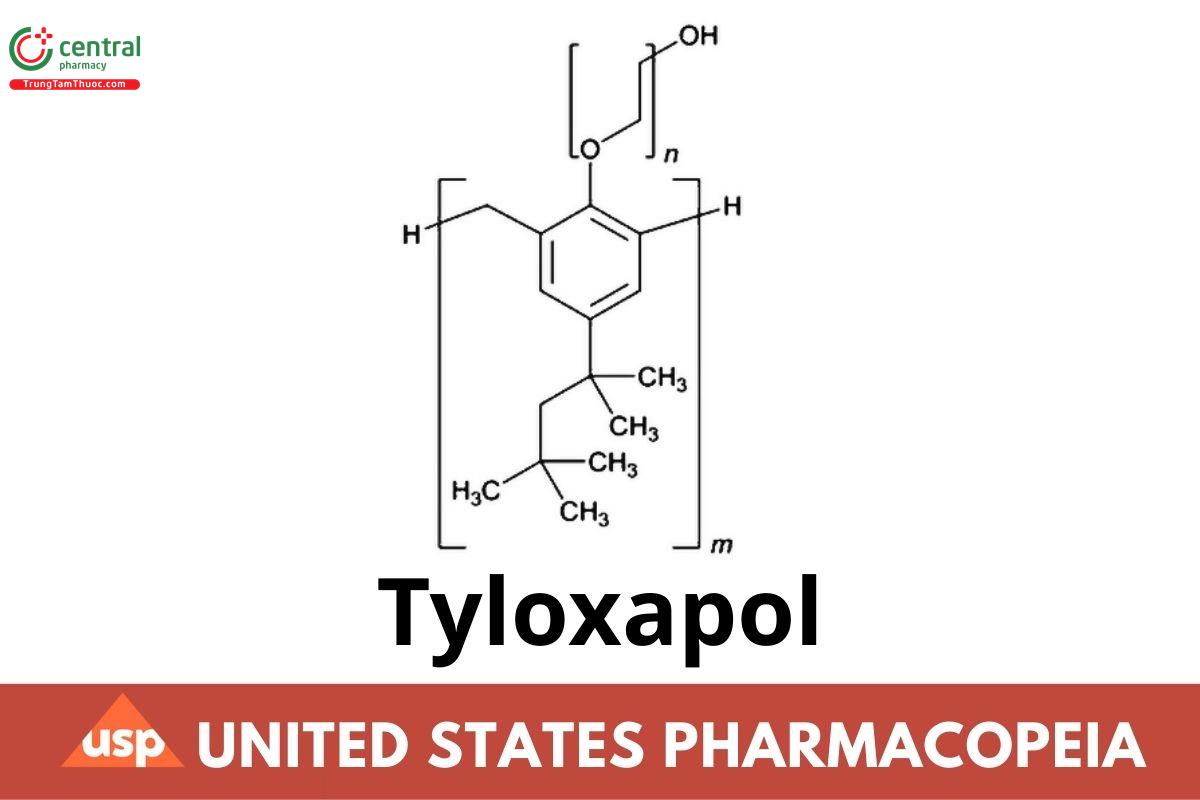
Phenol, 4-(1,1,3,3-tetramethylbutyl)-, polymer with formaldehyde and oxirane;
p-(1,1,3,3-Tetramethylbutyl)phenol polymer with ethylene oxide and formaldehyde
CAS RN: 25301-02-4.
1 DEFINITION
Tyloxapol is a nonionic liquid polymer of the alkyl aryl polyether alcohol type. (NOTE-Precautions should be exercised to prevent contact of Tyloxapol with metals.]
2 IDENTIFICATION
Change to read:
A. SPECTROSCOPIC IDENTIFICATION TESTS (197), Infrared Spectroscopy: 197F (CN 1-MAY-2020)
Analysis: On the undried specimen
Acceptance criteria: Meets the requirements
3 IMPURITIES
RESIDUE ON IGNITION (281): NMT 1.0%
3.1 LIMIT OF ANIONIC DETERGENTS
Standard solution: Transfer 50 mL of water and 1 mL of a solution of sodium lauryl sulfate containing 150 µg/mL to a 125-mL separator.
Sample solution: Mix 20 mL of a solution containing 10 mg/mL of Tyloxapol with 30 mL of water in a 125-mL separator.
Analysis: To both separators add 2 drops of 3 N hydrochloric acid, 1 drop of methylene blue solution (1 in 25), and 25 mL of chloroform.
Shake both separators gently for 2 min, allow to stand for 10 min, and transfer the chloroform layers to individual separators. Wash the chloroform extracts with separate 25-ml portions of water, transfer the chloroform solutions to matched 50-mL color-comparison tubes, and view downward over a white surface.
Acceptance criteria: The chloroform solution from the Sample solution is not darker than that from the Standard solution, corresponding to NMT 0.075% of anionic detergents (as sodium lauryl sulfate).
3.2 LIMIT OF ETHYLENE OXIDE
Standard solution
[CAUTION-Ethylene oxide is toxic and flammable. Prepare in a well-ventilated hood, using great care.]
Transfer 25 mL of dimethylformamide to a 50-mL volumetric flask and weigh. Add 0.5 mL of ethylene oxide. Reweigh to obtain the weight of ethylene oxide by difference. Dilute with dimethylformamide to volume. Dilute a portion of this solution with dimethylformamide to obtain a solution having a concentration of 10 µg/g of ethylene oxide.
Sample solution: Transfer 1 g of Tyloxapol into a glass- stoppered, 5-mL graduated cylinder. Dilute with dimethylformamide to 2.0 mL.
Chromatographic system
(See Chromatography 〈621〉, System Suitability.)
Mode: GC
Detector: Flame ionization
Column: 1.8-m × 2-mm glass column containing 5% phase G16 on support S12
Temperatures
Injection port: 200°
Detector: 250°
Column: See Table 1.
Table 1
| Initial Temperature (°) | Temperature Ramp (°/min) | Final Temperature (°) | Hold at Final Temperature (min) |
| 50 | 0 | 50 | 3 |
| 50 | 25 | 200 | 5 |
Carrier gas: Helium
Flow rate: 25 mL/min
Injection volume: 3 µL
System suitability
Sample: Standard solution
Suitability requirements
Relative standard deviation: NMT 10%
Analysis
Samples: Standard solution and Sample solution
Calculate the quantity of ethylene oxide in the portion of Tyloxapol taken:
Result = (ru /rs ) × (Cs /Cu )
ru = peak response of ethylene oxide from the Sample solution
rs = peak response of ethylene oxide from the Standard solution
Cs = concentration of ethylene oxide in the Standard solution (µg/mL)
Cu = concentration of Tyloxapol taken in the Sample solution (g/mL)
Acceptance criteria: NMT 10 µg/g
3.3 LIMIT OF FORMALDEHYDE
Diluent: Isopropyl alcohol and water (4 in 10)
Standard solution: Transfer 750 µL of a solution containing 27 µg/mL of formaldehyde to a 25-mL volumetric flask containing 5 mL of Diluent.
Sample solution: Prepare a solution containing 200 mg/mL of Tyloxapol in Diluent. Transfer 500 µL of this solution to a 25-mL volumetric flask containing 5 mL of Diluent.
Instrumental conditions
(See Ultraviolet-Visible Spectroscopy (857),)
Mode: Vis
Analytical wavelength: 520 nm
Cell: 1 cm
Analysis
Samples: Standard solution, Sample solution, and blank
To the Standard solution, the Sample solution, and a blank (prepared by placing 5 mL of Diluent in a 25-mL volumetric flask) add 500 µL of phenylhydrazine hydrochloride solution (7.5 in 100). Mix, and allow to stand for 10 ± 1 min. Add 300 µL of potassium ferricyanide solution (50 mg/mL) to each flask, mix, and allow to stand for 5 min ± 30 s. Then add 2.0 mL of 2.5 N sodium hydroxide to each. Mix, and allow to stand for 4 ± 1 min. Dilute each flask with Diluent to volume, mix, and read the absorbances after 10 ± 3 min.
Acceptance criteria: NMT 0.0075%; the absorbance of the Sample solution does not exceed that of the Standard solution.
3.4 FREE PHENOL
Sample solution: 10 mg/mL
Analysis: To 10 mL of Sample solution add 1 mL of bromine TS, and mix.
Acceptance criteria: No cloudiness or precipitation is observed immediately.
3.5 ABSENCE OF CATIONIC DETERGENTS
Sample solution: 10 mg/mL
Analysis: Place 10 mL of the Sample solution in a glass-stoppered, 50-mL graduated cylinder, and make distinctly alkaline to litmus with sodium carbonate TS (about 1 mL). Add 4 mL of aqueous bromophenol blue solution (0.4 mg/mL), mix, and add 10 mL of a 1-in-10 solvent mixture of ethylene dichloride in toluene. Shake gently, and allow the layers to separate.
Acceptance criteria: No blue color is observed in the organic solvent layer.
4 SPECIFIC TESTS
CLOUD POINT
Sample solution: Transfer 1.0 g of Tyloxapol, previously mixed, to a 150-mL beaker. Add 100.0 mL of water, and mix until dissolved. Warm the solution while mixing.
Analysis: Transient turbidity may be observed as the solution is warmed. Determine the temperature at which the mixture becomes completely turbid.
Acceptance criteria: The cloud point is between 92" and 97",
PH (791),
Sample solution: 50 mg/mL
Acceptance criteria: 4.0-7.0
5 ADDITIONAL REQUIREMENTS
PACKAGING AND STORAGE: Preserve in tight containers.
USP REFERENCE STANDARDS (11)
USP Tyloxapol RS

