
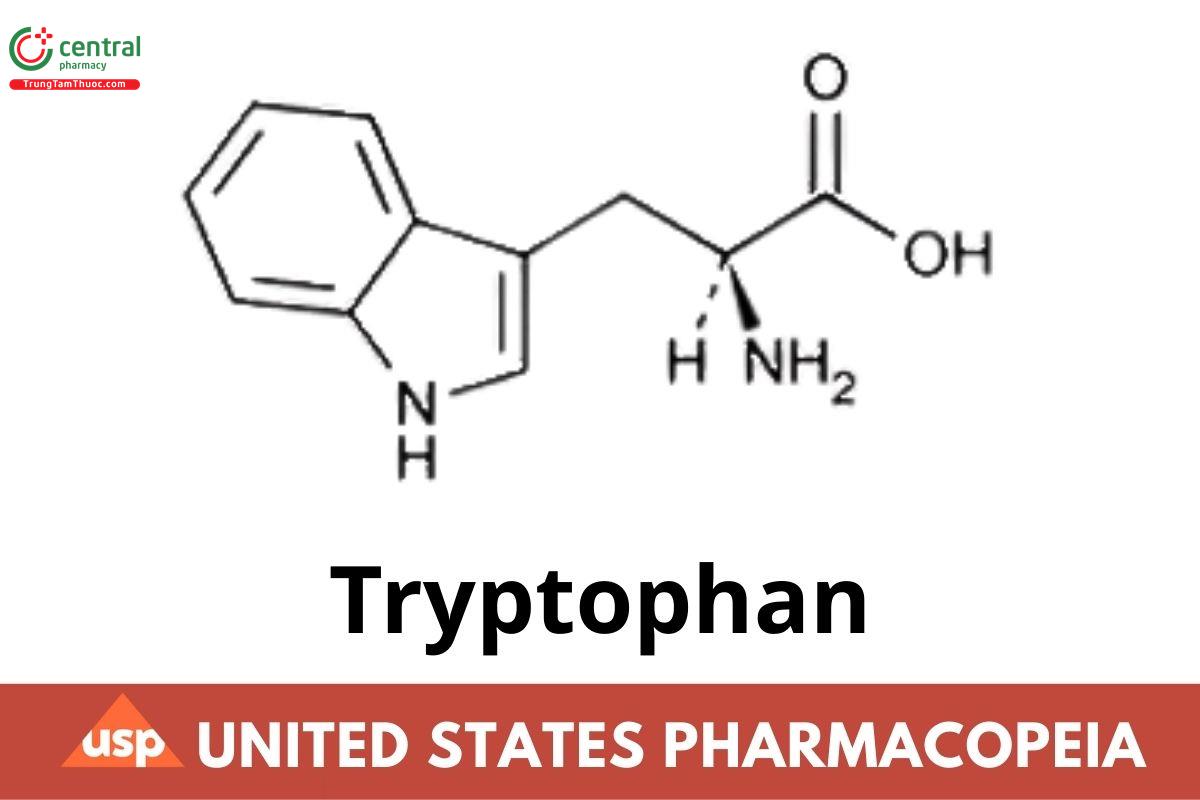
Tryptophan
If you find any inaccurate information, please let us know by providing your feedback here

Tóm tắt nội dung
This article is compiled based on the United States Pharmacopeia (USP) – 2025 Edition
Issued and maintained by the United States Pharmacopeial Convention (USP)
C11H12N2O2 204.23
l-Tryptophan CAS RN: 73-22-3; UNII: 8DUH1N11BX.
1 DEFINITION
Tryptophan contains NLT 98.5% and NMT 101.5% of C11H12N2O2, as L-tryptophan, calculated on the dried basis.
2 IDENTIFICATION
SPECTROSCOPIC IDENTIFICATION TESTS (197), Infrared Spectroscopy: 197K
3 ASSAY
PROCEDURE
Sample solution: Place 200 mg of Tryptophan in a 125-mL flask. Dissolve in a mixture of 3 mL of formic acid and 50 mL of glacial acetic acid.
Analysis: Titrate with 0.1 N perchloric acid VS, determining the endpoint potentiometrically. Perform a blank determination, and make any necessary correction (see Titrimetry (541)). Each mL of 0.1 N perchloric acid is equivalent to 20.42 mg of C, H,N,O,
Acceptance criteria: 98.5%-101.5% on the dried basis
4 IMPURITIES
4.1 INORGANIC IMPURITIES
RESIDUE ON IGNITION (281): NMT 0.1%
CHLORIDE AND SULFATE, Chloride (221): A 0.73-g portion shows no more chloride than corresponds to 0.50 mL of 0.020 N hydrochloric acid (0.05%). [NOTE-Gently heat the sample preparation to dissolve, if necessary.]
CHLORIDE AND SULFATE, Sulfate (221): A 0.33-g portion shows no more sulfate than corresponds to 0.10 mL of 0.020 N sulfuric acid (0.03%).
[NOTE-Gently heat the sample preparation to dissolve, if necessary.]
Change to read:
IRON (241), Procedures, Procedure 1 (CN 1-JUN-2023): NMT 30 ppm
4.2 ORGANIC IMPURITIES
PROCEDURE 1
Solution A: Trifluoroacetic acid in water (1 mL/L)
Solution B: Trifluoroacetic acid in an acetonitrile and water solution (80:20) (1 mL/L trifluoroacetic acid solution)
Standard solution: 1.0 mg/L each of USP Tryptophan Related Compound A RS and USP Tryptophan Related Compound B RS in water
Sample solution: 10.0 mg/mL of tryptophan in water
System suitability solution: 1.0 mg/L of USP Tryptophan Related Compound B RS in water
Mobile phase: See the gradient table below.
| Time (min) | Solution A (%) | Solution B (%) |
| 0 | 95 | 5 |
| 2 | 95 | 5 |
| 37 | 35 | 65 |
| 42 | 0 | 100 |
| 47 | 0 | 100 |
| 50 | 95 | 5 |
| 60 | 95 | 5 |
Chromatographic system
(See Chromatography 〈621〉, System Suitability.)
Mode: LC
Detector: UV 220 nm
Column: 4.6-mm × 25-cm; 5-µm packing L1
Column temperature: 30°
Flow rate: 1 mL/min
Injection size: 20 µL
System suitability
Sample: System suitability solution
Suitability requirement
Relative standard deviation: NMT 5.0%
Analysis
Samples: Standard solution and Sample solution
Calculate the percentage of each unspecied impurity in the portion of Tryptophan taken:
Result = (ru /rs ) × (Cs /Cu ) × 100
ru = peak area of each unspecied impurity in the Sample solution
rs = peak area of tryptophan related compound B in the Standard solution
Cs = concentration of USP Tryptophan Related Compound B RS in the Standard solution (µg/mL)
Cu = concentration of Tryptophan in the Sample solution (µg/mL)
Acceptance criteria
Total impurities 1: NMT 0.01% of the total impurities eluting prior to the tryptophan peak
Total impurities 2: NMT 0.03% of the total impurities eluting after the tryptophan peak. [Note—Exclude the peak for tryptophan related compound B.]
Tryptophan related compound A: If a peak for tryptophan related compound A is observed in the Sample solution, then perform the test for Procedure 2: Limit of Tryptophan Related Compound A, below.
Procedure 2: Limit of Tryptophan Related Compound A
Solution A: 18 mM monobasic sodium phosphate, ltered and degassed (pH 2.5), and acetonitrile (9:1)
Solution B: 10 mM monobasic sodium phosphate, ltered and degassed (pH 2.5), and acetonitrile (1:1)
Solution C: Acetonitrile in water (7:3)
Standard solution: 0.1 mg/L of USP Tryptophan Related Compound A RS in water
Sample solution: 10.0 mg/mL of Tryptophan in water
| Time (min) | Solution A (%) | Solution B (%) | Solution C (%) |
| 0 | 100 | 0 | 0 |
| 30 | 44 | 56 | 0 |
| 30.1 | 0 | 0 | 100 |
| 45 | 0 | 0 | 100 |
| 45.1 | 100 | 0 | 0 |
| 60 | 100 | 0 | 0 |
Chromatographic system
(See Chromatography 〈621〉, System Suitability.)
Mode: LC
Detector: UV 216 nm
Column: 3.9-mm × 15-cm; 5-µm packing L1
Column temperature: 30°
Flow rate: 1 mL/min
Injection size: 20 µL
System suitability
Sample: Standard solution
Suitability requirement
Relative standard deviation: NMT 5.0%
Analysis
Samples: Standard solution and Sample solution
Calculate the percentage of tryptophan related compound A in the portion of Tryptophan taken:
Result = (ru /rs ) × (Cs /Cu ) × 100
ru = peak area of tryptophan related compound A in the Sample solution
rs = peak area of tryptophan related compound A in the Standard solution
Cs = concentration of USP Tryptophan Related Compound A RS in the Standard solution (µg/mL)
Cu = concentration of Tryptophan in the Sample solution (µg/mL)
Acceptance criteria: NMT 10 ppm
5 SPECIFIC TESTS
Optical Rotation, Specific Rotation〈781S〉: −29.4° to −32.8°
Sample solution: 10 mg/mL, in water. [Note—Heat gently to dissolve, if necessary.]
pH 〈791〉: 5.5–7.0, in a solution (1 in 100)
Loss on Drying 〈731〉: Dry a sample at 105° for 3 h: it loses NMT 0.3% of its weight.
6 ADDITIONAL REQUIREMENTS
Packaging and Storage: Preserve in well-closed containers.
USP Reference Standards 〈11〉
USP l-Tryptophan RS
USP Tryptophan Related Compound A RS
(2S,2'S)-3,3'-[Ethane-1,1-diylbis(1H-indole-1,3-diyl)]bis(2-aminopropanoic acid).
C24H26N4O4 434.50
USP Tryptophan Related Compound B RS
2-Acetamido-3-(1H-indol-3-yl)propanoic acid.
C13H14N2O3 246.3

