
Trypsin
If you find any inaccurate information, please let us know by providing your feedback here

This article is compiled based on the United States Pharmacopeia (USP) – 2025 Edition
Issued and maintained by the United States Pharmacopeial Convention (USP)
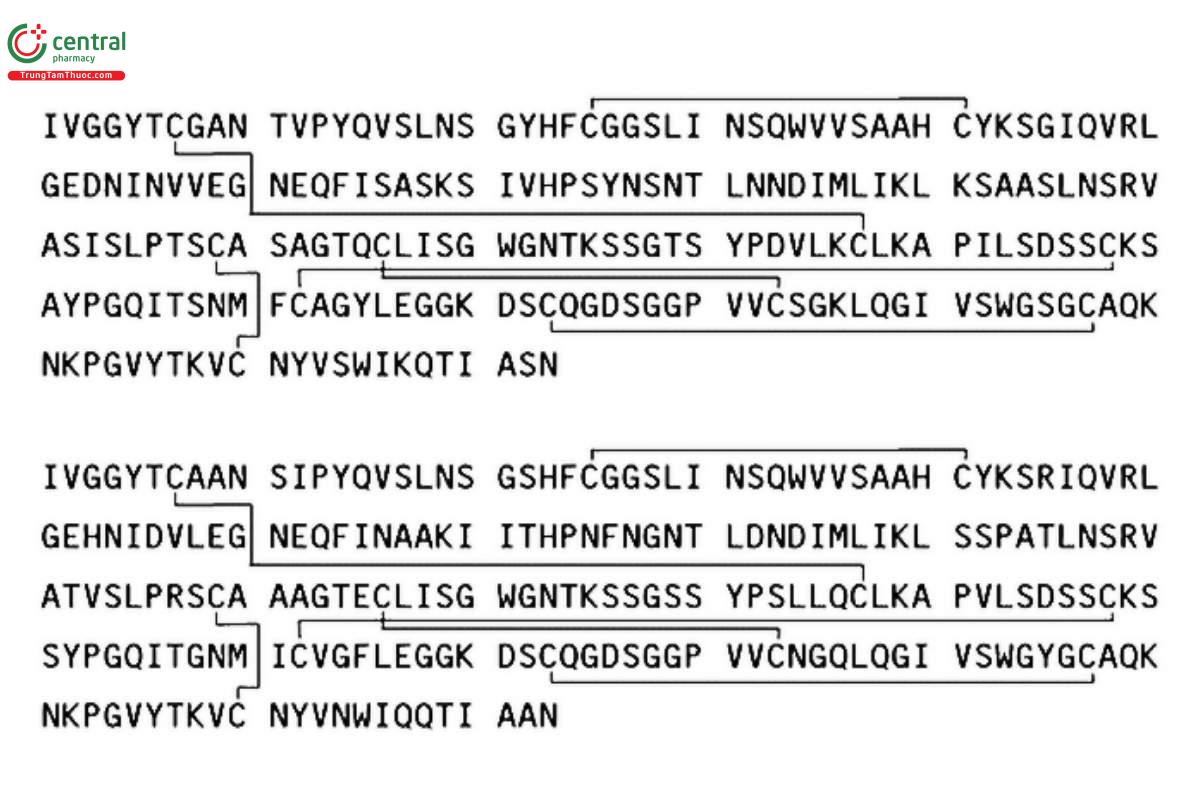
C1012H1585N279O324S14 (ERR 1-Dec-2020) 23,293 (for bovine β-Trypsin)
C1020H1597N287O321S14 23,463 (for porcine β-Trypsin) CAS RN: 9002-07-7. (USP 1-Dec-2020)
1 DEFINITION
Change to read:
(USP 1-Dec-2020) Trypsin is a proteolytic enzyme purified (USP 1-Dec-2020) from an extract of the pancreas of healthy bovine or porcine animals. (USP 1-Dec-2020) When assayed as directed herein, it contains NLT 85 Trypsin Units/mg, (USP 1-Dec-2020) calculated on the dried basis, and NLT 90.0% and NMT 110.0% of the labeled potency.(USP 1-Dec-2020)
2 IDENTIFICATION
Add the following:
A. It meets the requirements in the Assay (USP 1-Dec-2020)
Add the following:
Δ. Β.
Solution A: 0.1% (v/v) phosphoric acid in water prepared as follows. To 1000 mL of water add 1 mL of 85% phosphoric acid.
Solution B: 0.1% (v/v) phosphoric acid in acetonitrile prepared as follows. To 1000 mL of acetonitrile add 1 mL of 85% phosphoric acid.
Mobile phase: See Table 1.
Table 1
| Time (min) | Solution A (%) | Solution B (%) |
| 0 | 75 | 25 |
| 25 | 55 | 45 |
| 30 | 10 | 90 |
| 34 | 10 | 90 |
| 35 | 75 | 25 |
| 45 | 75 | 25 |
Diluent: 20 mM calcium chloride and 0.01 N hydrochloric acid, pH 2.0 ± 0.2 prepared as follows. Dissolve 2.9 g of calcium chloride dihydrate in approximately 700 mL of water, add 2.5 mL of 4 N hydrochloric acid, mix well, and dilute with water to a final volume of 1000 mL. Adjust, if necessary, with 4 N hydrochloric acid to a pH of 2.0 ± 0.2.
Standard solution
For USP TRYPSIN BOVINE RS: Dissolve a weighed quantity of USP Trypsin Bovine RS in Diluent to obtain a concentration of 70 mg/mL. Brief centrifugation at 2°-8° may be necessary to remove the insoluble particles.
For USP TRYPSIN RECOMBINANT PORCINE RS: The target protein concentration is 70 ± 10 mg/mL. Thaw 100 µL of USP Trypsin Recombinant Porcine RS at room temperature for about 1 h and mix.
Sample solution: Dissolve a weighed quantity of Trypsin of the appropriate species in Diluent to obtain a concentration of 70 mg/mL. Brief centrifugation at 2°-8° may be necessary to remove the insoluble portion of the Chromatographic system
(See Chromatography (621), System Suitability.)
Mode: LC
Detector: UV 280 nm
Column: 4.6-mm × 25-cm; 3-µm packing L1, pore size 200 Å
Temperatures
Autosampler: 5°
Column: 40°
Flow rate: 1.0 mL/min
Injection volume: 1 µL
System suitability
Sample: Standard solution
[NOTE-The relative retention times for a-trypsin and ẞ-trypsin are 0.96 and 1.0, respectively. The retention time for the ẞ-trypsin from bovine trypsin is approximately 11 min and from porcine trypsin is approximately 14 min.]
Suitability requirements
Resolution: NLT 1 between the a-trypsin and ẞ-trypsin peaks
Analysis
Samples: Standard solution and Sample solution
Acceptance criteria: The retention time of the ẞ-trypsin peak of the Sample solution corresponds to that of the appropriate species of the
Standard solution. (USP 1-Dec-2020)
3 ASSAY
Change to read:
PROCEDURE
Buffer: 100 mM Tris and 20 mM calcium chloride, pH 8.0, prepared as follows. Dissolve 1.21 g of tris(hydroxymethyl)aminomethane and 0.29 g of calcium chloride dihydrate in 100 mL of water, and adjust with 2 N hydrochloric acid to a pH of 8.0 (at 25 ± 1°).
Diluent: 20 mM calcium chloride and 0.01 N hydrochloric acid, pH 2.0 ± 0.2, prepared as follows. Dissolve 2.9 g of calcium chloride dihydrate in approximately 700 mL of water, add 2.5 mL of 4 N hydrochloric acid, mix well, and dilute with water to a final volume of 1000 mL. Adjust, if necessary, with 4 N hydrochloric acid to a pH of 2.0 ± 0.2.
Substrate stock solution: Dissolve 20 mg of carbobenzoxy-valyl-glycyl-arginine-4-nitril-anilide acetate1, accurately weighed, in 3.0 mL of water1. [NOTE-Use a freshly prepared solution only.]
Substrate solution: Mix 28 mL of Buffer and 2.8 mL of Substrate stock solution.
Standard solution
For USP TRYPSIN BOVINE RS: Dissolve a weighed quantity of USP Trypsin Bovine RS in Diluent to obtain a concentration of 2,000-2,400
Trypsin Units/mL. Prepare each Standard solution by diluting this solution with water using a serial dilution scheme to obtain a final concentration of approximately 0.25 Trypsin Units/mL. Prepare NLT 5 Standard solutions in parallel. Assay each Standard solution in duplicate.
For USP TRYPSIN RECOMBINANT PORCINE RS: Precool USP Trypsin Recombinant Porcine RS and water to approximately 4o. Start preparing Standard solutions immediately when the temperature has reached 4o. Prepare each Standard solution by diluting USP Trypsin Recombinant Porcine RS with water using a serial dilution scheme to obtain a final concentration of approximately 0.2 Trypsin Units/mL. Prepare NLT 5 Standard solutions in parallel. Assay each Standard solution in duplicate.
Sample stock solution: Dissolve a quantity of Trypsin of the appropriate species in Diluent to obtain a concentration of 10-20 mg/mL.
Sample solution: Dilute Sample stock solution with water using a serial dilution scheme to obtain a final concentration of approximately 0.25 Trypsin Units/mL. Prepare NLT 5 Sample solutions in parallel. Assay each Sample solution in duplicate.
[NOTE-Use an adjustable pipettor for each measurement and dilution operation. Use polystyrene test tubes when preparing the Standard solution and Sample solution, and use polystyrene pipet tips containing polyethylene filters to transfer samples. The pipet tip should not be wet before transfer, and each pipet tip should only be used for transferring one sample.]
Instrumental conditions
(See Ultraviolet-Visible Spectroscopy (857).)
Mode: UV
Analytical wavelength: 405 nm
Cell: 1 cm
Temperature: 25°
Analysis
Samples: Standard solution and Sample solution
Transfer 1.10 mL of Substrate solution into a polystyrene semimicro cuvette, allow the temperature to stabilize, check the cuvette for the specified temperature, and wait for 10 min. Start the reaction by adding 0.020 mL of Standard solution or Sample solution. Record the absorbance for at least 5 min, and determine the change in absorbance (AA/min) from the linear range of the reaction.
Calculate the activity of trypsin in Trypsin Units/mg in the portion of Trypsin taken:
Result = {[VT /(ε405 × V × B)] × (ΔA/min) × D}/C
VT = volume of the reaction mixture, 1.12 mL
ε405 = extinction coecient for 405 nm, 10.4 (mmol−1 · 1 cm−1)
V = volume of the Standard solution or Sample solution, 0.020 mL
B = absorption of cell length, 1 cm
D = dilution factor used to prepare the Sample solution from the Sample stock solution
C = concentration of Trypsin in Sample stock solution (mg/mL)
[Note—1 Trypsin Unit is the activity releasing the equivalent of 1 mmol/min of 4-nitril aniline from carbobenzoxy-valyl-glycyl-arginine-4- nitril-anilide acetate under the conditions of the Assay.]
System suitability
Samples: Standard solution and Sample solution
Suitability requirements
ΔA/min: 0.03–0.07, Standard solution and Sample solution
Average calculated activity: 80%–120% of the labeled value, Standard solution
Relative standard deviation: NMT 5% for the activities determined from 5 replicates, Standard solution and Sample solution
Acceptance criteria
Specic activity: NLT 85 Trypsin Units/mg on the dried basis
Labeled potency: 90.0%–110.0% (USP 1-Dec-2020)
4 IMPURITIES
Residue on Ignition 〈281〉: NMT 2.5%
Change to read:
Organic Impurities: Limit of Chymotrypsin
Monobasic potassium phosphate solution: 9.08 mg/mL monobasic potassium phosphate
Dibasic sodium phosphate solution: 9.46 mg/mL dibasic anhydrous sodium phosphate (USP 1-Dec-2020)
0.067 M phosphate buffer, pH 7.0: Monobasic potassium phosphate solution and Dibasic sodium phosphate solution (38.9:61.1). Adjust dropwise, if necessary, with Dibasic sodium phosphate solution to a pH of 7.0. (USP 1-Dec-2020)
Substrate solution: Dissolve 0.474 mg/mL of N-acetyl-l-tyrosine ethyl ester, suitable for use in determining chymotrypsin, in 0.067 M phosphate buffer, pH 7.0 with warming. When cool, dilute with 0.067 M phosphate buffer, pH 7.0 (1:1). [Note—The Substrate solution may be stored in the frozen state and used after thawing; it is important, however, to freeze immediately after preparation.]
Sample solution: 22 Trypsin Units/mL of Trypsin (USP 1-Dec-2020) in 0.0010 N hydrochloric acid
Blank solution: Add 3 mL of water to 0.2 mL of 0.0012 N hydrochloric acid. (USP 1-Dec-2020)
Instrumental conditions
(See Ultraviolet-Visible Spectroscopy 〈857〉.)
Mode: UV
Analytical wavelength: 237 nm
Cell: 1 cm
Temperature: 25°(USP 1-Dec-2020)
Analysis
[Note—Conduct the test in a suitable spectrophotometer equipped to maintain a temperature of 25° (USP 1-Dec-2020) in the cell compartment. Determine the temperature in the reaction cell before and after the measurement of absorbance to ensure that the temperature does not change by more than 1.0°.(USP 1-Dec-2020) ]
Samples: Sample solution and Blank solution (USP 1-Dec-2020)
Pipet 3.0 mL of Blank solution (USP 1-Dec-2020) into a 1-cm cell. Place this cell in the spectrophotometer and autozero the instrument with the Blank solution. (USP 1-Dec-2020) Pipet 200 µL of Sample solution into another 1-cm cell, add 3.0 mL of the Substrate solution, and place the cell in the spectrophotometer.
[Note—This order of addition is to be followed.]
At the time the Substrate solution is added, start a stopwatch, and read the absorbance at 30-s intervals for NLT 5 min. Repeat the procedure on the same dilution at least once. Absolute absorbance values are of less importance than the constancy of the rate of change of absorbance. If the rate of change does not remain constant for at least 3 min, repeat the run, and if necessary, use a lower concentration. The duplicate run at the same dilution should match the rst run in rate of absorbance change. Determine the average absorbance change/min, using only the values within the 3-min portion of the curve where the rate of absorbance is constant. Plot a curve of absorbance against time. (USP 1-Dec-2020)
Calculate the number of USP Chymotrypsin Units/mg of (USP 1-Dec-2020) Trypsin taken:
Result = (A2 – A1 )/(F × T × W)
A2 = absorbance straight-line initial reading
A1 = absorbance straight-line nal reading
F = chymotrypsin activity conversion factor, 0.0075/min
T = elapsed time between the initial and nal readings (min)
W = weight of (USP 1-Dec-2020) Trypsin in the portion of solution used to determine absorbance (mg)
[Note—One USP Chymotrypsin Unit is the activity causing a change in absorbance of 0.0075/min under the conditions specied in this test.] (USP 1-Dec-2020)
Acceptance criteria: NMT 50 USP Chymotrypsin Units/85 Trypsin Units, (USP 1-Dec-2020) indicating the presence of NMT approximately 5% (w/w) (USP 1-Dec-2020) of chymotrypsin
5 SPECIFIC TESTS
Microbial Enumeration Tests 〈61〉 and Tests for Specified Microorganisms 〈62〉: It meets the requirements of the tests for absence of Staphylococcus aureus, Pseudomonas aeruginosa, and Salmonella species.
Change to read:
Solubility Test: An amount, equivalent to 17,000 Trypsin Units, (USP 1-Dec-2020) is soluble in 10 mL of water and in 10 mL of saline TS.
Loss on Drying 〈731〉
Analysis: Dry under vacuum at 60° for 4 h.
Acceptance criteria: NMT 5.0%
6 ADDITIONAL REQUIREMENTS
Packaging and Storage: Preserve in tight containers, and avoid exposure to excessive heat.
Add the following:
Labeling: Label it to indicate that it has been prepared from bovine or porcine pancreas. (USP 1-Dec-2020)
Change to read:
USP Reference Standards 〈11〉
USP Trypsin Bovine RS
USP Trypsin Recombinant Porcine RS (USP 1-Dec-2020)
1 A suitable carbobenzoxy-valyl-glycyl-arginine-4-nitril-anilide acetate is Chromozym TRY from Roche Applied Science (catalog #10378496103) or equivalent.

