
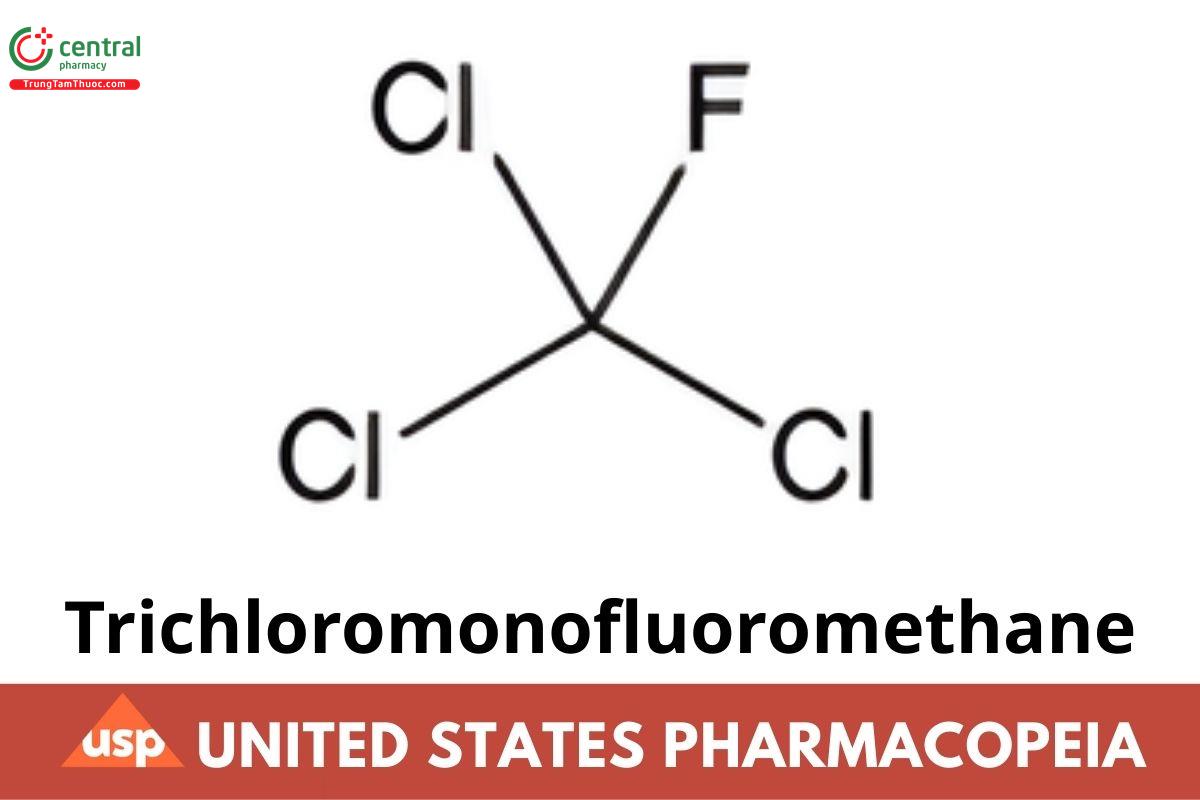
Trichloromonofluoromethane
If you find any inaccurate information, please let us know by providing your feedback here

Tóm tắt nội dung
This article is compiled based on the United States Pharmacopeia (USP) – 2025 Edition
Issued and maintained by the United States Pharmacopeial Convention (USP)
CCl3F 137.37
Methane, trichlorofluoro-;
Trichlorofluoromethane CAS RN®: 75-69-4.
1 DEFINITION
Trichloromonofluoromethane contains NLT 99.6% and NMT 100.0% of trichloromonofluoromethane (CCl3F), calculated on the anhydrous basis.
2 IDENTIFICATION
A. The IR absorption spectrum, determined in a 10-cm cell with sodium chloride windows, at atmospheric pressure, exhibits maxima, among others, at the following wavelengths, in μm: 4.67 (m), 5.95 (m), 7.28 (s), 8.06 (m), 9.2 (vs), 10.7 (vs), 11.8 (vs), and 13.4 (m). The stronger maxima are best obtained at pressures less than 10 mm of mercury.
3 ASSAY
3.1 Procedure
System suitability solution: Introduce a liquid-phase mixture of dichlorodifluoromethane, dichlorotetrafluoroethane, and
trichloromonofluoromethane into an evacuated headspace vial.
Sample solution: Introduce the liquid phase of Trichloromonofluoromethane into an evacuated headspace vial.
3.2 Chromatographic system
(See Chromatography 〈621〉, System Suitability.)
Mode: GC
Detector: Flame ionization
Column: 2-mm × 1.8-m stainless steel; 1% phase G25 on support S12
Temperatures
Injection port: 110°
Detector: 200°
Column: See Table 1.
Table 1
Initial Temperature (°) | Temperature Ramp (°/min) | Final Temperature (°) | Hold Time at Final Temperature (min) |
| 70 | 10 | 170 | 5 |
Carrier gas: Helium
Flow rate: 20 mL/min
Headspace sampler: The bath temperature is 100°, the valve/loop temperature is 105°, and the sampling time is 3 s. Make adjustments as
necessary to optimize peak areas to record trace-level impurities.
3.3 System suitability
Sample: Gas phase headspace of the System suitability solution
[Note—The relative retention times for dichlorodifluoromethane, dichlorotetrafluoroethane, and trichloromonofluoromethane are 0.5, 0.8, and 1.0, respectively.]
Suitability requirements
Resolution: NLT 2.0 between dichlorotetrafluoroethane and trichloromonofluoromethane
3.4 Analysis
Sample: Gas phase headspace of the Sample solution
Calculate the percentage of trichloromonofluoromethane (CCl3F) in the portion of Trichloromonofluoromethane taken.
Acceptance criteria: 99.6%–100.0% on the anhydrous basis
4 IMPURITIES
Inorganic Chlorides
Sample: 7 g
Analysis: Place 5 mL of anhydrous methanol in a test tube, add 3 drops of a saturated solution of silver nitrate in anhydrous methanol, shake, and add the Sample.
Acceptance criteria: No opalescence or turbidity is produced.
Chromatographic Purity
Analysis: In the chromatogram from the Assay, identify the dichlorodìluoromethane and dichlorotetrafluoroethane peaks from relative retention times of those peaks in the chromatogram of the System suitability solution.
Acceptance criteria
Sum of the peak areas for dichlorodifluoromethane and dichlorotetrafluoroethane: NMT 0.2% of the total of all peak areas
Sum of the areas of all peaks other than that for trichloromonofluoromethane: NMT 0.4% of the total of all peak areas.
5 SPECIFIC TESTS
Boiling Temperature
Analysis: Determine as directed in Propellants 〈602〉.
Acceptance criteria: Approximately 24°
Water
Analysis: Determine as directed in Propellants 〈602〉, and Water Deterimination, Method Ic 〈921〉.
Acceptance criteria: NMT 0.001%
High-Boiling Residues
Analysis: Determine as directed in Propellants 〈602〉.
Acceptance criteria: NMT 0.01%
6 ADDITIONAL REQUIREMENTS
Packaging and Storage: Preserve in tight cylinders, and avoid exposure to excessive heat.

