
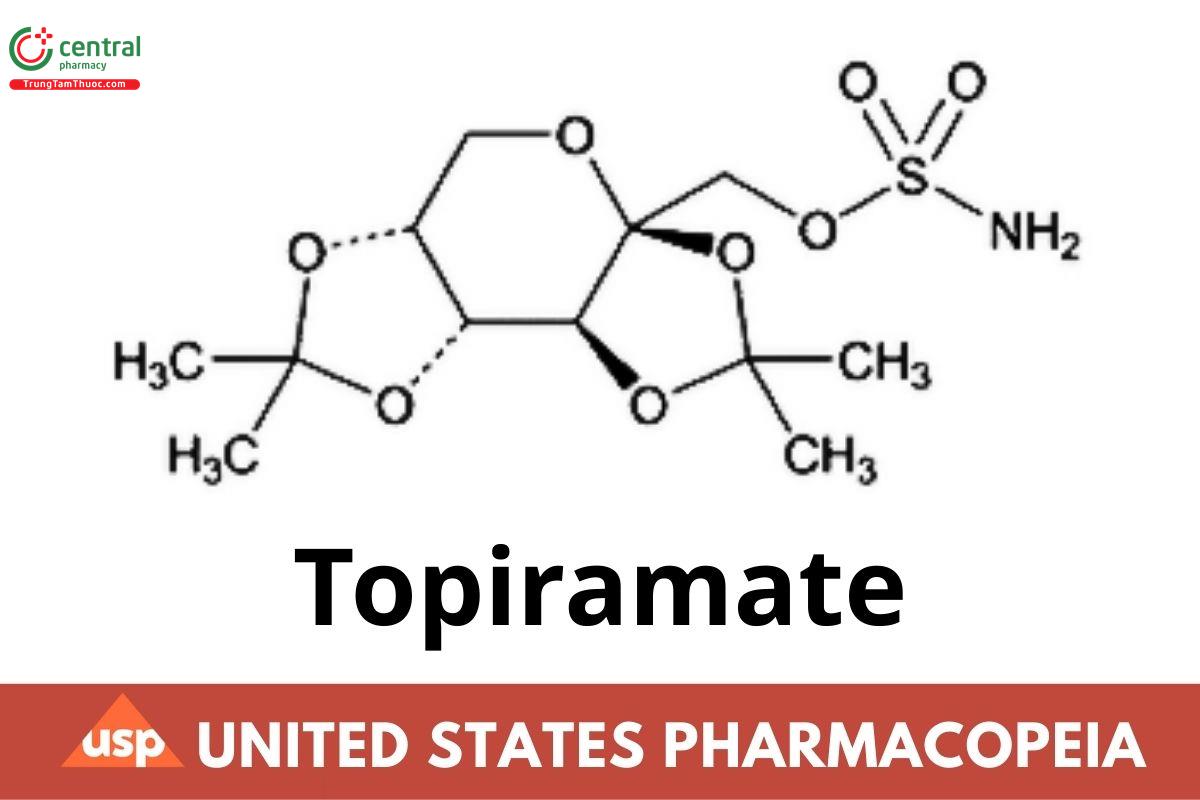
Topiramate
If you find any inaccurate information, please let us know by providing your feedback here

Tóm tắt nội dung
This article is compiled based on the United States Pharmacopeia (USP) – 2025 Edition
Issued and maintained by the United States Pharmacopeial Convention (USP)
C12H21NO8S 339.36
β-d-Fructopyranose, 2,3:4,5-bis-O-(1-methylethylidene)-, sulfamate;
2,3:4,5-Di-O-isopropylidene-β-d-fructopyranose sulfamate CAS RN: 97240-79-4; UNII: 0H73WJJ391.
1 DEFINITION
Topiramate contains NLT 98.0% and NMT 102.0% of topiramate (C12H21NO8S), calculated on the anhydrous basis.
[CAUTION-Great care must be exercised in handling topiramate because it is a suspected teratogen.]
2 IDENTIFICATION
Change to read:
A. SPECTROSCOPIC IDENTIFICATION TESTS (197), Infrared Spectroscopy: 197K (CN 1-MAY-2020)
B. The retention time of the major peak of the Sample solution corresponds to that of the Standard solution, as obtained in the Assay.
3 ASSAY
PROCEDURE
Mobile phase: Acetonitrile and water (50:50)
Standard solution: 2 mg/mL of USP Topiramate RS in Mobile phase
Sample solution: 2 mg/mL of Topiramate in Mobile phase
System suitability solution: 0.02 mg/mL each of USP Fructose RS and USP Topiramate Related Compound A RS in the Sample solution
Chromatographic system
(See Chromatography (621), System Suitability.)
Mode: LC
Detector: Refractive index
Column: 4.6-mm x 25-cm; 5-µm packing L1
Temperatures
Column: 50°
Detector: 55°
Flow rate: 0.6 mL/min
Injection volume: 20 µL
Run time: NLT 3 times the retention time of topiramate
System suitability
Samples: Standard solution and System suitability solution
[NOTE-See Table 1 for the relative retention times for fructose, topiramate related compound A, and topiramate.]
Suitability requirements
Resolution: NLT 1.5 between topiramate related compound A and topiramate, System suitability solution
Tailing factor: NMT 2.0, Standard solution
Relative standard deviation: NMT 2.0%, Standard solution
Analysis
Samples: Standard solution and Sample solution
Calculate the percentage of topiramate (C12H21NO8S) in the portion of Topiramate taken:
Result = (ru /rs ) × (Cs /Cu ) × 100
ru = peak response from the Sample solution
rs = peak response from the Standard solution
Cs = concentration of USP Topiramate RS in the Standard solution (mg/mL)
Cu = concentration of Topiramate in the Sample solution (mg/mL)
Acceptance criteria: 98.0%–102.0% on the anhydrous basis
4 IMPURITIES
RESIDUE ON IGNITION (281); NMT 0.2%
4.1 LIMIT OF SULFAMATE AND SULFATE
[NOTE-Use water with resistivity of NLT 18 megohm-cm for preparation of the Mobile phase, Standard solution, and Sample solution.]
Buffer: 0.8 g/L of p-hydroxybenzoic acid in water
Mobile phase: Methanol and Buffer (2.5:97.5). Adjust with sodium hydroxide solution to a pH of 9.4 ± 0.5.
Standard solution: 0.0045 mg/mL of sodium sulfate and 0.0030 mg/mL of sulfamic acid in Mobile phase
Sample solution: 6.0 mg/mL of Topiramate in Mobile phase
Chromatographic system
(See Chromatography (621), System Suitability.)
Mode: LC
Detector: Conductivity
Column: 4.6-mm x 15-cm; 5-µm packing L47
Detector temperature: 30°
Flow rate: 1.5 mL/min
[NOTE-A suitable background suppression unit may be used.]
Injection volume: 70 µL
System suitability
Sample: Standard solution
[NOTE-The relative retention time of sulfamate is 0.44 relative to sulfate.]
Suitability requirements
Relative standard deviation: NMT 15.0% for sulfamate and sulfate
Analysis
Samples: Standard solution and Sample solution
Calculate the percentage of sulfate ions in the portion of Topiramate taken:
Result = (ru /rs ) × (Cs /Cu ) × (Mr1 /Mr2 ) × 100
ru = peak response of the sulfate ion from the Sample solution
rs = peak response of the sulfate ion from the Standard solution
Cs = concentration of sodium sulfate in the Standard solution (mg/mL)
Cu = concentration of Topiramate in the Sample solution (mg/mL)
Mr1 = molecular weight of the sulfate anion, 96.04
Mr2 = molecular weight of anhydrous sodium sulfate, 142.04
Calculate the percentage of sulfamate ions in the portion of Topiramate taken:
Result = (ru /rs ) × (Cs /Cu ) × (Mr1 /Mr2 ) × 100
ru = peak response of the sulfamate ion from the Sample solution
rs = peak response of the sulfamate ion from the Standard solution
Cs = concentration of sulfamic acid in the Standard solution (mg/mL)
Cu = concentration of Topiramate in the Sample solution (mg/mL)
M = molecular weight of sulfamate anion, 96.09
M = molecular weight of sulfamic acid, 97.09
Acceptance criteria: NMT 0.1% of sulfate; NMT 0.1% of sulfamate
[NOTE- If N-methyltopiramate is a potential impurity, Organic Impurities, Procedure 1 and Organic Impurities, Procedure 3 are recommended; on the basis of synthetic route, perform either Organic Impurities, Procedure 2 or Organic Impurities, Procedure 3.]
4.2 ORGANIC IMPURITIES, PROCEDURE 1
Identification solution: 0.2 mg/mL of USP Topiramate Related Compound A RS in methanol
Standard solution A: 40 mg/mL of USP Topiramate RS in methanol
Standard solution B: 0.08 mg/mL of Topiramate from Standard solution A and methanol
Standard solution C: 0.04 mg/mL of Topiramate from Standard solution A and methanol
Sample solution: 40 mg/mL of Topiramate in methanol
Chromatographic system
(See Chromatography (621), General Procedures, Thin-Layer Chromatography.)
Mode: TLC
Adsorbent: 0.20-mm layer of chromatographic silica gel mixture, prewashed with methanol and air-dried
Application volume: 20 µL
Developing solvent system: Acetonitrile, methanol, and 0.5 M sodium chlorideTS (35:15:50)
Spray reagent: 30-mg/mL solution of phenol in alcohol and concentrated sulfuric acid (95:5)
Analysis
Samples: Standard solution B, Standard solution C, and Sample solution
Proceed as directed in the chapter. After elution, air-dry the plate, spray the plate with the Spray reagent, and let the plate air-dry. Then dry the plate for 10 min in an oven at 125°. [NOTE-The approximate R, values for topiramate and topiramate related compound A are 0.65 and 0.70, respectively. Disregard any spots at the origins of the chromatograms. Disregard any spot corresponding to topiramate related compound A because this impurity should be quantified using Procedure 3.] Examine the plate using visible light, and estimate the percentage of all secondary spots in the chromatogram of the Sample solution by comparing each spot with the principal spot from the chromatograms of each Standard solution.
Acceptance criteria: Any single spot is not greater in size and intensity than the spot for Standard solution C, NMT 0.1% of any individual impurity and NMT 0.5% of total impurities is found by TLC.
4.3 ORGANIC IMPURITIES, PROCEDURE 2
Mobile phase: Prepare as directed in the Assay.
[NOTE-Prepare all solutions fresh before use.]
Sample solution: 40 mg/mL of Topiramate in Mobile phase. [NOTE-Sonication may be used to aid dissolution.]
System suitability solution: 0.3 mg/mL each of USP Fructose RS and USP Topiramate Related Compound A RS in the Sample solution
Chromatographic system
(See Chromatography (621), System Suitability.)
Mode: LC
Detector: Refractive index
Column: 4.6-mm × 25-cm; 5-µm packing L1
Temperatures
Column: 50°
Detector: 55°
Flow rate: 0.6 mL/min
Injection volume: 50 µL
Run time: NLT 5 times the retention time of topiramate
System suitability
Sample: System suitability solution
[Note— See Table 1 for the relative retention times for fructose, topiramate related compound A, and topiramate.]
Suitability requirements
Resolution: NLT 1.0 between topiramate related compound A and topiramate
Relative standard deviation: NMT 2.0% for topiramate
Analysis
Sample: Sample solution
Calculate the percentage of each impurity in the portion of Topiramate taken:
Result = (ru /rT ) × (1/F) × 100
ru = peak area of each impurity
rT = sum of the peak areas of all the impurities and topiramate
F = relative response factor (see Table 1)
Acceptance criteria: See Table 1.
Table 1
| Name | Relative Retention Time | Relative Response Factor | Acceptance Criteria, NMT (%) |
| Fructose | 0.45 | 1.3 | 0.3 |
| Topiramate related compound A | 0.9 | 1.0 | 0.3 |
| Topiramate | 1.0 | 1.0 | - |
| Any individual unspecied impurity | - | 1.0 | 0.1 |
| Total impurities | - | - | 0.5 |
4.4 Organic Impurities, Procedure 3
Mobile phase: Methanol and water(32:68)
Standard solution: 10 mg/mL of USP Topiramate RS and 0.04 mg/mL of USP Topiramate Related Compound A RS in Mobile phase
Sample solution: 10 mg/mL of Topiramate in Mobile phase
Chromatographic system
(See Chromatography 〈621〉, System Suitability.)
Mode: LC
Detector: Refractive index
Column: 4.6-mm × 15-cm; 5-µm packing L15
Column temperature: 35°
Flow rate: 1.5 mL/min
Injection volume: 50 µL
System suitability
Sample: Standard solution
Suitability requirements
Resolution: NLT 1.0 between topiramate related compound A and topiramate
Relative standard deviation: NMT 2.0% for topiramate from six replicate injections
Analysis
Samples: Standard solution and Sample solution
Calculate the percentage of each impurity in the portion of Topiramate taken:
Result = (ru /rs ) × (Cs /Cu ) × (1/F) × 100
ru = peak area of each impurity from the Sample solution
rs = peak area of topiramate from the Standard solution
Cs = concentration of USP Topiramate RS in the Standard solution (mg/mL)
Cu = concentration of the Sample solution (mg/mL)
F = relative response factor (see Table 2)
Acceptance criteria: See Table 2.
Table 2
| Name | Relative Response Factor | Acceptance Criteria, NMT (%) |
| Topiramate related compound A | 1.1 | 0.3 |
| Any individual unspecied impurity | 1.0 | 0.10 |
| Total impurities | 1.0 | 0.5 |
5 SPECIFIC TESTS
OPTICAL ROTATION (781S), Procedures. Specific Rotation
Sample solution: 4-10 mg/mL in methanol
Acceptance criteria: -28.6° to -35.0°, measured at 20°
WATER DETERMINATION (921), Method /: NMT 0.5%
6 ADDITIONAL REQUIREMENTS
PACKAGING AND STORAGE: Preserve in tight, light-resistant containers, and store at controlled room temperature.
LABELING: If an Organic Impurities procedure other than Procedure 2 is used, then the labeling states the test with which the article complies.
The label also states that it is a suspected teratogen.
USP REFERENCE STANDARDS (11)
USP Fructose RS
USP Topiramate RS
USP Topiramate Related Compound A RS
2,3:4,5-Bis-0-(1-methylethylidene)-β-D-fructopyranose.
C12H20O6 260.28

