
Threonine
If you find any inaccurate information, please let us know by providing your feedback here
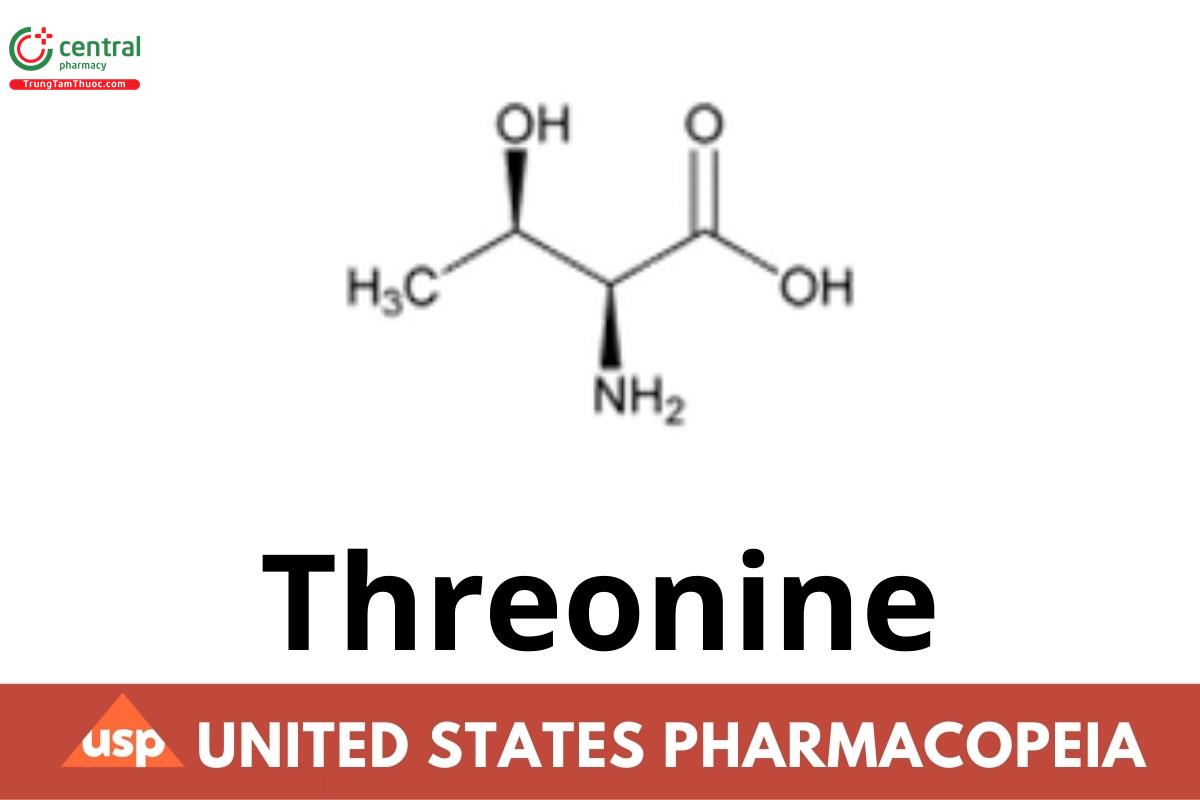

This article is compiled based on the United States Pharmacopeia (USP) – 2025 Edition
Issued and maintained by the United States Pharmacopeial Convention (USP)
1 DEFINITION
Threonine contains NLT 98.5% and NMT 101.5% of L-threonine (C4H9NO3), calculated on the dried basis.
2 IDENTIFICATION
A. SPECTROSCOPIC IDENTIFICATION TESTS 〈197〉 , Infrared Spectroscopy : 197K
3 ASSAY
PROCEDURE
Sample: 110 mg of Threonine
Blank: Mix 3 mL of formic acid and 50 mL of glacial acetic acid.
Titrimetric system (See Titrimetry 〈541〉.)
Mode: Direct titration
Titrant: 0.1 N perchloric acid VS Endpoint detection: Potentiometric
Analysis: Dissolve the Sample in 3 mL of formic acid and 50 mL of glacial acetic acid. Titrate with the Titrant. Perform the Blank determination.
Calculate the percentage of threonine (C4H9NO3) in the Sample taken:
Result = {[(VS − VB) × N × F]/W} × 100
VS = Titrant volume consumed by the Sample (mL)
VB = Titrant volume consumed by the Blank (mL)
N = actual normality of the Titrant (mEq/mL)
F = equivalency factor, 119.1 mg/mEq
W = Sample weight (mg)
Acceptance criteria: 98.5%–101.5% on the dried basis
4 IMPURITIES
RESIDUE ON IGNITION 〈281〉: NMT 0.4%
CHLORIDE AND SULFATE, Chloride〈221〉
Standard solution: 0.50 mL of 0.020 N hydrochloric acid Sample: 0.73 g of Threonine
Acceptance criteria: NMT 0.05%
CHLORIDE AND SULFATE, Sulfate〈221〉
Standard solution: 0.10 mL of 0.020 N sulfuric acid Sample: 0.33 g of Threonine
Acceptance criteria: NMT 0.03% Change to read:
IRON 〈241〉 , Procedures, Procedure 1 (CN 1-J -2023) : NMT 30 ppm
RELATED COMPOUNDS
Diluent: Hydrochloric acid and water (1:99)
System suitability solution: 0.4 mg/mL each of USP L-Threonine RS and USP L-Proline RS in Diluent
Standard solution: 0.05 mg/mL of USP L-Threonine RS in Diluent. [NOTE—This solution has a concentration equivalent to about 0.5% of that of the Sample solution.]
Sample solution: 10 mg/mL Threonine in 2 N hydrochloric acid
Chromatographic system
(See Chromatography 〈621〉, Thin-Layer Chromatography.)
Mode: TLC
Adsorbent: 0.25-mm layer of chromatographic silica gel mixture
Application volume: 5 µL
Developing solvent system: Butyl alcohol, glacial acetic acid, and water (3:1:1)
Spray reagent: 2 mg/mL of ninhydrin in a mixture of butyl alcohol and 2 N acetic acid (95:5)
System suitability
Suitability requirements: The chromatogram of the System suitability solution exhibits two clearly separated spots.
Analysis
Samples: System suitability solution, Standard solution, and Sample solution.
After air-drying the plate, spray with Spray reagent, and heat between 100° and 105° for 15 min. Examine the plate under white light.
Acceptance criteria: Any secondary spot of the Sample solution is not larger or more intense than the principal spot of the Standard solution. Individual impurities: NMT 0.5%
Total impurities: NMT 2.0%
5 SPECIFIC TESTS
OPTICAL ROTATION, Specific Rotation〈781S〉 Sample solution: 60 mg/mL in water Acceptance criteria: −26.7° to −29.1°
PH 〈791〉
Sample solution: 50 mg/mL solution
Acceptance criteria: 5.0–6.5
LOSS ON DRYING 〈731〉: Dry a sample at 105° for 3 h: it loses NMT 0.2% of its weight.
6 ADDITIONAL REQUIREMENTS
PACKAGING AND STORAGE: Preserve in well-closed containers.
USP REFERENCE STANDARDS 〈11〉
USP L-Proline RS USP L-Threonine RS

