
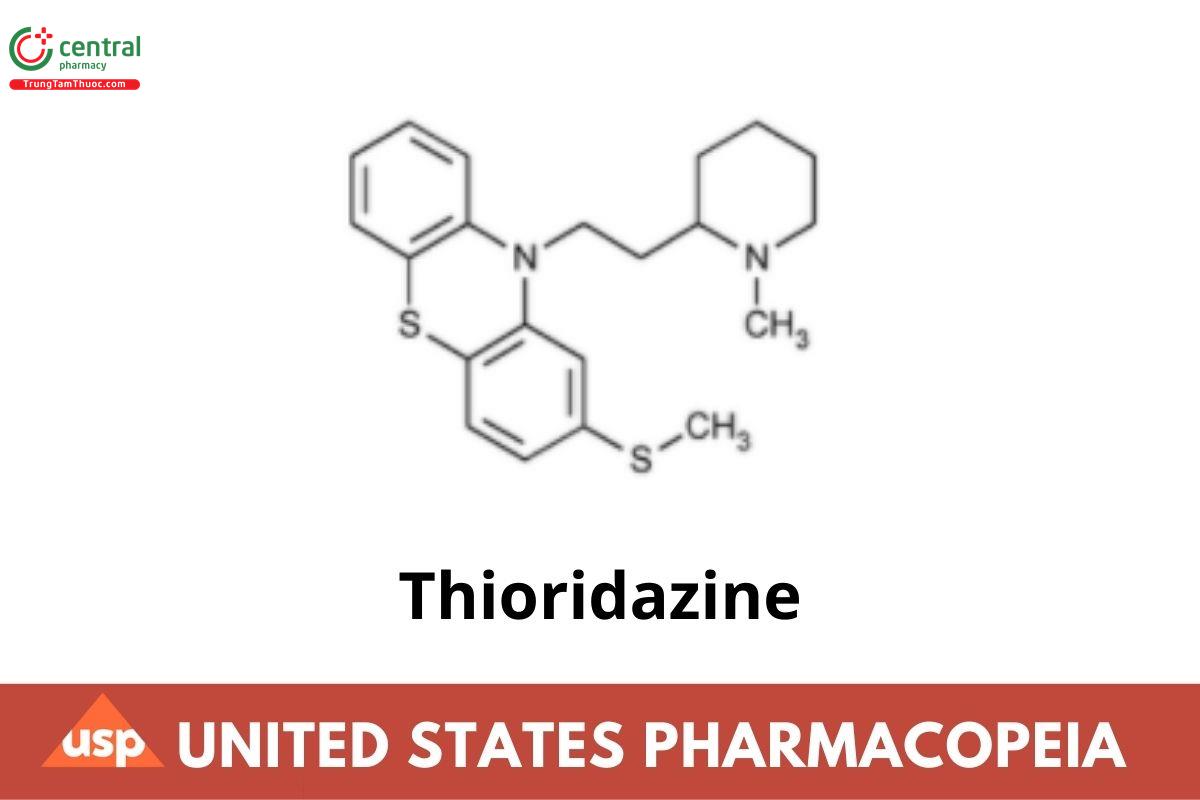
Thioridazine
If you find any inaccurate information, please let us know by providing your feedback here

This article is compiled based on the United States Pharmacopeia (USP) – 2025 Edition
Issued and maintained by the United States Pharmacopeial Convention (USP)
DOWNLOAD PDF HERE
1 DEFINITION
Thioridazine contains NLT 99.0% and NMT 101.0% of C21H26N2S2, calculated on the dried basis.
[Note—Throughout the following procedures, protect samples, the Reference Standard, and the solutions containing them by conducting the procedures without delay, under subdued light, or using low-actinic glassware.]
2 IDENTIFICATION
Change to read:
A. Spectroscopic Identification Tests 〈197〉, Infrared Spectroscopy: 197K (CN 1-May-2020)
3 ASSAY
Procedure
Sample solution: 300 mg of Thioridazine in 60 mL of glacial acetic acid
Analysis: Titrate with 0.1 N perchloric acid VS, determining the endpoint potentiometrically. Perform a blank determination, and make any necessary correction (see Titrimetry 〈541〉). Each mL of 0.1 N perchloric acid is equivalent to 37.06 mg of C H N S .
Acceptance criteria: 99.0%–101.0% on the dried basis
4 IMPURITIES
Residue on Ignition 〈281〉: NMT 0.1%
Organic Impurities
[Note—Conduct this procedure without delay, under subdued light.]
Diluent: Methanol and ammonium hydroxide (49:1)
Standard solution A: 50 μg/mL of USP Thioridazine RS in Diluent
Standard solution B: 20 μg/mL of USP Thioridazine RS in Diluent
Sample solution: 10 mg/mL of Thioridazine in Diluent
Chromatographic system
(See Chromatography 〈621〉, Thin-Layer Chromatography.)
Mode: TLC
Adsorbent: 0.25-mm layer of chromatographic silica gel mixture
Application volume: 5 μL
Developing solvent system: Chloroform, isopropyl alcohol, and ammonium hydroxide (74:25:1)
Analysis
Samples: Standard solution A, Standard solution B, and Sample solution
Immediately develop until the solvent front has moved about three-fourths of the length of the plate. Remove the plate from the chamber, mark the solvent front, allow the solvent to evaporate, and examine the plate under short-wavelength UV light.
Acceptance criteria: The chromatograms show principal spots at about the same R value; no secondary spot, if present from the Sample solution, is more intense than the principal spot from Standard solution A (0.5%); and the sum of the intensities of all secondary spots, if present in the Sample solution, is NMT 0.5%.
5 SPECIFIC TESTS
Loss on Drying 〈731〉: Dry a sample in vacuum at 50° for 4 h: it loses NMT 0.5% of its weight.
6 ADDITIONAL REQUIREMENTS
Packaging and Storage: Preserve in well-closed, light-resistant containers.
USP Reference Standards 〈11〉
USP Thioridazine RS

