
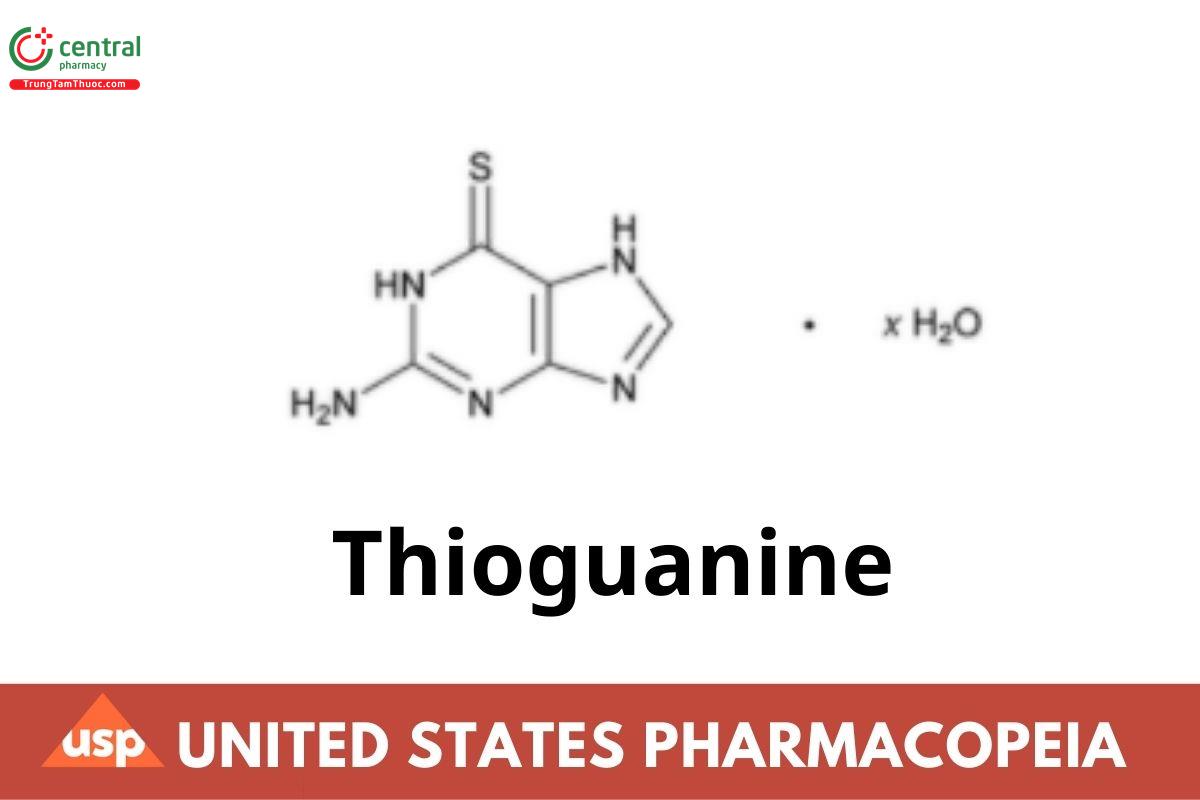
Thioguanine
If you find any inaccurate information, please let us know by providing your feedback here

Tóm tắt nội dung
This article is compiled based on the United States Pharmacopeia (USP) – 2025 Edition
Issued and maintained by the United States Pharmacopeial Convention (USP)
DOWNLOAD PDF HERE
1 DEFINITION
Thioguanine is anhydrous or contains one-half molecule of water of hydration. It contains NLT 96.0% and NMT 100.5% of thioguanine, calculated on the dried basis.
2 IDENTIFICATION
A. Spectroscopic Identification Tests 〈197〉, Infrared Spectroscopy: 197K
B. Spectroscopic Identification Tests 〈197〉, Ultraviolet-Visible Spectroscopy: 197U
Sample solution: Transfer 100 mg of Thioguanine, previously dried, to a 100-mL volumetric flask. Dissolve in a mixture of 15 mL of water and 1.5 mL of 1 N sodium hydroxide, dilute with water to volume, and mix. Transfer 10.0 mL of this solution to a second 100-mL volumetric flask, add 1% hydrochloric acid to volume, and mix. Finally, transfer 5.0 mL of the last solution to a third 100-mL volumetric flask, then add 1% hydrochloric acid to volume, and mix.
Acceptance criteria: The UV absorption spectrum of the Sample solution exhibits maxima and minima at the same wavelengths as that of a similar solution of USP Thioguanine RS.
3 ASSAY
Procedure
Phosphoric acid solution: Add 1 mL of phosphoric acid to 99 mL of water.
Mobile phase: 0.05 M monobasic sodium phosphate. Adjust with phosphoric acid to a pH of 3.0.
Standard stock solution: 0.4 mg/mL of USP Thioguanine RS in 0.01 N sodium hydroxide
Standard solution: 0.04 mg/mL of USP Thioguanine RS in Phosphoric acid solution from Standard stock solution
Sample stock solution: 0.4 mg/mL of Thioguanine in 0.01 N sodium hydroxide
Sample solution: 0.04 mg/mL of Thioguanine in Phosphoric acid solution from Sample stock solution
Chromatographic system
(See Chromatography 〈621〉, System Suitability.)
Mode: LC
Detector: UV 248 nm
Column: 4.6-mm × 5-cm; packing L1
Flow rate: 2.0 mL/min
Injection volume: 10 μL
System suitability
Sample: Standard solution
Suitability requirements
Relative standard deviation: NMT 2.0%
Analysis
Samples: Standard solution and Sample solution
Calculate the percentage of thioguanine in the portion of Thioguanine taken:
Result = (rU/rS) × (CS/CU) × 100
rU = peak response of thioguanine from the Sample solution
rS = peak response of thioguanine from the Standard solution
CS = concentration of USP Thioguanine RS in the Standard solution (mg/mL)
CU = concentration of Thioguanine in the Sample solution (mg/mL)
Acceptance criteria: 96.0%–100.5% on the dried basis
4 OTHER COMPONENTS
Nitrogen Determination 〈461〉, Method II
Sample: 100 mg
Analysis: Each milliliter of 0.1 N sulfuric acid is equivalent to 1.401 mg of nitrogen (N).
Acceptance criteria: 40.2%–43.1% on the dried basis
5 IMPURITIES
Delete the following:
Selenium 〈291〉
Sample: 200 mg
Acceptance criteria: NMT 30 ppm (USP 1-Dec-2021)
Free Sulfur
Sample solution: Dissolve 50 mg of Thioguanine in 5 mL of 1 N sodium hydroxide.
Acceptance criteria: The Sample solution is clear.
Phosphorous-Containing Substances
Solution A: Dissolve 8.3 g of ammonium molybdate in 40 mL of water, add 33 mL of dilute sulfuric acid (2 in 7), and dilute with water to 100.0 mL. [Note—This solution is stable for about 2 weeks.]
Instrumental conditions
Mode: UV-Vis
Cell: 1 cm
Analytical wavelength: 620 nm
Analysis: Transfer 50.0 mg of Thioguanine to a large test tube, add 1 mL of dilute sulfuric acid (2 in 7), and heat in a boiling water bath for 5 min. Cautiously add nitric acid, dropwise, continue heating until the mixture becomes colorless, and then heat for 1 min longer. Cool, dilute with water to about 10 mL, and transfer the solution to a 25-mL volumetric flask with the aid of a few milliliters of water. To the flask add 0.75 mL of Solution A and 1.0 mL of aminonaphtholsulfonic acid TS, dilute with water to volume, and mix.
Acceptance criteria: NMT 0.03% as phosphate; the absorbance is not greater than that produced by 1.5 mL of a similar solution of monobasic potassium phosphate in water having a known concentration of 10 μg/mL of phosphate (PO -3), concomitantly measured.
Change to read:
Organic Impurities
Mobile phase, Sample stock solution, and Chromatographic system: Proceed as directed in the Assay.
Standard stock solution: 0.04 mg/mL of USP Guanine RS in 0.01 N sodium hydroxide
Standard solution: 0.4 μg/mL of USP Guanine RS in Mobile phase from Standard stock solution
Sample solution: 0.04 mg/mL of Thioguanine in Mobile phase from Sample stock solution
System suitability solution: Transfer 1.0 mL of Standard stock solution into a 100-mL volumetric flask, and dilute with the Sample solution to volume.
System suitability
Samples: Standard solution and System suitability solution
[Note—The relative retention times for guanine and thioguanine are about 0.60 and 1.0, respectively.]
Suitability requirements
Resolution: NLT 3.0 between guanine and thioguanine, System suitability solution
Tailing factor: NMT 2.0, Standard solution
Relative standard deviation: NMT 5.0%, Standard solution
Analysis
Samples: Standard solution and Sample solution
Calculate the percentage of guanine in the portion of Thioguanine taken:
Result = (rU/rS) × (CS/CU) × 100
rU = peak response of guanine from the Sample solution
rS = peak response of guanine from the Standard solution
CS = concentration of USP Guanine RS (USP 1-Dec-2021) in the Standard solution (mg/mL)
CU = concentration of Thioguanine in the Sample solution (mg/mL)
Acceptance criteria: NMT 2.5%
6 SPECIFIC TESTS
Loss on Drying 〈731〉
Analysis: Dry under vacuum at 105° for 5 h.
Acceptance criteria: NMT 6.0%
7 ADDITIONAL REQUIREMENTS
Packaging and Storage: Preserve in tight containers.
Labeling: Label it to indicate its state of hydration.
USP Reference Standards 〈11〉
USP Guanine RS
USP Thioguanine RS

