
Terconazole
If you find any inaccurate information, please let us know by providing your feedback here
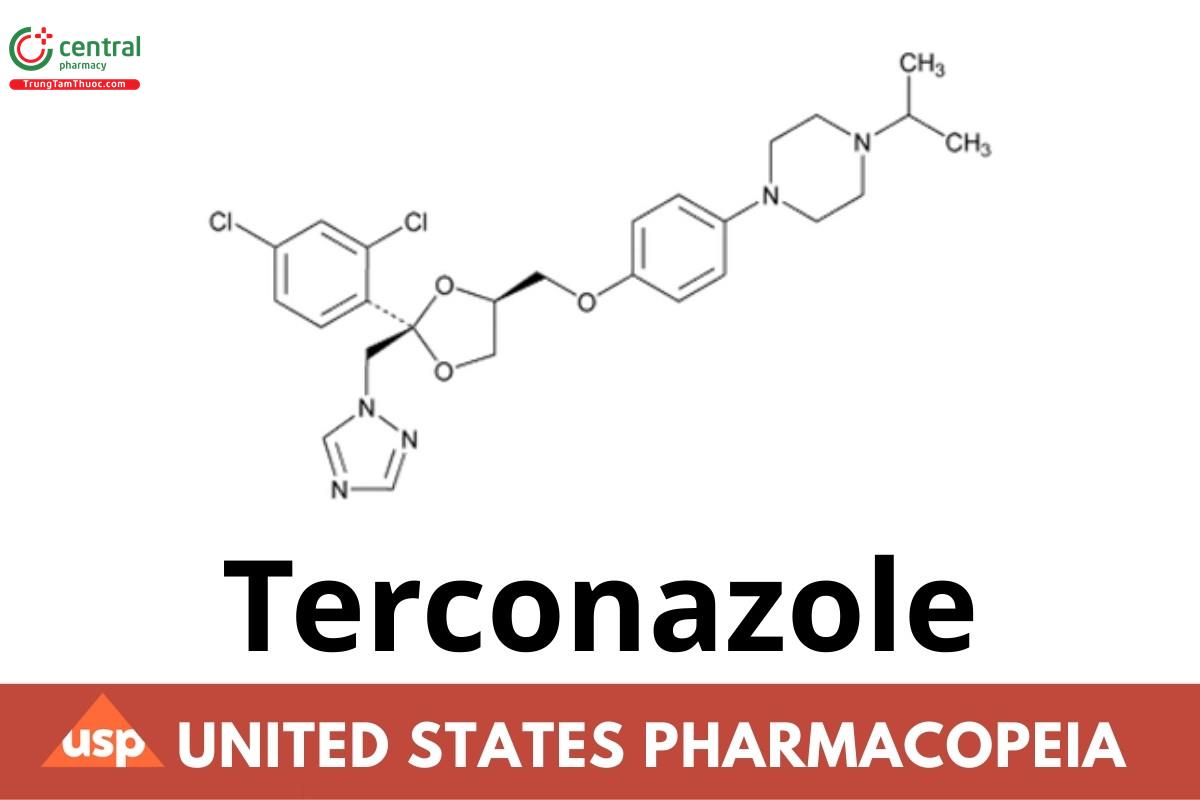

This article is compiled based on the United States Pharmacopeia (USP) – 2025 Edition
Issued and maintained by the United States Pharmacopeial Convention (USP)
Terconazole contains not less than 98.0 percent and not more than 102.0 percent of C26H31Cl2N5O3, calculated on the dried basis.
Packaging and storage—Preserve in light-resistant containers. Store at room temperature.
USP REFERENCE STANDARDS 〈11〉—
USP Terconazole RS
Change to read:
Identification, Spectroscopic Identification Tests 〈197〉, Infrared Spectroscopy : 19 7K. (CN 1-May-2020)
SPECIFIC ROTATION 〈781S〉: between −1° and +1° at 20°.
Test solution: 40 mg per mL solution in methylene chloride.
LOSS ON DRYING 〈731〉—Dry it in a vacuum at 80° for 4 hours: it loses not more than 0.75% of its weight, a 2.0-g specimen being used. RESIDUE ON IGNITION 〈281〉: not more than 0.1%, a 2.0-g specimen being used.
Related compounds—[NOTE—Use the solutions within 24 hours if protected from light and within 1 hour if not protected from light.] Solution A—Prepare and filter a 0.6% ammonium carbonate solution in water.
Solution B: acetonitrile.
Solution C: tetrahydrofuran.
Mobile phase—Use variable mixtures of Solution A, Solution B, and Solution C as directed for Chromatographic system. Make adjustments if necessary (see System Suitability under Chromatography 〈621〉).
Standard solution—Dissolve in and dilute with alcohol an accurately weighed quantity of USP Terconazole RS to obtain a solution having a known concentration of about 0.1 mg per mL.
Test solution—Dissolve in and dilute with alcohol an accurately weighed quantity of Terconazole to obtain a solution having a concentration of about 10 mg per mL.
Chromatographic system (see CHROMATOGRAPHY 〈621〉)—The liquid chromatograph is equipped with a 225-nm detector and a 4.6-mm × 10-cm column that contains 3-µm packing L1. The flow rate is about 2 mL per minute. The chromatograph is programmed as shown in the table below.
| Time (minutes) | Solution A (%) | Solution B (%) | Solution C (%) | Elution |
| 0–15 | 80→55 | 20→25 | 0→20 | linear gradient |
| 15–17 | 55→0 | 25→80 | 20 | linear gradient |
| 17–20 | 0 | 80 | 20 | isocratic |
| 20–21 | 0→80 | 80→20 | 20→0 | step gradient |
| 21–25 | 80 | 20 | 0 | re-equilibration |
Chromatograph the Standard solution, and record the peak responses as directed for Procedure: the tailing factor for terconazole peak is not less than 0.9 and not more than 1.3; and the relative standard deviation for replicate injection is not more than 5.0%.
Procedure—Separately inject equal volumes (about 10 µL) of the Test solution and the Standard solution into the chromatograph, record the chromatograms, and measure the peak responses. Identify the impurities using the relative retention times given in Table 1. Calculate the percentage of each terconazole related compound in the portion of Terconazole taken by the formula:
100(CS/CU)(rU/rS)(1/F)
in which CS and CU are the concentrations, in mg per mL, of terconazole in the Standard solution and the Test solution, respectively; rU is the peak response of each impurity obtained from the Test solution; rS is the peak response of terconazole obtained from the Standard solution; and F is the relative response factor for each impurity relative to terconazole.
Table 1
| Impurity | Approx. RRT | Relative Response Factor (F) | Limit (%) |
| Ba | 0.88 | 0.94 | 0.50 |
| Ab | 0.95 | 0.92 | 0.50 |
| Any unspecified impurity | — | 1.0 | 0.10 |
| Total impurities | — | — | 1.0 |
a 1-[4-[[(2RS,4SR)-2-(2,4-Dichlorophenyl)-2-[(4H-1,2,4-triazol-4-yl]methyl]-1,3-dioxolan-4-yl]methoxy]phenyl]-4-(1-methylethyl)piperazine.
b 1-[4-[[(2RS,4RS)-2-(2,4-Dichlorophenyl)-2-[(1H-1,2,4-triazol-1-yl)methyl]-1,3-dioxolan-4-yl)methoxy]phenyl]-4-(1-methylethyl)piperazine.
The limits in Table 1 are met. Disregard any impurity that is less than 0.10%.
Assay—Dissolve about 135 mg of Terconazole, accurately weighed, in about 70 mL of previously neutralized glacial acetic acid. Titrate with 0.1 N perchloric acid VS, and determine the endpoint potentiometrically (see Titrimetry 〈541〉). Each mL of 0.1 N perchloric acid is equivalent to 17.75 mg of C26H31Cl2N5O3 .

