
Technetium Tc 99m Pentetate Injection
If you find any inaccurate information, please let us know by providing your feedback here
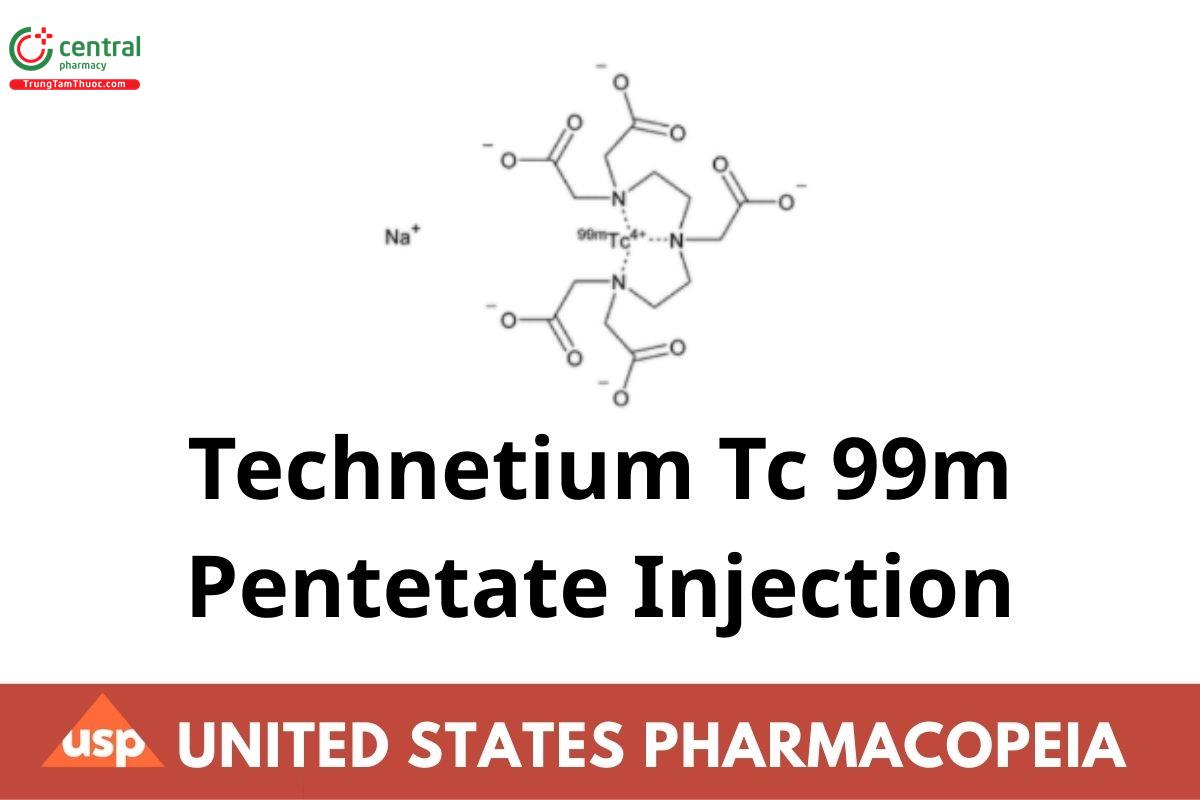

This article is compiled based on the United States Pharmacopeia (USP) – 2025 Edition
Issued and maintained by the United States Pharmacopeial Convention (USP)
DOWNLOAD PDF HERE
1 DEFINITION
Technetium Tc 99m Pentetate Injection is a sterile solution of pentetic acid that is complexed with 99mTc in Sodium Chloride Injection. It is suitable for intravenous administration or inhalation administration (USP 1-Dec-2024) and may contain buffers. It contains NLT 90.0% and NMT 110.0% of the labeled amount of 99mTc as the pentetic acid complex expressed in megabecquerel (microcurie or millicurie) per milliliter at the time indicated in the labeling. Other chemical forms of radioactivity are NMT 10.0% of the total radioactivity.
2 IDENTIFICATION
A. Radionuclidic Identity
(See Radioactivity 〈821〉, Identification of Radionuclides.)
Acceptance criteria: Its gamma-ray spectrum is identical to that of a specimen of 99mTc that exhibits a major photopeak having an energy of 0.140 MeV.
Add the following:
B. Radiochemical Identity
Analysis: Examine the radiochromatograms obtained in Analysis A and Analysis B of the Radiochemical Purity test.
Acceptance criteria: In Analysis A, the chromatogram shows the principal peak is at the solvent front (R 0.9–1.0). In Analysis B, the chromatogram shows the principal peak is at the origin (R 0–0.1). (USP 1-Dec-2024)
3 ASSAY
Radioactive Concentration (Strength)
(See Radioactivity 〈821〉, Assay of Radionuclides.)
Analysis: Using a suitable counting assembly, determine the radioactivity, in megabecquerel (microcurie) per milliliter, of the Injection by use of a calibrated system.
Acceptance criteria: 90.0%–110.0% of the labeled amount of 99mTc at the time indicated in the labeling
4 PURITY
Radionuclidic Purity
(See Radioactivity 〈821〉.)
Analysis: Using a suitable counting assembly, determine the radioactivity of each radionuclidic impurity in kilobecquerel per megabecquerel (microcurie per millicurie) of technetium 99m, in the Injection by use of a calibrated system.
Acceptance criteria
For Injection prepared from technetium 99m derived from parent molybdenum 99 formed as a result of neutron bombardment of stable molybdenum: See Table 1.
For Injection prepared from technetium 99m derived from parent molybdenum 99 formed as a result of uranium fission—gamma- and beta-emitting impurities: See Table 2.
Table 1
| Radionuclidic Impurity | Most Prominent Photopeaks | Half-Life | Acceptance Criteria, NMTa |
| Molybdenum 99 | 0.181 MeV gamma 0.740 MeV gamma 0.780 MeV gamma | 66.0 h | 0.15 kBq/MBq (μCi/mCi) |
Total of all other gamma- emitting radionuclidic impurities | - | - | 0.5 kBq/MBq (μCi/mCi)b |
a Radioactivity of radionuclidic impurity/radioactivity of Tc 99m per administered dose of Injection at the time of administration.
b Does not exceed 92 kBq (2.5 μCi) per administered dose of the Injection at the time of administration.
Table 2
| Radionuclidic Impurity | Most Prominent/Maximum Photopeaks | Half-Life | Acceptance Criteria, NMTa |
| Molybdenum 99 | 0.181 MeV gamma 0.740 MeV gamma 0.780 MeV gamma | 66.0 h | 0.15 kBq/MBq (μCi/mCi) |
| Iodine 131 | 0.364 MeV | 8.08 d | 0.05 kBq/MBq (μCi/mCi) |
| Ruthenium 103 | 0.497 MeV | 39.5 d | 0.05 kBq/MBq (μCi/mCi) |
| Strontium 89b | 1.463 MeV beta | 52.7 d | 0.0006 kBq/MBq (μCi/mCi) |
| Strontium 90b | 0.546 MeV beta | 27.7 y | 0.00006 kBq/MBq (μCi/mCi) |
| Gross alpha impurity | - | - | 0.001 Bq/MBq (nCi/mCi) |
All other beta- and gamma- emitting radionuclidic impurities | - | - | 0.01% |
a Radioactivity of radionuclidic impurity/radioactivity of Tc 99m present at the time of administration.
b Use a counting system appropriate for the detection of particulate radiations.
Change to read:
Radiochemical Purity
The determination of radiochemical purity for this Injection requires the use of two separate chromatographic systems.
Chromatographic system A
(See Chromatography 〈621〉, General Procedures, Thin-Layer Chromatography.)
Mode: TLC
Adsorbent: Glass fiber chromatographic strip impregnated with silica gel (1 cm × 10 cm)
Application volume: A volume of Injection providing a count rate of about 20,000 counts/min
Developing solvent system: Saline TS
Analysis A
Apply one small drop of the radioactive solution (about 20,000 counts/min) to the origin (1.5 cm from one end of the strip) of Adsorbent.
Immediately develop the chromatographic strip in the Developing solvent system. Allow the solvent (about 1 mL in the chamber) front to move to 8 cm from the origin, and allow it to dry. Determine the radioactivity distribution by scanning the Adsorbent with a suitable radioactivity counting instrument. Hydrolyzed Tc 99m is located at the origin (R 0–0.1) and the free Pertechnetate and Technetium Tc99m Pentetate are located at the solvent front (RF 0.85–1.0). After completing the test for Radiochemical Purity, use the TLC strip (radiochromatogram) for the Radiochemical Identity test.
Calculate the percentage of radioactivity at the origin:
ResultA = (rU/rT) × 100
rU = response at the origin of the radiochromatogram
rT = sum of all responses in the radiochromatogram
Chromatographic system B
(See Chromatography 〈621〉, General Procedures, Thin-Layer Chromatography.)
Mode: TLC
Adsorbent: Glass fiber chromatographic strip impregnated with silica gel (1 cm × 10 cm)
Application volume: A volume of Injection providing a count rate of about 20,000 counts/min
Developing solvent system: Acetone
Analysis B
Apply one small drop of the radioactive solution (about 20,000 counts/min) to the origin (1.5 cm from one end of the strip) of Adsorbent, and dry it under a stream of nitrogen. Develop the Adsorbent in the Developing solvent system. Allow the solvent front to move to 8 cm from the origin, and allow it to dry. Determine the radioactivity distribution by scanning the chromatogram with a suitable radioactivity counting instrument. Technetium Tc 99m pentetate and Hydrolyzed Technetium Tc 99m are located at the origin (R 0–0.1) and the free
Pertechnetate (TcO4 -) is located at the solvent front (RF 0.85–1.0). After completing the test for Radiochemical Purity, use the TLC strip for the Radiochemical Identity test.
Calculate the percentage of radioactivity at the solvent front:
ResultB = (rU/rT) × 100
rU = response at the solvent front of the radiochromatogram
rT = sum of all responses in the radiochromatogram
Acceptance criteria: The sum of the percentage of radioactivity at the origin in Analysis A (Result ) and the percentage of radioactivity at the solvent front in Analysis B (Result ) is NMT 10.0%. (USP 1-Dec-2024)
5 SPECIFIC TESTS
Delete the following:
Biological Distribution (USP 1-Dec-2024)
pH 〈791〉: 3.8–7.5
Add the following:
Appearance: Clear, free from visible particulates (USP 1-Dec-2024)
Change to read:
Bacterial Endotoxins Test 〈85〉: Meets the requirements. The Injection may be distributed or dispensed prior to completion of the test. (USP 1-Dec-2024)
Add the following:
Sterility Tests 〈71〉: Meets the requirements. The Injection may be distributed or dispensed prior to completion of the test. (USP 1-Dec-2024)
Delete the following:
Other Requirements (USP 1-Dec-2024)
6 ADDITIONAL REQUIREMENTS
Change to read:
Packaging and Storage: Preserve in single-dose or multiple-dose containers, at 25°; excursions permitted between 15° and 30°. (USP 1-Dec-2024)
Labeling: Label it to include the following, in addition to the information specified for Labeling 〈7〉, Labels and Labeling for Injectable Products: the time and date of calibration; the amount of 99mTc as labeled pentetic acid complex expressed as total megabecquerel (microcurie or millicurie) and concentration as megabecquerel (microcurie or millicurie) per milliliter at the time of calibration; the expiration date; and the statement: [Caution—Radioactive Material]. The labeling indicates that in making dosage calculations, correction is to be made for radioactive decay and also indicates that the radioactive half-life of 99mTc is 6.0 h.

