
Tartaric Acid
If you find any inaccurate information, please let us know by providing your feedback here
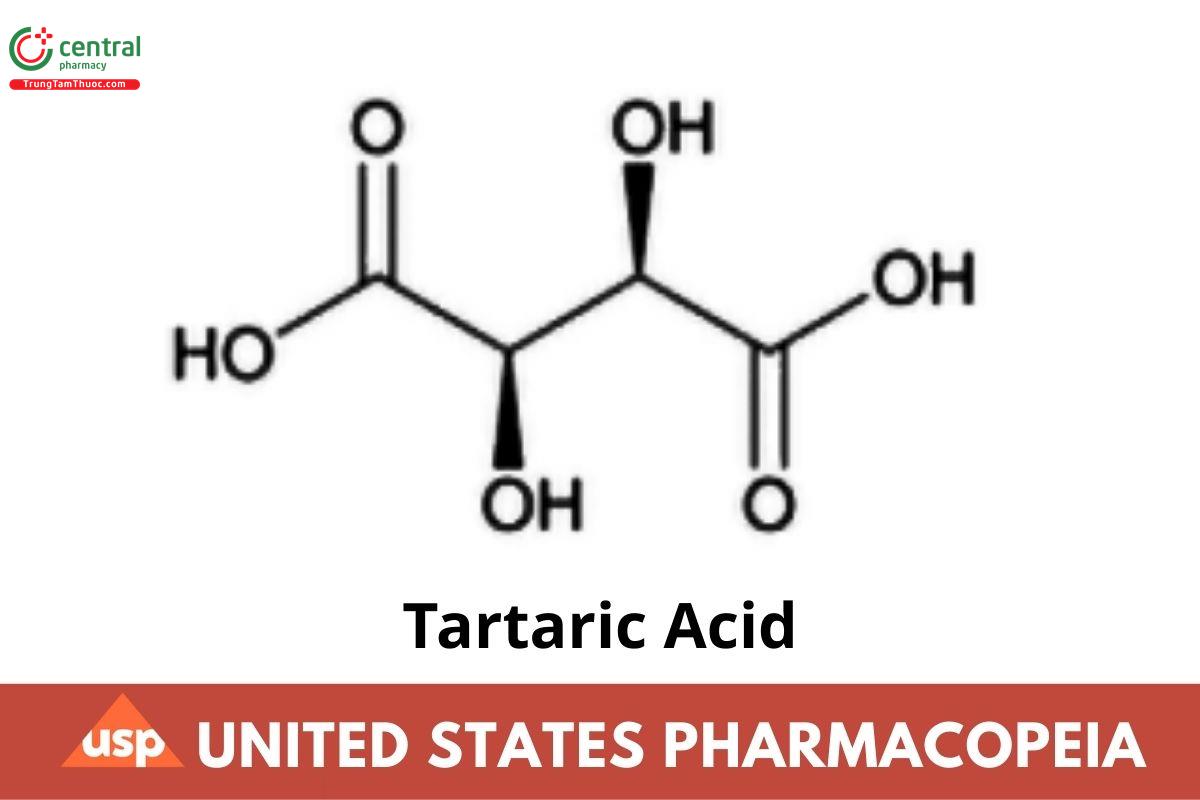

This article is compiled based on the United States Pharmacopeia (USP) – 2025 Edition
Issued and maintained by the United States Pharmacopeial Convention (USP)
C4H6O6 150.09
Butanedioic acid, 2,3-dihydroxy-;
Butanedioic acid, 2,3-dihydroxy-, [R-(R*,R*)]-;
Tartaric acid; l-(+)-Tartaric acid CAS RN®: 526-83-0; .87-69-4.
1 DEFINITION
Tartaric Acid, dried over phosphorus pentoxide for 3 h, contains NLT 99.7% and NMT 100.5% of C4H6O6
2 IDENTIFICATION
A. Identification Tests—General, Tartrate 〈191〉: It meets the requirements.
Change to read:
B. Spectroscopic Identification Tests 〈197〉, Infrared Spectroscopy: 197K (CN 1-May-2020)
3 ASSAY
Procedure
Sample: 2 g of Tartaric Acid, previously dried, in a conical ask
Analysis: Dissolve the Sample in 40 mL of water, add phenolphthalein TS, and titrate with 1 N sodium hydroxide VS. Each mL of 1 N sodium hydroxide is equivalent to 75.04 mg of C4H6O6.
Acceptance criteria: 99.7%–100.5%
4 IMPURITIES
Inorganic Impurities
Residue on Ignition 〈281〉: NMT 0.1%
Chloride and Sulfate, Sulfate 〈221〉
Sample solution: 10 mL of a 1-in-100 solution of Tartaric Acid
Analysis: Add to the Sample solution 3 drops of hydrochloric acid and 1 mL of barium chloride TS.
Acceptance criteria: No turbidity is produced.
5 SPECIFIC TESTS
Optical Rotation, Specific Rotation 〈781S〉: +12.0° to +13.0°
Sample solution: 200 mg/mL in water
Loss on Drying 〈731〉: Dry over phosphorus pentoxide for 3 h: it loses NMT 0.5% of its weight.
Limit of Oxalate
Sample solution: 10 mL of a 1-in-10 solution of Tartaric Acid
Analysis: Nearly neutralize the Sample solution with 6 N ammonium hydroxide, and add 10 mL of calcium sulfate TS.
Acceptance criteria: No turbidity is produced.
6 ADDITIONAL REQUIREMENTS
Packaging and Storage: Preserve in well-closed containers.
USP Reference Standards 〈11〉
USP Tartaric Acid RS

