
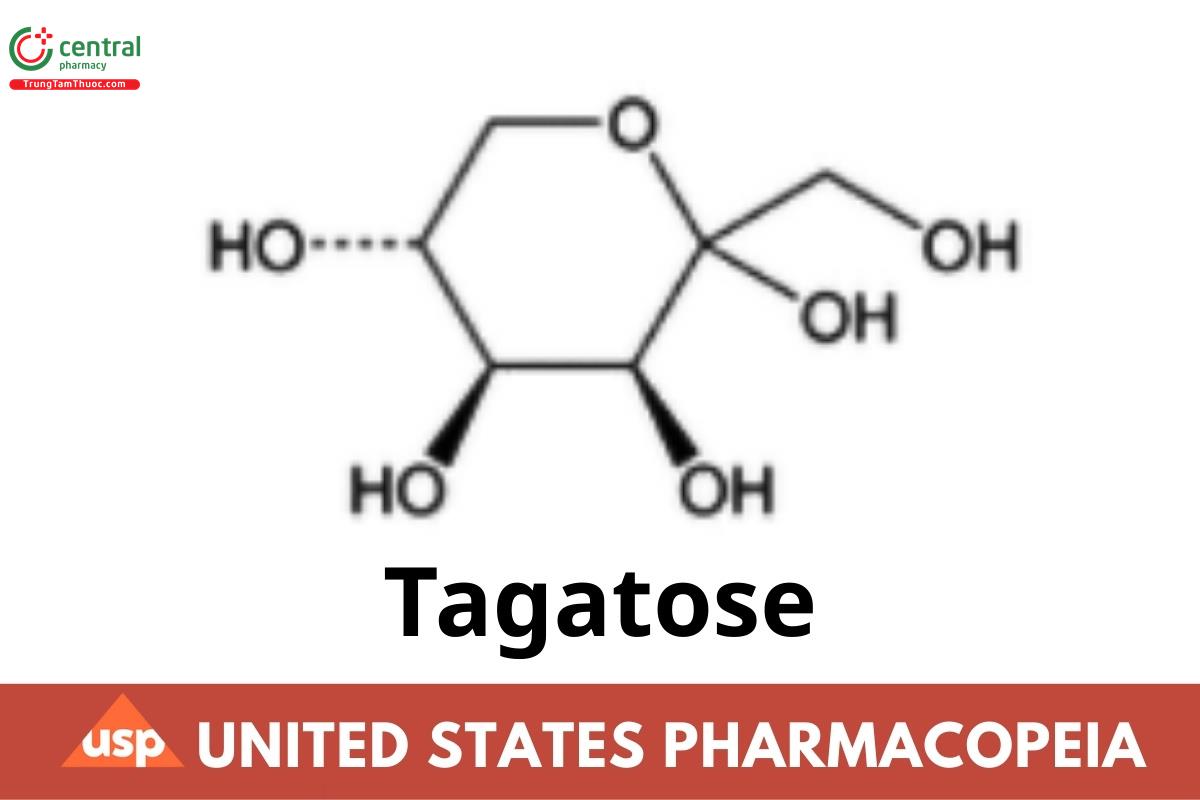
Tagatose
If you find any inaccurate information, please let us know by providing your feedback here

Tóm tắt nội dung
This article is compiled based on the United States Pharmacopeia (USP) – 2025 Edition
Issued and maintained by the United States Pharmacopeial Convention (USP)
C₆H₁₂O₆ 180.16
d-Tagatose;
d-lyxo-Hexulose CAS RN®: 87-81-0.
1 DEFINITION
Tagatose is a ketohexose, an epimer of d-fructose inverted at C-4. It is obtained from d-galactose by isomerization under alkaline conditions in the presence of calcium. It contains NLT 98.0% of tagatose (C₆H₁₂O₆), calculated on the dried basis.
2 IDENTIFICATION
A. The retention time of the major peak of the Sample solution corresponds to that of the Standard solution, as obtained in the Assay.
B. It meets the requirements of the test for Optical Rotation 〈781〉, Specific Rotation.
C.
Sample solution: 200 mg/mL of Tagatose
Analysis: Add 3 mL of the Sample solution to 5 mL of hot alkaline cupric tartrate TS.
Acceptance criteria: A copious red precipitate of cuprous oxide is formed.
3 ASSAY
3.1 Procedure
Mobile phase: 0.05 mg/mL of calcium acetate
Standard solution: 5 mg/mL of USP Tagatose RS. Pass through a filter of 0.2-µm pore size.
Sample solution: 5 mg/mL of Tagatose, previously dried. Pass through a filter of 0.2-µm pore size.
Chromatographic system
(See Chromatography 〈621〉, System Suitability.)
Mode: LC
Detector: Refractive index
Column: 7.8-mm × 30-cm; 9-µm packing L19
Column temperature: 85°
Flow rate: 0.6 mL/min
Injection size: 20 µL
System suitability
Sample: Standard solution
Suitability requirements
Relative standard deviation: NMT 2.0% of replicate injections
Analysis
Samples: Standard solution and Sample solution
Calculate the percentage of tagatose (C₆H₁₂O₆) in the portion of Tagatose taken:
Result = (rᵤ / rₛ) × (Cₛ / Cᵤ) × 100
rᵤ = peak response from the Sample solution
rₛ = peak response from the Standard solution
Cₛ = concentration of USP Tagatose RS in the Standard solution (mg/mL)
Cᵤ = concentration of Tagatose in the Sample solution (mg/mL)
Acceptance criteria: NLT 98.0% on the dried basis
4 IMPURITIES
4.1 Limit of Lead
Sample solution: 2.5 g of Tagatose dissolved in a mixture of 4 mL of sulfuric acid and 5 mL of hydrochloric acid. Dilute with water to 50 mL.
Standard stock solution A: Dissolve 1.60 g of lead nitrate in diluted nitric acid (10 mL of nitric acid diluted with 20 mL water, boiled to remove nitrous fumes, and cooled), and dilute with water to 1000 mL.
Standard stock solution B: Standard stock solution A and water (1:50).
[Note—This solution contains the equivalent of 20 µg/mL of lead.]
Standard solutions: To a series of 100-mL volumetric flasks pipet 0, 1, 2, 3, 4, and 5 mL of Standard stock solution B, and dilute with water to about 50 mL. Add 8 mL of sulfuric acid and 10 mL of hydrochloric acid to each flask, shake to dissolve, and dilute with water to volume.
[Note—These solutions contain 0, 0.2, 0.4, 0.6, 0.8, and 1.0 µg/mL of lead, respectively.]
Instrumental conditions
(See Atomic Absorption Spectroscopy 〈852〉.)
Mode: Atomic absorption
Analytical wavelength: 283.3 nm
Analysis
Samples: Standard solutions and Sample solution
Concomitantly determine the absorbances of the Standard solutions and the Sample solution. Plot the absorbances of the Standard solutions versus the concentration of lead. Using this graph, determine the concentration of lead in the Sample solution.
Acceptance criteria: NMT 1 ppm
5 SPECIFIC TESTS
Microbial Enumeration Tests 〈61〉 and Tests for Specified Microorganisms 〈62〉: It meets the requirements of the tests for absence of Salmonella species and Escherichia coli. The total aerobic microbial count does not exceed 1000 cfu/g, and the total combined molds and yeasts count does not exceed 100 cfu/g.
Melting Range or Temperature, Class I 〈741〉: 133°–144°
Optical Rotation, Specific Rotation 〈781〉: −4° to −7°
Sample solution: 10 mg/mL
Loss on Drying 〈731〉: Dry a sample at 102° for 2 h: it loses NMT 0.5% of its weight
Articles of Botanical Origin, Total Ash 〈561〉: NMT 0.1%, determined on a 1.0-g specimen
6 ADDITIONAL REQUIREMENTS
Packaging and Storage: Preserve in well-closed containers, and store at room temperature.
USP Reference Standards 〈11〉
USP Tagatose RS

