
TABLET FRIABILITY
If you find any inaccurate information, please let us know by providing your feedback here


This article is compiled based on the United States Pharmacopeia (USP) – 2025 Edition
Issued and maintained by the United States Pharmacopeial Convention (USP)
DOWNLOAD PDF HERE
Change to read:
This general information chapter has been harmonized with the corresponding texts of the European Pharmacopoeia and the Japanese Pharmacopoeia. The harmonized texts of these three pharmacopeias are therefore interchangeable, and the methods of the European Pharmacopoeia and/or the Japanese Pharmacopoeia may be used for demonstration of compliance instead of the present United States Pharmacopeia general information chapter method. These pharmacopeias have undertaken not to make any unilateral change to this harmonized chapter.
Portions of the chapter text that are national USP text, and are not part of the harmonized text, are marked with symbols to specify this fact. There are no local requirements or non-harmonized attributes in this chapter currently. (USP 1-Aug-2023)
Change to read:
1 PURPOSE (USP 1-AUG-2023)
This chapter provides guidelines for the friability determination of compressed, uncoated tablets. The test procedure presented in this chapter is generally applicable to most compressed tablets. The measurement of tablet friability supplements other physical strength tests, (USP 1-Aug-2023) such as tablet breaking force.
Change to read:
2 APPARATUS (USP 1-Aug-2023)
Use a drum with an internal diameter between 283.0 and 291.0(USP 1-Aug-2023) mm and a depth between 36.0 and 40.0(USP 1-Aug-2023) mm, of transparent synthetic polymer with polished internal surfaces, and subject to minimum static build-up (see Figure 1 for a typical apparatus). One side of the drum is removable. The tablets are tumbled at each turn of the drum by a curved projection with an inside radius between 75.5 and 85.5 mm that extends from the middle of the drum to the outer wall. The outer diameter of the central ring is between 24.5 and 25.5 mm. The drum is attached to the horizontal axis of a device that rotates from 24 to 26(USP 1-Aug-2023) rpm. Thus, at each turn the tablets roll or slide and fall onto the drum wall or onto each other.
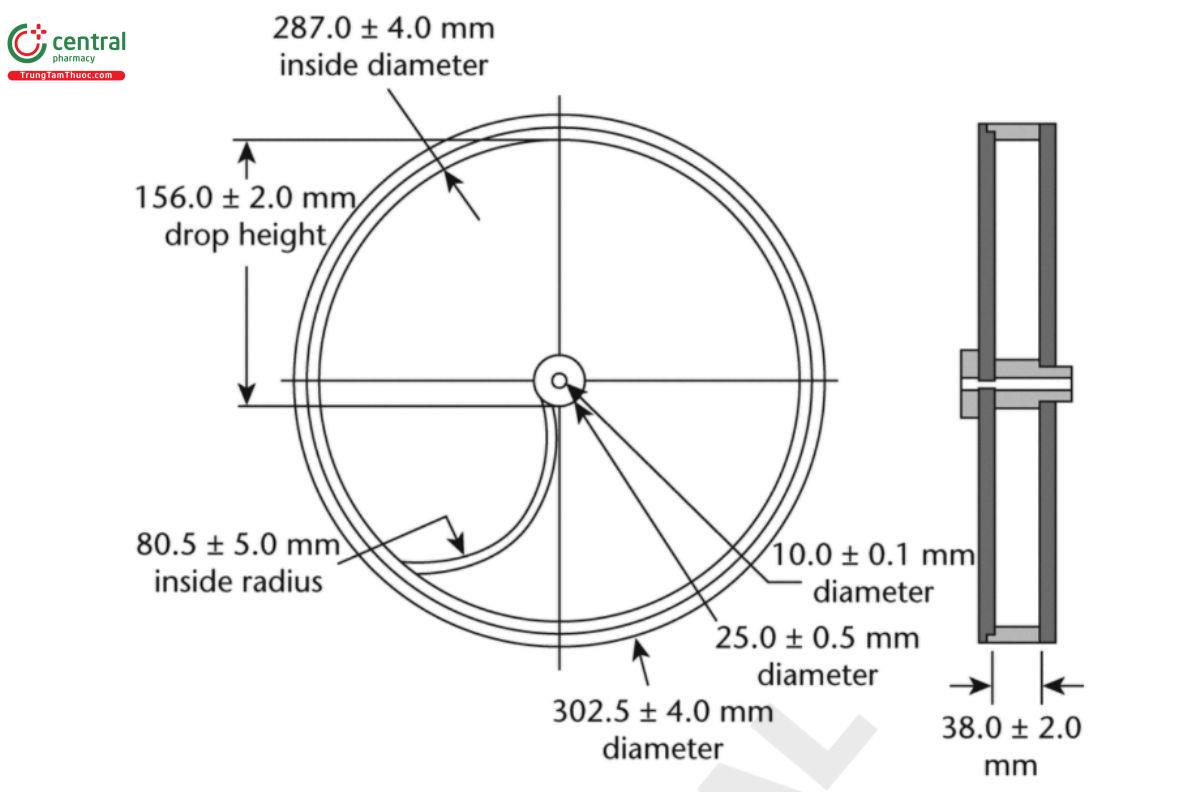
Change to read:
3 PROCEDURE (USP 1-Aug-2023)
For tablets with a unit weight equal to or less than 650 mg, take a sample of whole tablets corresponding as near as possible to 6.5 g. For tablets with a unit weight of more than 650 mg, take a sample of 10 whole tablets. The tablets should be carefully dedusted prior to testing.
Accurately weigh the tablet sample, and place the tablets in the drum. Rotate the drum 100 times using a speed from 24 to 26 rpm, (USP 1-Aug-2023) and remove the tablets. Remove any loose dust from the tablets as before, and accurately weigh.
Generally, the test is run once. If obviously cracked, cleaved, or broken tablets are present in the tablet sample after tumbling, the sample fails the test. If the results are difficult to interpret or if the weight loss is greater than the target value, the test should be repeated twice and the mean of the three tests determined. A (USP 1-Aug-2023) weight loss from a single test or the mean of three tests (USP 1-Aug-2023) of not more than 1.0% is considered acceptable for most products. Typically, in the case of effervescent and chewable tablets, the friability specification may be different.(USP 1-Aug-2023)
If tablet size or shape causes irregular tumbling, adjust the drum base so that the base forms an angle of about 10° with the horizontal and the tablets no longer bind together when lying next to each other, which prevents them from falling freely.
In the case of hygroscopic tablets, an appropriate humidity-controlled environment is required during(USP 1-Aug-2023) testing. Drums with dual scooping projections, or an apparatus with more than one drum, designed to test(USP 1-Aug-2023) multiple samples at the same (USP 1-Aug-2023) time, are also permitted.

