
Sutures - Diameter
If you find any inaccurate information, please let us know by providing your feedback here


Tóm tắt nội dung
This article is compiled based on the United States Pharmacopeia (USP) – 2025 Edition
Issued and maintained by the United States Pharmacopeial Convention (USP)
DOWNLOAD PDF HERE
1 CONTACT METHODS
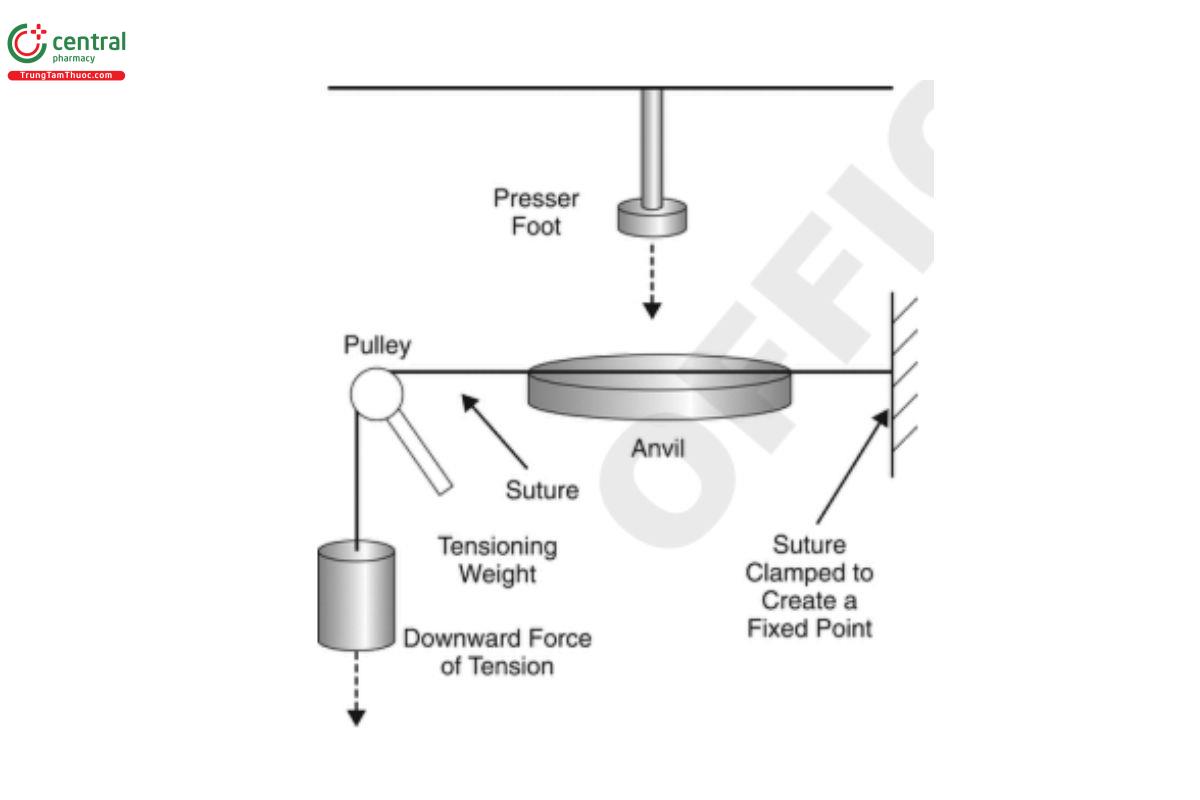
The gauge for determining suture diameter shall be mechanical or electrical, equipped with a direct-reading dial, a digital readout, or a printed readout. The gauge shall have a minimum accuracy of 0.002 mm, an anvil 50 ± 5 mm in diameter, and a flat contact point (presser foot) 12.70 ± 0.02 mm in diameter. The flat contact point and anvil surfaces shall be plane to within 0.005 mm and parallel to each other to within 0.005 mm. For suture sizes 7-0 and larger, the presser foot and moving parts attached to it shall apply a force of 210 ± 3 g to the specimen. For sutures of size 8-0 and smaller, the presser foot and moving parts attached to it shall apply a force of 60 ± 3 g to the specimen.
Measure sutures, whether packaged in dry or fluid form, immediately after removal from the container and without prior drying or conditioning. Do not stretch the suture before measuring.
2 MONOFILAMENT SUTURES (ABSORBABLE AND NONABSORBABLE)
For monofilament sutures, lay the strand across the center of the anvil (see Figure 1). Apply tension to the suture NMT required to straighten the suture. Measure the diameter of the suture by slowly lowering the presser foot to avoid crushing the suture. Measure the suture diameter at 3 locations corresponding to approximately one-fourth, one-half, and three-fourths of its labeled length. Each location is considered an individual measurement.
Repeat the test on a total of 10 suture strands. Compare each individual measurement to the individual specifications in the appropriate monograph. Compare the average of the 30 individual measurements to the average specification in the appropriate monograph.
3 MULTIFILAMENT SUTURES (ABSORBABLE AND NONABSORBABLE)
3.1 Diameter Measurement Strategy
Refer to Table 1 for the diameter measurement strategy for various suture lengths.
Table 1. Diameter Measurement Strategy
| Condition | Suture Length as Noted on Package (inches) | Number of Data Points / Strand | Number of Suture Strands | Sample Type |
|---|---|---|---|---|
| 1 | < 4 | 1 | 30 | Use a noncontact method |
| 2 | 4 to ≤12 | 1 | 30 | Strand |
| 3 | >12 to ≤48 | 3 | 10 | Strand |
| 4 | >48 | 3 | 10 | Random subsection |
For Condition 1, where the suture length is less than 4 inches during diameter testing, use a noncontact method. For Condition 2, measure the suture diameter at a single location on 30 strands for a total of 30 individual diameter measurements. For Condition 3, measure the suture diameter at 3 locations corresponding to approximately one-fourth, one-half, and three-fourths of the labeled length. Measure 10 strands for a total of 30 individual diameter measurements. For Condition 4, measure the suture diameter at 3 locations corresponding to approximately one-fourth, one-half, and three-fourths on a random subsection NLT 48 inches in length from the total suture product. Measure 10 strands for a total of 30 individual diameter measurements.
3.2 Preparation
Mount the suture on a tensioning board by clamping one end of the suture so that the strand lies across the center of the anvil in the same plane as the surface of the anvil and routing the free end of the suture to be tensioned, such as by passing the suture around a cylinder or a pulley and attaching a weight to the free end, ensuring the strand does not twist or untwist. Apply a load of about one-half of the knotted tensile strength for the nonsterilized Class I suture as given in Table 2. Class III sutures do not require tension.
3.3 Measurement
Measure the diameter of the suture by slowly lowering the presser foot to avoid crushing the suture. Measure the suture diameter as specified in Diameter Measurement Strategy. For suture sizes 2-0 and larger: Take 2 measurements at right angles to each other at each location. Average the 2 measurements taken at each location and record as the observed diameter at that location for comparison to the individual specifications. For suture sizes 3-0 and smaller, take a single measurement at each location for comparison to the individual specifications. Each location is considered an individual measurement. The average diameter of the samples are within the limits on average diameter (for all 30 measurements) per the monograph for the size stated on the label. None of the observed individual measurements should be less than or greater than the limits on individual diameter in the monograph. None of the individual observed measurements should be less or greater than the tolerances in the monograph.
3.4 Data Analysis
Compare each individual measurement to the individual specifications in the appropriate monograph. Compare the average of the 30 individual measurements to the average specification in the appropriate monograph.
4 NONCONTACT METHODS
The laser micrometer (optical micrometer) for determining suture diameter shall be equipped with a digital or printed readout. The laser micrometer shall have a minimum accuracy of 0.002 mm, and be capable of dual axis measurements. The test method should be correlated with the contact method and the appropriate specifications should be established based on the correlation.
Place the suture without any preconditioning into the path of the laser beam, ensuring the suture is appropriately aligned. For a monofllament suture, hold the suture with minimal applied tension. For a multifilament suture, apply a tensile load of about one-half of the knotted tensile strength (see Tensile Strength 〈881〉) for the nonsterilized Class I suture of the given size. Measure each suture at 3 points corresponding roughly to one-fourth, one-half, and three-fourths of its length.
5 TENSIONS
Tensions for both contact and noncontact methods are calculated to represent approximately one-half of the knot-pull limit for nonsterile Class I sutures of the designated size in Table 2.
Table 2. Tensioning Weights (in grams) for Measuring Multifilament Strand Diameters
| Size | Nonabsorbable | Absorbable |
|---|---|---|
| 12-0 | 0.6 | N/A |
| 11-0 | 3.8 | N/A |
| 10-0 | 12 | 12 |
| 9-0 | 27 | 25 |
| 8-0 | 38 | 35 |
| 7-0 | 69 | 70 |
| 6-0 | 125 | 125 |
| 5-0 | 250 | 340 |
| 4-0 | 375 | 475 |
| 3-0 | 600 | 887 |
| 2-0 | 899 | 1341 |
| 0 | 1351 | 1948 |
| 1 | 1702 | 2539 |
| 2 | 2199 | 3176 |
| 3 and 4 | 3046 | 3645 |
| 5 | 3849 | N/A |
| 6 | 4550 | N/A |
| 7 | 5647 | N/A (USP 1-Dec-2019) |

