
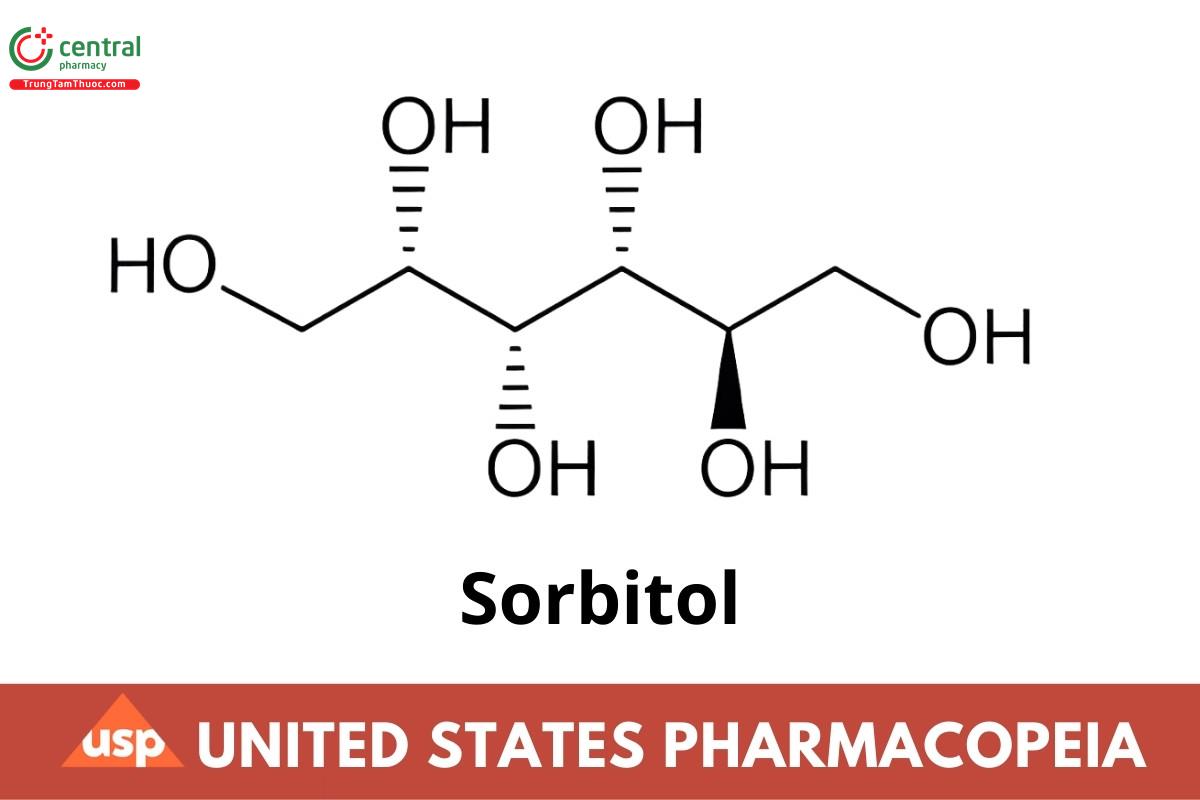
Sorbitol
If you find any inaccurate information, please let us know by providing your feedback here

This article is compiled based on the United States Pharmacopeia (USP) – 2025 Edition
Issued and maintained by the United States Pharmacopeial Convention (USP)
C6H14O6 182.17
D-Glucitol CAS RN®: 50-70-4.
1 DEFINITION
Sorbitol contains NLT 91.0% and NMT 100.5% of D-sorbitol (C6H14O6), calculated on the anhydrous basis. The amounts of total sugars, other polyhydric alcohols, and any hexitol anhydrides, if detected, are not included in the requirements, nor in the calculated amount as stated in General Notices, 5.60.10 Other Impurities in USP and NF Articles.
2 IDENTIFICATION
A.
Sample solution: 1 g of Sorbitol in 75 mL of water
Analysis: Transfer 3 mL of Sample solution to a 15-cm test tube and add 3 mL of a freshly prepared solution of catechol (1 in 10), and mix. Add 6 mL of sulfuric acid, and then gently heat the tube in a flame for 30 s.
Acceptance criteria: A deep pink or wine-red color appears.
B. The retention time of the major peak of the Sample solution corresponds to that from the Standard solution, as obtained in the Assay.
3 ASSAY
3.1 PROCEDURE
Mobile phase: Use degassed water.
System suitability solution: Prepare a solution containing 4.8 mg/g each of USP Sorbitol RS and mannitol.
Standard solution: 4.8 mg/g of USP Sorbitol RS
Sample solution: Dissolve 0.10 g of Sorbitol in water and dilute with water to 20 g. Record the final solution weight, and mix thoroughly.
3.2 Chromatographic system
(See Chromatography (621), System Suitability.)
Mode: LC
Detector: Refractive index
Column: 7.8-mm x 10-cm; packing L34
Temperatures
Column: 50 ± 2°
Detector: 35°
Flow rate: 0.7 mL/min
Injection volume: 10 µL
3.3 System suitability
Samples: System suitability solution and Standard solution
[NOTE-The relative retention times for mannitol and sorbitol are about 0.6 and 1.0, respectively.]
Suitability requirements
Resolution: NLT 2.0 between sorbitol and mannitol, System suitability solution
Relative standard deviation: NMT 2.0%, Standard solution
3.4 Analysis
Samples: Standard solution and Sample solution
Calculate the percentage of D-sorbitol (C6H14O6) in the portion of Sorbitol taken:
Result = (rU/rS) x (CS/CU) x [100/(100-W)] x 100
rU = peak response of sorbitol from the Sample solution
rS = peak response of sorbitol from the Standard solution
CS = concentration of USP Sorbitol RS in the Standard solution (mg/g)
CU = concentration of Sorbitol in the Sample solution (mg/g)
W = percentage obtained in the test for Water Determination (%)
Acceptance criteria: 91.0%-100.5% on the anhydrous basis
4 IMPURITIES
Change to read:
4.1 LIMIT OF NICKEL
[NOTE-When water is specified as the diluent, use deionized ultra-filtered water. Use of glass volumetric flasks is discouraged.]
Digest solution: Add 360 mL of hydrochloric acid, ultratrace, and 240 mL of nitric acid, ultratrace, to 1200 mL of water.
Blank solution: Add 40 mL of nitric acid, ultratrace, to a 2000-mL volumetric flask, dilute with water to volume, and mix well.
Internal standard solution: Transfer 2.0 mL of solution containing 1000 mg/L of yttrium1 to a 1000-mL volumetric flask, dilute with Blank solution to volume, and mix well. The Internal standard solution contains 2 µg/mL of yttrium. [NOTE-The concentration of the Internal standard solution can be adjusted if a high number of signal counts from the Internal standard solution causes an artifact.]
Standard stock solution: [NOTE-Prepare this solution fresh every 2 months.] Quantitatively dilute an accurately measured volume of the solution containing 1000 mg/L of nickel2 with Blank solution to obtain a solution containing 10 µg/mL of nickel.
Standard nickel solution A: [NOTE-Prepare this solution fresh weekly.] Pipet 1.0 mL of Standard stock solution into a 200-mL volumetric flask. Dilute the content in the flask with Blank solution to volume, and mix well. This solution contains 50 ng/mL of nickel.
Standard nickel solution B: [NOTE-Prepare this solution fresh weekly.] Pipet 2.0 mL of Standard stock solution into a 200-mL volumetric flask. Dilute the content in the flask with Blank solution to volume, and mix well. This solution contains 100 ng/mL of nickel.
Standard nickel solution C: [NOTE-Prepare this solution fresh weekly.] Pipet 4.0 mL of Standard stock solution into a 200-mL volumetric flask. Dilute the content in the flask with Blank solution to volume, and mix well. This solution contains 200 ng/mL of nickel.
Sample solution: Transfer 10.0 g of Sorbitol into a 125-mL conical flask. Add 40 mL of Digest solution, and place on a hot plate. Heat the solution for about 20 min, being careful to prevent the solution from boiling over. Pull the sample off the hot plate just before it turns a dark caramel color. [NOTE-Do not overburn the sample.] Transfer the flask's contents into a clean, dry, 50-mL volumetric flask with washings of Blank solution. Dilute with Blank solution to volume. Filter the sample into a 15-mL centrifuge tube, using a 10-mL disposable syringe fitted with a syringe filter of 0.45-µm pore size.
Instrumental conditions
(See Plasma Spectrochemistry (730).)
Mode: ICP-OES
Emission wavelengths: 232.005 nm for nickel and 371.029 nm for yttrium. Set the sample read time and other instrument parameters as appropriate or as recommended by the instrument manufacturer.
System suitability
Samples: Blank solution, Standard nickel solution A, Standard nickel solution B, and Standard nickel solution C
Suitability requirements
[NOTE-Instrument performance must be verified to conform to the manufacturer's specifications for resolution and sensitivity. Before analyzing samples, the instrument must pass a suitable performance check.]
Correlation coefficient: NLT 0.999, determined from the Calibration curve constructed in the Analysis
Analysis
Samples: Blank solution, Standard nickel solution A, Standard nickel solution B, Standard nickel solution C, and Sample solution
[NOTE-The following analysis is described for one type of ICP-OES instruments. If a different ICP-OES instrument is used, follow the instrument manufacturer's recommendations for operation.]
Take 3 replicate scans with the integration set as recommended by the instrument manufacturer. Follow the instrument manufacturer's recommendations for delivering the sample. Add the Internal standard solution in-line via a mixing block between the sample probe and the spray chamber. Flush the samples through the system before analysis. Program a read delay into the sampling routine to allow for fluid flow equilibration after the high-speed flush, before the first analytical read of the sample. Between samples, wash the pumping system by flushing the Blank solution.
Calibration curve: Generate the calibration curve using the Blank solution, Standard nickel solution A, Standard nickel solution B, and Standard nickel solution C as follows. Scan the Internal standard solution while running the Blank solution to measure the intensity of the yttrium emission. Hold this value constant throughout the remainder of the test. Separately scan the Blank solution, Standard nickel solution A, Standard nickel solution B, and Standard nickel solution C for nickel and yttrium. [NOTE-Add the Internal standard solution via an in-line mixing chamber.] Normalize the yttrium intensity to the value of the Internal standard solution. Apply this normalization factor to the nickel intensity, which is then referred to as the corrected nickel intensity. Construct a calibration curve by plotting the corrected nickel intensity versus the known concentrations, in ng/mL, of the nickel.
Similarly, analyze the Sample solution. Plot the intensity of the emission of the Sample solution on the calibration curve. Determine the concentration of nickel (C), in ng/mL, in the Sample solution through the calibration curve.
Calculate the content, in µg/g, of nickel in the portion of Sorbitol taken:
Result = (F x V x C)/W
F = conversion factor, 10-3 µg/ng (ng to µg)
V = volume of the Sample solution, 50 mL
C = concentration of nickel in the Sample solution (ng/mL)
W weight of Sorbitol (g)
Acceptance criteria: NMT 1 µg/g (NF 1-May-2021)
4.2 RESIDUE ON IGNITION (281)
NMT 0.1%, determined on a 1.5-g portion
4.3 REDUCING SUGARS
[NOTE-The amount determined in this test is not included in the calculated amount as required in General Notices, 5.60.10 Other Impurities in USP and NF Articles.]
Sample solution: Dissolve 3.3 g of Sorbitol in 3 mL of water with the aid of gentle heat. Cool and add 20.0 mL of cupric citrate TS and a few glass beads. Heat so that boiling begins after 4 min, and maintain boiling for 3 min. Cool rapidly and add 40 mL of diluted acetic acid, 60 mL of water, and 20.0 mL of 0.05 N iodine VS. With continuous shaking, add 25 mL of a mixture of 6 mL of hydrochloric acid and 94 mL of water.
Analysis: When the precipitate has dissolved, titrate the excess of iodine with 0.05 N sodium thiosulfate VS using 2 mL of starch TS, added toward the end of the titration, as an indicator.
Acceptance criteria: NLT 12.8 mL of 0.05 N sodium thiosulfate VS is required, corresponding to NMT 0.3% of reducing sugars, as Glucose.
4.4 CHLORIDE AND SULFATE (221), Chloride (if labeled for use in preparing parenteral dosage forms)
Sample: 1.5 g
Acceptance criteria: The Sample shows no more chloride than corresponds to 0.10 mL of 0.020 N hydrochloric acid (NMT 0.0050%).
4.5 CHLORIDE AND SULFATE (221), Sulfate (if labeled for use in preparing parenteral dosage forms)
Sample: 1.0 g
Acceptance criteria: The Sample shows no more sulfate than corresponds to 0.10 mL of 0.020 N sulfuric acid (NMT 0.01%).
5 SPECIFIC TESTS
5.1 MICROBIAL ENUMERATION TESTS (61) and TESTS FOR SPECIFIED MICROORGANISMS (62)
The total aerobic count using the Plate Method is NMT 103 cfu/g, and the total combined molds and yeasts count is NMT 102 cfu/g.
5.2 pH (791)
3.5-7.0, in a 10% (w/w) solution in carbon dioxide-free water
5.3 WATER DETERMINATION (921), Method I
NMT 1.5%
5.4 CLARITY AND COLOR OF SOLUTION (if labeled for use in preparing parenteral dosage forms)
Sample: 10.0 g
Analysis: Dissolve the Sample in 100.0 mL of carbon dioxide-free water.
Acceptance criteria: The solution is clear and colorless.
5.5 BACTERIAL ENDOTOXINS TEST (85)
(if labeled for use in preparing parenteral dosage forms): NMT 4 USP Endotoxin Units/g for parenteral dosage forms having a concentration of less than 100 g/L of sorbitol, and NMT 2.5 USP Endotoxin Units/g for parenteral dosage forms having a concentration of 100 g/L or more of sorbitol
6 ADDITIONAL REQUIREMENTS
6.1 PACKAGING AND STORAGE
Preserve in well-closed containers. No storage requirements are specified.
6.2 LABELING
Sorbitol intended for use in preparing parenteral dosage forms is so labeled.
6.3 USP REFERENCE STANDARDS (11)
USP Sorbitol RS
1 Yttrium ICP standard solutions are commercially available. A suitable yttrium ICP standard is available from LGC (www.lgcstandards.com) or Millipore Sigma (www.sigmaaldrich.com).
2 Nickel ICP standard solutions are commercially available. A suitable nickel ICP standard is available from LGC (www.lgcstandards.com) or Millipore Sigma (www.sigmaaldrich.com).

