
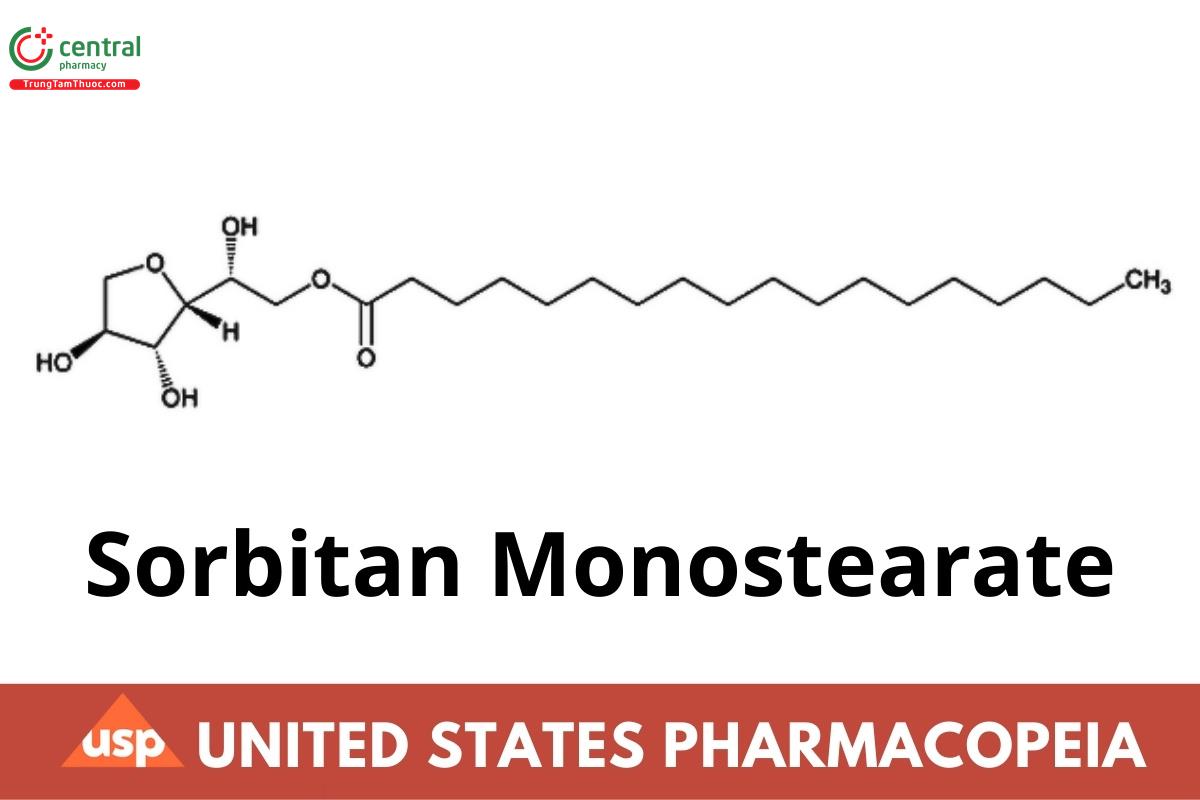
Sorbitan Monostearate
If you find any inaccurate information, please let us know by providing your feedback here

Tóm tắt nội dung
This article is compiled based on the United States Pharmacopeia (USP) – 2025 Edition
Issued and maintained by the United States Pharmacopeial Convention (USP)
Sorbitan, esters, monooctadecanoate;
Sorbitan Monostearate
CAS RN®: 1338-41-6.
1 DEFINITION
Sorbitan Monostearate is a partial ester of Stearic Acid with Sorbitol and its mono- and dianhydrides. It yields, upon saponification, NLT 68.0% and NMT 76.0% of fatty acids, and NLT 27.0% and NMT 34.0% of polyols (w/w).
2 IDENTIFICATION
2.1 A.
Sample: Residue obtained in the Assay for Fatty Acids
Acceptance criteria
Fats and Fixed Oils, Acid Value 〈401〉: 200–215 on 1-g sample
Fats and Fixed Oils, Iodine Value 〈401〉: NMT 4
2.2 B.
Standard solution: 33 mg/mL of USP Isosorbide RS, 25 mg/mL of USP 1,4-Sorbitan RS, and 25 mg/mL of sorbitol
Sample solution: 250 mg/mL of the polyols, obtained in the Assay for Polyols
Chromatographic system
(See Chromatography 〈621〉, Thin-Layer Chromatography.)
Mode: TLC
Adsorbent: 0.25-mm layer of chromatographic silica gel
Application volume: 2 µL
Developing solvent system: Acetone and glacial acetic acid (50:1)
Spray reagent: Sulfuric acid and water (50:50)
Analysis
Samples: Standard solution and Sample solution
Apply the Standard solution and Sample solution, and allow the spots to dry. Develop the chromatogram until the solvent front has moved about three-fourths of the length of the plate. Remove the plate from the developing chamber, mark the solvent front, and allow the solvent to evaporate. Spray evenly with Spray reagent until the surface is uniformly wet (do not overspray), and immediately place the sprayed plate on a 200° hot plate in a well-ventilated hood. Char until white fumes of sulfur trioxide cease, and cool.
Acceptance criteria: The Rᶠ values of the spots from the Sample solution correspond to those of the spots from the Standard solution.
3 ASSAY
3.1 Fatty Acids
Sample: 10 g
Analysis: Transfer the Sample to a 500-mL conical flask. Cautiously add 100 mL of alcohol, 3.0 g of potassium hydroxide, and a few glass beads. Connect a suitable condenser to the flask, reflux the mixture on a hot plate for 2 h, add 100 mL of water, and heat on a steam bath to evaporate the alcohol, adding water occasionally to replace the alcohol. Continue the evaporation until the odor of alcohol can no longer be detected, and transfer the saponification mixture, with the aid of 100 mL of hot water, to a 500-mL separator. Using extreme caution, neutralize to litmus paper with a mixture of equal volumes of sulfuric acid and water, noting the volume used, and add a 10% excess of the dilute acid. Allow the solution to cool. If salts appear, add sufficient water to produce a clear solution. Cautiously add 100 mL of solvent hexane, shake thoroughly, and withdraw the lower layer into a second 500-mL separator. Similarly extract with two more 100-mL portions of solvent hexane. Extract the combined hexane layers with 50-mL portions of water until neutral to litmus paper. Combine the extracts with the original aqueous phase to use for the Assay for Polyols. Evaporate the solvent hexane in a tared beaker on a steam bath nearly to dryness, dry under vacuum at 60° for 1 h, cool in a desiccator, and weigh the fatty acids.
Acceptance criteria: 68.0%–76.0%
3.2 Polyols
Sample solution: Aqueous solution retained from the Assay for Fatty Acids
Analysis: Neutralize the Sample solution with a potassium hydroxide solution (1 in 10) to a pH of 7, using a pH meter. Evaporate on a steam bath to a moist residue, extract the polyols from the salts with three 150-mL portions of dehydrated alcohol, boiling the salt residue for 3 min, and crushing it, as necessary, with the flattened end of a stirring rod, during each extraction; filtering each extract while hot through a medium-porosity, sintered-glass funnel provided with a sheet of retentive filter paper on which a layer of purified siliceous earth has been superimposed; and receiving the filtrates in a 1-L suction flask. Transfer the clear alcoholic polyols solution to a tared beaker, evaporate the alcohol on a steam bath, dry under vacuum at 60° for 1 h, cool in a desiccator, and weigh the polyols.
Acceptance criteria: 27.0%–34.0% (w/w)
4 IMPURITIES
Residue on Ignition 〈281〉: NMT 0.5%
5 SPECIFIC TESTS
Water Determination, Method I 〈921〉: NMT 1.5%
Fats and Fixed Oils, Acid Value 〈401〉: NMT 10
Fats and Fixed Oils, Hydroxyl Value 〈401〉: 235–260
Fats and Fixed Oils, Saponification Value 〈401〉: 147–157
6 ADDITIONAL REQUIREMENTS
Packaging and Storage: Preserve in well-closed containers
USP Reference Standards 〈11〉
USP Isosorbide RS
USP 1,4-Sorbitan RS
C6H12O5 164.16

