
Sorafenib Tosylate
If you find any inaccurate information, please let us know by providing your feedback here
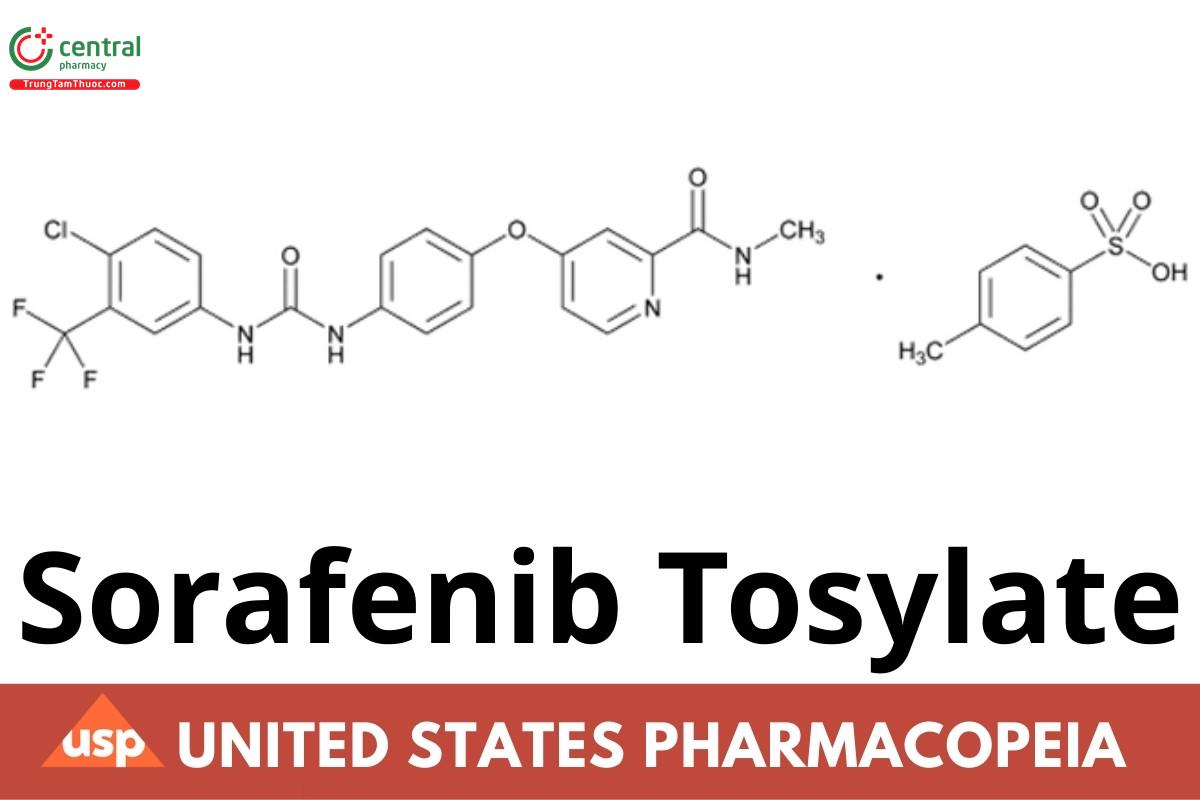

This article is compiled based on the United States Pharmacopeia (USP) – 2025 Edition
Issued and maintained by the United States Pharmacopeial Convention (USP)
1 DEFINITION
Sorafenib Tosylate contains NLT 97.0% and NMT 102.0% of sorafenib tosylate (C21H16ClF3N4O3 · C7H8O3S), calculated on the anhydrous and solvent-free basis.
2 IDENTIFICATION
A. SPECTROSCOPIC IDENTIFICATION TESTS 〈197〉, Infrared Spectroscopy: [NOTE—Methods described in 197K or 197A may be used.]
B. The retention time of the major peak of the Sample solution corresponds to that of the Standard solution, as obtained in the Assay.
3 ASSAY
PROCEDURE
Protect solutions containing sorafenib tosylate from light. Do not sonicate.
Solution A: 1 mL of phosphoric acid and 1 g of potassium phosphate, monobasic in 1 L of water
Solution B: Absolute alcohol and acetonitrile (4:6)
Mobile phase: See Table 1. Return to original conditions, and equilibrate the system for 10 min.
Table 1
| Time (min) | Solution A (%) | Solution B (%) |
| 0 | 95 | 5 |
| 2 | 95 | 5 |
| 24 | 56.5 | 43.5 |
| 32 | 10 | 90 |
| 27 | 10 | 90 |
Diluent: Dimethyl sulfoxide, acetonitrile, and phosphoric acid (85:15:0.1) Standard solution: 1.0 mg/mL of USP Sorafenib Tosylate RS in Diluent Sample solution: 1.0 mg/mL of Sorafenib Tosylate in Diluent
Chromatographic system
(See Chromatography 〈621〉, System Suitability.)
Mode: LC
Detector: UV 235 nm
Column: 2.1-mm × 15-cm; 3.5-µm packing L7
Column temperature: 75°
Flow rate: 0.6 mL/min
Injection volume: 3 µL
System suitability
Sample: Standard solution
Suitability requirements
Tailing factor: NMT 1.6
Relative standard deviation: NMT 0.73%
Analysis
Samples: Standard solution and Sample solution
Calculate the percentage of sorafenib tosylate (C21H16ClF3N4O3 · C7H8O3S) in the portion of Sorafenib Tosylate taken:
Result = (rU/rS) × (CS/CU) × 100
rU = peak response from the Sample solution
rS = peak response from the Standard solution
CS = concentration of USP Sorafenib Tosylate RS in the Standard solution (mg/mL)
CU = concentration of Sorafenib Tosylate in the Sample solution (mg/mL)
Acceptance criteria: 97.0%–102.0% on the anhydrous and solvent-free basis
4 IMPURITIES
ORGANIC IMPURITIES
Protect solutions containing sorafenib tosylate from light. Do not sonicate.
Solution A, Solution B, Mobile phase, Diluent, Standard solution, and Sample solution: Prepare as directed in the Assay.
System suitability solution: 3.0 µg/mL of USP Sorafenib Related Compound H RS in Standard solution. It contains 3.0 µg/mL of USP Sorafenib Related Compound H RS and 1.0 mg/mL of USP Sorafenib Tosylate RS in Diluent.
Sensitivity solution: 0.5 µg/mL of USP Sorafenib Tosylate RS in Diluent, from Standard solution
Chromatographic system
(See Chromatography 〈621〉, System Suitability.)
Mode: LC
Detector: UV 235 nm
Column: 2.1-mm × 15-cm; 3.5-µm packing L7
Column temperature: 75°
Flow rate: 0.6 mL/min
Injection volume: 3 µL
System suitability
Samples: System suitability solution and Sensitivity solution
Suitability requirements
Resolution: NLT 2.2 between the sorafenib related compound H and sorafenib peaks, System suitability solution Signal-to-noise ratio: NLT 10, Sensitivity solution
Analysis
Sample: Sample solution
Calculate the percentage of each impurity in the portion of Sorafenib Tosylate taken:
Result = [rU × (1/F)]/{Σ[rU × (1/F)] + rS} × 100
rU = peak response of each impurity from the Sample solution
F = relative response factor (see Table 2)
rS = peak response of sorafenib from the Sample solution
Acceptance criteria: See Table 2. The reporting threshold is 0.05%. Disregard toluenesulphonic acid at a relative retention time of 0.07. [NOTE—Toluenesulphonic acid is the counter ion of sorafenib and is present in the chromatogram of the Sample solution.]
Table 2
| Name | Relative Retention Time | Relative Response Factor | Acceptance Criteria, NMT (%) |
| Sorafenib impurity Aa | 0.15 | 1.5 | 0.15 |
| Sorafenib impurity Bb | 0.33 | 2.0 | 0.15 |
| Sorafenib impurity Cc | 0.68 | 0.80 | 0.15 |
| Sorafenib impurity Dd | 0.69 | 2.2 | 0.15 |
| Sorafenib impurity Ee | 0.73 | 1.5 | 0.15 |
| Sorafenib impurity Ff | 0.92 | 1.1 | 0.15 |
| Sorafenib related compound H | 0.98 | 1.1 | 0.30 |
| Sorafenib | 1.00 | — | — |
| Any individual unspecified impurity | — | 1.0 | 0.10 |
| Total impurities | — | — | 1.0 |
a 4-(4-Aminophenoxy)-N-methylpicolinamide.
b 4-(4-Formamidophenoxy)-N-methylpicolinamide.
c 4-Chloro-3-(trifluoromethyl)aniline.
d Isopropyl {4-[2-(methylcarbamoyl)pyridin-4-yl]oxyphenyl}carbamate.
e N,N’-Bis{4-[2-(N-methylcarbamoyl)-4-pyridyloxy]phenyl}urea.
f N-Methyl-4-{4-[3-(3-trifluoromethylphenyl)ureido]phenoxy}picolinamide.
5 SPECIFIC TESTS
WATER DETERMINATION 〈921〉 , Method I
Sample: 200 mg
Analysis: Evaporation technique Temperature: 150°
Heating time: 3 min Carrier gas: Nitrogen Flow rate: 70 mL/min
Reagent: Hydranal Coulomat AG, or Hydranal Coulomat AK or equivalent Acceptance criteria: NMT 1.0%
6 ADDITIONAL REQUIREMENTS
PACKAGING AND STORAGE: Preserve in tight containers, and protect from light. Store at room temperature.
USP REFERENCE STANDARDS 〈11〉
USP Sorafenib Tosylate RS
USP Sorafenib Related Compound H RS
4-(4-{3-[2-Chloro-3-(trifluoromethyl)phenyl]ureido}phenoxy)-N-methylpicolinamide.
C21H16ClF3N4O3 464.83 (USP 1-May-2021)

