
Sodium Succinate
If you find any inaccurate information, please let us know by providing your feedback here
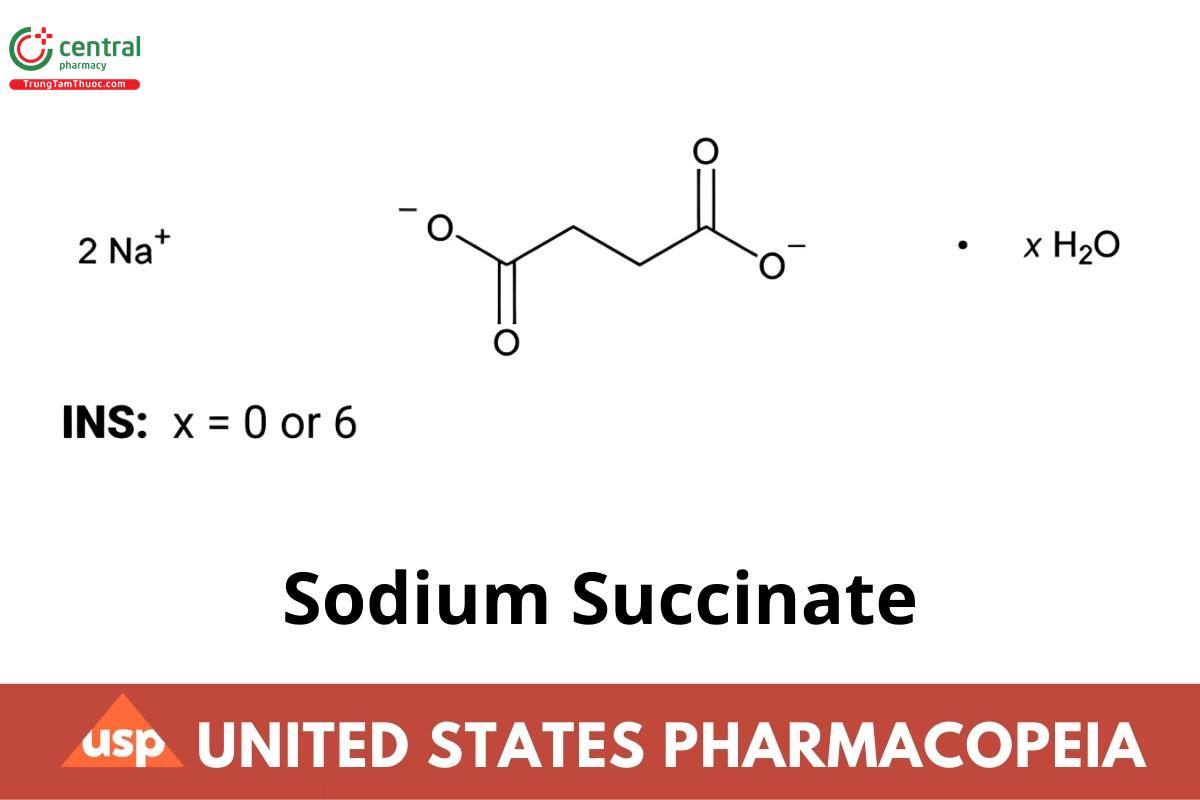

This article is compiled based on the United States Pharmacopeia (USP) – 2025 Edition
Issued and maintained by the United States Pharmacopeial Convention (USP)
NaOOC-CH2CH2-COONa (C4H4Na2O4) 162.05
Anhydrous disodium 1,4-butanedioate;
Anhydrous butanedioic acid disodium salt CAS RN®: 150-90-3.
NaOOC-CH2CH2-COONa·6H2O (C4H4Na2O4·6H2O) 270.14
Disodium 1,4-butanedioate hexahydrate;
Butanedioic acid disodium salt hexahydrate CAS RN®: 6106-21-4.
1 DEFINITION
Sodium Succinate, when dried at 120° for 2 h, contains NLT 98.0% and NMT 102.0% of disodium succinate (C4H4Na2O4).
2 IDENTIFICATION
Change to read:
A. SPECTROSCOPIC IDENTIFICATION TESTS (197), Infrared Spectroscopy: 197A OR 197K (CN 1-MAY-2020) Dry the Anhydrous Sodium Succinate or
Sodium Succinate Hexahydrate sample at 120° for 2 h before use.
B. CHROMATOGRAPHIC IDENTITY
Analysis: Proceed as directed in the Assay.
C. SODIUM
Acceptance criteria: Meets the requirements
3 ASSAY
3.1 PROCEDURE
Solution A: Dissolve 6.8 g of monobasic potassium phosphate in 2 L of water. Adjust with phosphoric acid to a pH of 2.3. Pass under vacuum through an HNWP (nylon hydrophilic) membrane filter of 0.45-µm pore size. This is a 25 mM potassium phosphate buffer with a pH of 2.3.
Mobile phase: Add 100 mL of methanol to 1900 mL of Solution A and mix well. Sonicate for 30 min and cool to room temperature.
Diluent: Add 10 mL of phosphoric acid to 1 L of water and mix well. This is a 1% phosphoric acid solution.
System suitability solution: 3.0 mg/mL of USP Anhydrous Sodium Succinate RS and 2.2 µg/mL of USP Fumaric Acid RS in Diluent
Standard solution: 3.0 mg/mL of USP Anhydrous Sodium Succinate RS in Diluent
Sample solution: 3.0 mg/mL of Anhydrous Sodium Succinate or Sodium Succinate Hexahydrate in Diluent. Dry Anhydrous Sodium Succinate or Sodium Succinate Hexahydrate at 120° for 2 h before use.
3.2 Chromatographic system
(See Chromatography (621), System Suitability.)
Mode: LC
Detector: UV 204 nm
Column: 4.6-mm x 15-cm; 3-µm packing L1
Column temperature: 30°
Flow rate: 1.0 mL/min
Injection volume: 10 µL
Run time: 10 min
3.3 System suitability
Samples: System suitability solution and Standard solution
[NOTE-The relative retention times for succinic acid and fumaric acid are 1.0 and 1.2, respectively.]
Suitability requirements
Resolution: NLT 2.0 between succinic acid and fumaric acid, System suitability solution
Tailing factor: 0.8-2.0, Standard solution
Relative standard deviation: NMT 0.5%, Standard solution
3.4 Analysis
Samples: Standard solution and Sample solution
Calculate the percentage of sodium succinate (C4H4Na2O4) in the portion of sample taken:
Result = (rU/rS) x (CS/CU) x 100
rU = peak response from the Sample solution
rS = peak response from the Standard solution
CS = concentration of USP Anhydrous Sodium Succinate RS in the Standard solution (mg/mL)
CU = concentration of Anhydrous Sodium Succinate or Sodium Succinate Hexahydrate in the Sample solution (mg/mL)
Acceptance criteria: 98.0%-102.0%
4 IMPURITIES
4.1 LIMIT OF SODIUM ACETATE, SODIUM MALEATE, AND SODIUM FUMARATE
Solution A, Mobile phase, Diluent, and Chromatographic system: Proceed as directed in the Assay.
Acetic acid stock solution: Transfer 37.5 mg of USP Glacial Acetic Acid RS to a 25-mL volumetric flask that contains 10 mL of Diluent. Dissolve and dilute with Diluent to volume. Transfer 1.0 mL of this solution to a 10-mL volumetric flask and dilute with Diluent to volume. This solution is equivalent to 200 µg/mL of sodium acetate in Diluent.
Maleic acid stock solution: Transfer 36.5 mg of USP Maleic Acid RS to a 50-mL volumetric flask. Dissolve and dilute with Diluent to volume. Transfer 1.0 mL of this solution to a 10-mL volumetric flask and dilute with Diluent to volume. This solution is equivalent to 100 µg/mL of sodium maleate in Diluent.
Fumaric acid stock solution: Transfer 36.5 mg of USP Fumaric Acid RS to a 50-mL volumetric flask. Dissolve and dilute with Diluent to volume. Transfer 1.0 mL of this solution to a 10-mL volumetric flask and dilute with Diluent to volume. This solution is equivalent to 100 µg/mL of sodium fumarate in Diluent.
System suitability solution: 10 mg/mL of USP Anhydrous Sodium Succinate RS, 15 µg/mL of USP Glacial Acetic Acid RS, and 7.3 µg/mL each of USP Maleic Acid RS and USP Fumaric Acid RS in Diluent
Standard solution: Transfer 1 mL each of Acetic acid stock solution, Maleic acid stock solution, and Fumaric acid stock solution to a 10-mL volumetric flask and dilute with Diluent to volume.
Sample solution: 10 mg/mL of Anhydrous Sodium Succinate or Sodium Succinate Hexahydrate in Diluent
System suitability
Samples: System suitability solution and Standard solution
[NOTE-The relative retention times for acetic acid, maleic acid, succinic acid, and fumaric acid are 0.7, 0.8, 1.0, and 1.2, respectively.]
Suitability requirements
Resolution: NLT 1.5 between acetic acid and maleic acid; NLT 2.0 between succinic acid and fumaric acid, System suitability solution
Relative standard deviation: NMT 5.0%, Standard solution
Analysis
Samples: Standard solution and Sample solution
Based on the Standard solution, identify the peaks of acetic acid, maleic acid, and fumaric acid. Compare peak areas of acetic acid, maleic acid, and fumaric acid in the Standard solution and the Sample solution.
Acceptance criteria
Sodium acetate: The peak area of acetic acid in the Sample solution is NMT the peak area of acetic acid in the Standard solution, corresponding to NMT 0.2% of sodium acetate in Sodium Succinate.
Sodium maleate: The peak area of maleic acid in the Sample solution is NMT the peak area of maleic acid in the Standard solution, corresponding to NMT 0.1% of sodium maleate in Sodium Succinate.
Sodium fumarate: The peak area of fumaric acid in the Sample solution is NMT the peak area of fumaric acid in the Standard solution, corresponding to NMT 0.1% of sodium fumarate in Sodium Succinate.
4.2 LIMIT OF SULFATE
Standard solution: 0.4 mL of 0.005 mol/L sulfuric acid
Sample solution: Dissolve 1.0 g of Anhydrous Sodium Succinate or Sodium Succinate Hexahydrate in 30 mL of water and neutralize with a diluted hydrochloric acid (1 in 40).
Analysis: Proceed as directed in Chloride and Sulfate (221), Sulfate.
Acceptance criteria: NMT 0.019% as SO4
5 SPECIFIC TESTS
5.1 ACIDITY AND ALKALINITY
Sample solution: Dissolve 1.0 g of Anhydrous Sodium Succinate or Sodium Succinate Hexahydrate in carbon dioxide-free water and dilute with water to 20 mL.
Analysis: Proceed as directed in pH (791).
Acceptance criteria: 7.0-9.0
5.2 LOSS ON DRYING (731)
Analysis: Proceed as directed in Loss on Drying (731). Dry at 120° for 2 h.
Acceptance criteria
Anhydrous Sodium Succinate: NMT 2.0%
Sodium Succinate Hexahydrate: 37.0%-41.0%
6 ADDITIONAL REQUIREMENTS
6.1 PACKAGING AND STORAGE
Preserve in tight containers. Store at room temperature.
6.2 LABELING
Label it to state, as part of the official title, anhydrous or hexahydrate for sodium succinate.
6.3 USP REFERENCE STANDARDS (11)
USP Anhydrous Sodium Succinate RS
USP Fumaric Acid RS
USP Glacial Acetic Acid RS
USP Maleic Acid RS

