
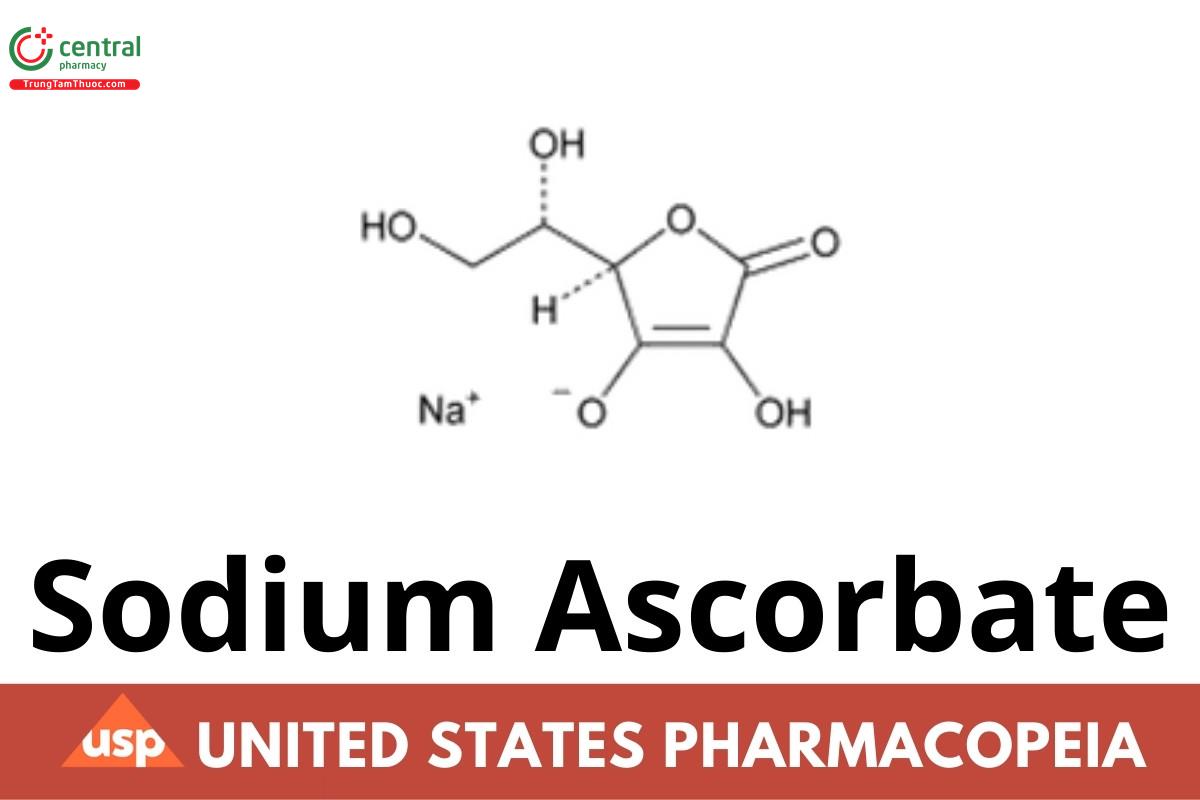
Sodium Ascorbate
If you find any inaccurate information, please let us know by providing your feedback here

Tóm tắt nội dung
This article is compiled based on the United States Pharmacopeia (USP) – 2025 Edition
Issued and maintained by the United States Pharmacopeial Convention (USP)
1 DEFINITION
Sodium Ascorbate contains NLT 99.0% and NMT 101.0% of sodium ascorbate (C6H7NaO6), calculated on the dried basis.
2 IDENTIFICATION
A. SPECTROSCOPIC IDENTIFICATION TESTS 〈197〉 , Infrared Spectroscopy: 197M Sample: Use undried Sodium Ascorbate.
Acceptance criteria: Meets the requirements Change to read:
B. The retention time of the ascorbic acid peak of the Sample solution corresponds to that of the Standard solution, as obtained in the Assay. (USP 1-Aug-2023)
Change to read:
C. Characteristic emission lines for sodium at 330.2, 589.0, and 589.6 nm of the Sample solution correspond to those of the Standard solution, as obtained in the Content of Sodium. (USP 1-Aug-2023)
3 ASSAY
Change to read:
PROCEDURE
Mobile phase: 50 mM monobasic sodium phosphate. Adjust with phosphoric acid to a pH of 2.5. Diluent: Dissolve 73 g of metaphosphoric acid in 1.0 L of water.
Standard stock solution: 2 mg/mL of USP Ascorbic Acid RS in Diluent
Standard solution: 0.2 mg/mL of USP Ascorbic Acid RS in Mobile phase, from the Standard stock solution
Sample stock solution: Transfer 220 mg of Sodium Ascorbate to a 100-mL volumetric flask. Dissolve and dilute with Diluent to volume. Sample solution: 0.22 mg/mL of Sodium Ascorbate in Mobile phase, from the Sample stock solution
Chromatographic system
(See Chromatography 〈621〉, System Suitability.) Mode: LC
Detector: UV 245 nm
Column: 4.6-mm × 25-cm; 5-µm packing L96 Temperature
Autosampler: 5°
Column: 10°
Flow rate: 0.8 mL/min Injection volume: 10 µL
System suitability
Sample: Standard solution Suitability requirements
Tailing factor: NMT 2.0, Standard solution
Relative standard deviation: NMT 2.0% for the ascorbate peak, Standard solution Analysis
Samples: Standard solution and Sample solution
Calculate the percentage of sodium ascorbate (C6H7NaO6) in the portion of sample taken:
Result = (rU/rS) × (CS/CU) × (Mr1/Mr2) × 100
rU = peak response of ascorbic acid from the Sample solution
rS = peak response of ascorbic acid from the Standard solution
CS = concentration of USP Ascorbic Acid RS in the Standard solution (mg/mL)
CU = concentration of Sodium Ascorbate in the Sample solution (mg/mL)
Mr1 = molecular weight of sodium ascorbate, 198.11
Mr2 = molecular weight of ascorbic acid, 176.12
Acceptance criteria: 99.0%–101.0% on the dried basis (USP 1-Aug-2023)
Add the following:
4 OTHER COMPONENTS
4.1 CONTENT OF SODIUM
Stock aqua regia solution: Trace metal grade hydrochloric acid and trace metal grade nitric acid (3:1) prepared as follows. Add nitric acid to hydrochloric acid and mix. [NOTE—Periodically vent the solution in an appropriate fume hood.]
Diluent: Stock aqua regia solution and deionized water (1:9) prepared as follows. Add 1 volume of Stock aqua regia solution to 2 volumes of deionized water. Dilute with additional deionized water to volume, and mix well.
Standard stock solution: Using a commercially available sodium standard solution in 5% (v/v) nitric acid solution, pipet an appropriate
amount of sodium standard solution into a volumetric flask and dilute with 5% (v/v) nitric acid solution to obtain a 1000-mg/L sodium solution.
Standard solution A: Dilute the Standard stock solution with Diluent to obtain a concentration of 24.0 mg/L. Standard solution B: Dilute the Standard stock solution with Diluent to obtain a concentration of 26.0 mg/L. Standard solution C: Dilute the Standard stock solution with Diluent to obtain a concentration of 48.0 mg/L. Standard solution D: Dilute the Standard stock solution with Diluent to obtain a concentration of 60.0 mg/L. Standard solution E: Dilute the Standard stock solution with Diluent to obtain a concentration of 72.0 mg/L. Standard solution F: Dilute the Standard stock solution with Diluent to obtain a concentration of 84.0 mg/L.
Sample solution: Transfer 26 mg of Sodium Ascorbate, accurately weighed and equivalent to about 3 mg of sodium, to a 50-mL volumetric flask. Add about 40 mL of Diluent, sonicate to dissolve, and dilute with Diluent to volume.
Blank: Diluent Instrumental conditions
(See Plasma Spectrochemistry 〈730〉.)
Mode: ICP–OES
Emission wavelength: About 589.6 nm or optimized wavelength for sodium. For Identification C, detect additional sodium emission lines at 330.2 and 589.0 nm. [NOTE—The operating conditions may be developed and optimized based on the manufacturer's recommendation. The wavelengths selected should be demonstrated experimentally to provide sufficient specificity, sensitivity, linearity, accuracy, and precision.]
System suitability
Sample: Standard solutions Suitability requirements
Correlation coefficient: NLT 0.99, determined from the linear calibration constructed in the Analysis, Standard solutions A–F Relative standard deviation: NMT 2.0% from five replicate analyses, Standard solution D
Analysis
Samples: Diluent, Standard solutions, and Sample solution
Construct a linear calibration curve using the intensity of the emission from the six Standard solutions. Determine the emission lines of sodium in each Standard solution and the Sample solution. Plot the emission values of sodium in the Standard solutions versus the concentration, in mg/L, of sodium, and draw the straight line best fitting the plotted points. From the graph, determine the concentration (C), in mg/L, of sodium in the Sample solution.
Calculate the percentage of sodium in the portion of Sodium Ascorbate taken:
Result = C × (V/W) × 100
C = concentration of sodium in the Sample solution (mg/L)
V = volume of the Sample solution (L)
W = sample weight (mg)
Acceptance criteria: 11.1%–12.1% on the dried basis (USP 1-Aug-2023)
5 SPECIFIC TESTS
OPTICAL ROTATION 〈781S〉 , Procedures, Specific Rotation
Sample solution: 100 mg/mL in carbon dioxide-free water. Use the solution immediately after preparation. Acceptance criteria: +103° to +108°
PH 〈791〉
Sample solution: 100-mg/mL solution Acceptance criteria: 7.0–8.0
LOSS ON DRYING 〈731〉
Analysis: Dry under vacuum over phosphorous pentoxide at 60° for 4 h. Acceptance criteria: NMT 0.25%
6 ADDITIONAL REQUIREMENTS
PACKAGING AND STORAGE: Preserve in tight, light-resistant containers.
Change to read:
USP REFERENCE STANDARDS 〈11〉
USP Ascorbic Acid RS (USP 1-Aug-2023)
USP Sodium Ascorbate RS

