
Simethicone
If you find any inaccurate information, please let us know by providing your feedback here

Tóm tắt nội dung
This article is compiled based on the United States Pharmacopeia (USP) – 2025 Edition
Issued and maintained by the United States Pharmacopeial Convention (USP)
1 DEFINITION
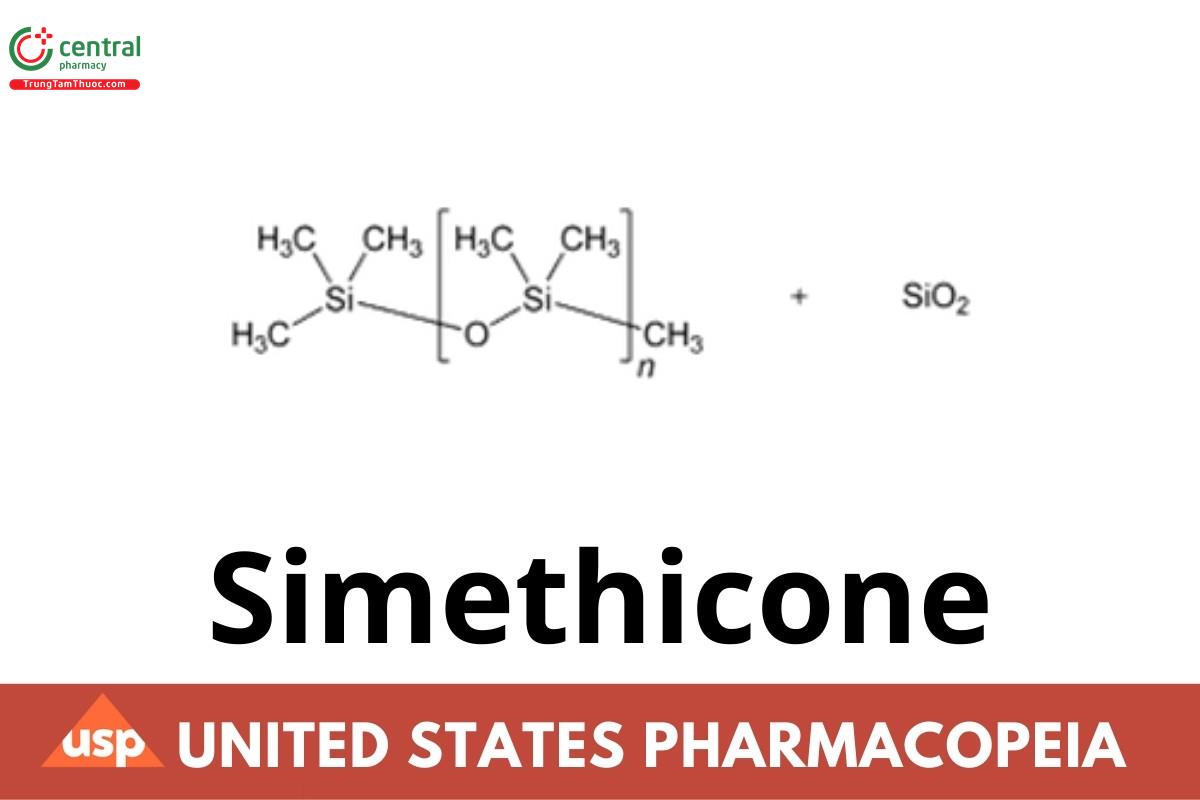
Simethicone is a mixture of fully methylated linear siloxane polymers containing repeating units of the formula [–(CH3)2SiO–]n , stabilized with trimethylsiloxy end-blocking units of the formula [–(CH3)2SiO–], and silicon dioxide. It contains NLT 90.5% and NMT 99.0% of polydimethylsiloxane ([–(CH3)2SiO–]n), and NLT 4.0% and NMT 7.0% of silicon dioxide.
2 IDENTIFICATION
Change to read:
A. SPECTROSCOPIC IDENTIFICATION TESTS 〈197〉 , Infrared Spectroscopy: 197F. (CN 1-M -2020) Meets the requirements
3 ASSAY
PROCEDURE
Standard stock solution: 2 mg/mL of USP Polydimethylsiloxane RS in toluene
Standard solution: Add 25.0 mL of Standard stock solution to a round, narrow-mouth, screw-capped, 120-mL bottle. Add 50 mL of dilute hydrochloric acid (2 in 5), close the bottle securely with a cap having an inert liner, and shake for 5 min, accurately timed, on a reciprocating shaker at a suitable rate (e.g., about 200 oscillations/min and a stroke of 38 ± 2 mm). Transfer the mixture to a 125-mL separator, and remove 5 mL of the upper organic (toluene) layer to a 15-mL, screw-capped test tube containing 0.5 g of anhydrous sodium sulfate. Close the tube with a screw-cap having an inert liner, agitate vigorously, and centrifuge the mixture until a clear supernatant is obtained.
Sample stock solution: Add 50 mg of Simethicone to a round, narrow-mouth, screw-capped, 120-mL bottle. Add 25.0 mL of toluene, and swirl to disperse.
Sample solution: Using the Sample stock solution, proceed as directed in the Standard solution, beginning with “Add 50 mL of dilute hydrochloric acid (2 in 5)”.
Blank: Add 25 mL of toluene to a round, narrow-mouth, screw-capped, 120-mL bottle. Proceed as directed in the Standard solution, beginning with “Add 50 mL of dilute hydrochloric acid (2 in 5)”.
Instrumental conditions Mode: IR
Analytical wavelength: Wavelength of maximum absorbance at about 7.9 µm Cell: 0.5 mm
Analysis
Samples: Standard solution and Sample solution
Determine the absorbance of the Samples, using the Blank to set the instrument.
Calculate the percentage of polydimethylsiloxane [–(CH ) SiO–] in the portion of Simethicone taken:
Result = (AU/AS) × (CS/CU) × 100
AU = absorbance of the Sample solution
AS = absorbance of the Standard solution
CS = concentration of USP Polydimethylsiloxane RS in the Standard stock solution (mg/mL)
CU = concentration of Simethicone in the Sample stock solution (mg/mL)
Acceptance criteria: 90.5%–99.0%
4 OTHER COMPONENTS
CONTENT OF SILICON DIOXIDE
Standard solution: Transfer 3.00 g of USP Simethicone RS to a screw-capped bottle, add 10.0 mL of n-hexane, and mix by shaking. Sample solution: Transfer 3.00 g of Simethicone to a screw-capped bottle, add 10.0 mL of n-hexane, and mix by shaking.
Dimethicone solution: Transfer 3.00 g of dimethicone having a viscosity of 500 centistokes to a screw-capped bottle, add 10.0 mL of n- hexane, and mix by shaking.
Instrumental conditions
Mode: IR
Analytical wavelength: 7–9 µm Cell: 0.1 mm
Blank: n-Hexane Analysis
Samples: Standard solution, Sample solution, and Dimethicone solution
Record the absorbance spectra of the Samples between 7 and 9 µm. Determine the absorbances of the Samples at the wavelength of minimum absorbance at about 8.2 µm, observed in the spectrum obtained from the Dimethicone solution.
Calculate the percentage of silicon dioxide in the portion of Simethicone taken:
Result = [(AU − AD)/(AS − AD)] × C
AU = absorbance of the Sample solution
AD = absorbance of the Dimethicone solution
AS = absorbance of the Standard solution
C = designated percentage of silicon dioxide in USP Simethicone RS Acceptance criteria: 4.0%–7.0%
5 SPECIFIC TESTS
5.1 LOSS ON HEATING
Sample: 15 g
Analysis: Heat the Sample in an open, tared vessel having a diameter of 5.5 ± 0.5 cm and a wall height of 2.5 ± 1.0 cm at 200° in a circulating air oven for 4 h, and allow to come to room temperature in a desiccator before weighing.
Acceptance criteria: NMT 18.0%
5.2 DEFOAMING ACTIVITY
Foaming solution: 1 g of octoxynol 9 in 100 mL of water
Sample solution: Transfer 200 mg of Simethicone to a 60-mL bottle, add 50 mL of tertiary butyl alcohol, cap the bottle, and shake vigorously. Warm slightly, if necessary, to dissolve.
Analysis
Samples: Foaming solution and Sample solution
For each test use a clean, unused, 250-mL glass jar. Add, dropwise, 500 µL of the Sample solution to the 250-mL glass jar, fitted with a 50- mm cap, containing 100 mL of the Foaming solution. Cap the jar, and clamp it in an upright position on a wrist-action shaker. Using a radius of 13.3 ± 0.4 cm (measured from the center of the shaft to the center of the bottle), shake for 10 s through an arc of 10° at a frequency of 300 ± 30 strokes/min. Record the time required for the foam to collapse. The time, in s, for foam collapse is determined at the instant the first portion of foam-free liquid surface appears, measured from the end of the shaking period.
Acceptance criteria: The defoaming activity time does not exceed 15 s.
6 ADDITIONAL REQUIREMENTS
PACKAGING AND STORAGE: Preserve in tight containers.
USP REFERENCE STANDARDS 〈11〉
USP Polydimethylsiloxane RS USP Simethicone RS

