
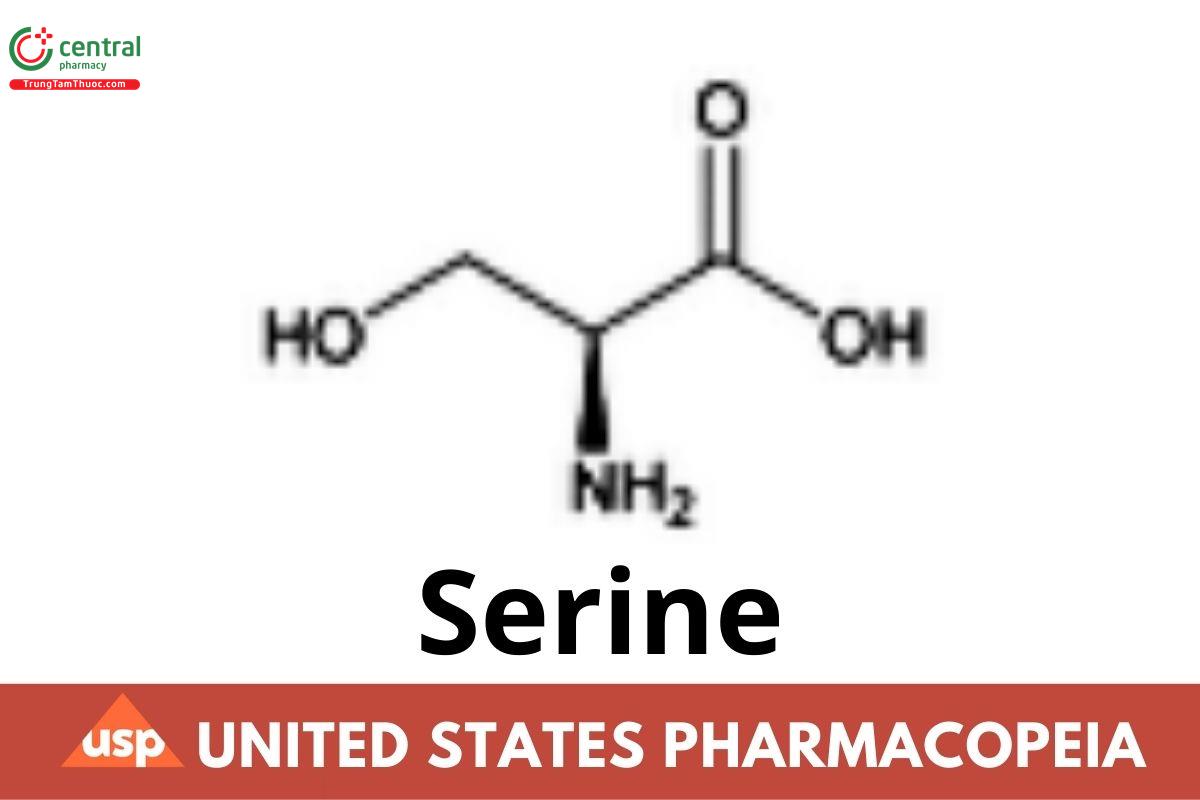
Serine
If you find any inaccurate information, please let us know by providing your feedback here

Tóm tắt nội dung
This article is compiled based on the United States Pharmacopeia (USP) – 2025 Edition
Issued and maintained by the United States Pharmacopeial Convention (USP)
C3H7NO3 105.09
l-Serine CAS RN®: 56-45-1; UNII: 452VLY9402.
1 DEFINITION
Serine contains NLT 98.5% and NMT 101.5% of l-serine (C3H7NO3 ), calculated on the dried basis.
2 IDENTIFICATION
A, Spectroscopic Identification Tests 〈197〉, Infrared Spectroscopy: 197K
3 ASSAY
Procedure
Sample: 100 mg of Serine
Blank: Mix 3 mL of formic acid and 50 mL of glacial acetic acid.
Titrimetric system
(See Titrimetry 〈541〉.)
Mode: Direct titration
Titrant: 0.1 N perchloric acid VS
Endpoint detection: Potentiometric
Analysis: Dissolve the Sample in 3 mL of formic acid and 50 mL of glacial acetic acid. Titrate with the Titrant. Perform the Blank determination.
Calculate the percentage of serine (C3H7NO3 ) in the Sample taken:
Result = {[(VS − VB) × N × F]/W} × 100
VS = Titrant volume consumed by the Sample (mL)
VB = Titrant volume consumed by the Blank (mL)
N = actual normality of the Titrant (mEq/mL)
F = equivalency factor, 105.1 mg/mEq
W = Sample weight (mg)
Acceptance criteria: 98.5%–101.5% on the dried basis
4 IMPURITIES
Residue on Ignition 〈281〉: NMT 0.1%
Chloride and Sulfate, Chloride〈221〉
Standard solution: 0.50 mL of 0.020 N hydrochloric acid
Sample: 0.73 g of Serine
Acceptance criteria: NMT 0.05%
Chloride and Sulfate, Sulfate〈221〉
Standard solution: 0.10 mL of 0.020 N sulfuric acid
Sample: 0.33 g of Serine
Acceptance criteria: NMT 0.03%
Change to read:
Iron 〈241〉, Procedures, Procedure 1) : NMT 30 ppm
Related Compounds
System suitability solution: 0.4 mg/mL each of USP l-Serine RS and USP l-Methionine RS in 0.1 N hydrochloric acid Standard solution: 0.05 mg/mL of USP l-Serine RS in 0.1 N hydrochloric acid. [Note—This solution has a concentration equivalent to about 0.5% of that of the Sample solution.]
Sample solution: 10 mg/mL of Serine in 0.1 N hydrochloric acid
Chromatographic system
(See Chromatography 〈621〉, Thin-Layer Chromatography.)
Mode: TLC
Adsorbent: 0.25-mm layer of chromatographic silica gel mixture
Application volume: 5 µL
Developing solvent system: Butyl alcohol, glacial acetic acid, and water (3:1:1)
Spray reagent: 2 mg/mL of ninhydrin in a mixture of butyl alcohol and 2 N acetic acid (95:5)
System suitability
Suitability requirements: The chromatogram of the System suitability solution exhibits two clearly separated spots. Analysis
Samples: System suitability solution, Standard solution, and Sample solution.
After air-drying the plate, spray with Spray reagent, and heat between 100° and 105° for 15 min. Examine the plate under white light. Acceptance criteria: Any secondary spot of the Sample solution is not larger or more intense than the principal spot of the Standard solution.
Individual impurities: NMT 0.5% Total impurities: NMT 2.0%
5 SPECIFIC TESTS
Optical Rotation, Specific Rotation 〈781S〉
Sample solution: 100 mg/mL in 2 N hydrochloric acid
Acceptance criteria: +14.0° to +15.6°
Loss on Drying 〈731〉: Dry a sample at 105° for 3 h: it loses NMT 0.2% of its weight.
6 ADDITIONAL REQUIREMENTS
Packaging and Storage: Preserve in well-closed containers.
USP Reference Standards 〈11〉
USP l-Methionine RS
USP l-Serine RS

