
Sargramostim
If you find any inaccurate information, please let us know by providing your feedback here

Tóm tắt nội dung
This article is compiled based on the United States Pharmacopeia (USP) – 2025 Edition
Issued and maintained by the United States Pharmacopeial Convention (USP)
C639H1002N168O196S8 (protein moiety) 14,414 CAS RN®: 123774-72-1; UNII: 5TAA004E22.
1 DEFINITION
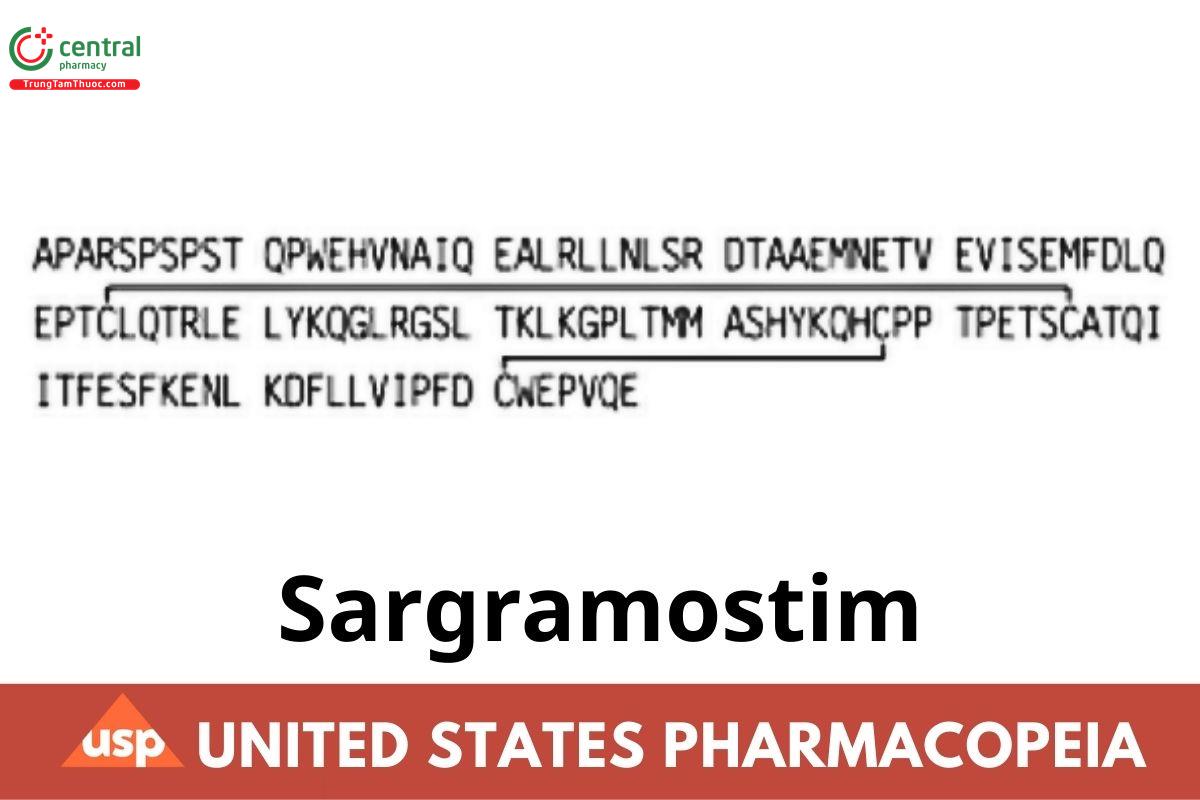
Sargramostim is a single-chain, glycosylated polypeptide of 127 Amino acid residues expressed from Saccharomyces cerevisiae. The glycoprotein primarily consists of three molecular species having relative molecular weights of approximately 19,500; 16,800; and 15,500 due to different levels of glycosylation. Sargramostim has the property of generating granulocyte, macrophage, and mixed granulocyte macrophage colonies from hematopoietic progenitor cells found in bone marrow. It possesses the primary sequence of the natural form of granulocyte-macrophage colony-stimulating factor with a substitution in the amino acid residue at position 23 (Leu23 in place of Arg23). It has a biological potency of NLT 73.0% and NMT 146.0% of the potency stated on the label, the potency being 5.6 million USP Sargramostim Units/mg of protein. The presence of host cell DNA and host cell protein impurities in Sargramostim is process- specific; the limits of these impurities are determined by validated methods.
2 IDENTIFICATION
A. The retention times of the peaks of the Sample solution do not differ by more than 0.5 min from those of the Standard solution, as obtained in the test for Chromatographic Purity.
B. Peptide Mapping
Solution A: Trifluoroacetic acid and water (1:1000), filtered and degassed
Solution B: Trifluoroacetic acid and acetonitrile (1:1000), filtered and degassed
Mobile phase: See Table 1.
Table 1
Time (min) | Solution A (%) | Solution B (%) |
0 | 100 | 0 |
35 | 65 | 35 |
50 | 35 | 65 |
Digestion solution: Dissolve 29.4 mg of calcium chloride and 1.8 mg of β-alanine in 2 mL of water. Adjust with hydrochloric acid to a pH of 4.0. Add 0.4 mg of trypsin, and mix.
Standard solution: 500 µg/mL of USP Sargramostim RS in water. Transfer 100 µL of this solution to a clean test tube, and add 11 µL of pH 7.6 buffer solution (see Reagents, Indicators, and Solutions—Buffer Solutions) containing 0.1 M tris(hydroxymethyl)aminomethane. Add 25 µL of Digestion solution, and incubate at 37° for 2 h. Quench the reaction by adding 3 µL of 20% Trifluoroacetic acid.
Sample solution: 500 µg/mL of Sargramostim in water. Transfer 100 µL of this solution to a clean test tube, and add 11 µL of pH 7.6 buffer solution (see Reagents, Indicators, and Solutions—Buffer Solutions) containing 0.1 M tris(hydroxymethyl)aminomethane. Add 25 µL of Digestion solution, and incubate at 37° for 2 h. Quench the reaction by adding 3 µL of 20% Trifluoroacetic acid.
Chromatographic system
(See Chromatography 〈621〉, System Suitability.)
Mode: LC
Detector: UV 220 nm
Column: 4.6-mm × 25-cm; 10-µm packing L1
Column temperature: Ambient
Flow rate: 1 mL/min
Injection volume: 100 µL
Analysis
Samples: Standard solution and Sample solution
Equilibrate the system with a Mobile phase consisting of 100% Solution A. Measure the responses for the eight major peaks as defined in the USP Sargramostim RS Data Sheet.
Acceptance criteria: The retention times of the peak responses of the Sample solution correspond to those of the Standard solution if the retention times of the corresponding peaks do not differ by more than 0.3 min; the peak area ratios for peaks 4, 8, and 10 are between 0.7 and 1.3; and no additional significant peaks or shoulders are found.
3 ASSAY
Procedure
Iscove's Modified Dulbecco's medium: Prepare a mixture of the ingredients in the quantities shown in Table 2 in sufficient water to obtain 1 L of medium, and sterilize by filtration.
Table 2
Calcium chloride | 165.00 mg |
Potassium chloride | 330.00 mg |
Potassium nitrate | 0.076 mg |
Magnesium sulfate | 97.67 mg |
Sodium chloride | 4505.00 mg |
Sodium bicarbonate | 3024.00 mg |
Monobasic sodium phosphate | 125.00 mg |
Sodium selenite | 0.0173 mg |
Glucose | 4500.00 mg |
HEPES (4-[2-hydroxyethyl]-1- piperazineethanesulfonic acid) | 5958.00 mg |
Phenol red | 15.00 mg |
Sodium pyruvate | 110.00 mg |
l-Alanine | 25.00 mg |
L-arginine hydrochloride | 84.00 mg |
l-Asparagine | 28.40 mg |
l-Aspartic acid | 30.00 mg |
L-Cystine dihydrochloride | 91.24 mg |
l-Glutamic acid | 75.00 mg |
l-Glutamine | 584.00 mg |
Glycine | 30.00 mg |
l-Histidine hydrochloride | 42.00 mg |
l-Isoleucine | 105.00 mg |
l-Leucine | 105.00 mg |
l-Lysine hydrochloride | 146.00 mg |
l-Methionine | 30.00 mg |
l-Phenylalanine | 66.00 mg |
l-Proline | 40.00 mg |
l-Serine | 42.00 mg |
l-Threonine | 95.00 mg |
l-Tryptophan | 16.00 mg |
l-Tyrosine disodium | 103.79 mg |
l-Valine | 94.00 mg |
Biotin | 0.013 mg |
Calcium pantothenate | 4.00 mg |
Choline chloride | 4.00 mg |
Cyanocobalamin | 0.013 mg |
Folic acid | 4.00 mg |
Inositol | 7.20 mg |
Niacinamide | 4.00 mg |
Pyridoxal hydrochloride | 4.00 mg |
Ribonavin | 0.40 mg |
Thiamine | 4.00 mg |
Medium A: Prepare a mixture of Iscove's Modified Dulbecco's medium with 10% heat-inactivated fetal bovine serum as described in Table 3. Table 3
Iscove's Modified Dulbecco's medium | 500 mL |
Fetal bovine serum (inactivated at 56° for 30 min) | 50 mL |
Penicillin, streptomycin, and l-glutamine mixture containing, in each mL, 5000 units of penicillin G potassium, 5000 µg of Streptomycin sulfate, and 29.2 mg of l glutamine | 5 mL |
Gentamicin (50 mg/mL) | 0.5 mL |
2-Mercaptoethanol | 0.5 mL |
Prepare aseptically, sterilize by filtration, and store at 2°–8°. Use within 1 month.
Medium B: 1 µg/mL of USP Sargramostim RS in Medium A. Prepare aseptically, sterilize by filtration, and store at 2°–8°. Use within 1 month. Standard solution: 100 ng/mL of USP Sargramostim RS in Medium A. Dispense aseptically in equal portions, and store at −60° or below. Use within 24 months. Store thawed portions at a temperature between 2° and 8°, and use within 1 month. At the time of use, dilute with Medium A to obtain a solution having a known concentration of 2 ng/mL.
Sample solution: 2 ng/mL of Sargramostim in Medium A
Cell culture preparation: Prepare cell cultures of TF-1 cells (ATCC CRL-2003). Passage the cultures every 3–4 days, using a 1:10 subculture of the cells for up to 3 months. After 3 months, initiate a new culture. Use Medium A containing 0.5% Medium B for passage propagation and storage in the frozen state.
Cell suspension: Wash the cells three times in Medium A, and adjust the cell concentration to 5 × 10⁴ cells/mL in Medium A. Tritiated thymidine solution: 1.0 mL of a solution of tritiated thymidine with a specific activity of 20 Ci/mmol in 49 mL of Medium A. Store at 2°–8°. Use within 2 weeks.
Analysis: Use a 96-well, at-bottom microtitration plate with wells arranged in 8 rows (labeled A–H), with 12 wells (numbered 1–12) in each row. Place 50 µL of Medium A in wells 2–12. Place 100 µL of the Standard solution or each Sample solution or Medium A (negative control) in well 1. Make serial dilutions by transferring 50 µL from well 1 to well 2, and so on through well 12 (serial two-fold dilutions). Place 50 µL of the Cell suspension in each well, and incubate the microtitration plate for 72 h at 37° in a 10% carbon dioxide incubator. Following incubation, add 25 µL of Tritiated thymidine solution to each well, and return the plate to the same incubator for an additional 4–5 h. Before harvesting the cells on a filter mat, prewet the mat filter, using distilled water. [Note—The prewetting minimizes background radiation noise.] Using a multiple, automated sample harvesting system, place the incubated plate under the harvesting system. Fill the wells to the top with deionized water. Aspirate the water, and pass it through the collecting filter mat. Repeat the procedure at least ve times or until all the cells have been fully harvested. When all wells have been fully harvested, pour 5–10 mL of alcohol on the plate tray, and aspirate the methanol. Repeat the procedure if further drying of the filter mat is desired. [Note—The alcohol helps to dry out the filter mat by carrying away the wash uid.] Remove the filter mat, and repeat the procedure until all plates under test have been harvested.
Dry the filter mat in a drying oven for about 30 min. Place the completely dry filter mats in a beta counter, and determine the amount of radioactivity in each cell well.
Convert the amount of incorporated radioactivity in each well to a percentage of the maximum incorporated radioactivity. If fewer than ve values are between 3% and 97% of the maximum revision, repeat the Assay. Using the least-squares method of regression analysis, plot the slope of each test specimen versus the slope of the standard, excluding any values exceeding the maximum of each dilution set. Calculate the USP Sargramostim Units in each mL of the Sample solution in terms of the dilution that gives half-maximal activity. To convert this value to units of protein/mg, divide the USP Sargramostim Units/mL by the weight, in mg/mL, of protein in the initial undiluted solution.
Acceptance criteria: The potency is 73.0%–146.0% of the potency stated on the label in terms of USP Sargramostim Units/mg of protein.
4 SPECIFIC TESTS
Chromatographic Purity
Solution A: Trifluoroacetic acid and water (1:1000), filtered and degassed
Solution B: Trifluoroacetic acid and acetonitrile (1:1000), filtered and degassed
Solution C: Dissolve 116.9 g of sodium chloride in 2 L of water, adding 2 mL of Trifluoroacetic acid.
Mobile phase: See Table 4. Make adjustments if necessary (see Chromatography 〈621〉, System Suitability).
Table 4
Time (min) | Solution A (%) | Solution B (%) | Solution C (%) |
0 | 55 | 25 | 20 |
40 | 15 | 65 | 20 |
Standard solution: 1 mg/mL of USP Sargramostim RS in water
Sample solution: 1 mg/mL of Sargramostim in water
Chromatographic system
(See Chromatography 〈621〉, System Suitability.)
Mode: LC
Detector: UV 220 nm
Column: 4.6-mm × 25-cm; packing L1
Column temperature: Ambient
Flow rate: 1 mL/min
Injection volume: 50 µL
Analysis
Samples: Standard solution and Sample solution
Equilibrate the system with a Mobile phase consisting of 55% Solution A, 25% Solution B, and 20% Solution C. After injection of the solution under test, the composition is changed linearly. The major peaks are from hyperglycosylated sargramostim and from the three glycosylated forms of sargramostim, as indicated in the USP Sargramostim RS Data Sheet.
Calculate the percentage of hyperglycosylated sargramostim in the Sample solution:
Result = (rU/rT) × 100
rU = peak response of hyperglycosylated sargramostim
rT = sum of all the peak responses of sargramostim
Calculate the percentage of each of the three glycosylated forms of sargramostim in the Sample solution:
Result = (rU/rT) × 100
rU = peak response of each individual glycosylated form of sargramostim
rT = sum of all the peak responses of all three glycosylated forms of sargramostim
Acceptance criteria: The peak responses of the Sample solution correspond to those of the Standard solution, and no peaks or shoulders are present in the chromatogram of the Sample solution that are not present in the chromatogram of the Standard solution. NMT 5.6% of hyperglycosylated sargramostim. The percentages of each of the three glycosylated forms of sargramostim, in order of elution, are 25%– 42%, 14%–32%, and 35%–53%.
Protein Content
Standard solutions: 100, 200, 400, 600, 800, and 1000 µg/mL of USP Sargramostim RS in water
Sample solution: Between 250 and 500 µg/mL of Sargramostim in water
BCA reagent: Dissolve 10 g of bicinchoninic acid, 20 g of sodium carbonate monohydrate, 1.6 g of sodium tartrate, 4 g of sodium hydroxide, and 9.5 g of sodium bicarbonate in water. Adjust, if necessary, with sodium hydroxide or sodium bicarbonate to a pH of 11.25. Dilute with water to 1 L, and mix.
Copper sulfate reagent: 40 mg/mL of cupric sulfate
Copper–BCA reagent: Copper sulfate reagent and BCA reagent (1:50). [Note—If a commercially available kit is used, follow the manufacturer's instructions for preparation of the Copper–BCA reagent.]
Blank: Water
Analytical wavelength: 562 nm
Analysis: Mix 0.1 mL each of Standard solution,Sample solution, and Blank with 2 mL of the Copper–BCA reagent. Incubate the solutions at 37° for 30 min, and allow to stand for 5 min at room temperature. Within 60 min after incubation, determine the absorbances of the Standard solutions and the Sample solution in 1-cm cells with a suitable spectrophotometer (see Ultraviolet-Visible Spectroscopy 〈857〉), using the Blank to set the instrument to zero. Plot the absorbances of the Standard solutions versus the concentrations, in µg/mL, of USP Sargramostim RS, and draw a straight line best fitting the plotted points. From the graph, determine the concentration, in µg/mL, of protein in the Sample solution.
Microbial Enumeration Tests 〈61〉and Tests for Specified Microorganisms 〈62〉: The total aerobic microbial count does not exceed 1 cfu/mL. Bacterial Endotoxins Test 〈85〉: NMT 5 USP Endotoxin Units/mg
5 ADDITIONAL REQUIREMENTS
Packaging and Storage: Preserve in sealed containers, and store at a temperature of −20° or below.
USP Reference Standards 〈11〉
USP Sargramostim RS

