
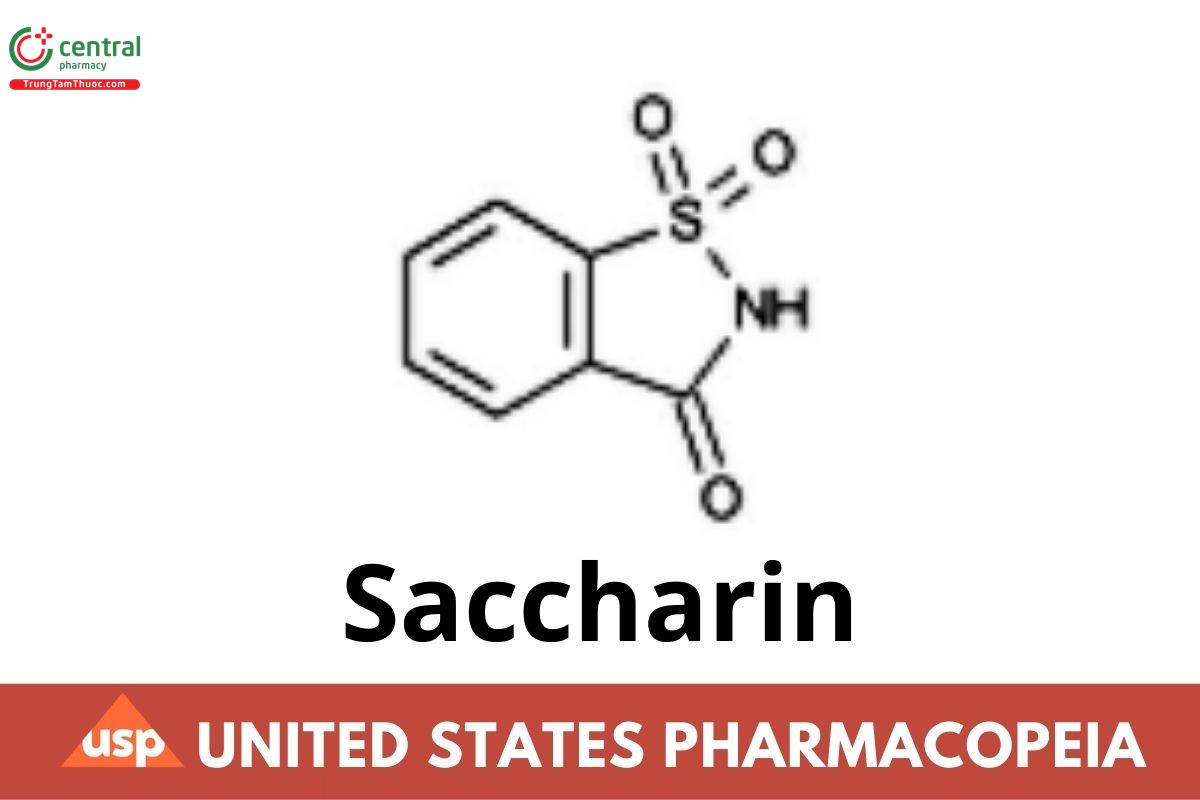
Saccharin
If you find any inaccurate information, please let us know by providing your feedback here

Tóm tắt nội dung
This article is compiled based on the United States Pharmacopeia (USP) – 2025 Edition
Issued and maintained by the United States Pharmacopeial Convention (USP)
C7H5NO3S 183.18
1,2-Benzisothiazol-3(2H)-one, 1,1-dioxide;
1,2-Benzisothiazolin-3-one 1,1-dioxide CAS RN®: 81-07-2.
1 DEFINITION
Saccharin contains NLT 98.0% and NMT 102.0% of saccharin (C7H5NO3S), calculated on the dried basis.
2 IDENTIFICATION
A. Spectroscopic Identification Tests 〈197〉, Infrared Spectroscopy: 197K
3 ASSAY
Procedure
Solution A: 50 mM dibasic potassium phosphate (K2HPO4) buffer in 0.1% (v/v) phosphoric acid solution
Solution B: Methanol
Mobile phase: See Table 1.
Table 1
Time (min) | Solution A (%) | Solution B (%) |
0 | 90 | 10 |
7.0 | 90 | 10 |
8.0 | 5 | 95 |
10.0 | 5 | 95 |
10.1 | 90 | 10 |
15.0 | 90 | 10 |
Diluent: Methanol and water (50:50 v/v)
System suitability solution: 0.1 mg/mL of phthalic anhydride and 0.1 mg/mL of USP Saccharin RS in Diluent
Standard solution: 0.1 mg/mL of USP Saccharin RS in Diluent
Sample solution: 0.1 mg/mL of Saccharin in Diluent
Chromatographic system
(See Chromatography 〈621〉, System Suitability.)
Mode: LC
Detector: UV 230 nm
Column: 4.6-mm × 15-cm; 3.5-µm packing L1
Column temperature: 20 ± 5°
Flow rate: 1.0 mL/min
Injection volume: 10 µL
Run time: 15 min
System suitability
Samples: System suitability solution and Standard solution
[Note—The retention times for phthalic anhydride and saccharin are about 6.3 and 7.3 min, respectively. Phthalic anhydride is a potential impurity.]
Suitability requirements
Resolution: NLT 1.5 between the phthalic anhydride and saccharin peaks, System suitability solution
Tailing factor: NMT 1.5, Standard solution
Relative standard deviation: NMT 0.73% for ve replicate injections, Standard solution
Analysis
Samples: Standard solution and Sample solution
Calculate the percentage of saccharin in the portion of Saccharin taken:
Result = (rU/rS) × (CS/CU) × 100
rU = peak area of saccharin from the Sample solution
rS = peak area of saccharin from the Standard solution
CS = concentration of USP Saccharin RS in the Standard solution (mg/mL)
CU = concentration of Saccharin in the Sample solution (mg/mL)
Acceptance criteria: 98.0%–102.0% on the dried basis
4 IMPURITIES
Residue on Ignition 〈281〉: NMT 0.2%, using an ignition temperature of 600 ± 50°
Limit of Toluenesulfonamides
Internal standard solution: 0.25 mg/mL of caffeine in methylene chloride
Standard stock solution: 20.0 µg/mL of USP o-Toluenesulfonamide RS and 20.0 µg/mL of USP p-Toluenesulfonamide RS in methylene chloride
Standard solution: Evaporate 5.0 mL of the Standard stock solution to dryness in a stream of nitrogen. Dissolve the residue in 1 mL of the Internal standard solution.
Sample solution: Suspend 10 g of Saccharin in 20 mL of water, and dissolve using 5–6 mL of 10 N sodium hydroxide. If necessary, adjust the solution with 1 N sodium hydroxide or 1 N hydrochloric acid to a pH of 7–8, and dilute with water to 50 mL. Shake the solution with four quantities each of 50 mL of methylene chloride. Combine the lower layers, dry over anhydrous sodium sulfate, and filter. Wash the filter and the sodium sulfate with 10 mL of methylene chloride. Combine the solution and the washings, and evaporate almost to dryness in a water bath at a temperature not exceeding 40°. Using a small quantity of methylene chloride, quantitatively transfer the residue into a suitable 10- mL tube, evaporate to dryness in a stream of nitrogen, and dissolve the residue in 1.0 mL of the Internal standard solution.
Blank solution: Evaporate 200 mL of methylene chloride to dryness in a water bath at a temperature not exceeding 40°. Dissolve the residue in 1 mL of methylene chloride.
Chromatographic system
(See Chromatography 〈621〉, System Suitability.)
Mode: GC
Detector: Flame ionization
Column: 0.53-mm × 10-m fused silica; coated with a 2-µm lm of phase G3
Temperatures
Injector: 250°
Column: 180°
Detector: 250°
Carrier gas: Nitrogen
Flow rate: 10 mL/min
Injection volume: 1 µL
Injection type: Split ratio, 2:1
System suitability
Samples: Standard solution and Blank solution
[Note—The substances are eluted in the following order: o-toluenesulfonamide, p-toluenesulfonamide, and caffeine.] Suitability requirements: No peaks at the retention times for the internal standard, o-toluenesulfonamide, or p-toluenesulfonamide; Blank solution
Resolution: NLT 1.5 between o-toluenesulfonamide and p-toluenesulfonamide, Standard solution
Analysis
Samples: Standard solution and Sample solution
Acceptance criteria: See Table 2. If any peaks due to o-toluenesulfonamide and p-toluenesulfonamide appear in the chromatogram of the Sample solution, the ratio of their areas to that of the Internal standard solution is NMT the corresponding ratio in the chromatogram of the Standard solution.
Table 2
Name | Acceptance Criteria, NMT (ppm) |
o-Toluenesulfonamide | 10 |
p-Toluenesulfonamide | 10 |
Limit of Benzoate and Salicylate
Sample solution: 10 mL of a hot, saturated solution of saccharin
Analysis: Add ferric chloride TS dropwise to the Sample solution.
Acceptance criteria: No precipitate or violet color appears in the liquid.
5 SPECIFIC TESTS
Melting Range or Temperature 〈741〉: 226°–230°
Loss on Drying 〈731〉
Analysis: Dry at 105° for 2 h.
Acceptance criteria: NMT 1.0%
Change to read:
Readily Carbonizable Substances Test 〈271〉
Matching uid A: Cobaltous chloride CS, ferric chloride CS, cupric sulfate CS, and water (0.1:0.4:0.1:4.4) Sample solution: 40 mg/mL in sulfuric acid maintained at 48°–50° for 10 min
Acceptance criteria: The Sample solution has no more color than Matching uid A, when viewed against a white background.
Clarity of Solution
[Note—The Sample solution is to be compared to Reference suspension A in diffused daylight 5 min after preparation of Reference suspension A.]
Diluent: 200-g/L solution of sodium acetate
Hydrazine solution: 10.0 mg/mL of hydrazine sulfate. [Note—Allow to stand for 4–6 h.]
Methenamine solution: Transfer 2.5 g of methenamine to a 100-mL glass-stoppered flask, add 25.0 mL of water, insert the glass stopper, and mix to dissolve.
Primary opalescent suspension: Transfer 25.0 mL of Hydrazine solution to the Methenamine solution in the 100-mL glass-stoppered flask. Mix, and allow to stand for 24 h. [Note—This suspension is stable for 2 months, provided it is stored in a glass container free from surface defects. The suspension must not adhere to the glass and must be well mixed before use.]
Opalescence standard: Dilute 15.0 mL of the Primary opalescent suspension with water to 1000 mL. [Note—This suspension should not be used beyond 24 h after preparation.]
Reference suspension A: Opalescence standard and water (1 in 20)
Reference suspension B: Opalescence standard and water (1 in 10)
Sample solution: 200 mg/mL in Diluent
Analysis
Samples: Diluent, Reference suspension A, Reference suspension B, Sample solution, and water
Transfer a sufficient portion of the Sample solution to a test tube of colorless, transparent, neutral glass with a at base and an internal diameter of 15–25 mm to obtain a depth of 40 mm. Similarly transfer portions of Reference suspension A, Reference suspension B, water, and Diluent to separate matching test tubes. Compare the solutions in diffused daylight, viewing vertically against a black background (see Visual Comparison 〈630〉). [Note—The diffusion of light must be such that Reference suspension A can readily be distinguished from water, and that Reference suspension B can readily be distinguished from Reference suspension A.]
Acceptance criteria: The Sample solution shows the same clarity as that of water or Diluent, or its opalescence is NMT that of Reference suspension A.
Color of Solution
Diluent A: 200-g/L solution of sodium acetate
Diluent B: 10-g/L solution of hydrochloric acid
Standard stock solution: Ferric chloride CS, cobaltous chloride CS, cupric sulfate CS, and Diluent B (3.0:3.0:2.4:1.6) Standard solution: Standard stock solution and Diluent B (1 in 100). [Note—Prepare the Standard stock solution and Standard solution immediately before use.]
Sample solution: Use the Sample solution from the test for Clarity of Solution.
Analysis
Samples: Diluent A, Standard solution, Sample solution, and water
Transfer a sufficient portion of the Sample solution to a test tube of colorless, transparent, neutral glass with a flat base and an internal diameter of 15–25 mm to obtain a depth of 40 mm. Similarly transfer portions of the Standard solution, Diluent A, and water to separate, matching test tubes. Compare the solutions in diffused daylight, viewing vertically against a white background (see Visual Comparison 〈630〉).
Acceptance criteria: The Sample solution has the appearance of water or Diluent A, or is not more intensely colored than the Standard solution.
6 ADDITIONAL REQUIREMENTS
Packaging and Storage: Preserve in well-closed containers. Store at room temperature.
USP Reference Standards 〈11〉
USP Saccharin RS
USP o-Toluenesulfonamide RS
USP p-Toluenesulfonamide RS

