
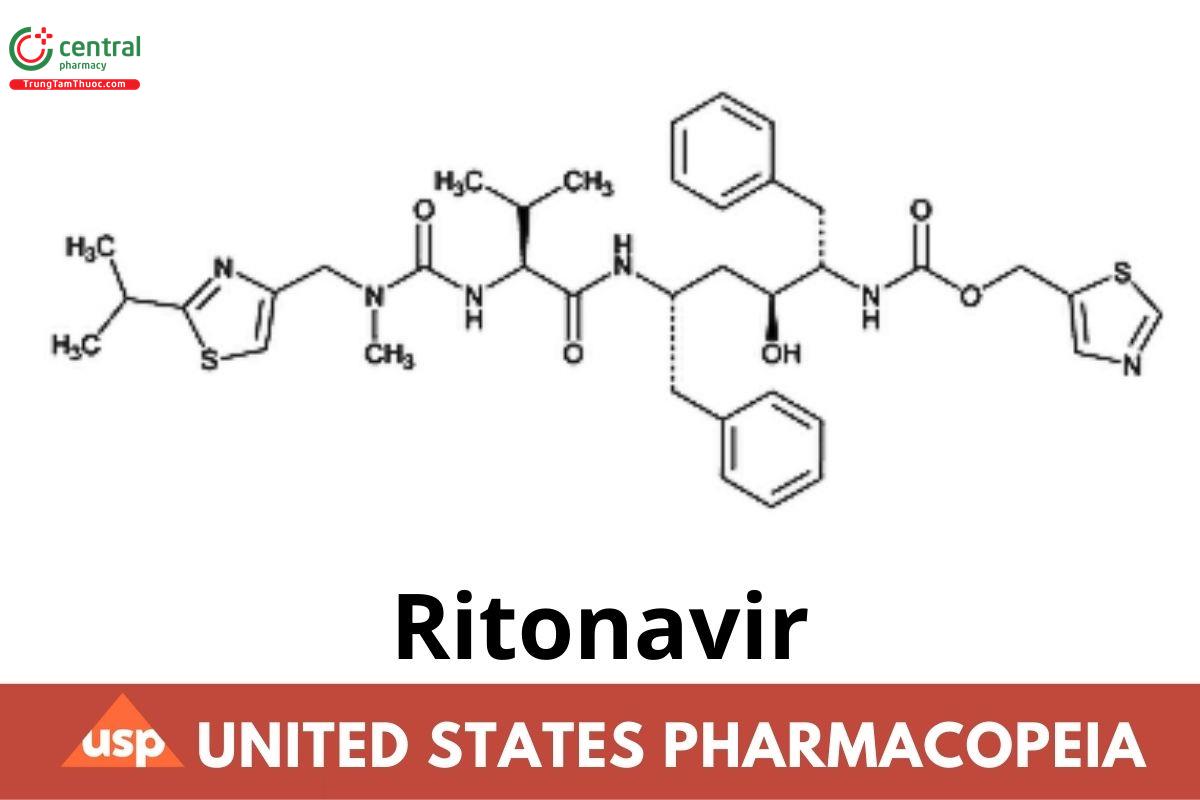
Ritonavir
If you find any inaccurate information, please let us know by providing your feedback here

Tóm tắt nội dung
This article is compiled based on the United States Pharmacopeia (USP) – 2025 Edition
Issued and maintained by the United States Pharmacopeial Convention (USP)
C37H48N6O5S2 720.94
2,4,7,12-Tetraazatridecan-13-oic acid, 10-hydroxy-2-methyl-5-(1-methylethyl)-1-[2-(1-methylethyl)-4-thiazolyl]-3,6-dioxo-8,11-bis(phenylmethyl)-5- thiazolylmethyl ester [5S-(5R*,8R*,10R*,11R*)]-;
5-Thiazolylmethyl [(αS)-α-[(1S,3S)-1-hydroxy-3-[(2S)-2-[3-[(2-isopropyl-4-thiazolyl)methyl]-3-methylureido]3-methylbutyramido]-4- phenylbutyl]phenethyl]carbamate CAS RN®: 155213-67-5; UNII: O3J8G9O825.
1 DEFINITION
Ritonavir contains NLT 97.0% and NMT 102.0% of ritonavir (C37H48N6O5S2), calculated on the anhydrous basis.
2 IDENTIFICATION
Change to read:
A. Spectroscopic Identification Tests 〈197〉, Infrared Spectroscopy: 197K
B. The retention time of the major peak of the Sample solution is within 2% of the retention time of the major peak of the Standard solution, as obtained in the Assay.
3 ASSAY
Procedure
Solution A: 4.1 mg/mL of monobasic potassium phosphate in water
Solution B: Acetonitrile, tetrahydrofuran (inhibitor-free), n-butanol, and Solution A (18:8:5:69)
Mobile phase: Solution B
Diluent: Acetonitrile and Solution A (1:1)
Standard stock solution: 2.0 mg/mL of USP Ritonavir RS in Diluent. [Note—This solution may be kept for 5 days if refrigerated.] Standard solution 1: 0.10 mg/mL of USP Ritonavir RS from the Standard stock solution diluted with Diluent
Standard solution 2: 0.025 mg/mL of USP Ritonavir RS from Standard solution 1 diluted with Diluent
Sample solution: 0.025 mg/mL of Ritonavir in Diluent
Chromatographic system
(See Chromatography 〈621〉, System Suitability.)
Mode: LC
Detector: UV 240 nm
Column: 4.6-mm × 15-cm; 3-µm packing L26
Column temperature: 60°
Flow rate: 1 mL/min
Injection volume: 50 µL
Run time: 40 min
System suitability
Sample: Standard solution 2
Suitability requirements
Capacity factor, k′: NLT 13
Column efficiency: NLT 5000 theoretical plates
Tailing factor: 0.8–1.2
Relative standard deviation: NMT 2.0%
Analysis
Samples: Standard solution 2 and Sample solution
Calculate the percentage of ritonavir (C37H48N6O5S2) in the portion of Ritonavir taken:
Result = (rU/rS) × (CS/CU) × 100
rU = peak response from the Sample solution
rS = peak response from the Standard solution
CS = concentration of USP ritonavir RS in the Standard solution (mg/mL)
CU = concentration of ritonavir in the Sample solution (mg/mL)
Acceptance criteria: 97.0%–102.0% on the anhydrous basis
4 IMPURITIES
Residue on Ignition 〈281〉: NMT 0.2%, determined on 1.0 g
Organic Impurities
Ritonavir is alkali sensitive. All glassware should be prerinsed with distilled water before use to remove residual detergent contamination.
Solution A, Solution B, Mobile phase, Diluent, Standard stock solution, and Standard solution 1: Prepare as directed in the Assay. Solution C: Acetonitrile, tetrahydrofuran (inhibitor-free), n-butanol, and Solution A (47:8:5:40)
Mobile phase: See Table 1.
Table 1
Time (min) | Solution B (%) | Solution C (%) |
0 | 100 | 0 |
60 | 100 | 0 |
120 | 0 | 100 |
120.1 | 100 | 0 |
155 | 100 | 0 |
Identity solution: 1 mg/mL of USP Ritonavir Related Compounds Mixture RS in Diluent
Standard solution 2: 5 µg/mL of USP Ritonavir RS from Standard solution 1 in Diluent. [Note—This is stable for 48 h.] Sample solution: 1 mg/mL of Ritonavir in Diluent
Chromatographic system
(See Chromatography 〈621〉, System Suitability.)
Mode: LC
Detector: UV 240 nm
Column: 4.6-mm × 15-cm; 3-µm packing L26
Column temperature: 60°
Flow rate: 1 mL/min
Injection volume: 50 µL
Run time
Standard solution 2: 40 min
System suitability
Samples: Identity solution and Standard solution 2
[Note—See Table 2 for relative retention times.]
Resolution: NLT 1.0 between hydroxyritonavir and hydantoin aminoalcohol peaks, Identity solution Peak-to-valley ratio: NLT 1 for ritonavir and the 4-hydroxy isomer, Identity solution
Capacity factor, k′: NLT 13, Standard solution 2
Column efficiency: NLT 5000 theoretical plates, Standard solution 2
Tailing factor: 0.8–1.2, Standard solution 2
Relative standard deviation: NMT 3.0%, Standard solution 2
Analysis
Samples: Diluent, Identity solution, Standard solution 2, and Sample solution
Calculate the percentage of each impurity in the portion of Ritonavir taken:
Result = (rU/rS) × (CS/CU) × (1/F) × 100
rU = peak response of each impurity from the Sample solution 2
rS = peak response from the Standard solution 2
CS = concentration of Standard solution 2 (mg/mL)
CU = concentration of ritonavir in the Sample solution (mg/mL)
F = relative response factor (see Table 2)
Acceptance criteria: See Table 2.
Table 2
Name | Relative Retention | Relative Response Factor | Acceptance Criteria, NMT (%) |
Mixture of ureidovaline and N deacylvaline ritonavira | 0.07 | 1.0 | 0.1 |
Acetamidoalcoholb | 0.15 | 1.0 | 0.1 |
2,5-Thiazolylmethyl dicarbamatec | 0.24 | 1.37 | 0.1 |
Hydroxyritonavird | 0.36 | 1.0 | 0.3 |
Hydantoin aminoalcohole | 0.39 | 0.73 | 0.1 |
Ritonavir hydroperoxidef | 0.45 | 1.0 | 0.1 |
Hydantoin-oxazolidinone derivativeg | 0.47 | 0.76 | 0.1 |
Ethyl analogh | 0.64 | 1.0 | 0.1 |
Mixture of BOC-aminoalcohol and isobutoxycarbonyl aminoalcoholi | 0.81 | 0.74 | 0.1 |
Oxazolidinone derivativej | 0.87 | 0.53 | 0.1 |
Ureidovaline isobutyl esterk | 0.94 | 1.0 | 0.1 |
4-Hydroxy isomerl | 1.05 | 1.0 | 0.1 |
3R-Epimerm | 1.11 | 1.0 | 0.3 |
Aminoalcohol Urea derivativen | 1.14 | 1.0 | 0.1 |
3R,5R-Diastereomero | 1.23 | 1.0 | 0.1 |
5R-Epimerp | 1.32 | 1.0 | 0.1 |
Diacyl valine ureaq | 1.62 | 1.0 | 0.1 |
Divalinyl analogr | 2.87 | 0.73 | 0.2 |
O-Acyl ritonavirs | 3.20 | 1.0 | 0.1 |
Any other individual impurity | — | 1.0 | 0.1 |
Total impurities | — | — | 1.0 |
a Ureidovaline is [N-methyl[(2-isopropyl-4-thiazolyl)methyl]amino]carbonyl-l-valine and N-deacylvaline ritonavir is thiazol-5-ylmethyl(2S,3S,5S)-5-[(S)-2-amino-3-methylbutanamido]-3-hydroxy-1,6-diphenylhexan-2-ylcarbamate.
b Thiazol-5-ylmethyl (2S,3S,5S)-5-acetamido-3-hydroxy-1,6-diphenylhexan-2-ylcarbamate.
c Bis(thiazol-5-ylmethyl) (2S,3S,5S)-3-hydroxy-1,6-diphenylhexane-2,5-diyldicarbamate.
d Thiazol-5-ylmethyl (2S,3S,5S)-3-hydroxy-5-[(S)-2-(3-{[2-(2-hydroxypropan-2-yl)thiazol-4-yl]methyl}-3-methylureido)-3- methylbutanamido]-1,6-diphenylhexan-2-ylcarbamate.
e Thiazol-5-ylmethyl (2S,3S,5S)-3-hydroxy-5-[(S)-4-isopropyl-2,5-dioxoimidazolidin-1-yl]-1,6-diphenylhexan-2-ylcarbamate. f Thiazol-5-ylmethyl (2S,3S,5S)-5-[(S)-2-(3-{[2-(2-hydroperoxypropan-2-yl)thiazol-4-yl]methyl}-3-methylureido)-3-methylbutanamido]-3- hydroxy-1,6-diphenylhexan-2-ylcarbamate.
g(4S,5S)-Thiazol-5-ylmethyl 4-benzyl-5-{(S)-2-[(S)-4-isopropyl-2,5-dioxoimidazolidin-1-yl]-3-phenylpropyl}-2-oxooxazolidine-3-carboxylate. h Thiazol-5-ylmethyl (2S,3S,5S)-5-[(S)-2-{3-[(2-ethylthiazol-4-yl)methyl]-3-methylureido}-3-methylbutanamido]-3-hydroxy-1,6-diphenylhexan 2-ylcarbamate.
i BOC-aminoalcohol is thiazol-5-ylmethyl (2S,3S,5S)-(5-t-butoxycarbonylamino)-3-hydroxy-1,6-diphenylhexan-2-ylcarbamate and isobutoxycarbonyl aminoalcohol is thiazol-5-ylmethyl (2S,3S,5S)-(5-isobutoxycarbonylamino)-3-hydroxy-1,6-diphenylhexan-2-ylcarbamate. j (S)-N-[(S)-1-[(4S,5S)-4-Benzyl-2-oxooxazolidin-5-yl]-3-phenylpropan-2-yl]-2-{3-[(2-isopropylthiazol-4-yl)methyl]-3-methylureido}-3- methylbutanamide.
k( S)-Isobutyl 2-{3-[(2-isopropylthiazol-4-yl)methyl]-3-methylureido}-3-methylbutanoate.
l Thiazol-5-ylmethyl (2S,4S,5S)-4-hydroxy-5-[(S)-2-{3-[(2-isopropylthiazol-4-yl)methyl]-3-methylureido}-3-methylbutanamido]-1,6- diphenylhexan-2-ylcarbamate.
m Thiazol-5-ylmethyl (2S,3R,5S)-3-hydroxy-5-[(S)-2-{3-[(2-isopropylthiazol-4-yl)methyl]-3-methylureido}-3-methylbutanamido]-1,6- diphenylhexan-2-ylcarbamate.
n Bis(thiazol-5-ylmethyl) (2S,2'S,3S,3'S,5S,5'S)-5,5'-carbonylbis(azanediyl)bis(3-hydroxy-1,6-diphenylhexane-5,2-diyl)dicarbamate.
o Thiazol-5-ylmethyl (2S,3R,5R)-3-hydroxy-5-[(S)-2-{3-[(2-isopropylthiazol-4-yl)methyl]-3-methylureido}-3-methylbutanamido]-1,6- diphenylhexan-2-ylcarbamate.
p Thiazol-5-ylmethyl (2S,3S,5R)-3-hydroxy-5-[(S)-2-{3-[(2-isopropylthiazol-4-yl)methyl]-3-methylureido}-3-methylbutanamido]-1,6- diphenylhexan-2-ylcarbamate.
q(3S,4S,6S,10S,13S,15S,16S)-Bis(thiazol-5-ylmethyl)-4,15-dihydroxy-10-isopropyl-8,11-dioxo-3,6,13,16-tetrabenzyl-2,7,9,12,17- pentaazaoctadecanedioate.
r (2S,2'S)-N,N'-[(2S,3S,5S)-3-Hydroxy-1,6-diphenylhexane-2,5-diyl]bis(2-{3-[(2-isopropylthiazol-4-yl)methyl]-3-methylureido}-3- methylbutanamide).
s(S)-[(5S,8S,10S,11S)-8,11-Dibenzyl-5-isopropyl-1-(2-isopropylthiazol-4-yl)-2-methyl-3,6,13-trioxo-15-(thiazol-5-yl)-14-oxa-2,4,7,12- tetraazapentadecan-10-yl] 2-{3-[(2-isopropylthiazol-4-yl)methyl]-3-methylureido}-3-methylbutanoate.
5 SPECIFIC TESTS
Water Determination 〈921〉, Method I: NMT 0.5%, determined on 0.500 g
6 ADDITIONAL REQUIREMENTS
Packaging and Storage: Preserve in tight, light-resistant containers. Store between 5° and 30°.
USP Reference Standards 〈11〉
USP Ritonavir RS
USP Ritonavir Related Compounds Mixture RS

