
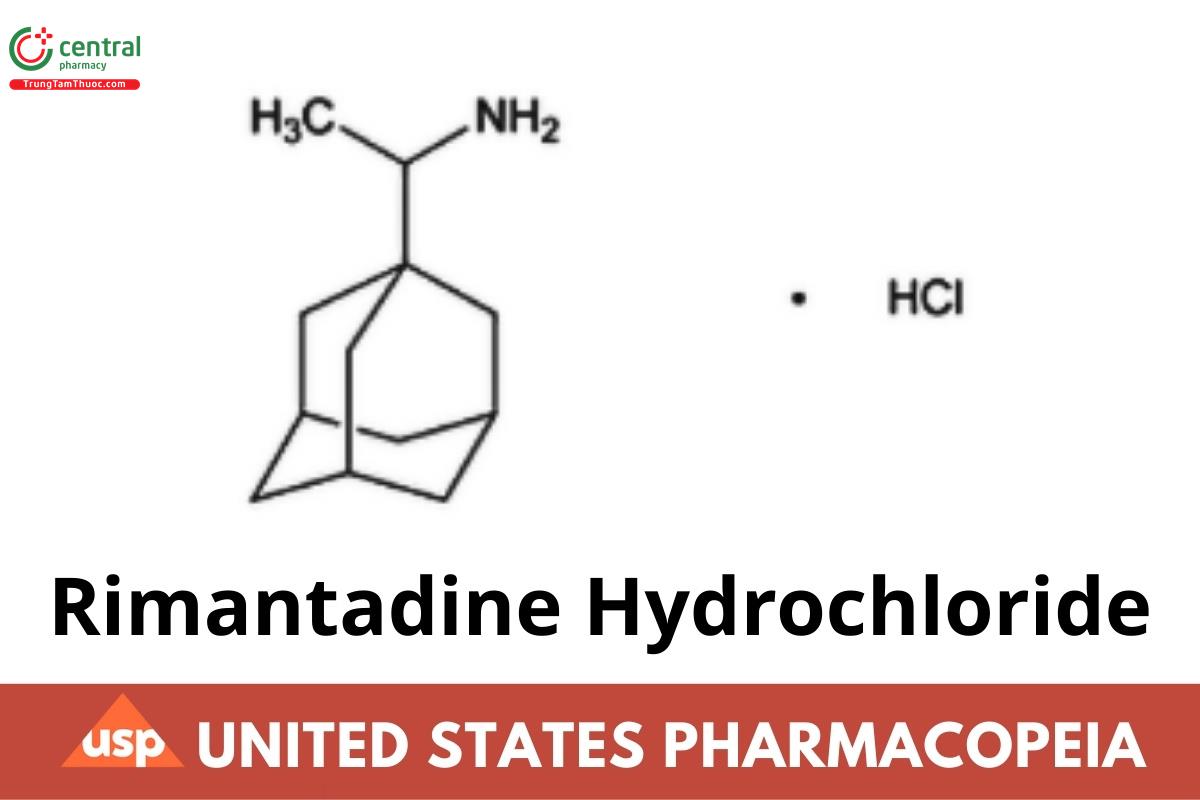
Rimantadine Hydrochloride
If you find any inaccurate information, please let us know by providing your feedback here

Tóm tắt nội dung
This article is compiled based on the United States Pharmacopeia (USP) – 2025 Edition
Issued and maintained by the United States Pharmacopeial Convention (USP)
C12H21N · HCl 215.76
Tricyclo[3.3.1.13,7]-decane-1-methanamine, α-methyl-, hydrochloride.
α-Methyl-1-adamantanemethylamine hydrochloride CAS RN®: 1501-84-4; UNII: JEI07OOS8Y.
Rimantadine Hydrochloride contains not less than 98.0 percent and not more than 102.0 percent of C12H21N · HCl, calculated on the dried basis.
Packaging and storage—Preserve in well-closed containers, and store between 15° to 30°.
1 USP Reference standards 〈11〉
USP Rimantadine Hydrochloride RS
2 Identification
A: Spectroscopic Identification Tests 〈197〉, Infrared Spectroscopy: 197K.
B: The retention time of the rimantadine peak in the chromatogram of the Assay preparation corresponds to that in the chromatogram of the Standard preparation, as obtained in the Assay.
Change to read:
X-ray powder diffraction 〈941〉 (CN 1-May-2022)—The X-ray diffraction pattern conforms to that of USP Rimantadine Hydrochloride RS, similarly determined.
Loss on drying 〈731〉—Dry it at 105° for 3 hours: it loses not more than 0.5% of its weight.
Residue on ignition 〈281〉: not more than 0.2%.
3 Ordinary impurities 〈466〉
Test solution—Transfer 100 mg of Rimantadine Hydrochloride to a 10-mL centrifuge tube, add 2 mL of 1 N sodium hydroxide, and mix. Add 2 mL of chloroform, and mix on a vortex mixer for 1 minute. Allow the layers to separate, and apply 10 µL of the organic layer.
Standard solution—Proceed as directed for the Test solution, using USP Rimantadine Hydrochloride RS in place of the test specimen.
Eluant: a mixture of ethyl acetate, methanol, and ammonium hydroxide (80:10:4).
Procedure—Use a low-actinic glass tank. Dry the plate in a stream of hot air, then heat in an oven at 105° for 30 minutes. Allow the plate to cool to room temperature.
Visualization—Place the plate in an atmosphere of chlorine, prepared by mixing 1.5% potassium permanganate solution and diluted hydrochloric acid (1:1), for about 90 minutes. Allow to air-dry for 60 minutes, and follow with visualization technique 20.
4 Limit of toluene
Standard solution—Transfer 10 µL of toluene to a 100-mL volumetric flask, dilute with chloroform to volume, and mix.
Test solution—Transfer about 750 mg of Rimantadine Hydrochloride, accurately weighed, to a 10-mL volumetric flask, dilute with chloroform to volume, and mix.
Chromatographic system (see Chromatography 〈621〉)—The gas chromatograph is equipped with a flame-ionization detector and a 2-mm × 2-m column that contains 80- to 100-mesh support S1A. The column temperature is maintained at about 200°, and nitrogen is used as the carrier gas. The injection port and detector temperatures are maintained at about 250°. Chromatograph the Standard solution, and record the peak responses as directed for Procedure: the tailing factor is not more than 1.5 for toluene; and the relative standard deviation for replicate injections is not more than 2.0%.
Procedure—Separately inject equal volumes (about 5 µL) of the Standard solution and the Test solution into the chromatograph, record the chromatograms for 9 minutes, and measure the responses for the toluene peaks. Calculate the percentage of toluene in the portion of Rimantadine Hydrochloride taken by the formula:
0.867(100/W)(rU/rS)
in which 0.867 is the specific gravity of toluene; W is the weight, in mg, of Rimantadine Hydrochloride taken to prepare the Test solution; and rU and rS are the toluene peak responses obtained from the Test solution and the Standard solution, respectively: not more than 0.1% is found.
5 Assay
Internal standard solution—Transfer about 400 mg of n-eicosane to a 250-mL volumetric flask, dilute with hexane to volume, and mix.
Standard preparation—Transfer about 40 mg of USP Rimantadine Hydrochloride RS, accurately weighed, to a 50-mL centrifuge tube, add 15 mL of 1 N sodium hydroxide, and mix. Add 25.0 mL of Internal standard solution, and shake by mechanical means for about 15 minutes. Allow the layers to separate, and filter a portion of the top hexane layer through anhydrous sodium sulfate. Use the clear filtrate.
Assay preparation—Using about 40 mg of Rimantadine Hydrochloride, accurately weighed, proceed as directed for Standard preparation.
Chromatographic system (see Chromatography 〈621〉)—The gas chromatograph is equipped with a flame-ionization detector and a 4-mm × 1.8-m glass column that is packed with 3% phase G19 on 100- to 200-mesh support S1A. The column temperature is maintained at about 160°, and the injection port and detector temperatures are maintained at about 250°. Nitrogen is used as the carrier gas. Adjust the carrier flow rate and temperature so that the n-eicosane elutes at about 8 minutes. Chromatograph the Standard preparation, and record the peak responses as directed for Procedure: the tailing factor is not more than 2.0 for rimantadine; and the relative standard deviation for replicate injections is not more than 2.0%.
Procedure—Separately inject equal volumes (about 2 µL) of the Standard preparation and the Assay preparation into the chromatograph, record the chromatograms, and measure the responses for the major peaks. Calculate the quantity, in mg, of C12H21N · HCl in the portion of Rimantadine Hydrochloride taken by the formula:
25C(RU/RS)
in which C is the concentration, in mg per mL, of USP Rimantadine Hydrochloride in the Standard preparation; and RU and RS are the ratios of the rimantadine peak response to the n-eicosane peak response obtained from the Assay preparation and the Standard preparation, respectively.

