
Riboavin 5′-Phosphate Sodium
If you find any inaccurate information, please let us know by providing your feedback here
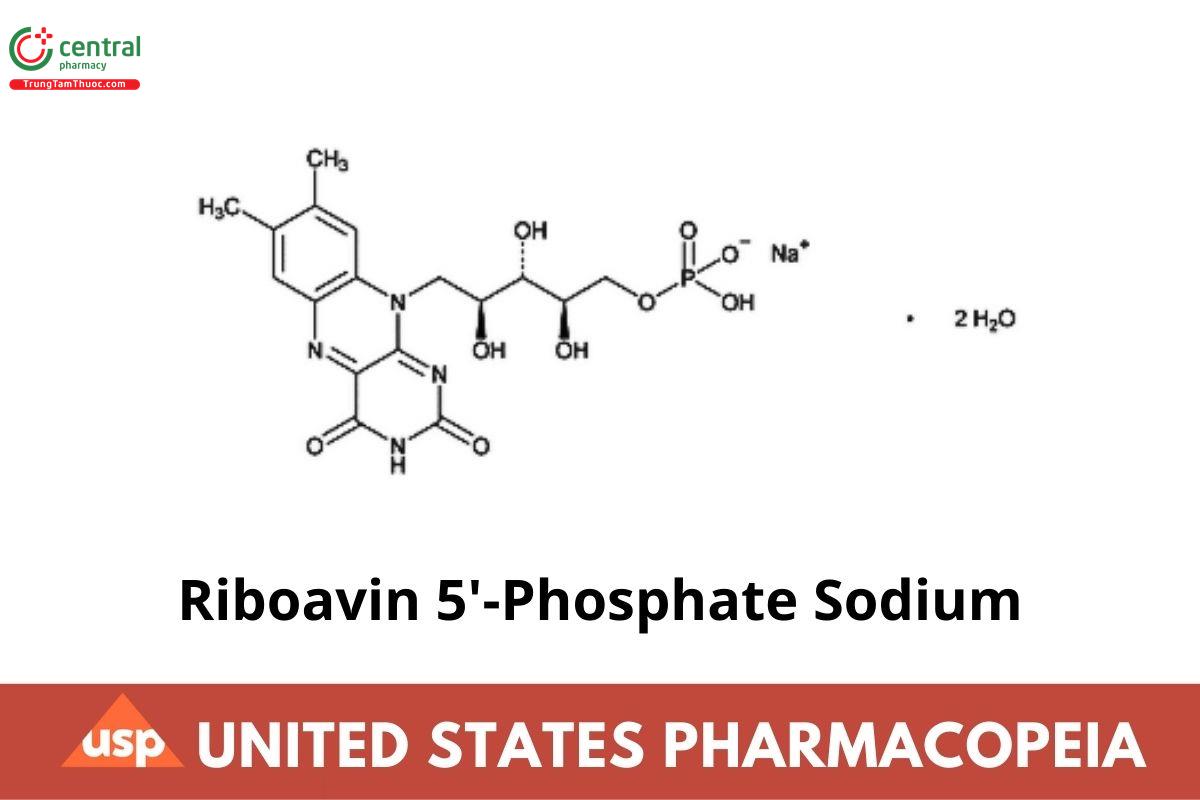

This article is compiled based on the United States Pharmacopeia (USP) – 2025 Edition
Issued and maintained by the United States Pharmacopeial Convention (USP)
1 DEFINITION
Riboflavin 5′-Phosphate Sodium contains NLT the equivalent of 73.0% and NMT the equivalent of 79.0% of riboflavin (C₁₇H₂₀N₄O₆), calculated on the dried basis.
2 IDENTIFICATION
A. Color and Fluorescence of Solution
Sample solution: 0.01 mg/mL in water
Analysis: Alternately expose to transmitted light and long-wavelength UV light.
Acceptance criteria: The solution is pale greenish yellow by transmitted light, and it exhibits an intense yellowish green fluorescence by reflected light under long-wavelength UV light that disappears upon the addition of mineral acids or alkalies.
B. Identification Tests—General, Sodium 〈191〉 and Phosphate 〈191〉
Sample solution: To 0.5 g add 10 mL of nitric acid. Evaporate the mixture on a water bath to dryness, and ignite the residue until the carbon is removed. Dissolve the residue in 5 mL of water, and filter.
Acceptance criteria: The Sample solution meets the requirements.
3 ASSAY
Procedure
[Note—Conduct the assay so that all solutions are protected from actinic light at all stages, preferably by using low-actinic glassware.]
Standard solution: 0.35 µg/mL prepared as follows. Transfer 35 mg of USP Riboflavin RS to a 250-mL conical flask. Add 20 mL of pyridine and 75 mL of water, and dissolve the riboflavin by frequent shaking. Transfer the solution to a 1000-mL volumetric flask, and dilute with water to volume. Transfer 10.0 mL of this solution to a second 1000-mL volumetric flask, add sufficient 0.1 N sulfuric acid (about 4 mL) so that the final pH of the solution is between 5.9 and 6.1, and dilute with water to volume.
Sample solution: Transfer 50 mg of Riboflavin 5′-Phosphate Sodium to a 250-mL conical flask. Add 20 mL of pyridine and 75 mL of water, and dissolve the riboflavin by frequent shaking. Transfer the solution to a 1000-mL volumetric flask, and dilute with water to volume. Transfer 10.0 mL of this solution to a second 1000-mL volumetric flask, add sufficient 0.1 N sulfuric acid (about 4 mL) so that the final pH of the solution is between 5.9 and 6.1, and dilute with water to volume.
Blank: Proceed as directed in the Analysis, omitting the test specimen.
Instrumental conditions
(See Fluorescence Spectroscopy 〈853〉.)
Mode: Fluorescence
Excitation wavelength: 440 nm
Emission wavelength: 530 nm
Analysis
Samples: Standard solution, Sample solution, and Blank
Determine the maximum fluorescence intensities of the solutions against the Blank.
Calculate the percentage of riboflavin (C₁₇H₂₀N₄O₆) in the portion of Riboflavin 5′-Phosphate Sodium taken:
Result = (Iᵤ / Iₛ) × (Cₛ / Cᵤ) × 100
Iᵤ = fluorescence intensity from the Sample solution
Iₛ = fluorescence intensity from the Standard solution
Cₛ = concentration of USP Riboflavin RS in the Standard solution (µg/mL)
Cᵤ = concentration of Riboflavin 5′-Phosphate Sodium in the Sample solution (µg/mL)
Acceptance criteria: 73.0%–79.0% on the dried basis
4 IMPURITIES
Free Phosphate
Acid molybdate solution: Prepare a 70-mg/mL solution of ammonium molybdate in water. Dilute 25 mL of this solution with water to 200 mL. To this dilution slowly add 25 mL of 7.5 N sulfuric acid.
Ferrous sulfate solution: 100 mg/mL of ferrous sulfate in 0.15 N sulfuric acid, prepared just before use
Standard solution: 44.0 µg/mL of monobasic potassium phosphate in water
Sample solution: 3 mg/mL of Riboflavin 5′-Phosphate Sodium in water
Blank: Water
Instrumental conditions
(See Ultraviolet-Visible Spectroscopy 〈857〉.)
Mode: UV-Vis
Analytical wavelength: 700 nm
Cell: 1 cm
Analysis
Samples: Standard solution, Sample solution, and Blank
Transfer 10.0 mL each to separate 50-mL conical flasks. Add 10.0 mL of Acid molybdate solution and 5.0 mL of Ferrous sulfate solution. Mix and determine the absorbances against the Blank.
Acceptance criteria: NMT 1% as PO₄. The absorbance of the Sample solution is NMT that of the Standard solution.
Free Riboflavin and Riboflavin Diphosphates
[Note—Protect all solutions from actinic light.]
Mobile phase: Methanol and 0.054 M monobasic potassium phosphate (15:85)
System suitability solution: Prepare a 2-mg/mL solution of USP Phosphated Riboflavin RS in water. Dilute to 160 µg/mL with Mobile phase.
Standard solution: 60 mg USP Riboflavin RS in 250 mL. Dissolve in 1 mL hydrochloric acid, dilute with water to volume, then dilute to 9.6 µg/mL with Mobile phase.
Sample solution: 2-mg/mL solution of Riboflavin 5′-Phosphate Sodium in water. Dilute to 160 µg/mL with Mobile phase.
Chromatographic system
Mode: LC
Detector: Fluorometer
Excitation: 440 nm
Emission: 530 nm (monochromator) or 470 nm (filter)
Column: 3.9-mm × 30-cm; packing L1
Flow rate: 2 mL/min
Injection size: 100 µL
| Name | Relative Retention Time |
|---|---|
| Riboflavin 3′4′-diphosphate | 0.23 |
| Riboflavin 3′5′-diphosphate | 0.39 |
| Riboflavin 4′5′-diphosphate | 0.58 |
| Riboflavin 3′-monophosphate | 0.70 |
| Riboflavin 4′-monophosphate | 0.87 |
| Riboflavin 5′-monophosphate | 1.00 |
| Riboflavin | 1.63 |
The retention time of riboflavin 5′-monophosphate is 20–25 min.
System suitability
Resolution: NLT 1.0 between riboflavin 4′-monophosphate and riboflavin 5′-monophosphate
Relative standard deviation: NMT 1.5% for riboflavin 5′-monophosphate
Analysis
Samples: Standard solution and Sample solution
Identify peaks by comparison with the System suitability solution.
Calculate free riboflavin:
Result = (rᵤ / rₛ) × (Cₛ / Cᵤ) × 100
rᵤ = peak area of free riboflavin from Sample
rₛ = peak area of riboflavin from Standard
Cₛ = concentration of USP Riboflavin RS (µg/mL)
Cᵤ = concentration of Riboflavin 5′-Phosphate Sodium (µg/mL)
Calculate riboflavin diphosphates:
Result = (rᵤ / rₛ) × (Cₛ / Cᵤ) × 100
rᵤ = sum of peak areas of riboflavin diphosphates
rₛ = peak area of riboflavin from Standard
Cₛ = concentration of USP Riboflavin RS (µg/mL)
Cᵤ = concentration of Riboflavin 5′-Phosphate Sodium (µg/mL)
Acceptance criteria:
Free riboflavin: NMT 6.0% (dried basis)
Riboflavin diphosphates: NMT 6.0% (dried basis)
Limit of Lumiflavin
Alcohol-free chloroform: Prepare by washing chloroform with water and drying over anhydrous sodium sulfate.
Sample solution: Shake 35 mg of Riboflavin 5′-Phosphate Sodium with 10 mL of Alcohol-free chloroform for 5 min, and filter.
Blank: Alcohol-free chloroform
Instrumental conditions
(See Ultraviolet-Visible Spectroscopy 〈857〉.)
Analytical wavelength: 440 nm
Cell: 1 cm
Analysis
Measure absorbance of Sample vs Blank.
Acceptance criteria: Absorbance NMT 0.025.
5 SPECIFIC TESTS
Residue on Ignition 〈281〉: NMT 25.0%
Optical Rotation, Specific Rotation 〈781S〉:
Sample: 15 mg/mL in 5 N HCl, used within 15 min
Acceptance criteria: +37.0° to +42.0°
pH 〈791〉: 10 mg/mL
Acceptance criteria: 5.0–6.5
Loss on Drying 〈731〉:
Dry under vacuum over phosphorus pentoxide at 100° for 5 h
Acceptance criteria: NMT 7.5%
6 ADDITIONAL REQUIREMENTS
Packaging and Storage: Preserve in tight, light-resistant containers.
USP Reference Standards 〈11〉
USP Phosphated Riboflavin RS
USP Riboflavin RS

