
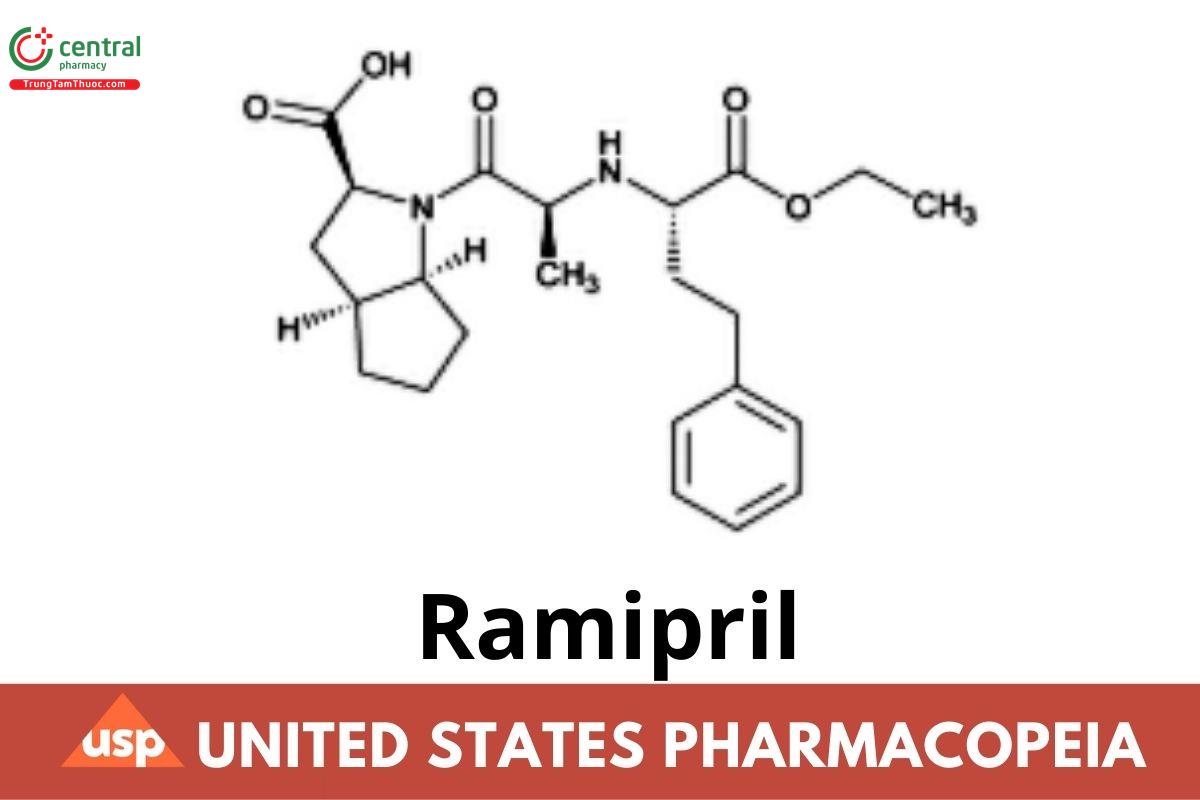
Ramipril
If you find any inaccurate information, please let us know by providing your feedback here

Tóm tắt nội dung
This article is compiled based on the United States Pharmacopeia (USP) – 2025 Edition
Issued and maintained by the United States Pharmacopeial Convention (USP)
C23H32N2O5 416.52
Cyclopenta[b]pyrrole-2-carboxylic acid, 1-[2-[[1-(ethoxycarbonyl)-3-phenylpropyl]amino]-1-oxopropyl]octahydro-, [2S-[1[R*(R*)],2α,3aβ,6aβ]]-; (2S,3aS,6aS)-1-[(S)-N-[(S)-1-Carboxy-3-phenylpropyl]alanyl]octahydrocyclopenta[b]pyrrole-2-carboxylic acid, 1-ethyl ester (2S,3aS,6aS)-1-{[(S)-1-Ethoxy-1-oxo-4-phenylbutan-2-yl]-L-alanyl}octahydrocyclopenta[b]pyrrole-2-carboxylic acid CAS RN®: 87333-19-5; UNII: L35JN3I7SJ.
1 DEFINITION
Ramipril contains NLT 98.0% and NMT 102.0% of ramipril (C23H32N2O5), calculated on the dried basis.
2 IDENTIFICATION
A. Spectroscopic Identification Tests 〈197〉, Infrared Spectroscopy: 197K
B: The retention time of the major peak of the Sample solution corresponds to that of the Standard solution, as obtained in the Assay.
3 ASSAY
Change to read:
Procedure
Buffer: 0.1% solution of sodium dodecyl sulfate. Adjust with phosphoric acid to a pH of 2.4 ± 0.1.
Mobile phase: Acetonitrile and Buffer (45:55). Adjust with phosphoric acid to a pH of 2.75 ± 0.1.
System suitability solution: 0.2 mg/mL of USP Ramipril RS and 0.01 mg/mL of USP Ramipril Related Compound A RS, in Mobile phase Standard solution: 0.2 mg/mL of USP Ramipril RS in Mobile phase
Sample stock solution: 1 mg/mL of Ramipril prepared as follows. Dissolve 100 mg of Ramipril in 10 mL of Acetonitrile in a 100-mL volumetric flask, and dilute with Mobile phase to volume.
Sample solution: 0.2 mg/mL of Ramipril in Mobile phase from Sample stock solution
Chromatographic system
(See Chromatography 〈621〉, System Suitability.)
Mode: LC
Detector: UV 210 nm
Column: 4.6-mm × 15-cm; 5 μm packing L1
Flow rate: 1.8 mL/min
Injection volume: 20 µL
Run time: NLT 2 times the retention time of ramipril
System suitability
Samples: System suitability solution and Standard solution
[Note—The relative retention time for ramipril related compound A and ramipril are 0.8 and 1.0, respectively.] Suitability requirements
Resolution: NLT 2.0 between ramipril and ramipril related compound A, System suitability solution
Relative standard deviation: NMT 0.73%, Standard solution
Analysis
Samples: Standard solution and Sample solution
Calculate the percentage of ramipril (C23H32N2O5) in the portion of Ramipril taken:
Result = (rU/rS) × (CS/CU) × 100
rU = peak response of ramipril from the Sample solution
rS = peak response of ramipril from the Standard solution
CS = concentration of USP Ramipril RS in the Standard solution (mg/mL)
CU = nominal concentration of ramipril in the Sample solution (mg/mL)
Acceptance criteria: 98.0%–102.0% on the dried basis
4 IMPURITIES
Residue on Ignition 〈281〉: NMT 0.1%
Delete the following:
Limit of Palladium
Diluent: Water and nitric acid (997:3)
Standard stock solution: Dissolve 50 mg of palladium metal taken in a 100-mL volumetric flask, in 9 mL of hydrochloric acid, and dilute with water to volume.
Standard solutions: 0.02, 0.03, and 0.05 µg/mL of palladium in Diluent from Standard stock solution
Sample solution: 2 mg/mL of Ramipril in Diluent
Blank solution: 1.5 mg/mL of magnesium nitrate in Diluent
Instrumental conditions
(See Atomic Absorption Spectroscopy 〈852〉.)
Mode: Atomic absorption spectrophotometry
Analytical wavelength: 247.6 nm palladium emission line
Lamp: Palladium hollow-cathode
Flame: Air–acetylene
Injection volume: 20 µL each for the Standard solutions and Sample solution, and 10 µL for the Blank solution Analysis: Concomitantly determine the absorbances of the Standard solutions, Sample solution, and the Blank solution. Plot the absorbances of the Standard solutions versus the concentration, in µg/mL, of palladium, and draw the straight line best fitting the three plotted points. From the graph so obtained, determine the concentration, CP , in µg/mL, of palladium in the Sample solution.
Calculate the percentage of palladium in the portion of Ramipril taken:
Result = (CP/CR) × 100
CP = concentration of palladium in the Sample solution (µg/mL)
CR = concentration of Ramipril in the Sample solution (µg/mL)
Acceptance criteria: 20 ppm
Change to read:
Organic Impurities
Solution A: 2.0 g of sodium perchlorate in a mixture of 800 mL of water and 0.5 mL of triethylamine. Adjust with phosphoric acid to a pH of about 3.6 ± 0.1, and add 200 mL of acetonitrile.
Solution B: 2.0 g of sodium perchlorate in a mixture of 300 mL of water and 0.5 mL of triethylamine. Adjust with phosphoric acid to a pH of about 2.6 ± 0.1, and add 700 mL of acetonitrile.
System suitability solution: 0.5 mg/mL each of USP Ramipril RS, USP Ramipril Related Compound A RS, USP Ramipril Related Compound B RS, USP Ramipril Related Compound C RS, and USP Ramipril Related Compound D RS in Solution B
Standard solution: 5 µg/mL of USP Ramipril RS in Solution B
Sensitivity solution: 0.5 µg/mL of USP Ramipril RS in Solution B from Standard solution
Sample solution: 1 mg/mL of Ramipril in Solution A. Keep the Sample solution cold until injected.
Mobile phase: See Table 1.
Table 1
Time (min) | Solution A (%) | Solution B (%) |
0 | 90 | 10 |
6 | 90 | 10 |
7 | 75 | 25 |
20 | 65 | 35 |
30 | 25 | 75 |
40 | 25 | 75 |
45 | 90 | 10 |
55 | 90 | 10 |
Chromatographic system
(See Chromatography 〈621〉, System Suitability.)
Mode: LC
Detector: UV 210 nm
Column: 4.0-mm × 25-cm; 3-µm packing L1
Column temperature: 65°
Flow rate: 1 mL/min
Injection volume: 10 µL
System suitability
Samples: System suitability solution, Standard solution, and Sensitivity solution
[Note—See Table 2 for relative retention times.]
Suitability requirements
Resolution: NLT 3.0 between ramipril related compound A and ramipril, System suitability solution
Relative standard deviation: NMT 5.0% for ramipril, Standard solution
Signal-to-noise ratio: NLT 10, Sensitivity solution
Analysis
Samples: Standard solution and Sample solution
Calculate the percentage of each specified and any unspecified impurity in the portion of Ramipril taken:
Result = (rU/rS) × (CS/CU) × 100 × (1/F)
rU = peak response of each individual impurity from the Sample solution
rS = peak response of ramipril from the Standard solution
CS = concentration of USP Ramipril RS in the Standard solution (mg/mL)
CU = concentration of ramipril in the Sample solution (mg/mL)
F = relative response factor (see Table 2)
Acceptance criteria: See Table 2. The reporting threshold is 0.05%.
Table 2
Name | Relative Retention Time | Relative Response Factor | Acceptance Criteria, NMT (%) |
Ramipril related compound A | 0.8 | 1.0 | 0.5 |
Ramipril | 1.0 | — | — |
Ramipril related compound B | 1.3 | 1.0 | 0.5 |
Ramipril related compound C | 1.5 | 0.42 | 0.5 |
Ramipril related compound D | 1.6 | 1.0 | 0.5 |
Any unspecified impurity | — | — | 0.10 |
Total impurities | — | — | 1.0 |
5 SPECIFIC TESTS
Optical Rotation 〈781S〉, Procedures, Specific Rotation
Sample solution: 10 mg/mL of Ramipril in 0.1 M methanolic hydrochloric acid
Acceptance criteria: +32.0° to +38.0°, at 20°
Loss on Drying 〈731〉
Analysis: Dry under vacuum at a pressure not exceeding 5 mm of mercury at 60° for 6 h.
Acceptance criteria: NMT 0.2%
6 ADDITIONAL REQUIREMENTS
Packaging and Storage: Preserve in tight containers.
Change to read:
USP Reference Standards 〈11〉
USP Ramipril RS
USP Ramipril Related Compound A RS
(2S,3aS,6aS)-1-{[(S)-1-carboxy-3-phenylpropyl]-L-alanyl}octahydrocyclopenta[b]pyrrole-2-carboxylic acid.
C22H30N2O5 402.49
USP Ramipril Related Compound B RS
(2S,3aS,6aS)-1-{[(S)-1-Methoxy-1-oxo-4-phenylbutan-2-yl]-L-alanyl}octahydrocyclopenta[b]pyrrole-2-carboxylic acid; Also known as Ramipril isopropylester.
C24H34N2O5 430.55
USP Ramipril Related Compound C RS
(2S,3aS,6aS)-1-{[(S)-4-Cyclohexyl-1-ethoxy-1-oxobutan-2-yl]-L-alanyl}octahydrocyclopenta[b]pyrrole-2-carboxylic acid hydrochloride; Also known as Hexahydroramipril hydrochloride.
C23H38N2O5 · HCl 459.02
USP Ramipril Related Compound D RS
Ethyl (S)-2-[(3S,5aS,8aS,9aS)-3-methyl-1,4-dioxodecahydro-2H-cyclopenta[4,5]pyrrolo[1,2-a]pyrazin-2-yl]-4-phenylbutanoate.
C23H30N2O4 398.50

