
Raloxifene Hydrochloride
If you find any inaccurate information, please let us know by providing your feedback here
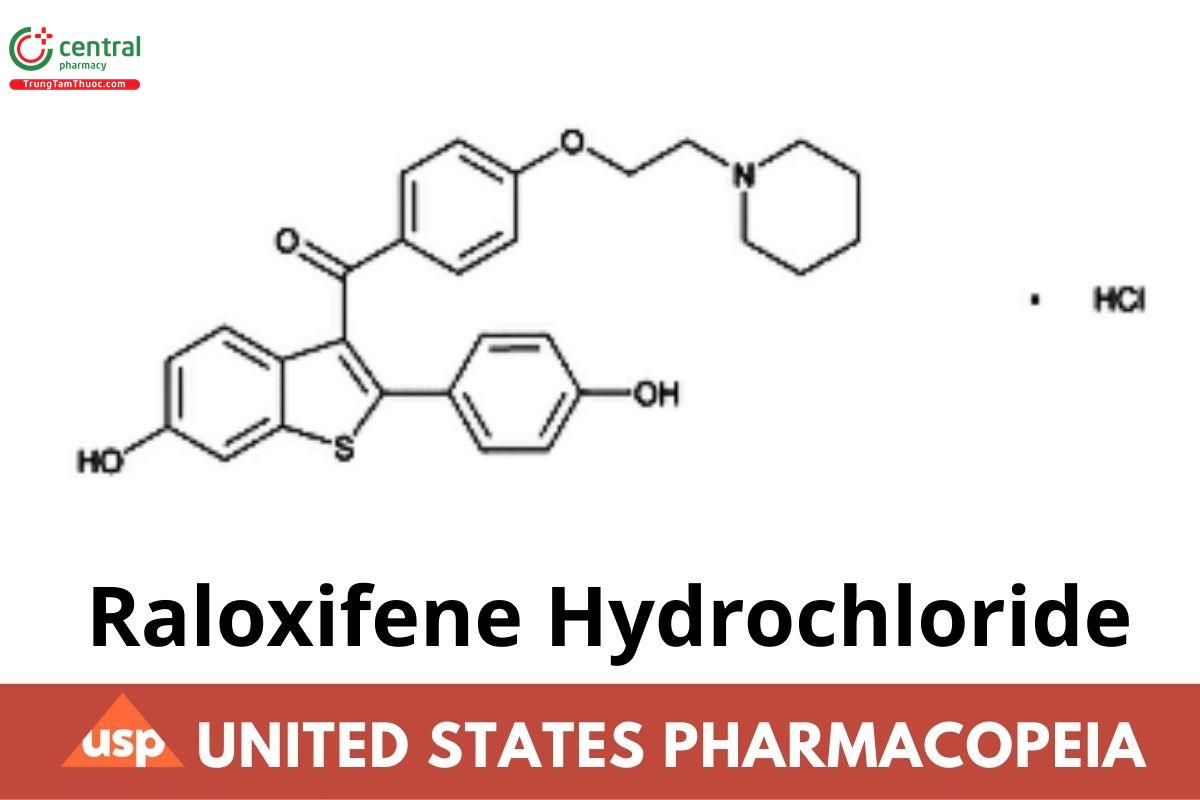

This article is compiled based on the United States Pharmacopeia (USP) – 2025 Edition
Issued and maintained by the United States Pharmacopeial Convention (USP)
C28H27NO4S · HCl 510.04
Methanone, [6-hydroxy-2-(4-hydroxyphenyl)benzo[b]thien-3-yl][4-[2-(1-piperidinyl)ethoxy]phenyl]-, hydrochloride; 6-Hydroxy-2-(p-hydroxyphenyl)benzo[b]thien-3-yl-p-(2-piperidinoethoxy)phenyl ketone, hydrochloride CAS RN®: 82640-04-8; UNII: 4F86W47BR6.
1 DEFINITION
Raloxifene Hydrochloride contains NLT 97.5% and NMT 102.0% of raloxifene hydrochloride (C28H27NO4S · HCl), calculated on the dried basis.
2 IDENTIFICATION
Change to read:
A. Spectroscopic Identification Tests 〈197〉, Infrared Spectroscopy: 197K
B. Identification Tests—General, Chloride〈191〉: It meets the requirements, the sample being dissolved in methanol.
3 ASSAY
Procedure
Buffer: Dissolve 7.2 g of monobasic potassium phosphate in 1000 mL of water. Add 1.5 mL of phosphoric acid, and further adjust with phosphoric acid or potassium hydroxide solution to a pH of 2.5 ± 0.1.
Mobile phase: Acetonitrile and Buffer (33:67)
System suitability solution: Prepare as directed in the test for Organic Impurities.
Standard solution: 0.05 mg/mL of USP Raloxifene Hydrochloride RS in Mobile phase
Sample solution: 0.05 mg/mL of Raloxifene Hydrochloride in Mobile phase
Chromatographic system
(See Chromatography 〈621〉, System Suitability.)
Mode: LC
Detector: UV 280 nm
Column: 4.6-mm × 15-cm; 3.5-µm base-deactivated packing L7
Column temperature: 35°
Flow rate: 1.5 mL/min
Injection volume: 10 µL
System suitability
Sample: System suitability solution
Suitability requirements
Resolution: NLT 2.0 between raloxifene and raloxifene related compound C
Tailing factor: NMT 2.0 for raloxifene
Relative standard deviation: NMT 0.7% for raloxifene
Analysis
Samples: Standard solution and Sample solution
Calculate the percentage of raloxifene hydrochloride (C28H27NO4S · HCl) in the portion of Raloxifene Hydrochloride taken:
Result = (rU/rS) × (CS/CU) × 100
rU = peak response from the Sample solution
rS = peak response from the Standard solution
CS = concentration of USP Raloxifene Hydrochloride RS in the Standard solution (mg/mL)
CU = concentration of the Sample solution (mg/mL)
Acceptance criteria: 97.5%–102.0% on the dried basis
4 IMPURITIES
Residue on Ignition 〈281〉: NMT 0.1%
Organic Impurities
Solution A: Dissolve 9.0 g of monobasic potassium phosphate in 1000 mL of water. Add 0.6 mL of phosphoric acid, and further adjust with phosphoric acid or potassium hydroxide solution to a pH of 3.0 ± 0.1.
Solution B: Acetonitrile
Mobile phase: See Table 1. [Note—Adjust the start time of the gradient step on the basis of the instrument's dwell volume.] Table 1
| Time (min) | Solution A (%) | Solution B (%) |
| 0.00 | 75 L | 25 |
| 9.00 | 75 | 25 |
| 40.25 | 50 | 50 |
| 42.25 | 75 | 25 |
| 49.00 | 75 | 25 |
Diluent A: Solution A and acetonitrile (70:30)
Diluent B: Tetrahydrofuran and methanol (70:30)
Raloxifene related compound C solution: 0.15 mg/mL of USP Raloxifene Related Compound C RS in Diluent B
System suitability solution: Transfer 15 mg of USP Raloxifene Hydrochloride RS to a 50-mL volumetric flask, add 1.0 mL of Raloxifene related compound C solution, and dilute with Diluent A to volume.
Standard solution: 0.003 mg/mL of USP Raloxifene Hydrochloride RS in Diluent A
Sample solution: 3 mg/mL of Raloxifene Hydrochloride in Diluent A
Chromatographic system
(See Chromatography 〈621〉, System Suitability.)
Mode: LC
Detector: UV 280 nm
Column: 4.6-mm × 25-cm; 5-µm base-deactivated packing L7
Column temperature: 35°
Flow rate: 1 mL/min
Injection volume: 10 µL
System suitability
Sample: System suitability solution
Suitability requirements
Resolution: NLT 3.0 between raloxifene and raloxifene related compound C
Tailing factor: NMT 2.0 for raloxifene
Analysis
Samples: Standard solution and Sample solution
Record the chromatograms for NLT two times the retention time of the raloxifene peak, and measure all of the peak responses. Calculate the percentage of each impurity in the portion of Raloxifene Hydrochloride taken:
Result = (rU/rS) × (CS/CU) × 100
rU = peak response of each impurity in the Sample solution
rS = peak response of raloxifene in the Standard solution
CS = concentration of USP Raloxifene Hydrochloride RS in the Standard solution (mg/mL)
CU = concentration of the Sample solution (mg/mL)
Acceptance criteria: See Table 2. The reporting level for impurities is 0.05%.
Table 2
| Name | Relative Retention Time | Acceptance Criteria, NMT (%) |
| Raloxifene 3,7-diketonea | 0.74 | 0.20 |
| Raloxifene | 1.00 | — |
| Any unspecified individual impurity | — | 0.10 |
| Total impurities | — | 0.5 |
a Methanone, [6-hydroxy-2-(4-hydroxyphenyl)benzo[b]thien-3,7-diyl]bis[4-[2-(1-piperidinyl)ethoxy]phenyl].
5 SPECIFIC TESTS
Loss on Drying 〈731〉
Analysis: Dry a sample at 105° for 3 h.
Acceptance criteria: NMT 0.5%
6 ADDITIONAL REQUIREMENTS
Packaging and Storage: Preserve in well-closed containers, and store at room temperature.
USP Reference Standards 〈11〉
USP Raloxifene Hydrochloride RS
USP Raloxifene Related Compound C RS
1-(2-{4-[6-Hydroxy-2-(4-hydroxyphenyl)benzothiophene-3-carbonyl]phenoxy}ethyl)piperidine 1-oxide monohydrate.
C28H27NO5S. H2O 507.60

