
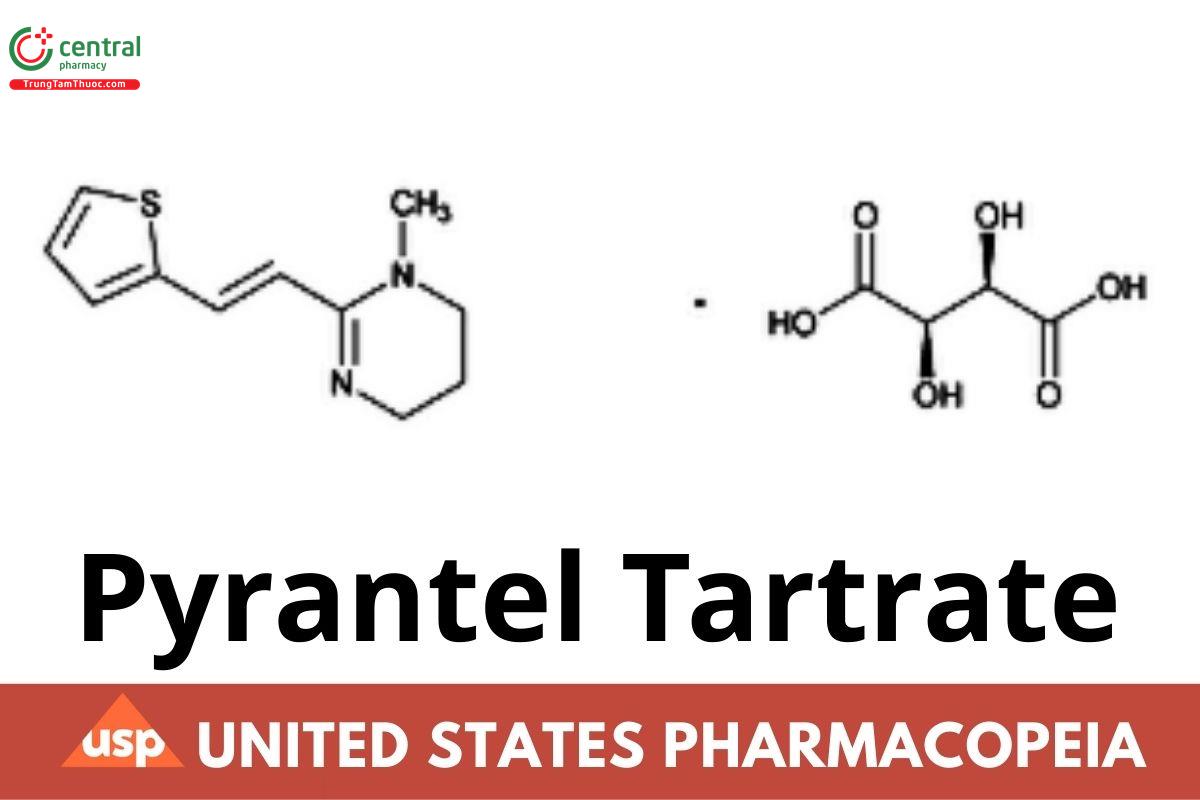
Pyrantel Tartrate
If you find any inaccurate information, please let us know by providing your feedback here

Tóm tắt nội dung
This article is compiled based on the United States Pharmacopeia (USP) – 2025 Edition
Issued and maintained by the United States Pharmacopeial Convention (USP)
C11H14N2S.C4H16O6 356.39
Pyrimidine, 1,4,5,6-tetrahydro-1-methyl-2-[2-(2-thienyl)ethenyl]-, (E)-, (2R,3R)-2,3-dihydroxybutanedioate (1:1); (E)-1,4,5,6-Tetrahydro-1-methyl-2-[2-(2-thienyl)vinyl]pyrimidine tartrate (1:1) CAS RN®: 33401-94-4; UNII: SC82VF0480.
1 DEFINITION
Pyrantel Tartrate contains NLT 98.0% and NMT 102.0% of pyrantel tartrate (C11H14N2S.C4H16O6), calculated on the dried basis.
2 IDENTIFICATION
Change to read:
A. Spectroscopic Identification Tests 〈197〉, Infrared Spectroscopy: 197K (CN 1-May-2020)
[Note—Concomitantly prepare potassium bromide dispersions of the Standard and sample. Differences between sets of Standard/sample spectra may occur as a result of differing specimen preparation or environmental conditions.]
B. Identification Tests—General, Tartrate 〈191〉
C. The retention time of the major peak of the Sample solution corresponds to that of the Standard solution, as obtained in the Assay.
3 ASSAY
Procedure
[Note—Protect all solutions containing Pyrantel Tartrate from light.]
Mobile phase: Acetonitrile, glacial acetic acid, diethylamine, and water (94:2.5:1:2.5)
Standard solution: 0.42 mg/mL of USP Pyrantel Tartrate RS in Mobile phase
Sample solution: 0.42 mg/mL of Pyrantel Tartrate in Mobile phase
Chromatographic system
(See Chromatography 〈621〉, System Suitability.)
Mode: LC
Detector: UV 316 nm
Column: 4.6-mm × 25-cm; 5-µm packing L3
Flow rate: 1 mL/min
Injection volume: 5 µL
System suitability
Sample: Standard solution
Suitability requirements
Tailing factor: NMT 1.5
Relative standard deviation: NMT 0.73%
Analysis
Samples: Standard solution and Sample solution
Calculate the percentage of pyrantel tartrate (C11H14N2S.C4H16O6) in the portion of Pyrantel Tartrate taken:
Result = (rU/rS) × (CS/CU) × 100
rU = peak response from the Sample solution
rS = peak response from the Standard solution
CS = concentration of USP Pyrantel Tartrate RS in the Standard solution (mg/mL)
CU = concentration of Pyrantel Tartrate in the Sample solution (mg/mL)
Acceptance criteria: 98.0%–102.0% on the dried basis
4 IMPURITIES
Residue on Ignition 〈281〉: NMT 0.1%
Organic Impurities
[Note—Protect all solutions containing Pyrantel Tartrate from light.]
Mobile phase: Acetonitrile, glacial acetic acid, diethylamine, and water (94:2.5:1:2.5)
Standard solution: 0.84 µg/mL of USP Pyrantel Tartrate RS in Mobile phase
Sample solution: 0.42 mg/mL of Pyrantel Tartrate in Mobile phase
System suitability solution: Expose a portion of the Sample solution to short-wavelength UV light for 30 min (Pyrantel Tartrate undergoes partial degradation to cis-pyrantel). A degradation level to at least 0.3% of cis-pyrantel must be obtained, as shown by the appearance of a corresponding peak in the chromatogram. If it is not obtained, again expose the solution to short-wavelength UV light. Chromatographic system
(See Chromatography 〈621〉, System Suitability.)
Mode: LC
Detector: UV 236 and 316 nm
Column: 4.6-mm × 25-cm; 5-µm packing L3
Flow rate: 1 mL/min
Run time: 2.5 times the retention time of pyrantel
Injection volume: 100 µL
System suitability
Sample: System suitability solution
[Note—The relative retention times for pyrantel and cis-pyrantel are 1.0 and 1.2, respectively.]
Suitability requirements
System suitability requirements must be met at both 236 and 316 nm.
Resolution: NLT 1.5 between pyrantel and cis-pyrantel
Analysis
Samples: Standard solution and Sample solution
Calculate the percentage of each impurity detected at 236 nm in the portion of Pyrantel Tartrate taken:
Result = (rU/rS) × (CS/CU) × 100
rU = peak response of each individual impurity detected at 236 nm from the Sample solution
rS = peak response detected at 236 nm from the Standard solution
CS = concentration of the Standard solution (µg/mL)
CU = concentration of the Sample solution (µg/mL)
Calculate the percentage of each impurity detected at 236 nm in the portion of Pyrantel Tartrate taken:
Result = (rU/rS) × (CS/CU) × 100
rU = peak response of each individual impurity detected at 316 nm from the Sample solution
rS = peak response detected at 316 nm from the Standard solution
CS = concentration of the Standard solution (µg/mL)
CU = concentration of the Sample solution (µg/mL)
Acceptance criteria
Any individual impurity: NMT 0.2% of any individual impurity detected at 236 nm; NMT 0.2% of any individual impurity detected at 316 nm
Total impurities: NMT 1.0% of total impurities detected at 236 nm; NMT 1.0% of total impurities detected at 316 nm
5 SPECIFIC TESTS
pH 〈791〉
Sample solution: 10.0 mg/mL in carbon dioxide-free water
Acceptance criteria: 3.3–3.7
Loss on Drying 〈731〉
Analysis: Dry at 105° for 4 h.
Acceptance criteria: NMT 1.0%
6 ADDITIONAL REQUIREMENTS
Packaging and Storage: Preserve in well-closed containers protected from light, and store at room temperature.
Labeling: Label it to indicate that it is for veterinary use only.
USP Reference Standards 〈11〉
USP Pyrantel Tartrate RS

