
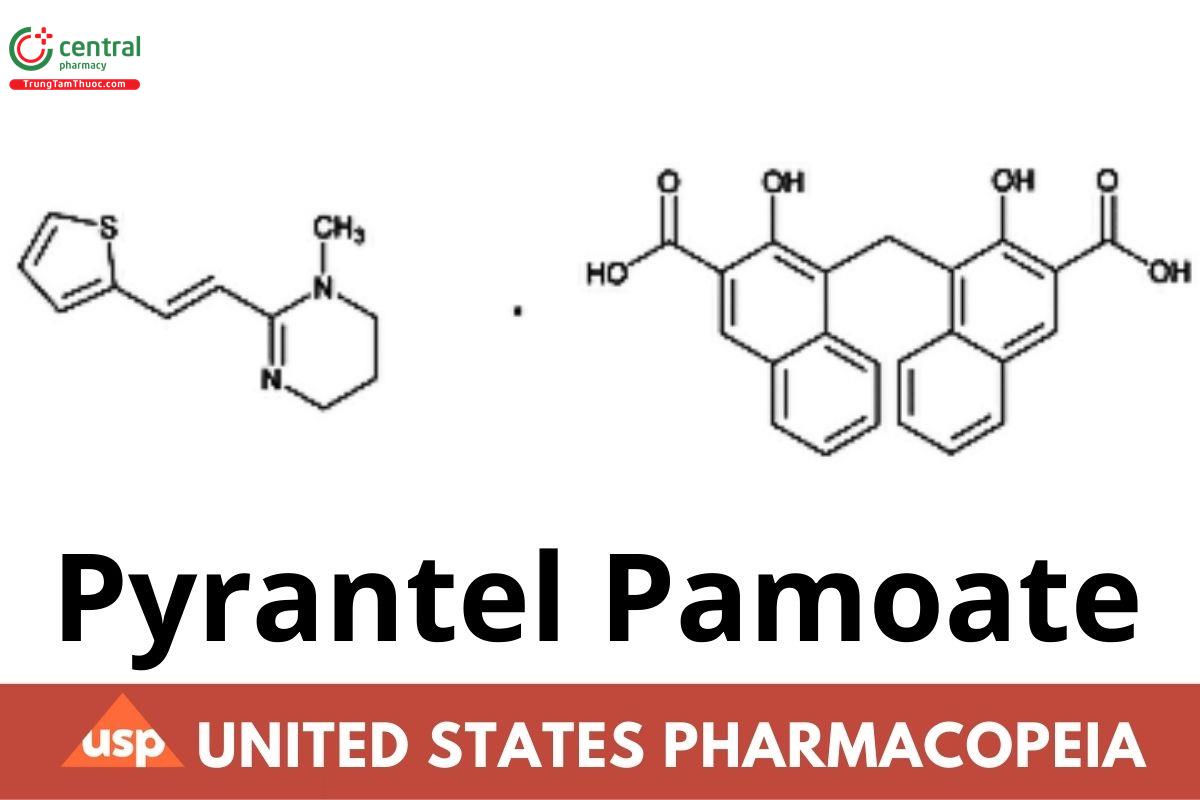
Pyrantel Pamoate
If you find any inaccurate information, please let us know by providing your feedback here

Tóm tắt nội dung
This article is compiled based on the United States Pharmacopeia (USP) – 2025 Edition
Issued and maintained by the United States Pharmacopeial Convention (USP)
C11H14N2S.C23H16O6 594.68
Pyrimidine, 1,4,5,6-tetrahydro-1-methyl-2-[2-(2-thienyl) ethenyl]-, (E)-, compd. with 4,4'-methylenebis[3-hydroxy-2-naphthalenecarboxylic acid] (1:1);
(E)-1,4,5,6-Tetrahydro-1-methyl-2-[2-(2-thienyl)vinyl]pyrimidine 4,4'-methylenebis[3-hydroxy-2-naphthoate] (1:1) CAS RN®: 22204-24-6; UNII: 81BK194Z5M.
1 DEFINITION
Pyrantel Pamoate contains NLT 97.0% and NMT 103.0% of pyrantel pamoate (C34H30N2O6S), calculated on the dried basis.
2 IDENTIFICATION
A. Spectroscopic Identification Tests 〈197〉, Infrared Spectroscopy: 197K or 197A
B. The retention time of the major peaks due to pyrantel base and pamoic acid of the Sample solution correspond to those of the Standard solution, as obtained in the Assay.
3 ASSAY
Procedure
[Note—Use low-actinic glassware in preparing solutions of pyrantel pamoate, or otherwise protect the solutions from unnecessary exposure to bright light. Complete the Assay without prolonged interruption.]
Mobile phase: Acetonitrile, glacial acetic acid, diethylamine, and water (92.8: 3: 1.2: 3)
[Note—Increasing the amount of acetonitrile in the Mobile phase increases retention times. Increasing the amount of acetic acid, water, and diethylamine decreases retention times. Should the Mobile phase need to be adjusted, maintain the ratios among acetic acid, diethylamine, and water (1: 0.4: 1).]
Standard solution: 80 µg/mL of USP Pyrantel Pamoate RS in Mobile phase
Sample solution: 80 µg/mL of Pyrantel Pamoate in Mobile phase
Chromatographic system
(See Chromatography 〈621〉, System Suitability.)
Mode: LC
Detector: UV 288 nm
Column: 4.6-mm × 25-cm; 5-μm packing L3
Flow rate: 1 mL/min
Injection volume: 20 µL
Run time: NLT 2.5 times the retention times of pyrantel
System suitability
Sample: Standard solution
[Note—The relative retention times for pamoic acid and pyrantel are 0.6 and 1.0, respectively.]
Suitability requirements
Resolution: NLT 10.0 between pyrantel and pamoic acid
Tailing factor: NMT 1.3 for the pyrantel peak
Relative standard deviation: NMT 1.0% for the pyrantel peak
Analysis
Samples: Standard solution and Sample solution
Calculate the percentage of pyrantel pamoate (C34H30N2O6S) in the portion of Pyrantel Pamoate taken:
Result = (rU/rS) × (CS/CU) × 100
rU = peak response of pyrantel from the Sample solution
rS = peak response of pyrantel from the Standard solution
CS = concentration of USP Pyrantel Pamoate RS in the Standard solution (µg/mL)
CU = concentration of Pyrantel Pamoate in the Sample solution (µg/mL)
Acceptance criteria: 97.0%–103.0% on the dried basis
4 OTHER COMPONENTS
Content of Pamoic Acid
Mobile phase: Acetonitrile, glacial acetic acid, diethylamine, and water (92.8: 3: 1.2: 3)
[Note—Increasing the amount of acetonitrile in the Mobile phase increases retention times. Increasing the amount of acetic acid, water, and diethylamine decreases retention times. Should the Mobile phase need to be adjusted, maintain the ratios among acetic acid, diethylamine, and water (1: 0.4: 1).]
Standard solution: 52 µg/mL of USP Pamoic Acid RS in Mobile phase
Sample solution: 80 µg/mL of Pyrantel Pamoate in Mobile phase
Chromatographic system
(See Chromatography 〈621〉, System Suitability.)
Mode: LC
Detector: UV 288 nm
Column: 4.6-mm × 25-cm; 5-μm packing L3
Flow rate: 1 mL/min
Injection volume: 20 µL
System suitability
Sample: Standard solution
Suitability requirements
Relative standard deviation: NMT 1.0%
Analysis
Samples: Standard solution and Sample solution
Calculate the percentage of pamoic acid (C23H16O6) in the portion of Pyrantel Pamoate taken:
Result = (rU/rS) × (CS/CU) × 100
rU = peak response of pamoic acid from the Sample solution
rS = peak response of pamoic acid from the Standard solution
CS = concentration of USP Pamoic Acid RS in the Standard solution (µg/mL)
CU = concentration of Pyrantel Pamoate in the Sample solution (µg/mL)
Acceptance criteria: 63.4%–67.3% of pamoic acid, calculated on the dried basis
5 IMPURITIES
Residue on Ignition 〈281〉
Sample: 1.33 g
Acceptance criteria: NMT 0.5%
Change to read:
Limit of Iron
(See Iron 〈241〉, Procedures, Procedure 1 .)
Analysis: To the residue obtained in the test for Residue on Ignition, add hydrochloric acid and nitric acid (3:2) and evaporate on a steam bath to dryness. Dissolve the residue in 2 mL of hydrochloric acid with the aid of gentle heat. Add 18 mL of hydrochloric acid, dilute with water to 50 mL, and mix. Dilute 5 mL of this solution with water to 47 mL.
Acceptance criteria: NMT 0.0075%
Organic Impurities
Diluent: Glacial acetic acid, diethylamine, and water (5:2:5)
Mobile phase: Acetonitrile and Diluent (92.8: 7.2). [Note—Prepare the solutions immediately before use, and protect from light at all stages.] Standard stock solution: 0.8 mg/mL of USP Pyrantel Pamoate RS prepared as follows. Dissolve using 7% of the nal volume of Diluent, and dilute with acetonitrile to volume.
Standard solution: 4 µg/mL of USP Pyrantel Pamoate RS in Mobile phase from the Standard stock solution
System suitability stock solution: 0.2 mg/mL of USP Pyrantel Related Compound A RS and 40 µg/mL of USP Pyrantel Pamoate RS prepared as follows. Dissolve a quantity of USP Pyrantel Related Compound A RS first in the Standard stock solution, using 5% of the nal volume, and dilute with Diluent to volume.
System suitability solution: 4 µg/mL of USP Pyrantel Related Compound A RS and 0.8 µg/mL of USP Pyrantel Pamoate RS in Mobile phase from the System suitability stock solution
Sensitivity solution: 0.2 µg/mL of USP Pyrantel Pamoate RS in Mobile phase from the Standard solution
Sample solution: 0.8 mg/mL of Pyrantel Pamoate prepared as follows. Dissolve the sample in 7% of the nal volume of Diluent. Dilute with acetonitrile to volume.
Chromatographic system
(See Chromatography 〈621〉, System Suitability.)
Mode: LC
Detector: UV 288 nm
Column: 4.6-mm × 25-cm; 5-μm packing L3
Flow rate: 1.0 mL/min Injection volume: 20 µL System suitability
Samples: System suitability solution and Sensitivity solution
Suitability requirements
Resolution: NLT 4.0 between pyrantel and pyrantel related compound A, System suitability solution
Tailing factor: NMT 1.5 for the pyrantel peak, System suitability solution
Relative standard deviation: NMT 10.0% for the pyrantel peak, System suitability solution
Signal-to-noise ratio: NLT 10.0, Sensitivity solution
Analysis
Samples: Standard solution, System suitability solution, and Sample solution
[Note—Record the chromatograms for about 4 times the retention time of pyrantel. Disregard any peak in the Sample solution having an area less than one-tenth the principal peak in the Standard solution.]
Calculate the percentage of pyrantel related compound A in the portion of Pyrantel Pamoate taken:
Result = (rU/rS) × (CS/CU) × 100
rU = peak response of pyrantel related compound A from the Sample solution
rS = peak response of pyrantel related compound A from the System suitability solution
CS = concentration of USP Pyrantel Related Compound A RS in the System suitability solution (µg/mL)
CU = concentration of Pyrantel Pamoate in the Sample solution (µg/mL)
Calculate the percentage of impurity B or any unspecified impurity in the portion of Pyrantel Pamoate taken:
Result = (rU/rS) × (CS/CU) × (1/F) × 100
rU = peak response of impurity B or any unspecified impurity from the Sample solution
rS = peak response of pyrantel from the Standard solution
CS = concentration of USP Pyrantel Pamoate RS in the Standard solution (µg/mL)
CU = concentration of Pyrantel Pamoate in the Sample solution (µg/mL)
F = relative response factor (see Table 1)
Acceptance criteria: See Table 1. The reporting threshold is 0.05%.
Table 1
Name | Relative Retention Time | Relative Response Factor | Acceptance Criteria, NMT (%) |
Pamoic acida | 0.5 | — | — |
Pyrantel (E-isomer) | 1.0 | — | — |
Pyrantel related compound Ab | 1.3 | — | 0.5 |
Impurity Bc | 1.8 | 2.5 | 0.2 |
Individual unspecified impurities | — | 1.0 | 0.1 |
Total unspecified impurities | — | — | 0.3 |
Total impurities | — | — | 1.0 |
a For identification purposes only.
b 1-Methyl-2-[(Z)-2-(thiophen-2-yl)ethenyl]-1,4,5,6-tetrahydropyrimidine.
c (E)-N-[3-(Methylamino)propyl]-3-(thiophen-2-yl)prop-2-enamide.
6 SPECIFIC TESTS
Loss on Drying 〈731〉
Analysis: Dry under vacuum at 60° for 3 h.
Acceptance criteria: NMT 2.0%
7 ADDITIONAL REQUIREMENTS
Packaging and Storage: Preserve in well-closed, light-resistant containers.
USP Reference Standards 〈11〉
USP Pamoic Acid RS C23H16O6 388.38
USP Pyrantel
USP Pyrantel Related Compound A RS
(Z)-1-Methyl-2-[2-(2-thiophenyl)vinyl]-1,4,5,6-tetrahydropyrimidine 4,4’-methylenebis[3-hydroxy-2-naphthoate] (1:1). C11H14N2S.C23H16O6 594.68

