
Pullulan
If you find any inaccurate information, please let us know by providing your feedback here
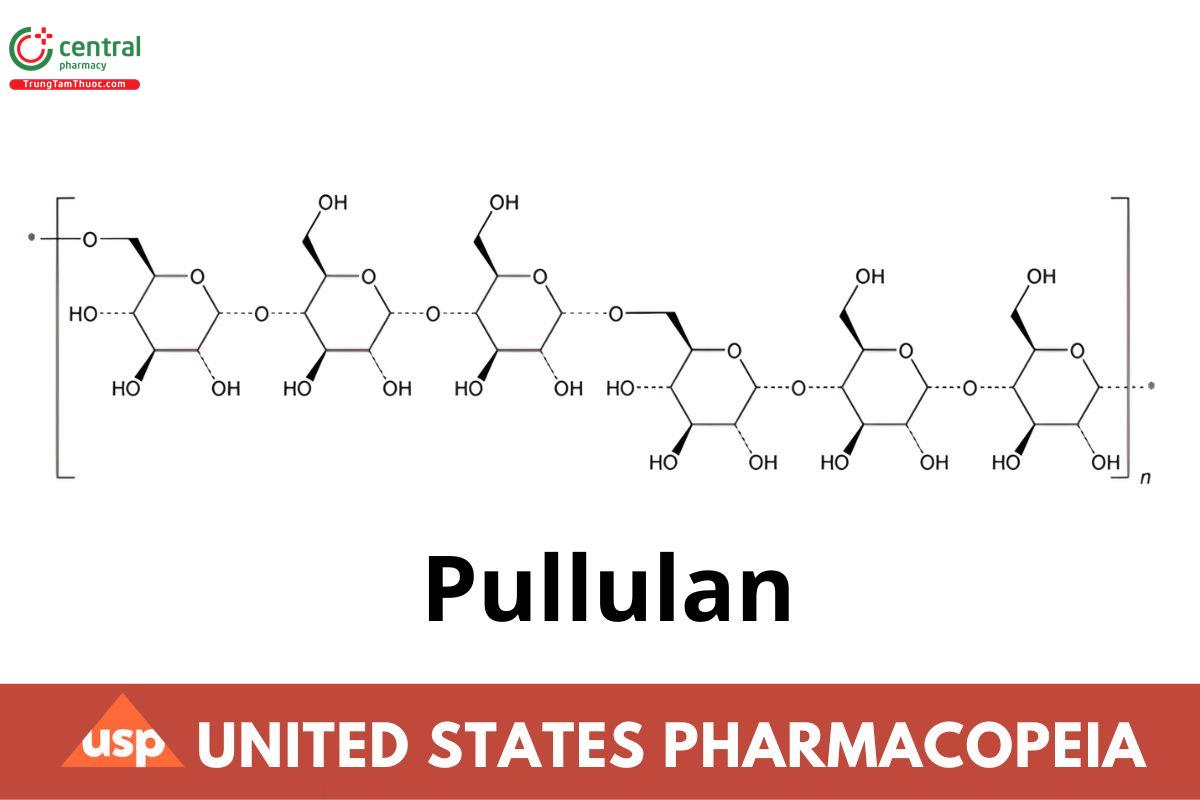

This article is compiled based on the United States Pharmacopeia (USP) – 2025 Edition
Issued and maintained by the United States Pharmacopeial Convention (USP)
(C36H60O30)n
Poly[6)-α-d-glucopyranosyl-(1→4)-α-d-glucopyranosyl-(1→4)-α-d-glucopyranosyl-(1→]
CAS RN®: 9057-02-7.
1 DEFINITION
Pullulan is a neutral, simple polysaccharide produced by the growth of Aureobasidium pullulans. It has a chain structure of repeated α-1,6-bonds of maltotriose composed of three glucoses in α-1,4-bonds. It may contain some maltotetraosyl units. It contains NLT 90% of glucan, calculated on the dried basis.
2 IDENTIFICATION
A. Sample: 10 g
Analysis: Dissolve the Sample in 100 mL of water by adding in small portions with stirring.
Acceptance criteria: A viscous solution is produced.
B. Pullulanase sample solution: 10 units/mL of pullulanase
Sample solution: The viscous solution obtained in Identification test A
Analysis: Mix 10 mL of the Sample solution with 0.1 mL of Pullulanase sample solution, and allow to incubate at 25° for 20 min.
Acceptance criteria: A substantial loss of viscosity is observed.
C. Sample solution: 20 mg/mL
Analysis: To 10 mL of the Sample solution add 2 mL of polyethylene glycol 600.
Acceptance criteria: A white precipitate is formed immediately.
3 ASSAY
Content of Monosaccharide, Disaccharide, and Oligosaccharides
Sample stock solution: 8 mg/mL, on previously dried material
Sample solution: To 1.0 mL of the Sample stock solution add 0.1 mL of saturated potassium chloride solution, and shake vigorously with 3 mL of methyl alcohol. Centrifuge, and use the supernatant.
Standard solution: Dilute 1.0 mL of the Sample stock solution with water to 50 mL.
Blank: Water
Instrumental conditions
(See Ultraviolet-Visible Spectroscopy 〈857〉.)
Mode: Vis
Analytical wavelength: 620 nm
Analysis
Samples: Sample solution, Standard solution, and Blank
Transfer 0.2 mL each of the Standard solution, Sample solution, and Blank to a test tube containing 5 mL of a 1-in-500 solution of anthrone in 75% (v/v) sulfuric acid, with the test tube placed in ice water. Mix each tube immediately, and then heat the test tube at 90° for 10 min. Remove the tube, and allow it to cool in cold running water.
Determine the absorbances of the resulting solutions at the specified wavelength.
Determine the percentage of monosaccharide, disaccharide, and oligosaccharides in the portion of the sample taken:
Result = (DU /DS ) × (AU − AB )/(AS − AB ) × 100
DU = dilution factor for the Sample solution, 4.1
DS = dilution factor for the Standard solution, 50
AU = absorbance of the Sample solution
AS = absorbance of the Standard solution
AB = absorbance of the Blank
Acceptance criteria: The total content of monosaccharide, disaccharide, and oligosaccharides is NMT 10.0%, corresponding to NLT 90% of glucan on the dried basis.
4 IMPURITIES
Residue on Ignition 〈281〉
Sample: 2.0 g
Acceptance criteria: NMT 0.3%
Nitrogen Determination, Method II〈461〉
Sample: 3 g, previously dried
Analysis: Proceed as directed in the chapter, replacing the 7 mL of sulfuric acid with 12 mL of sulfuric acid for the decomposition and
replacing the 30 mL of sodium hydroxide solution (2 in 5) with 40 mL of a solution of sodium hydroxide (2 in 5).
Acceptance criteria: NMT 0.05%
5 SPECIFIC TESTS
Microbial Enumeration Tests 〈61〉and Tests for Specified Microorganisms 〈62〉: The total aerobic microbial count does not exceed 102 cfu/g, and the total combined molds and yeasts count does not exceed 102 cfu/g.
pH 〈791〉
Sample: 1.0 g
Analysis: Dissolve the Sample in 10 mL of freshly boiled and cooled water.
Acceptance criteria: 4.5–6.5
Loss on Drying 〈731〉
Analysis: Dry at 90° under vacuum for 6 h.
Acceptance criteria: NMT 6.0%
Viscosity—Capillary Methods 〈911〉
Sample: Exactly 10.0 g, previously dried
Analysis: Dissolve the Sample in water to make exactly 100 g, and perform the test at 30 ± 0.1° using a Ubbelohde-type viscometer.
Acceptance criteria: The kinematic viscosity is 100–180 mm2 · s−1.
6 ADDITIONAL REQUIREMENTS
Packaging and Storage: Preserve in well-closed containers. No storage requirements specified.
Labeling: Label it to indicate the viscosity, giving the type of viscosity parameter, concentration of the solution, and the type of equipment used.

