
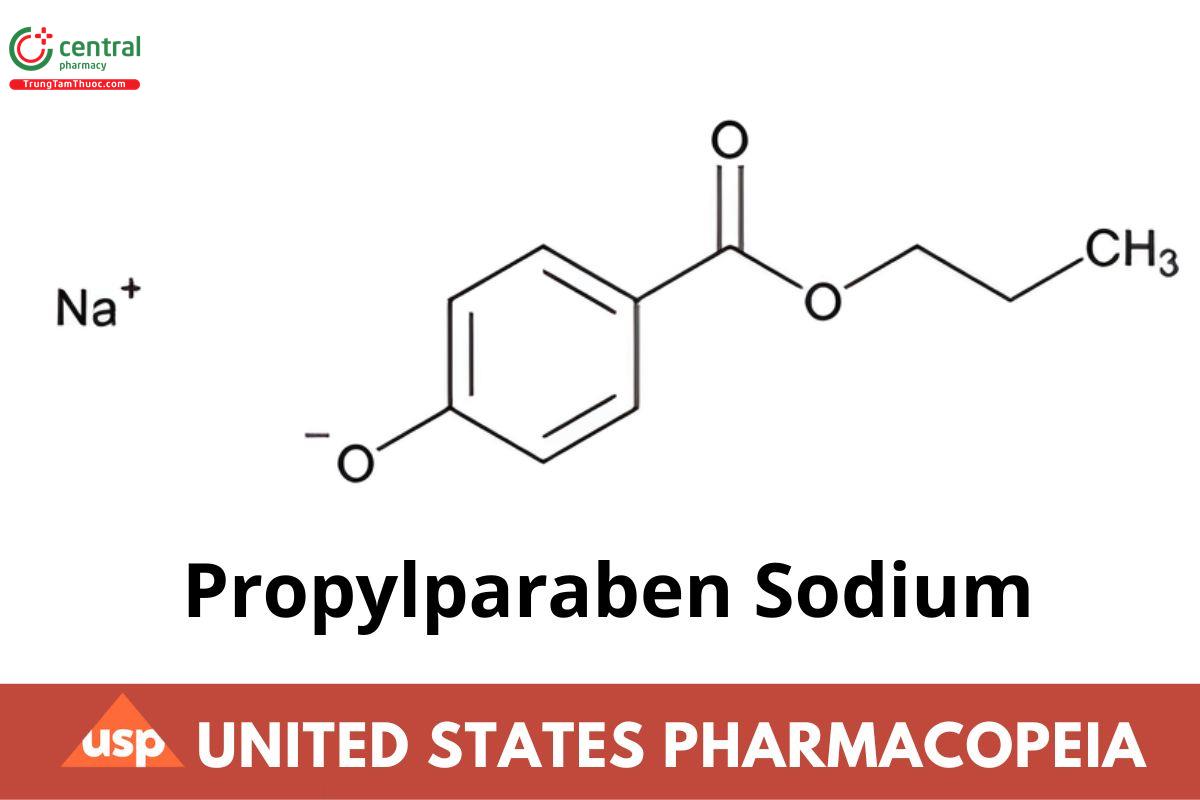
Propylparaben Sodium
If you find any inaccurate information, please let us know by providing your feedback here

Tóm tắt nội dung
This article is compiled based on the United States Pharmacopeia (USP) – 2025 Edition
Issued and maintained by the United States Pharmacopeial Convention (USP)
C10H12NaO3 202.20
Benzoic acid, 4-hydroxy-, propyl ester, sodium salt;
Propyl p-hydroxybenzoate, sodium salt;
Sodium 4-propoxycarbonylphenolate CAS RN®: 35285-69-9.
1 DEFINITION
Propylparaben Sodium contains NLT 94.0% and NMT 102.0% of propylparaben sodium (C10H12NaO3), calculated on the anhydrous basis.
2 IDENTIFICATION
A. Standard: 0.5 g of USP Propylparaben RS
Sample: 0.5 g
Analysis: Dissolve the Sample in 5 mL of water. Acidify with hydrochloric acid, and filter the resulting precipitate. Wash the precipitate with water, and dry over silica gel for 5 h. Repeat with the Standard.
Acceptance criteria: The IR absorption spectrum of a Mineral oil dispersion of the Sample exhibits maxima only at the same wavelengths as those of a mineral oil dispersion of the Standard.
B. Sample solution: Ignite 0.3 g of Propylparaben Sodium, cool, and dissolve the residue in 3 mL of 3 N hydrochloric acid.
Acceptance criteria: A platinum wire dipped in the Sample solution imparts an intense, persistent yellow color to a nonluminous flame.
3 ASSAY
3.1 Procedure
Mobile phase: Methanol and a 6.8-g/L solution of potassium dihydrogen phosphate (65:35, v/v)
System suitability solution: 5.0 μg/mL each of p-hydroxybenzoic acid, USP Ethylparaben RS, and USP Propylparaben RS in Mobile phase
Standard solution: Dissolve 50.0 mg of USP Propylparaben RS in 2.5 mL of methanol, and dilute with Mobile phase to 50.0 mL. Dilute 10.0 mL of this solution with Mobile phase to 100.0 mL.
Sample solution: Dissolve 50.0 mg of Propylparaben Sodium in 2.5 mL of methanol, and dilute with Mobile phase to 50.0 mL. Dilute 10.0 mL of this solution with Mobile phase to 100.0 mL.
3.2 Chromatographic system
(See Chromatography 〈621〉, System Suitability.)
Mode: LC
Detector: UV 272 nm
Column: 4.6-mm × 15-cm; 5-μm packing L1
Flow rate: 1.3 mL/min
Injection volume: 10 μL
Run time: About 2.5 times the retention time of the propylparaben peak
3.3 System suitability
Samples: System suitability solution and Standard solution
[Note—The retention time of propylparaben is about 4.0 min; the relative retention times for p-hydroxybenzoic acid, ethylparaben, and propylparaben are about 0.4, 0.7, and 1.0, respectively.]
3.4 Suitability requirements
Resolution: NLT 3.0 between the ethylparaben and propylparaben peaks, System suitability solution
Relative standard deviation: NMT 0.85% for six injections, Standard solution
3.5 Analysis
Samples: Standard solution and Sample solution
Calculate the percentage of propylparaben sodium (C10H12NaO3) in the portion of Propylparaben Sodium taken:
Result = P × (rU × CS )/(rS × CU ) × (M /M )
P = labeled purity of USP Propylparaben RS expressed as a percentage
rU = peak area of propylparaben from the Sample solution
CS = concentration of propylparaben in the Standard solution
rS = peak area of propylparaben from the Standard solution
CU = concentration of Propylparaben Sodium in the Sample solution
M = molecular weight of propylparaben sodium, 202.20
M = molecular weight of propylparaben, 180.20
Acceptance criteria: 94.0%–102.0% on the anhydrous basis
4 IMPURITIES
Related Compounds
Mobile phase, System suitability solution, Sample solution, and Chromatographic system: Proceed as directed in the Assay.
Standard solution: Dilute 1.0 mL of the Sample solution with Mobile phase to 20.0 mL. Dilute 1.0 mL of this solution with Mobile phase to 10.0 mL.
System suitability
Sample: System suitability solution
[Note—The retention time of propylparaben is about 4.0 min; the relative retention times for p-hydroxybenzoic acid, ethylparaben, and propylparaben are about 0.4, 0.7, and 1.0, respectively.]
Suitability requirements
Resolution: NLT 3.0 between the ethylparaben and propylparaben peaks
Analysis
Samples: Standard solution and Sample solution Acceptance criteria p-Hydroxybenzoic acid: NMT 4.0%; the peak area in the Sample solution, multiplied by 1.4 to correct for the calculation of content, is NMT 8 times the area of the principal peak in the Standard solution.
Unspecified impurities: NMT 0.5%; the peak area of each impurity in the Sample solution is NMT the area of the principal peak in the Standard solution.
Total impurities: NMT 1.0%; the total peak area for all unspecified impurities in the Sample solution is NMT twice the area of the principal peak in the Standard solution.
Chloride and Sulfate, Chloride 〈221〉
Standard solution: 0.10 mL of 0.020 N hydrochloric acid
Sample: 0.2 g
Analysis: Proceed as directed in the chapter.
Acceptance criteria: 0.035%; the Sample shows no more chloride than the Standard solution.
Chloride and Sulfate, Sulfate 〈221〉
Standard solution: 0.30 mL of 0.020 N sulfuric acid
Sample: 0.25 g
Analysis: Proceed as directed in the chapter.
Acceptance criteria: 0.12%; the Sample shows no more sulfate than the Standard solution.
5 SPECIFIC TESTS
pH 〈791〉
Sample solution: 1 mg/mL
Acceptance criteria: 9.5–10.5
Water Determination, Method I 〈921〉: NMT 5.0%
Completeness of Solution 〈641〉
Sample solution: Dissolve 1 g in water.
Acceptance criteria: Meets the requirements
6 ADDITIONAL REQUIREMENTS
Packaging and Storage: Preserve in tight containers.
USP Reference Standards 〈11〉
USP Ethylparaben RS
USP Propylparaben RS

