
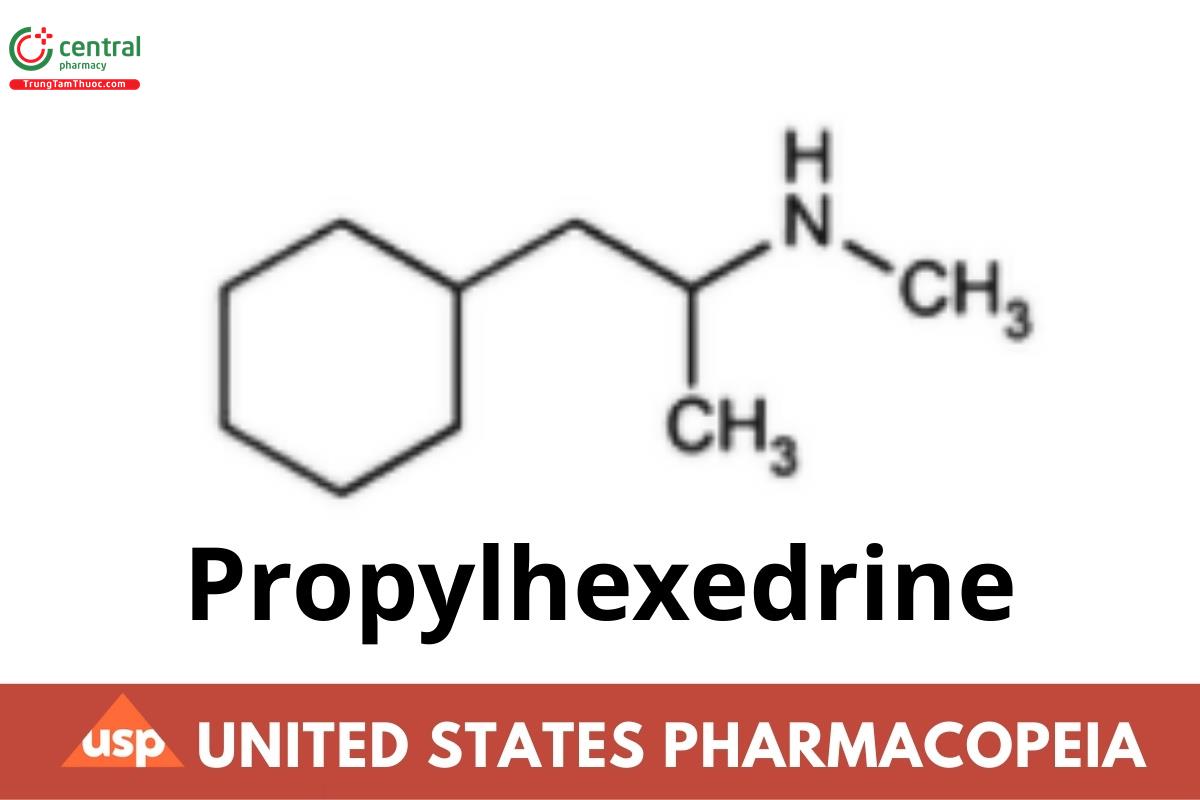
Propylhexedrine
If you find any inaccurate information, please let us know by providing your feedback here

Tóm tắt nội dung
This article is compiled based on the United States Pharmacopeia (USP) – 2025 Edition
Issued and maintained by the United States Pharmacopeial Convention (USP)
C10H21N 155.28
Cyclohexaneethanamine, N,a-dimethyl-, (±)-.
(±)-N,a-Dimethylcyclohexaneethylamine CAS RN®: 101-40-6; UNII: LQU92IU8LL.
Propylhexedrine contains not less than 98.0 percent and not more than 101.0 percent of C10H21N.
Packaging and storage-Preserve in tight containers.
1 Identification
A: To 3 mL of water contained in a small flask add about 0.1 mL of it and 0.5 mL of 1 N hydrochloric acid, and agitate the mixture until clear. Add 20 mL of trinitrophenol TS, insert the stopper in the flask, shake vigorously for a few minutes, and allow to stand for 2 hours. Filter, wash the precipitate with about 20 mL of cold water, and dry in vacuum at 60° for 4 hours: the picrate so obtained melts between 108° and 110°
(see Melting Range or Temperature (741)).
[CAUTION-Picrates may explode.]
B: A solution, prepared as directed in Identification test A, yields a brown precipitate with iodine TS and a white precipitate with mercuric-potassium iodide TS.
SPECIFIC GRAVITY (841): between 0.848 and 0.852.
Assay-Tare a glass-stoppered conical flask containing about 15 mL of water, add quickly about 0.5 mL of Propylhexedrine, and again weigh. Add to the contents of the flask 30 mL of neutralized alcohol, then add methyl red TS, and titrate with 0.1 N sulfuric acid VS. Perform a blank determination, and make any necessary correction. Each mL of 0.1 N sulfuric acid is equivalent to 15.53 mg of C10H21N.

