
Proparacaine Hydrochloride
If you find any inaccurate information, please let us know by providing your feedback here
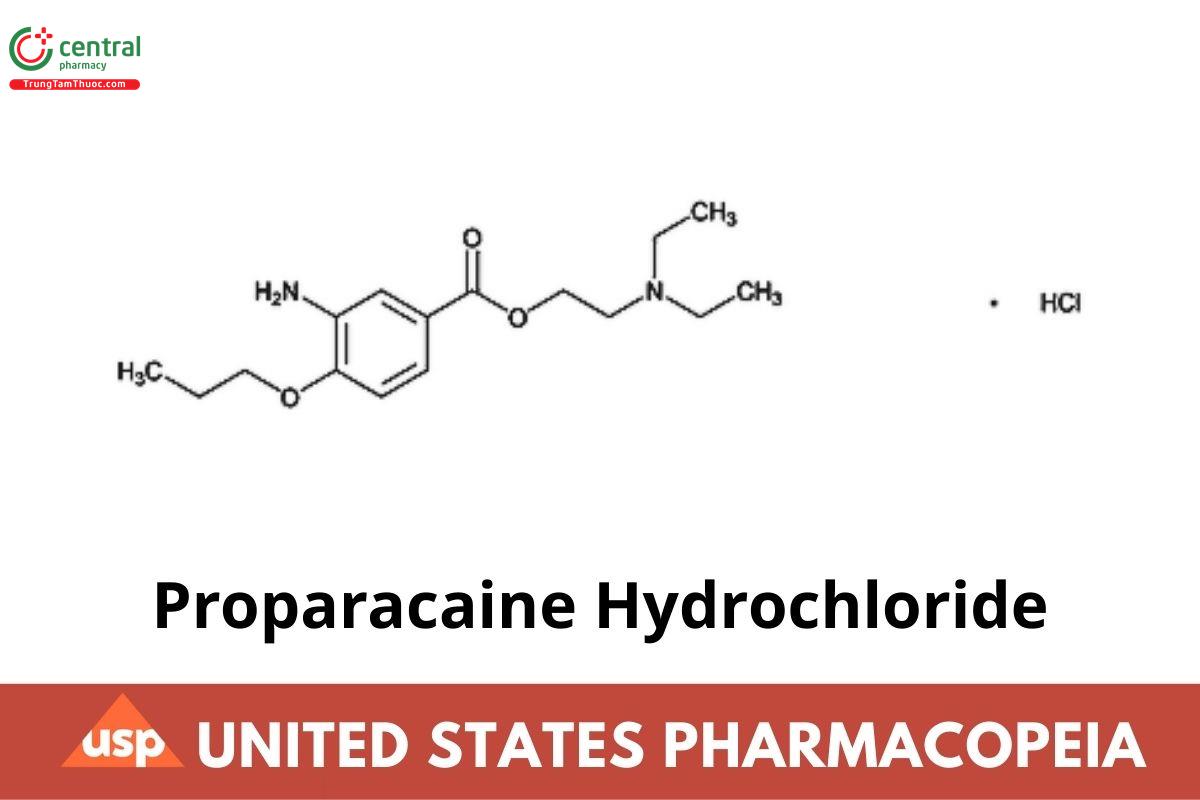

This article is compiled based on the United States Pharmacopeia (USP) – 2025 Edition
Issued and maintained by the United States Pharmacopeial Convention (USP)
1 DEFINITION
Proparacaine Hydrochloride contains NLT 97.0% and NMT 103.0% of proparacaine hydrochloride (C₁₆H₂₆N₂O₃ · HCl), calculated on the dried basis.
2 IDENTIFICATION
A. Identification—Organic Nitrogenous Bases 〈181〉: Meets the requirements
B. Ultraviolet Absorption
Buffer: Prepare as directed for pH 6.0 phosphate buffer (see Reagents, Indicators, and Solutions—Solutions, Buffer Solutions). Dilute with water to prepare a 10% solution.
Analytical wavelength: 310 nm
Sample stock solution: 0.2 mg/mL of Proparacaine Hydrochloride
Sample solution: 0.02 mg/mL of Proparacaine Hydrochloride prepared as follows. To a volume of the Sample stock solution equivalent to 10% of the flask volume, add 2% of the flask volume of Buffer, and dilute with water to volume.
Acceptance criteria: The UV absorption spectrum of the Sample solution exhibits maxima and minima at the same wavelengths as those of a similarly prepared solution of USP Proparacaine Hydrochloride RS, concomitantly measured, and the respective absorptivities, calculated on the dried basis, do not differ by more than 3.0%.
Change to read:
C. Identification Tests—General 〈191〉, Chemical Identification Tests, Chloride
Sample solution: 20 mg/mL of Proparacaine Hydrochloride
Analysis: Proceed as directed in the chapter using the procedure for ▲amine hydrochlorides.▲ (USP 1-May-2021)
Acceptance criteria: Meets the requirements
3 ASSAY
Procedure
Sample solution: Transfer 250 mg of Proparacaine Hydrochloride to a 250-mL conical flask. Add 80 mL of a 1-in-20 solution of acetic anhydride in glacial acetic acid, and heat on a steam bath for 10 min. Cool to room temperature, and add 10 mL of mercuric acetate TS.
Titrimetric system
Mode: Direct titration
Titrant: 0.1 N perchloric acid VS
Endpoint detection: Visual
Analysis: Titrate with Titrant to a blue-green endpoint using 1 or 2 drops of crystal violet TS as the indicator. Perform a blank determination, and make any necessary correction. Each milliliter of 0.1 N perchloric acid is equivalent to 33.09 mg of proparacaine hydrochloride (C₁₆H₂₆N₂O₃ · HCl).
Acceptance criteria: 97.0%–103.0% on the dried basis
4 IMPURITIES
Residue on Ignition 〈281〉: NMT 0.15%
Ordinary Impurities 〈466〉
Standard solution: Methanol
Sample solution: Methanol
Eluant: Butyl alcohol, glacial acetic acid, and water (5:1:3)
Visualization: 1; 17
Acceptance criteria: Meets the requirements
5 SPECIFIC TESTS
Melting Range or Temperature 〈741〉: 178°–185°, but the range between beginning and end of melting does not exceed 2°
Loss on Drying 〈731〉
Analysis: Dry at 105° for 3 h.
Acceptance criteria: NMT 0.5%
6 ADDITIONAL REQUIREMENTS
Packaging and Storage: Preserve in well-closed containers.
USP Reference Standards 〈11〉
USP Proparacaine Hydrochloride RS

