
Propantheline Bromide
If you find any inaccurate information, please let us know by providing your feedback here
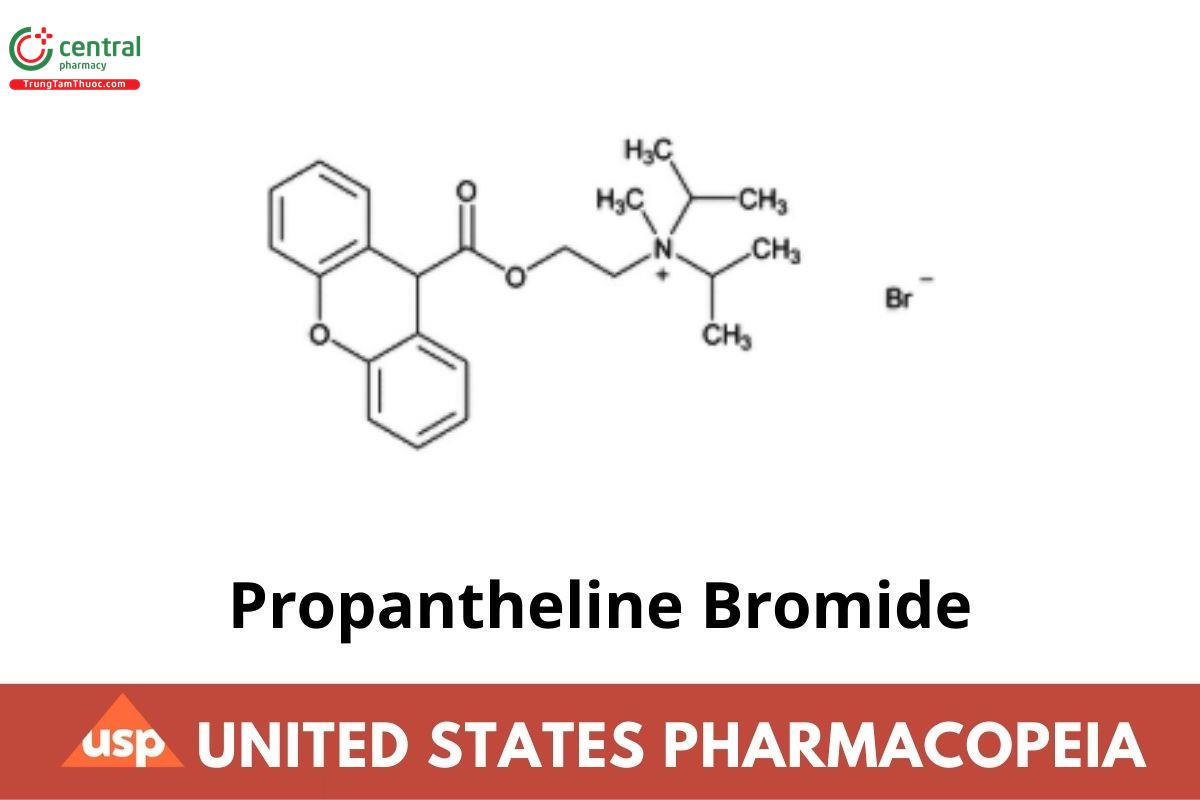

This article is compiled based on the United States Pharmacopeia (USP) – 2025 Edition
Issued and maintained by the United States Pharmacopeial Convention (USP)
1 DEFINITION
Propantheline Bromide contains NLT 98.0% and NMT 102.0% of propantheline bromide (C₂₃H₃₀BrNO₃), calculated on the dried basis.
2 IDENTIFICATION
A.
Sample solution: 6 mg/mL of Propantheline Bromide in chloroform
Analysis: In a well-ventilated hood, apply 2 mL of Sample solution dropwise to a salt plate while continuously evaporating the solvent with the aid of an IR heat lamp and a current of dry air. Heat the residue at 105° for 15 min.
Acceptance criteria: The IR absorption spectrum of the residue on the single salt plate exhibits maxima only at the same wavelengths as those of a similar preparation of USP Propantheline Bromide RS, treated in the same manner.
B. Thin-Layer Chromatographic Identification Test 〈201〉
Standard solution: 6 mg/mL USP Propantheline Bromide RS in chloroform
Sample solution: 6 mg/mL of Propantheline Bromide in chloroform
Chromatographic system
(See Chromatography 〈621〉, Thin-Layer Chromatography.)
Mode: TLC
Adsorbent: 0.25-mm layer of chromatographic silica gel
Application volume: 5 µL
Developing solvent system: Acetone and 1 N hydrochloric acid (1:1)
Spray reagent: Potassium–bismuth iodide TS
Analysis
Samples: Standard solution and Sample solution
Develop the chromatogram until the solvent front has moved three-fourths the length of the plate. Dry the plate at 105° for 5 min. Spray the plate with Spray reagent, and heat at 105° for 5 min.
Acceptance criteria: The Rf value of the principal spot from the Sample solution corresponds to that from the Standard solution.
C. Identification Tests—General, Bromide 〈191〉
Sample solution: 10 mg/mL
Analysis: Add 2 mL of 2 N nitric acid to 5 mL of Sample solution.
Acceptance criteria: This solution meets the requirements of the tests for bromide, except that in the test A, the chloroform layer may be yellow.
3 ASSAY
Procedure
Sample: 600 mg
Analysis: Dissolve the Sample in a mixture of 20 mL of glacial acetic acid and 15 mL of mercuric acetate TS, warming slightly if necessary to dissolve. Cool to room temperature. Titrate the Sample solution with 0.1 N perchloric acid VS, determining the endpoint potentiometrically. Perform a blank determination, and make any necessary correction. Each mL of 0.1 N perchloric acid is equivalent to 44.84 mg of propantheline bromide (C₂₃H₃₀BrNO₃).
Acceptance criteria: 98.0%–102.0% on the dried basis
4 IMPURITIES
Residue on Ignition 〈281〉: NMT 0.1%
Organic Impurities
Buffer: 17.3 g of sodium dodecyl sulfate in 1000 mL of water containing 10 mL of phosphoric acid in a 2000-mL volumetric flask. Add 250 mL of 0.5 M sodium hydroxide, and while stirring, adjust with 0.5 M sodium hydroxide or dilute phosphoric acid (1 in 10) to a pH of 3.5 ± 0.05. Dilute with water to volume.
Mobile phase: Acetonitrile and Buffer (55:45)
Standard solution:
6.0 µg/mL of USP Propantheline Bromide Related Compound A RS,
1.5 µg/mL of USP Xanthanoic Acid RS, and
1.5 µg/mL of USP Xanthone RS in Mobile phase
Sample solution: 0.3 mg/mL of Propantheline Bromide in Mobile phase
Chromatographic system
(See Chromatography 〈621〉, System Suitability.)
Mode: LC
Detector: UV 254 nm
Column: 4.6-mm × 25-cm; packing L7
Flow rate: 2.0 mL/min
Run time: NLT 1.5 times the retention time of the propantheline bromide peak
Injection volume: 50 µL
System suitability
Sample: Standard solution
Suitability requirements
Resolution: NLT 1.2 between the least resolved peaks
Relative standard deviation: NMT 6.0% for each component
Analysis
Samples: Standard solution and Sample solution
Calculate the percentage of xanthanoic acid, xanthone, and propantheline bromide related compound A in the portion of Propantheline Bromide taken:
Result = (rᵤ / rₛ) × (Cₛ / Cᵤ) × 100
rᵤ = peak response of xanthanoic acid, xanthone, or propantheline bromide related compound A from the Sample solution
rₛ = peak response of xanthanoic acid, xanthone, or propantheline bromide related compound A from the Standard solution
Cₛ = concentration of xanthanoic acid, xanthone, or propantheline bromide related compound A in the Standard solution (µg/mL)
Cᵤ = concentration of Propantheline Bromide in the Sample solution (µg/mL)
Calculate the percentage of all unknown impurities in the portion of Propantheline Bromide taken:
Result = (rᵤ / Σr) × 100
rᵤ = peak response of each unknown impurity
Σr = sum of the responses of all the measured peaks
Acceptance criteria:
Disregard any peak less than 0.1%.
Individual impurities: NMT 2.0% for propantheline bromide related compound A; NMT 0.5% each for xanthone and xanthanoic acid
Total impurities: NMT 3.0%
5 SPECIFIC TESTS
Content of Bromide
Sample: 500 mg
Analysis: Dissolve the Sample in 40 mL of water, and add 10 mL of glacial acetic acid and 40 mL of methanol. Titrate the Sample solution with 0.1 N silver nitrate VS, using eosin Y TS as an indicator. Each mL of 0.1 N silver nitrate is equivalent to 7.990 mg of bromide.
Acceptance criteria: 17.5%–18.2% of bromide, calculated on the dried basis
Loss on Drying 〈731〉
Analysis: Dry at 105° for 4 h.
Acceptance criteria: NMT 0.5%
6 ADDITIONAL REQUIREMENTS
Packaging and Storage: Preserve in well-closed containers.
USP Reference Standards 〈11〉
USP Propantheline Bromide RS
USP Propantheline Bromide Related Compound A RS
9-Hydroxypropantheline bromide.
C₂₃H₃₀BrNO₄ 464.39
USP Xanthanoic Acid RS C₁₃H₆O₄ 226.23
USP Xanthone RS C₁₃H₈O₂ 196.21

