
Propanediol
If you find any inaccurate information, please let us know by providing your feedback here

This article is compiled based on the United States Pharmacopeia (USP) – 2025 Edition
Issued and maintained by the United States Pharmacopeial Convention (USP)
DOWNLOAD PDF HERE
1 DEFINITION
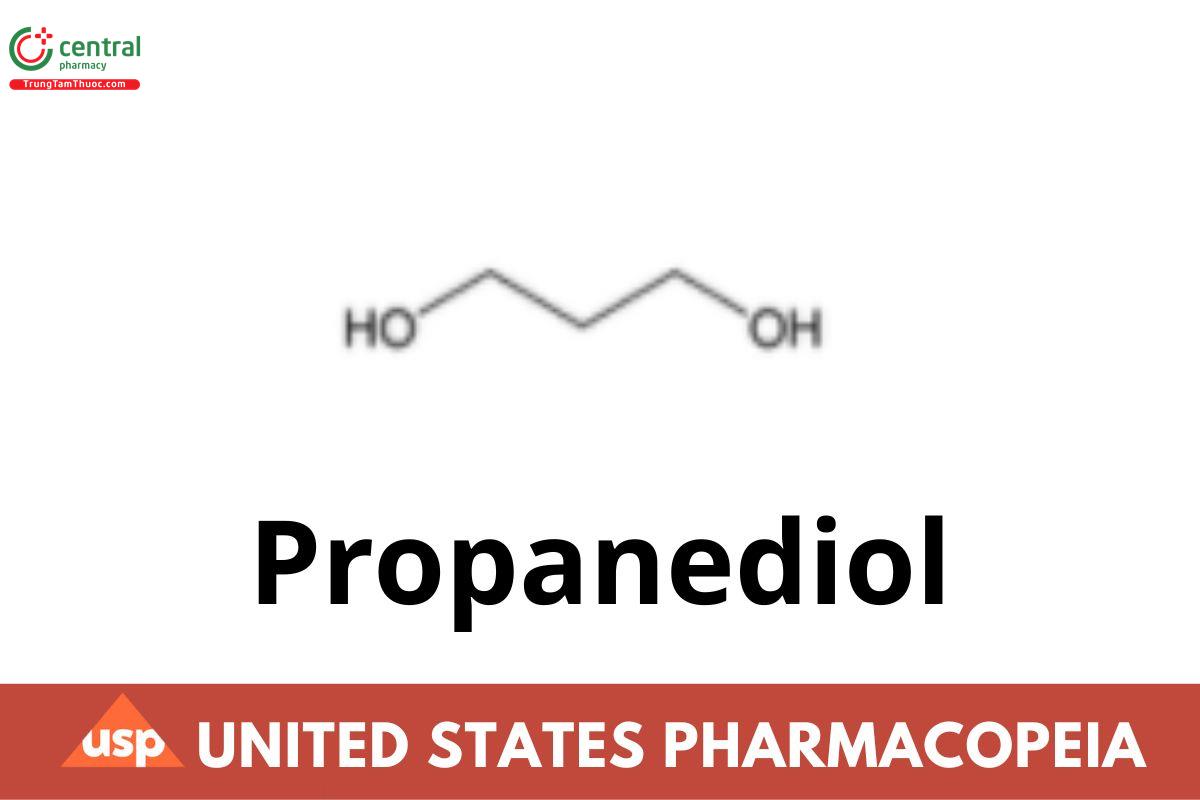
Propanediol contains NLT 99.7% of 1,3-propanediol (C3H8O2). It may be of vegetable, other natural source, or synthetic origin.
2 IDENTIFICATION
Change to read:
A. Spectroscopic Identification Tests 〈197〉, Infrared Spectroscopy: 197F (CN 1-May-2020)
B. The retention time of the major peak of the Sample solution corresponds to the 1,3-propanediol peak of the System suitability solution, as obtained in the Assay.
3 ASSAY
Procedure
System suitability solution: Mix quantities of USP Propylene Glycol RS and USP 1,3-Propanediol RS to obtain a solution containing about 5%
propylene glycol and 95% propanediol.
Sample solution: Propanediol (neat)
Chromatographic system
(See Chromatography 〈621〉, System Suitability.)
Mode: GC
Detector: Flame ionization
Column: 0.25-mm × 30-m capillary column; bonded with a 0.25-μm layer of phase G16
Temperatures
Detector: 250°
Injection port: 250°
Column: See Table 1.
Table 1
Initial Temperature (°) | Temperature Ramp (°/min) | Final Temperature (°) | Hold Time at Final Temperature (min) |
| 50 | 15 | 200 | - |
| 200 | 40 | 250 | 17 |
Carrier gas: Helium
Flow rate: 1.1 mL/min
Injection volume: 0.2 μL
Split type: Split ratio of 18:1
System suitability
Sample: System suitability solution
[Note—The relative retention times for propylene glycol and propanediol are 0.7 and 1.0, respectively.]
Suitability requirements
Resolution: NLT 2.0 between the peaks due to propylene glycol and propanediol
Analysis
Sample: Sample solution
Calculate the percentage of propanediol in the portion of sample taken:
Result = (rU/rT) × 100
rU = peak response for propanediol in the Sample solution
rT = sum of all peak responses in the Sample solution
Acceptance criteria: NLT 99.7%
4 IMPURITIES
Limit of Related Glycol Substances
System suitability solution, Sample solution, Chromatographic system, and System suitability: Proceed as directed in the Assay.
Analysis
Sample: Sample solution
Calculate the percentage of each individual impurity in the portion of Propanediol taken:
Result = (rU/rT) × 100
rU = peak response of each individual impurity in the Sample solution
rT = sum of all peak responses in the Sample solution
Acceptance criteria
Each individual impurity: NMT 0.1%
Total impurities: NMT 0.3%
Limit of Aldehydes
Formaldehyde methanol solution:1 A solution containing 37% (w/w) of formaldehyde and 10%–15% (w/w) of methanol in water
Phenolphthalein solution: Dissolve 0.1 g of phenolphthalein in 80 mL of alcohol, and dilute with water to 100 mL.
Quantification of Formaldehyde methanol solution: To 2.0 g of Formaldehyde methanol solution, add 100 mL of a freshly prepared 100mg/mL solution of sodium sulfite in carbon-dioxide free water. Add 0.1 mL of Phenolphthalein solution, and titrate with 0.5 N sulfuric acid until the color changes from pink to colorless. Carry out a blank titration.
Calculate the percentage content of formaldehyde in Formaldehyde methanol solution using the following expression:
Result (PHCHO) = {[(VS− VB) × N × MW × F]/W} × 100
VS = volume of 0.5 N sulfuric acid used in the assay (mL)
VB = volume of 0.5 N sulfuric acid used in the blank (mL)
N = normality of the titrant (mEq/mL)
MW = milliequivalent weight of formaldehyde, 30.03 mg/mEq
F = unit conversion factor, 10−3 g/mg
W = weight of sample (g)
Standard stock solution: 1.2 μg/mL of Formaldehyde methanol solution in carbon-dioxide free water, prepared from appropriately diluting
Formaldehyde methanol solution in carbon-dioxide free water
Standard solutions: Introduce into 50-mL volumetric flasks 1.0-, 3.0-, 5.0-, 10.0-, 15.0-, and 25.0-mL of Standard stock solution, respectively.
Calculate the content of formaldehyde, in μg, in the Standard solutions using the following expression. Proceed as directed in the Analysis below.
Result (content of formaldehyde) = V × C × PHCHO × 0.01
V = volume of the Standard stock solution added into the Standard solution (mL)
C = concentration of Formaldehyde methanol solution in the Standard stock solution (μg/mL)
PHCHO = percentage content of formaldehyde in Formaldehyde methanol solution, as determined above
Sample solution: Introduce 5.0 mL of 0.2 g/mL of propanediol in carbon-dioxide free water into a 50-mL volumetric flask. Proceed as directed in the Analysis below.
Blank solution: Prepare in the same manner as for the Standard solutions but omitting the Standard stock solution.
Instrumental conditions
(See Ultraviolet-Visible Spectroscopy 〈857〉.)
Mode: Vis spectrophotometry
Analytical wavelength: 655 nm
Analysis
Samples: Blank solution, Standard solutions, and Sample solution
To each flask of the Blank solution, Standard solutions, and Sample solution add 2 mL of a freshly prepared 5 mg/mL solution of methylbenzothiazolone hydrazone hydrochloride adjusted with 0.02 N sodium hydroxide to a pH of 4.0. Allow the solutions to stand for 30 min. Add 5 mL of a freshly prepared 7 mg/mL solution of ferric chloride. Cap and swirl the flasks. Allow to stand for 5 min. Add methanol to each flask, and dilute with methanol to 50.0 mL. Mix thoroughly, then allow to stand for 1 min.
Measure the absorbance of the solutions using the treated Blank solution as compensation liquid.
Plot the absorbance of the treated Standard solution versus the content of formaldehyde, in μg, in the Standard solution. Obtain the content of formaldehyde WHCHO , in μg, in the treated Sample solution based on the calibration curve.
Calculate the content of aldehydes expressed as formaldehyde (HCHO) in the portion of Propanediol taken:
Result = WHCHO/(C × V)
WHCHO = content of formaldehyde in the treated Sample solution, determined from the calibration curve (μg)
C = concentration of Propanediol in the Sample solution (g/mL)
V = volume of the Sample solution in the analysis (mL)
Acceptance criteria: NMT 20 μg/g, expressed as HCHO.
5 SPECIFIC TESTS
Acidity
Sample: 50 mL of Propanediol
Phenolphthalein solution: Dissolve 0.1 g of phenolphthalein in 80 mL of alcohol, and dilute with water to 100 mL.
Titrimetric system
(See Titrimetry 〈541〉)
Mode: Direct titration
Titrant: 0.01 N sodium hydroxide VS
Endpoint detection: Visual
Analysis: To 50 mL of water, add 1 mL of Phenolphthalein solution, then add Titrant until the solution remains pink for 30 s. Add the Sample, and titrate with Titrant until the color turns back to pink and remains for more than 30 s.
Calculate the acidity, as acetic acid (CH3COOH):
Result = (VT × N × WMeq)/V
VT = Titrant volume (mL)
N = Titrant normality (mEq/mL)
WMeq = milliequivalent weight of acetic acid, 60.05 mg/mEq
V = volume of Propanediol in the Sample (mL)
Acceptance criteria: NMT 0.1 mg/mL, calculated as acetic acid (CH COOH)
Water Determination, Method Ic 〈921〉: NMT 0.1%
6 ADDITIONAL REQUIREMENTS
Packaging and Storage: Preserve in well-closed containers. Do not store above 50°. Protect from moisture.
Labeling: Label it to indicate whether Propanediol is derived from vegetable, other natural source, or synthetic origin.
USP Reference Standards 〈11〉
USP 1,3-Propanediol RS
USP Propylene Glycol RS

