
Promazine Hydrochloride
If you find any inaccurate information, please let us know by providing your feedback here

Tóm tắt nội dung
This article is compiled based on the United States Pharmacopeia (USP) – 2025 Edition
Issued and maintained by the United States Pharmacopeial Convention (USP)
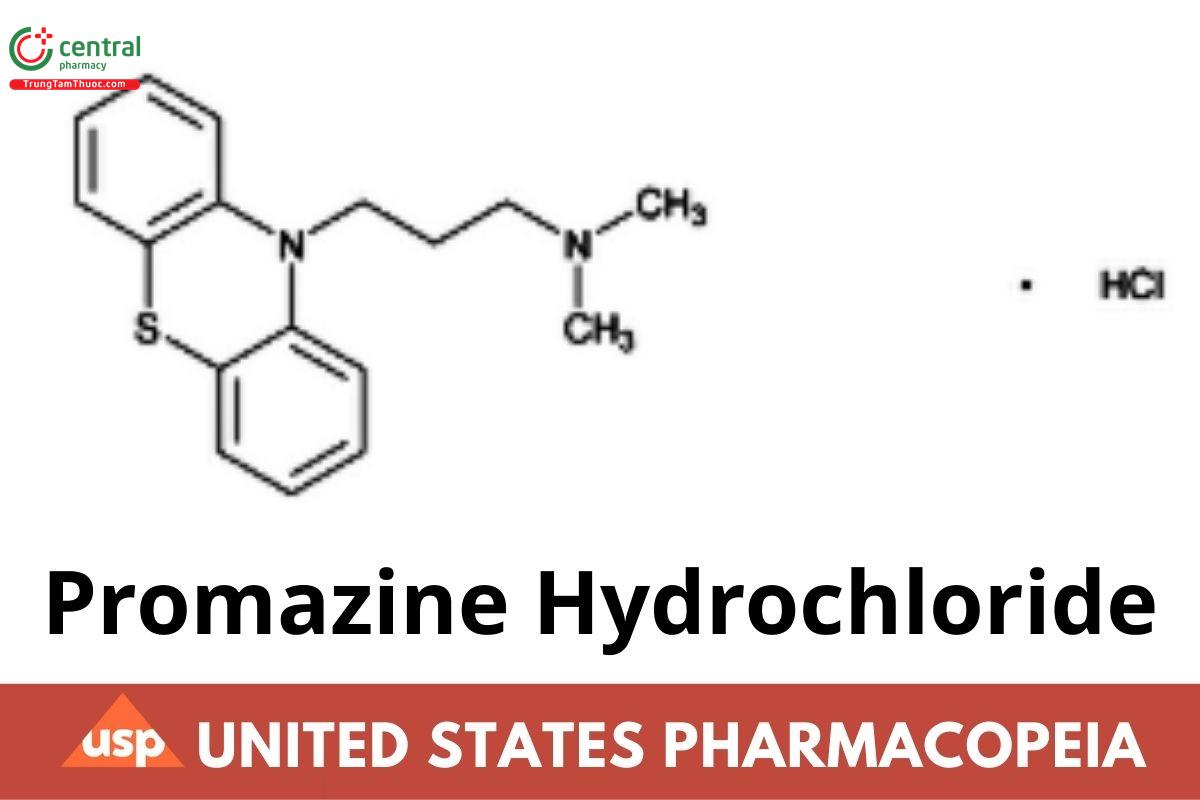
C17H20N2S.HCl. 320.88
10-H-Phenothiazine-10-propanamine, N,N-dimethyl-, monohydrochloride;
10-3-(Dimethylamino)propylphenothiazine monohydrochloride CAS RN®: 53-60-1; UNII: U16EOR79U4.
1 DEFINITION
Promazine Hydrochloride, dried at 105° for 2 h, contains NLT 98.0% and NMT 102.0% of promazine hydrochloride (C17H20N2S.HCl).
[Note—Throughout the following procedures, protect samples, the Reference Standard, and solutions containing them, by conducting the procedures without delay, under subdued light, or using low-actinic glassware.]
2 IDENTIFICATION
A. Spectroscopic Identification Tests 〈197〉, Infrared Spectroscopy: 197K
Change to read:
B. Spectroscopic Identification Tests 〈197〉, Ultraviolet-Visible Spectroscopy: 197U (USP 1-May-2022)
Analytical wavelengths: 252 and 301 nm
Diluent: 0.1 N hydrochloric acid
Sample solution A: 50 µg/mL of previously dried Promazine Hydrochloride in Diluent
Sample solution B: 5 µg/mL of Promazine Hydrochloride from Sample solution A in Diluent
Blank: Diluent
Analysis: Determine the absorbance of Sample solution A at 301 nm and the absorbance of Sample solution B at 252 nm. Calculate the absorbance ratio:
Result = 10 × (A252/A301)
A252 = absorbance of Sample solution B at 252 nm
A301 = absorbance of Standard solution A at 301 nm
Acceptance criteria: 7.1–7.9
C. Identification Tests—General 〈191〉, Chemical Identification Tests, Chloride: Meets the requirements
3 ASSAY
Change to read:
Procedure
[Note—Use low-actinic glassware.]
Diluent: 0.1 N hydrochloric acid
Standard solution: 50 µg/mL of USP Promazine Hydrochloride RS in Diluent
Sample solution: 50 µg/mL of previously dried Promazine Hydrochloride in Diluent
Instrumental conditions
(See Ultraviolet-Visible Spectroscopy 〈857〉.) (USP 1-May-2022)
Mode: UV
Cell: 1 cm
Blank: Diluent
Analysis
Samples: Standard solution and Sample solution
Without delay, concomitantly determine the absorbances of the Standard solution and the Sample solution. Calculate the percentage of promazine hydrochloride (C17H20N2S.HCl) in the portion of Promazine Hydrochloride taken:
Result = (AU/AS) × (CS/CU) × 100
AU = absorbance of the Sample solution
AS = absorbance of the Standard solution
CS = concentration of USP Promazine Hydrochloride RS in the Standard solution (µg/mL)
CU = concentration of Promazine Hydrochloride in the Sample solution (µg/mL)
Acceptance criteria: 98.0%–102.0% on the previously dried basis
4 IMPURITIES
Residue on Ignition 〈281〉: NMT 0.1%
Delete the following:
Selenium 〈291〉
Sample: 100 mg of Promazine Hydrochloride and 200 mg of magnesium oxide
Acceptance criteria: The absorbance of the Test Solution is NMT one-half that of the Standard Solution (NMT 0.003%)Organic Impurities
[Note—Perform this test under conditions of subdued light and with no unnecessary delays between the preparation of the solutions and the development of the chromatographic plate.]
Standard stock solution: 0.4 mg/mL of USP Promazine Hydrochloride RS in methanol
Standard solutions: See Table 1. Dilute the Standard stock solution with methanol to obtain Standard solutions having the following compositions.
Table 1
Standard Solution | Dilution | Concentration (µg/mL) | Percentage (%, for comparison with Sample solution) |
A | Undiluted | 400 | 2.0 |
B | 1 in 2 | 200 | 1.0 |
C | 3 in 10 | 120 | 0.6 |
D | 1 in 10 | 40 | 0.2 |
Sample solution: 20 mg/mL of Promazine Hydrochloride in methanol
Chromatographic system
(See Chromatography 〈621〉, General Procedures, Thin-Layer Chromatography.)
Mode: TLC
Adsorbent: 0.25-mm layer of chromatographic silica gel mixture
Application volume: 10 µL
Developing solvent system: Toluene, alcohol, and ammonium hydroxide (95:15:1)
Analysis
Samples: Standard solutions and Sample solution
Apply separately the Standard solutions and the Sample solution to a thin-layer chromatographic plate coated with the Adsorbent, and allow to dry. Position the plate in a chromatographic chamber and develop the chromatograms in the Developing solvent system until the solvent front has moved about three-fourths of the length of the plate. Remove the plate from the developing chamber, mark the solvent front, and allow the solvent to evaporate by air drying for 15 min. Examine the plate under short-wavelength UV light. Compare the intensities of any secondary spots observed in the chromatogram of the Sample solution with those of the principal spots in the chromatograms of the Standard solutions.
Acceptance criteria: The sum of the intensities of secondary spots obtained from the Sample solution corresponds to NMT 2.0% of related compounds, with no single impurity corresponding to more than 1.0%.
5 SPECIFIC TESTS
Completeness and Clarity of Solution: A solution of Promazine Hydrochloride in water (1 in 10) and a solution of Promazine Hydrochloride in chloroform (1 in 10) are practically clear and show NMT a light yellow color.
Melting Range or Temperature 〈741〉, Class I: 172°–182°, but the range between beginning and end of melting does not exceed 3° pH 〈791〉
Sample solution: A solution of Promazine Hydrochloride in water (1 in 20)
Acceptance criteria: 4.2–5.2
Loss on Drying 〈731〉
Analysis: Dry at 105° for 2 h.
Acceptance criteria: NMT 0.5%
6 ADDITIONAL REQUIREMENTS
Packaging and Storage: Preserve in tight, light-resistant containers.
USP Reference Standards 〈11〉
USP Promazine Hydrochloride RS

