
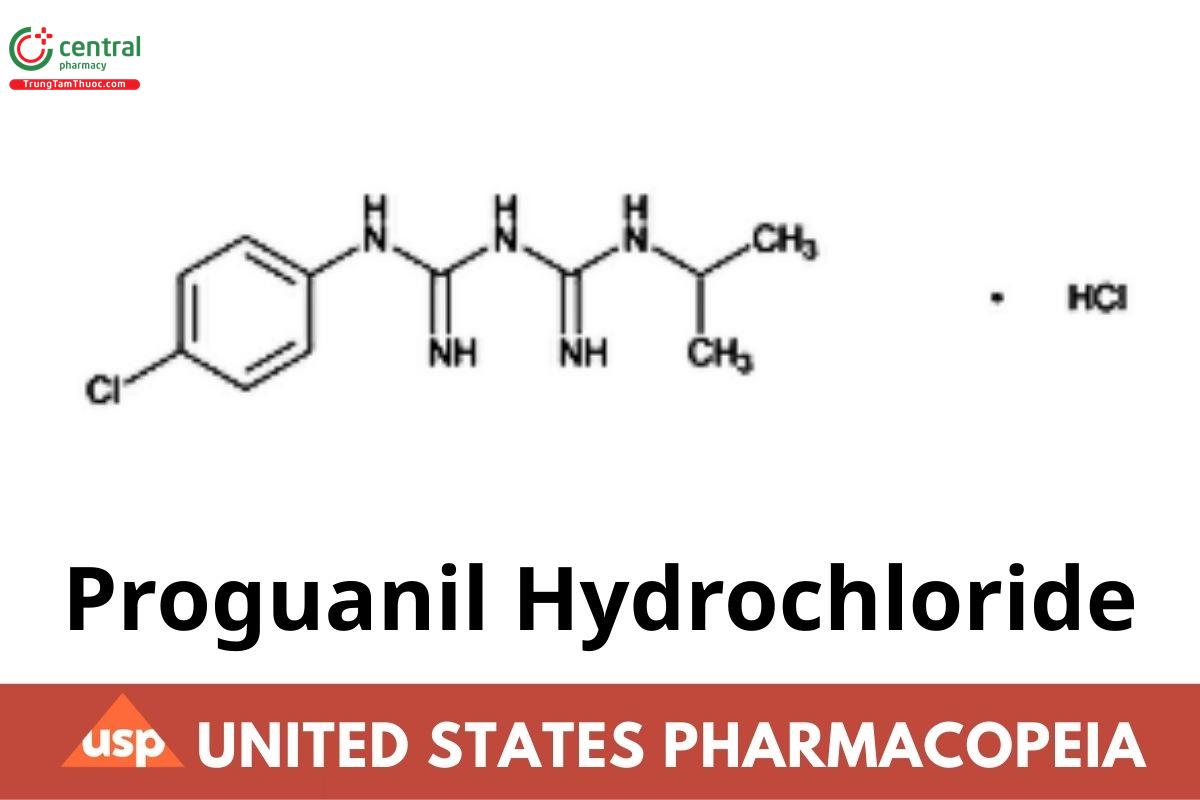
Proguanil Hydrochloride
If you find any inaccurate information, please let us know by providing your feedback here

Tóm tắt nội dung
This article is compiled based on the United States Pharmacopeia (USP) – 2025 Edition
Issued and maintained by the United States Pharmacopeial Convention (USP)
C11H16ClN5 .HCl 290.19
Biguanide, 1-(4-chlorophenyl)-5-isopropyl, hydrochloride;
1-(p-Chlorophenyl)-5-isopropylbiguanide hydrochloride CAS RN®: 637-32-1; UNII: R71Y86M0WT.
1 DEFINITION
Proguanil Hydrochloride contains NLT 98.5% and NMT 101.0% of proguanil hydrochloride (C11H16ClN5. HCl), calculated on the dried basis.
2 IDENTIFICATION
Change to read:
A. Spectroscopic Identification Tests 〈197〉, Infrared Spectroscopy: 197K
B. Identification Tests—General, Chloride〈191〉: Meets the requirements
3 ASSAY
Procedure
Solution A: 0.65 g/L of 1-pentanesulfonic acid sodium salt and 7.0 g/L of sodium perchlorate in water. Adjust with 1% trifluoroacetic acid to a pH of 3.0.
Solution B: 0.65 g/L of 1-pentanesulfonic acid sodium salt and 7.0 g/L of sodium perchlorate in a mixture of methanol, acetonitrile, and water (400:400:200). Add 4 mL of 1% trifluoroacetic acid to 1 L of this solution.
Mobile phase: See Table 1.
Table 1
Time (min) | Solution A (%) | Solution B (%) |
0 | 75 | 25 |
20 | 40 | 60 |
25 | 75 | 25 |
35 | 75 | 25 |
Diluent: Acetonitrile, methanol, and water (200:200:600)
Standard solution: 0.2 mg/mL of USP Proguanil Hydrochloride RS in Diluent
Sample solution: 0.2 mg/mL of Proguanil Hydrochloride in Diluent
Chromatographic system
(See Chromatography 〈621〉, System Suitability.)
Mode: LC
Detector: UV 235 nm
Column: 4.6-mm × 7.5-cm; 3.5-µm packing L7
Column temperature: 40°
Flow rate: 1.5 mL/min
System suitability
Sample: Standard solution
Suitability requirements
Tailing factor: NMT 2.0
Relative standard deviation: NMT 0.73%
Analysis
Samples: Standard solution and Sample solution
Calculate the percentage of proguanil hydrochloride (C11H16ClN5.HCl) in the portion of Proguanil Hydrochloride taken:
Result = (rU/rS) × (CS/CU) × 100
rU = peak response of proguanil from the Sample solution
rS = peak response of proguanil from the Standard solution
CS = concentration of USP Proguanil Hydrochloride RS in the Standard solution (mg/mL)
CU = concentration of Proguanil Hydrochloride in the Sample solution (mg/mL)
Acceptance criteria: 98.5%–101.0% on the dried basis
4 IMPURITIES
Residue on Ignition 〈281〉: NMT 0.1%
Limit of Chloroaniline
Solution A: 3.45 g/L solution of sodium nitrite
Solution B: 50 g/L solution of ammonium sulfamate
Solution C: 1 mg/mL of naphthylethylenediamine dihydrochloride in water. Prepare immediately before use. Standard solution: 1.25 mg/L solution of chloroaniline
Sample solution: Dissolve 100 mg in 1 mL of 2 N hydrochloric acid, and dilute with water to 20 mL.
Analysis: Cool the Sample solution to 5°. Add 1 mL of Solution A, and allow to stand at 5° for 5 min. Add 2 mL of Solution B, and allow to stand for 10 min. Add 2 mL of Solution C, dilute with water to 50 mL, and allow to stand for 30 min.
Acceptance criteria: Any red color produced is not more intense than that of a standard prepared at the same time and in the same manner, using 20 mL of Standard solution (250 ppm).
Organic Impurities, Procedure 1
[Note—On the basis of the synthetic route, perform either Procedure 1 or Procedure 2. Procedure 2 is recommended when proguanil related compound A, proguanil related compound E, proguanil related compound F, and proguanil related compound G (see Table 3) may be present.] Mobile phase: Dissolve 3.78 g of sodium hexanesulfonate in a mixture of 1200 mL of methanol, 800 mL of water, and 10 mL of glacial acetic acid.
Identification solution: 0.5 µg/mL of USP Proguanil Related Compound C RS in Mobile phase
System suitability stock solution: 0.5 µg/mL of USP Proguanil Related Compound D RS in Mobile phase
System suitability solution: Dilute 1 mL of the Standard stock solution with Mobile phase to 200 mL. To 1 mL of the resulting solution, add 1 mL of System suitability stock solution.
Standard stock solution: 0.1 mg/mL of USP Proguanil Hydrochloride RS in Mobile phase
Standard solution: 0.2 µg/mL of USP Proguanil Hydrochloride RS from the Standard stock solution in Mobile phase Sample solution: 0.1 mg/mL of Proguanil Hydrochloride in Mobile phase
Chromatographic system
(See Chromatography 〈621〉, System Suitability.)
Mode: LC
Detector: UV 230 and 254 nm
Column: 4.6-mm × 12.5-cm; 5-µm packing L1, or 4.6-mm × 15-cm; 5-µm packing L1
Flow rate: 1 mL/min
Injection volume: 20 µL
Run time: At least 5 times the retention time of the proguanil peak at both wavelengths
System suitability
Samples: System suitability solution and Standard solution
Suitability requirements
Resolution: NLT 5 between proguanil related compound D and proguanil, System suitability solution at 230 nm
Relative standard deviation: NMT 10.0%, Standard solution at 230 nm
Analysis
Samples: Identification solution, System suitability stock solution, Standard solution, and Sample solution
[Note—The relative retention times for proguanil related compound D, proguanil, and proguanil related compound C are about 0.46, 1.0, and 2.5, respectively.]
Identify the components based on their relative retention times, and measure the responses for the major peaks.
Calculate the percentage of proguanil related compound C and proguanil related compound D, as detected at 230 nm, in the portion of Proguanil Hydrochloride taken:
Result = (rU/rS) × (CS/CU) × 100
rU = peak response of proguanil related compound C or proguanil related compound D from the Sample solution
rS = peak response of proguanil from the Standard solution
CS = concentration of USP Proguanil Hydrochloride RS in the Standard solution (mg/mL)
CU = concentration of Proguanil Hydrochloride in the Sample solution (mg/mL)
Calculate the percentage of any other impurity, as detected at 230 nm, in the portion of Proguanil Hydrochloride taken:
Result = (rU/rS) × (CS/CU) × 100
rU = peak response of each impurity at 230 nm from the Sample solution
rS = peak response of of proguanil at 230 nm from the Standard solution
CS = concentration of USP Proguanil Hydrochloride RS in the Standard solution (mg/mL)
CU = concentration of Proguanil Hydrochloride in the Sample solution (mg/mL)
Calculate the percentage of any other impurity, as detected at 254 nm, in the portion of Proguanil Hydrochloride taken:
Result = (rU/rS) × (CS/CU) × 100
rU = peak response of each impurity at 254 nm from the Sample solution
rS = peak response of of proguanil at 254 nm from the Standard solution
CS = concentration of USP Proguanil Hydrochloride RS in the Standard solution (mg/mL)
CU = concentration of Proguanil Hydrochloride in the Sample solution (mg/mL)
Calculate the percentage of total impurities as the sum of the calculated percentage contents of known and unknown impurities, considering each peak at the wavelength at which the peak shows the higher value.
Acceptance criteria: See Table 2.
Table 2
Name | Relative Retention Time | Acceptance Criteria, NMT (%) |
Proguanil related compound Da | 0.46 | 0.2 |
Proguanil | 1.0 | — |
Proguanil related compound Cb | 2.5 | 0.2 |
Any other impurityc | — | 0.1 |
Total impurities | — | 0.5 |
a1,5-Diisopropylbiguanide or 1,5-Bis(1-methylethyl)biguanide.
b 1,5-Bis(4-chlorophenyl)biguanide.
c Disregard any peak below 0.05%.
Organic Impurities, Procedure 2
Solution A, Solution B, Mobile phase, and Diluent: Proceed as directed in the Assay.
Standard stock solution: 0.2 mg/mL each of USP Proguanil Related Compound A RS, USP Proguanil Related Compound C RS, USP Proguanil Related Compound D RS, USP Proguanil Related Compound E RS, USP Proguanil Related Compound F RS, and USP Proguanil Related Compound G RS in Diluent
Standard solution: 0.2 µg/mL of USP Proguanil Hydrochloride RS and 0.2 µg/mL each of USP Proguanil Related Compound A RS, USP Proguanil Related Compound C RS, USP Proguanil Related Compound D RS, USP Proguanil Related Compound E RS, USP Proguanil Related Compound F RS, and USP Proguanil Related Compound G RS in Diluent from the Standard stock solution
System suitability solution: 0.2 mg/mL of USP Proguanil Hydrochloride RS and 2 µg/mL each of USP Proguanil Related Compound A RS, USP Proguanil Related Compound C RS, USP Proguanil Related Compound D RS, USP Proguanil Related Compound E RS, USP Proguanil Related Compound F RS, and USP Proguanil Related Compound G RS in Diluent from the Standard stock solution
Sample solution: 0.2 mg/mL of Proguanil Hydrochloride in Diluent
Chromatographic system
(See Chromatography 〈621〉, System Suitability.)
Mode: LC
Detector: UV 235 nm
Column: 4.6-mm × 7.5-cm; 3.5-µm packing L7
Column temperature: 40°
Flow rate: 1.5 mL/min
Injection volume: 20 µL
System suitability
Sample: System suitability solution
Suitability requirements
Resolution: NLT 2.0 between proguanil and proguanil related compound G
Tailing factor: NMT 2.0 for proguanil
Relative standard deviation: NMT 2.0% for the proguanil peak
Analysis
Samples: Standard solution and Sample solution
Calculate the percentage of each proguanil related compound and any other impurity in the portion of Proguanil Hydrochloride taken:
Result = (rU/rS) × (CS/CU) × 100
rU = peak response of the proguanil related compound or any other impurity from the Sample solution
rS = peak response of the corresponding proguanil related compound or proguanil (for calculating any other impurity) from the Standard solution
CS = concentration of the corresponding proguanil related compound or proguanil hydrochloride (for calculating any other impurity) in the Standard solution (mg/mL)
CU = concentration of Proguanil Hydrochloride in the Sample solution (mg/mL)
Acceptance criteria: See Table 3.
Table 3
Name | Relative Retention Time | Acceptance Criteria, NMT (%) |
Proguanil related compound Aa | 0.11 | 0.1 |
Proguanil related compound Db | 0.34 | 0.1 |
Proguanil related compound Ec | 0.51 | 0.1 |
Proguanil | 1.00 | — |
Proguanil related compound Gd | 1.05 | 0.1 |
Proguanil related compound Fe | 1.38 | 0.1 |
Proguanil related compound Cf | 1.49 | 0.1 |
Any other impurity | — | 0.10 |
Total impurities | — | 0.5 |
a 1-Cyano-3-isopropylguanidine.
b 1,5-Diisopropylbiguanide or 1,5-Bis(1-methylethyl) biguanide.
c 1-(4-Chlorophenyl)-3-cyanoguanidine.
d 1-(3-Chlorophenyl)-5-isopropylbiguanide.
e 1-(3,4-Dichlorophenyl)-5-isopropylbiguanide.
f 1,5-Bis(4-chlorophenyl)biguanide.
5 SPECIFIC TESTS
Acidity or Alkalinity
Sample: 400 mg
Analysis: Add 0.4 mL of methyl red–methylene blue TS to 35 mL of water maintained at 60°–65°. Neutralize with either 0.01 N sodium hydroxide or 0.01 N hydrochloric acid to a gray color. Add the Sample, and stir until completely dissolved.
Acceptance criteria: The solution is gray or green. NMT 0.2 mL of 0.01 N hydrochloric acid is required to change the color of the solution to reddish-violet.
Loss on Drying 〈731〉
Analysis: Dry a sample at 105° for 2 h.
Acceptance criteria: NMT 0.5%
6 ADDITIONAL REQUIREMENTS
Packaging and Storage: Preserve in well-closed, light-resistant containers, and store at room temperature.
Labeling: If a test for Organic Impurities other than Procedure 1 is used, then the labeling states with which Organic Impurities test the article complies.
USP Reference Standards 〈11〉
USP Proguanil Hydrochloride RS
USP Proguanil Related Compound A RS
1-Cyano-3-isopropylguanidine.
C5H10N4 126.16
USP Proguanil Related Compound C RS
1,5-Bis(4-chlorophenyl)biguanide.
C14H13Cl2N5 322.19
USP Proguanil Related Compound D RS
1,5-Bis(1-methylethyl)biguanide or
1,5-Diisopropylbiguanide.
C8H19N5 185.27
USP Proguanil Related Compound E RS
1-(4-Chlorophenyl)-3-cyanoguanidine.
C8H7ClN4 194.62
USP Proguanil Related Compound F RS
1-(3,4-Dichlorophenyl)-5-isopropylbiguanide.
C11H15Cl2N5 288.18
USP Proguanil Related Compound G RS
1-(3-Chlorophenyl)-5-isopropylbiguanide.
C11H16ClN5 253.73

