
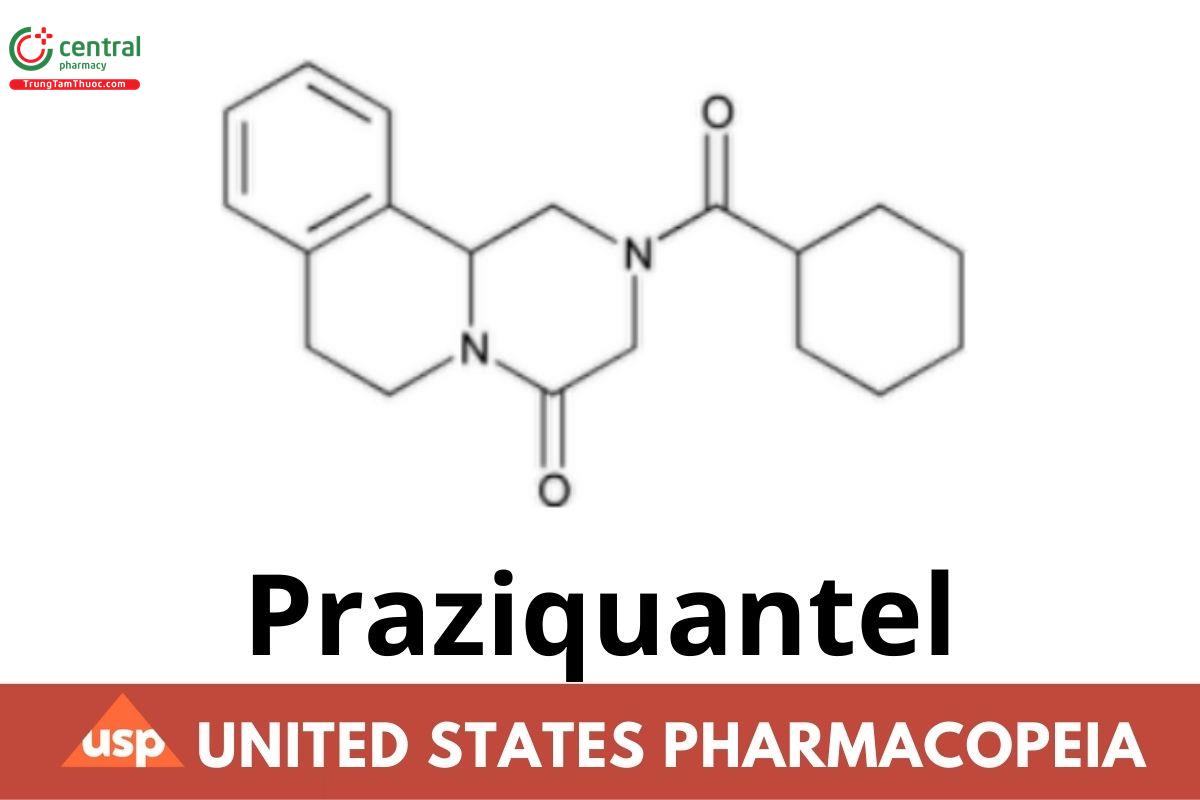
Praziquantel
If you find any inaccurate information, please let us know by providing your feedback here

Tóm tắt nội dung
This article is compiled based on the United States Pharmacopeia (USP) – 2025 Edition
Issued and maintained by the United States Pharmacopeial Convention (USP)
C19H24N2O2 312.41
4H-Pyrazino[2,1-a]isoquinolin-4-one, 2-(cyclohexylcarbonyl)-1,2,3,6,7,11b-hexahydro-;
2-(Cyclohexylcarbonyl)-1,2,3,6,7,11b-hexahydro-4H-pyrazino[2,1-a]isoquinolin-4-one CAS RN®: 55268-74-1; UNII: 6490C9U457.
1 DEFINITION
Praziquantel contains NLT 98.5% and NMT 101.0% of praziquantel (C19H24N2O2), calculated on the dried basis.
2 IDENTIFICATION
Change to read:
A. Spectroscopic Identification Tests 〈197〉, Infrared Spectroscopy: 197K (CN 1-May-2020)
B. The retention time of the major peak of the Sample solution corresponds to that of the Standard solution, as obtained in the Assay.
3 ASSAY
Procedure
Mobile phase: Acetonitrile and water (60:40)
Standard solution: 0.18 mg/mL of USP Praziquantel RS in Mobile phase
Sample solution: 0.18 mg/mL of Praziquantel in Mobile phase
3.1 Chromatographic system
(See Chromatography 〈621〉, System Suitability.)
Mode: LC
Detector: UV 210 nm
Column: 4-mm × 25-cm; 10-µm packing L1
Flow rate: 1.5 mL/min
Injection volume: 10 µL
3.2 System suitability
Sample: Standard solution
Suitability requirements
Tailing factor: NMT 1.5
Relative standard deviation: NMT 1.0%
3.3 Analysis
Samples: Standard solution and Sample solution
Calculate the percentage of praziquantel (C19H24N2O2) in the portion of Praziquantel taken:
Result = (rU /rS ) × (CS /CU ) × 100
rU = peak response from the Sample solution
rS = peak response from the Standard solution
CS = concentration of USP Praziquantel RS in the Standard solution (mg/mL)
CU = concentration of Praziquantel in the Sample solution (mg/mL)
Acceptance criteria: 98.5%–101.0% on the dried basis
4 IMPURITIES
Residue on Ignition 〈281〉: NMT 0.1%
4.1 Limit of Phosphate
Solution A: Dissolve 250 mg of cupric sulfate and 4.5 g of ammonium acetate in sufficient 2 N acetic acid to obtain 100 mL of solution. Solution B: 30 mg/mL of ammonium molybdate
Solution C: Grind in a mortar 5 g of sodium sulfite, 94.3 g of sodium metabisulfite, and 700 mg of 4-amino-3-hydroxy-1-naphthalenesulfonic acid. Dissolve 1.5 g of this mixture in 10 mL of water, heating gently if necessary. Use this solution only when freshly prepared. Standard stock solution: 100 µg/mL of phosphate (PO4)3− prepared as follows. Dissolve 143.3 mg of dried monobasic potassium phosphate in water to make 1000 mL of solution.
Standard solution: 5 µg/mL of phosphate (PO4)3− from the Standard stock solution
Sample solution: 10 mg/mL of Praziquantel, prepared as follows. Add 30 mL of water to 500 mg of sample, and heat to boiling. Allow to cool, and filter, collecting the filtrate in a 50-mL volumetric flask. Wash the filter with water, collect the washings in the volumetric flask, and dilute with water to volume.
Analysis: Treat 10 mL of the Standard solution and 10 mL of the Sample solution as follows. To each, add 5 mL of Solution A, 2 mL of Solution B, 1 mL of Solution C, and 1 mL of perchloric acid solution (3 in 100); mix; and allow to stand for 15 min.
Acceptance criteria: The Sample solution does not have a blue color that is darker than that of the Standard solution (0.05%).
4.2 Organic Impurities
Mobile phase and Chromatographic system: Proceed as directed in the Assay.
Standard solution: 0.04 mg/mL each of USP Praziquantel Related Compound A RS, USP Praziquantel Related Compound B RS, and USP Praziquantel Related Compound C RS in Mobile phase
Sample solution: 20 mg/mL of Praziquantel in Mobile phase
Analysis
Samples: Standard solution and Sample solution
Calculate the percentages of praziquantel related compound A, praziquantel related compound B, or praziquantel related compound C in the portion of Praziquantel taken:
Result = (rU /rS ) × (CS /CU ) × 100
rU = peak response of praziquantel related compound A, praziquantel related compound B, or praziquantel related compound C from the Sample solution
rS = peak response of praziquantel related compound A, praziquantel related compound B, or praziquantel related compound C from the Standard solution
CS = concentration of USP Praziquantel Related Compound A RS, USP Praziquantel Related Compound B RS, or USP Praziquantel Related Compound C RS in the Standard solution (mg/mL)
CU = concentration of Praziquantel in the Sample solution (mg/mL)
Acceptance criteria: See Table 1.
Table 1
Name | Relative Retention Time | Acceptance Criteria, NMT (%) |
Praziquantel related compound Aa | 0.8 | 0.2 |
Praziquantel | 1.0 | — |
Praziquantel related compound Bb | 1.8 | 0.2 |
Praziquantel related compound Cc | 2.1 | 0.2 |
a 2-Benzoyl-1,2,3,6,7,11b-hexahydro-4H-pyrazino [2,1-a]isoquinolin-4-one.
b 2-(Cyclohexylcarbonyl)-2,3,6,7-tetrahydro-4H-pyrazino [2,1-a]isoquinolin-4-one.
c 2-(N-Formylhexahydrohippuroyl-1,2,3,4-tetrahydroisoquinolin-1-one.
5 SPECIFIC TESTS
Loss on Drying 〈731〉
Analysis: Dry a sample in a vacuum at a pressure not exceeding 5 mm of mercury at 50° over phosphorus pentoxide for 2 h.
Acceptance criteria: NMT 0.5%
6 ADDITIONAL REQUIREMENTS
Packaging and Storage: Preserve in well-closed, light-resistant containers.
USP Reference Standards 〈11〉
USP Praziquantel RS
USP Praziquantel Related Compound A RS
2-Benzoyl-1,2,3,6,7,11b-hexahydro-4H-pyrazino [2,1-a]isoquinolin-4-one.
C19H18N2O2 306.37
USP Praziquantel Related Compound B RS
2-(Cyclohexylcarbonyl)-2,3,6,7-tetrahydro-4H-pyrazino [2,1-a]isoquinolin-4-one.
C19H22N2O2 310.40
USP Praziquantel Related Compound C RS
2-(N-Formylhexahydrohippuroyl-1,2,3,4-tetrahydroisoquinolin-1-one.
C19H22N2O4 342.39

