
Potassium Citrate
If you find any inaccurate information, please let us know by providing your feedback here
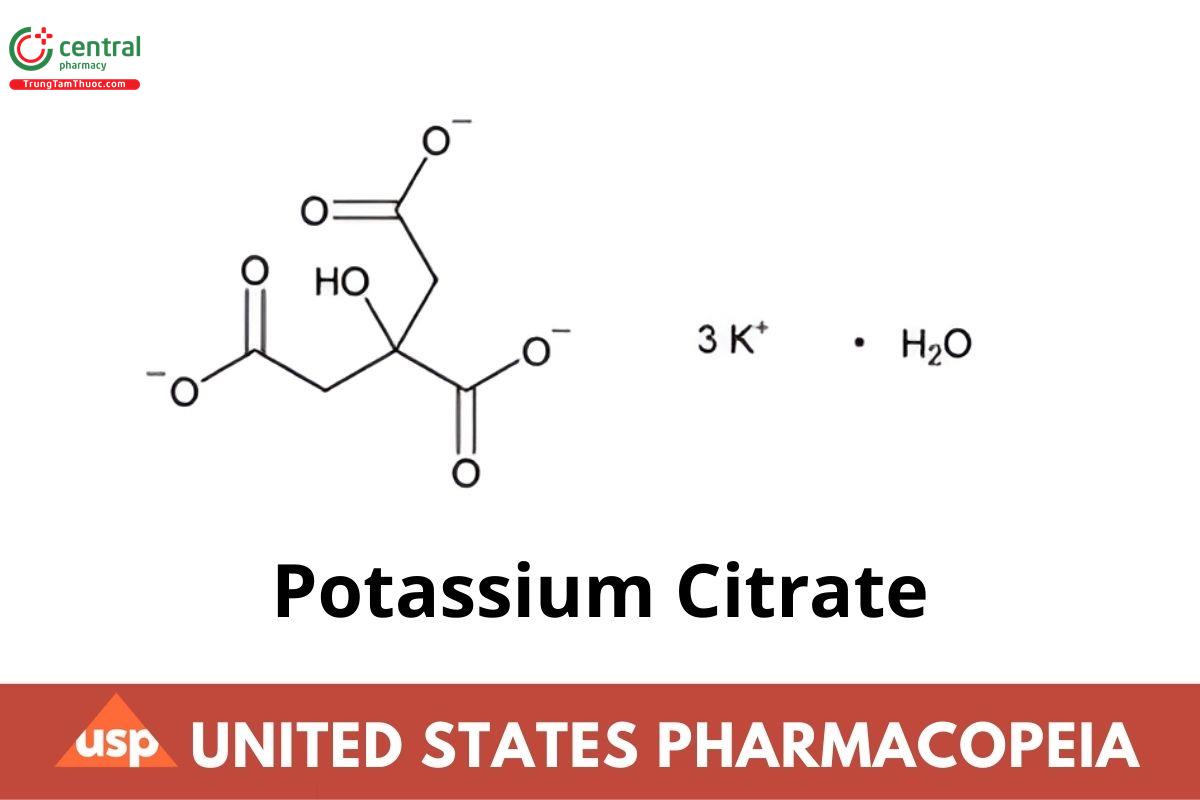

This article is compiled based on the United States Pharmacopeia (USP) – 2025 Edition
Issued and maintained by the United States Pharmacopeial Convention (USP)
C6H5K3O7 · H2O 324.41
C6H5K3O7 306.40
1,2,3-Propanetricarboxylic acid, 2-hydroxy-, tripotassium salt, monohydrate;
Tripotassium citrate monohydrate CAS RN®: 6100-05-6.
Anhydrous CAS RN®: 866-84-2.
1 DEFINITION
Potassium Citrate contains NLT 99.0% and NMT 100.5% of potassium citrate (C6H5K3O7), calculated on the dried basis.
2 IDENTIFICATION
A. Identification Tests - General, Potassium〈191〉andCitrate〈191〉: A 100-mg/mL solution meets the requirements.
3 ASSAY
Procedure
Sample: 200 mg of Potassium Citrate
Blank: 25 mL of glacial acetic acid
Titrimetric system
(See Titrimetry 〈541〉.)
Mode: Direct titration
Titrant: 0.1 N perchloric acid VS
Endpoint detection: Visual
Analysis: Dissolve the Sample in 25 mL of glacial acetic acid, add 2 drops of crystal violet TS, and titrate with the Titrant to a green endpoint.
Perform a Blank determination.
Calculate the percentage of potassium citrate (C6H5K3O7) in the Sample taken:
Result = {[(VS − VB) × N × F]/W} × 100
VS = Titrant volume consumed by the Sample (mL)
VB = Titrant volume consumed by the Blank (mL)
N = actual normality of the Titrant (mEq/mL)
F = equivalency factor, 102.1 mg/mEq
W = Sample weight (mg)
Acceptance criteria: 99.0%–100.5% on the dried basis
4 IMPURITIES
Tartrate
Sample: 1 g of Potassium Citrate
Analysis: Dissolve the Sample in 1.5 mL of water in a test tube, add 1 mL of 6 N acetic acid, and scratch the walls of the test tube with a glass rod.
Acceptance criteria: No crystalline precipitate is formed.
5 SPECIFIC TESTS
Alkalinity
Sample solution: Dissolve 1 g of Potassium Citrate in 20 mL of water.
Analysis: To the Sample solution add 0.20 mL of 0.10 N sulfuric acid, and add 1 drop of phenolphthalein TS.
Acceptance criteria: The Sample solution is alkaline to litmus. No pink color is produced after the addition of phenolphthalein TS.
Loss on Drying 〈731〉: Dry a sample at 180° for 4 h: it loses 3.0%–6.0% of its weight.
6 ADDITIONAL REQUIREMENTS
Packaging and Storage: Preserve in tight containers.

