
Polyethylene Glycol 30 Dipolyhydroxystearate 5
If you find any inaccurate information, please let us know by providing your feedback here
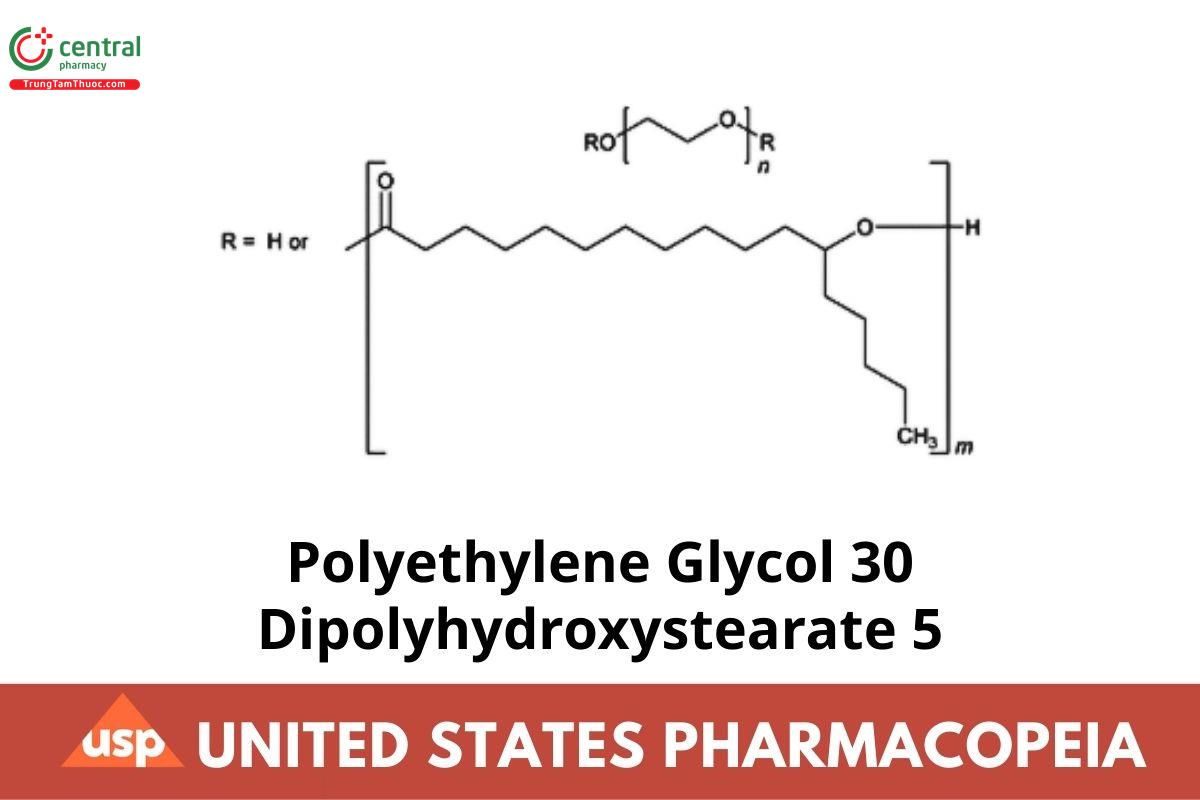

This article is compiled based on the United States Pharmacopeia (USP) – 2025 Edition
Issued and maintained by the United States Pharmacopeial Convention (USP)
1 DEFINITION
Polyethylene Glycol 30 Dipolyhydroxystearate 5 is the polyethylene glycol (PEG) diester of poly(12-hydroxystearic acid) containing a polyethylene glycol backbone, with both the terminal hydroxyl groups linked by ester bonds to branched oligomers, based on hydroxystearic acid. It is obtained by esterification of polyethylene glycol with 12-hydroxystearic acid. The average number of units of ethylene oxide in the polyethylene glycol chain is in the range of 30–35. The size of each polyhydroxystearic acid group is about 5 monomer units.
2 IDENTIFICATION
A. Spectroscopic Identification Tests 〈197〉, Infrared Spectroscopy: 197A
B. It meets the requirements in Specific Tests for Fats and Fixed Oils 〈401〉, Procedures, Saponification Value.
C. It meets the requirements in Specific Tests for Fats and Fixed Oils 〈401〉, Procedures, Hydroxyl Value.
3 IMPURITIES
Residue on Ignition 〈281〉: NMT 0.5%
Ethylene Oxide and Dioxane 〈228〉, Method II
Acceptance criteria
For ethylene oxide: NMT 1 ppm
For dioxane: NMT 10 ppm
4 SPECIFIC TESTS
Fats and Fixed Oils 〈401〉, Procedures, Hydroxyl Value
Pyridine–acetic anhydride reagent: Just before use, mix 3 volumes of freshly opened or freshly distilled pyridine with 1 volume of freshly opened or freshly distilled acetic anhydride.
Analysis: Transfer about 4.0 g of accurately weighed sample to a glass-stoppered 250-mL conical flask. Add 5.0 mL of Pyridine–acetic anhydride reagent. Heat in a steam bath for 1 h, keeping the level of the water about 2.5 cm above the level of the liquid in the flask. Add 5 mL of water through the condenser. If the solution appears cloudy, add a sufficient amount of pyridine to clear it. Shake the flask and heat in the water bath for 10 min. Cool and add 5 mL of alcohol, previously neutralized to phenolphthalein TS. Add 1 mL of phenolphthalein TS and titrate with 0.5 N alcoholic potassium hydroxide VS, recording the volume, in milliliters, consumed by the residual acid in the test solution. Carry out a blank test under the same conditions.
Acceptance criteria: 12–30
Fats and Fixed Oils 〈401〉, Procedures, Acid Value
[Note—Petroleum ether with a 100°–120° boiling range can be used to replace ether in the test.]
Acceptance criteria: NMT 10.0
Fats and Fixed Oils 〈401〉, Procedures, Saponification Value
Analysis: Accurately weigh about 2.0 g of Polyethylene Glycol 30 Dipolyhydroxystearate 5 and add to it 30.0 mL of 0.5 N alcoholic potassium hydroxide. Heat the flask in a steam bath, under a suitable condenser to maintain reflux for 60 min, frequently rotating the contents. Add 50 mL of dehydrated alcohol before carrying out the titration.
Acceptance criteria: 125–150
Fats and Fixed Oils 〈401〉, Procedures, Iodine Value
Analysis: Accurately weigh 1.0 g of Polyethylene Glycol 30 Dipolyhydroxystearate 5 into a 250-mL iodine flask, dissolve it in 15 mL of chloroform, add 25.0 mL of iodobromide TS. Insert the stopper in the vessel securely, and allow it to stand for 30 min protected from light, with occasional shaking. Add 10 mL of a 100-g/L solution of potassium iodide TS and 100 mL of water. Titrate the liberated iodine with 0.1 N sodium thiosulfate VS, shaking thoroughly after each addition of thiosulfate. When the color of the iodine becomes quite pale, add 5 mL of starch TS, and continue the titration with 0.1 N sodium thiosulfate VS until the blue color is discharged. Perform a blank test at the same time with the same quantities of the same reagents and in the same manner.
Acceptance criteria: NMT 10.0
Fats and Fixed Oils 〈401〉, Procedures, Peroxide Value: NMT 5.0
Water Determination 〈921〉, Method I: NMT 1.0%
5 ADDITIONAL REQUIREMENTS
Packaging and Storage: Preserve in tight containers, in a cool place.
USP Reference Standards 〈11〉
USP Polyethylene Glycol 30 Dipolyhydroxystearate 5 RS
▲ (NF 1-Aug-2023)

