
Piroxicam
If you find any inaccurate information, please let us know by providing your feedback here
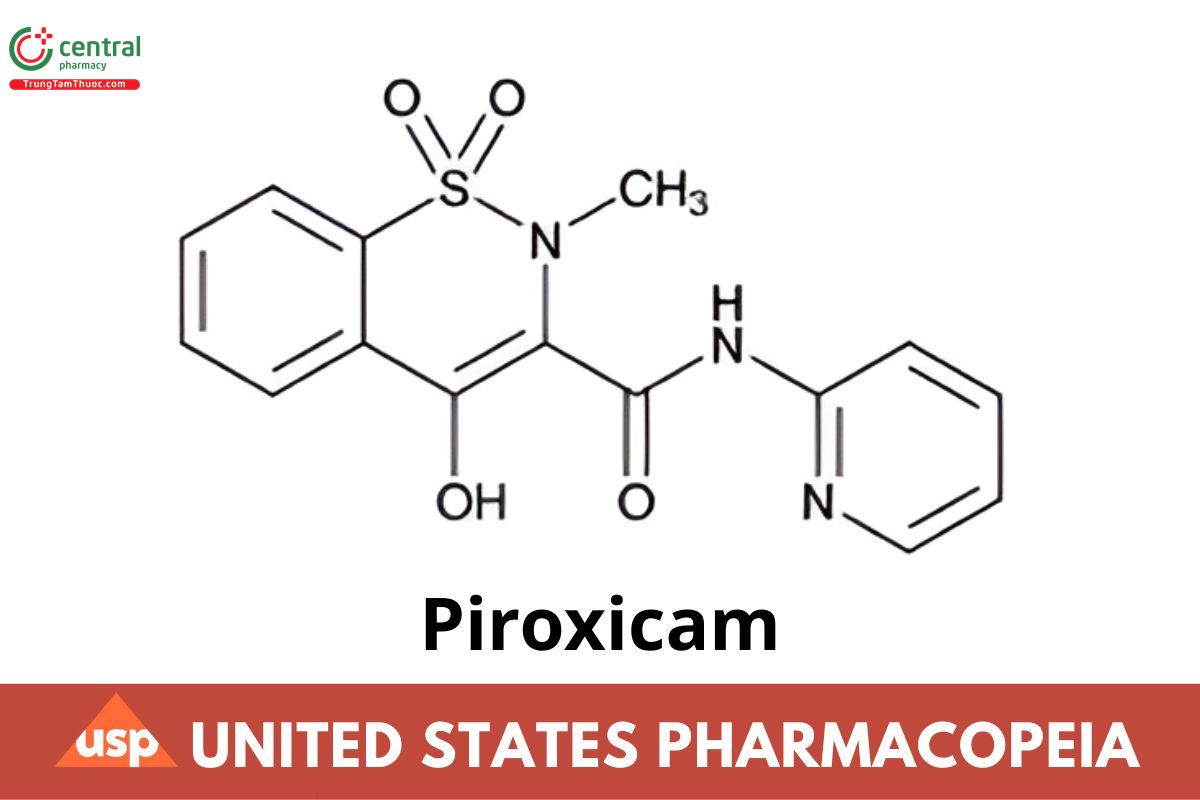

This article is compiled based on the United States Pharmacopeia (USP) – 2025 Edition
Issued and maintained by the United States Pharmacopeial Convention (USP)
C15H13N3O4S 331.35
2H-1,2-Benzothiazine-3-carboxamide, 4-hydroxy-2-methyl-N-2-pyridinyl-, 1,1-dioxide;
4-Hydroxy-2-methyl-N-2-pyridyl-2H-1,2-benzothiazine-3-carboxamide 1,1-dioxide CAS RN®: 36322-90-4; UNII: 13T4O6VMAM.
1 DEFINITION
Piroxicam contains NLT 97.0% and NMT 103.0% of piroxicam (C15H13N3O4S).
2 IDENTIFICATION
A. Spectroscopic Identification Tests 〈197〉, Infrared Spectroscopy: 197M. Do not dry specimens.
Delete the following:
B. Spectroscopic Identification Tests 〈197〉, Ultraviolet-Visible Spectroscopy: 197U
Solution: 10 μg/mL
Medium: Hydrochloric acid in methanol (1 in 1200)
Acceptance criteria: Meets the requirements (USP 1-Dec-2020)
Delete the following:
C. Thin-Layer Chromatography 〈201〉
Diluent: Chloroform and methanol (1:1)
Standard solution: 1 mg/mL of USP Piroxicam RS in Diluent
Sample solution: 1 mg/mL in Diluent
Chromatographic system
(See Chromatography 〈621〉, Thin-Layer Chromatography.)
Absorbent: 0.25-mm layer of chromatographic silica gel
Application volume: 20 μL
Developing solvent system: Toluene and glacial acetic acid (95:5)
Analysis
Samples: Standard solution and Sample solution
Allow the spots to dry, and develop the chromatogram in the Developing solvent system until the solvent front has moved about three-fourths of the length of the plate. Remove the plate from the developing chamber, and air-dry. Place the plate in the developing chamber, and develop as before. Remove the plate from the chamber, mark the solvent front, and air-dry. Locate the spots on the plate by viewing under short-wavelength UV light.
Acceptance criteria: The R value of the principal spot of the Sample solution corresponds to that of the Standard solution. (USP 1-Dec-2020)
Add the following:
B. The retention time of the major peak of the Sample solution corresponds to that of the Standard solution, as obtained in the Assay (USP 1-Dec-2020)
3 ASSAY
Change to read:
Procedure
Solution A: Mix 1 mL of phosphoric acid with 1000 mL of water.
Solution B: Acetonitrile
Mobile phase: See Table 1.
Table 1
| Time (min) | Solution A (%) | Solution B (%) |
|---|---|---|
| 0.0 | 65 | 35 |
| 2.0 | 65 | 35 |
| 6.0 | 5 | 95 |
| 6.1 | 65 | 35 |
| 11.0 | 65 | 35 |
Diluent: Methanol
Standard solution: 0.05 mg/mL of USP Piroxicam RS in Diluent. Sonicate to dissolve, if needed.
Sample solution: 0.05 mg/mL of Piroxicam in Diluent. Sonicate to dissolve, if needed.
Chromatographic system
(See Chromatography 〈621〉, System Suitability.)
Mode: LC
Detector: UV 340 nm
Column: 4.6-mm × 15-cm; 3.5-μm packing L1
Temperatures
Autosampler: 4°
Column: 35°
Flow rate: 1 mL/min
Injection volume: 10 μL
System suitability
Sample: Standard solution
Suitability requirements
Tailing factor: NMT 2.0
Relative standard deviation: NMT 1.0% (USP 1-Dec-2020)
Analysis
Samples: Standard solution and Sample solution
Calculate the percentage of piroxicam (C15H13N3O4S) in the portion of Piroxicam taken:
Result = (rU/rS) × (CS/CU) × 100
rU = peak response of piroxicam from the Sample solution
rS = peak response of piroxicam from the Standard solution
CS = concentration of USP Piroxicam RS in the Standard solution (mg/mL)
CU = concentration of Piroxicam in the Sample solution (mg/mL)
Acceptance criteria: 97.0%–103.0%
4 IMPURITIES
Add the following:
Limit of Piroxicam Related Compound B
Solution A, Solution B, Mobile phase, Diluent, and Chromatographic system: Proceed as directed in the Assay.
System suitability solution: 1000 μg/mL of USP Piroxicam RS and 10 μg/mL each of USP Piroxicam Related Compound B RS and USP Piroxicam Related Compound G RS in Diluent. Sonicate to dissolve, if needed. Use freshly prepared solution.
Standard solution: 2 μg/mL of USP Piroxicam Related Compound B RS in Diluent. Sonicate to dissolve, if needed. Use freshly prepared solution.
Sample solution: 1.0 mg/mL of Piroxicam in Diluent. Sonicate to dissolve, if needed. Use freshly prepared solution.
System suitability
Samples: System suitability solution and Standard solution
[Note - The relative retention times for piroxicam related compound B, piroxicam related compound G, and piroxicam are 0.89, 0.95, and 1.0, respectively.]
Suitability requirements
Resolution: NLT 1.5 between piroxicam related compound B and piroxicam related compound G, System suitability solution
Relative standard deviation: NMT 5.0%, Standard solution
Analysis
Samples: Standard solution and Sample solution
Calculate the percentage of piroxicam related compound B in the portion of Piroxicam taken:
Result = (rU/rS) × (CS/CU) × 100
rU = peak response of piroxicam related compound B from the Sample solution
rS = peak response of piroxicam related compound B from the Standard solution
CS = concentration of USP Piroxicam Related Compound B RS in the Standard solution (μg/mL)
CU = concentration of Piroxicam in the Sample solution (μg/mL)
Acceptance criteria: NMT 0.2% (USP 1-Dec-2020)
Add the following:
Organic Impurities
Solution A: 0.5% of glacial acetic acid in water. Adjust with ammonium hydroxide to a pH of 6.2.
Solution B: Acetonitrile
Mobile phase: See Table 2.
Table 2
| Time (min) | Solution A (%) | Solution B (%) |
|---|---|---|
| 0.0 | 95 | 5 |
| 3.0 | 95 | 5 |
| 5.0 | 77 | 23 |
| 10.0 | 77 | 23 |
| 15.0 | 40 | 60 |
| 15.1 | 95 | 5 |
| 20.0 | 95 | 5 |
Sensitivity solution: 0.5 μg/mL of USP Piroxicam RS in methanol. Sonicate to dissolve, if needed. Use freshly prepared solution.
Standard solution: 2 μg/mL each of USP Piroxicam RS, USP Piroxicam Related Compound A RS, USP Piroxicam Related Compound D RS, USP Piroxicam Related Compound G RS, and USP Piroxicam Related Compound J RS in methanol. Sonicate to dissolve, if needed. Use freshly prepared solution.
Sample solution: 1.0 mg/mL of Piroxicam in methanol. Sonicate to dissolve, if needed. Use freshly prepared solution.
Chromatographic system
(See Chromatography 〈621〉, System Suitability.)
Mode: LC
Detector: UV 235 nm for quantitation of piroxicam, piroxicam related compound A, piroxicam related compound D, and any unspecified impurity; UV 355 nm for quantitation of piroxicam related compound G, and piroxicam related compound J
Column: 4.6-mm × 15-cm; 3.5-μm packing L1
Temperatures
Autosampler: 4°
Column: 30°
Flow rate: 1 mL/min
Injection volume: 10 μL
System suitability
Samples: Sensitivity solution and Standard solution
Suitability requirements
Resolution: NLT 5.0 between piroxicam and piroxicam related compound G, Standard solution
Relative standard deviation: NMT 5.0% for piroxicam and piroxicam related compounds A, D, G, and J; Standard solution
Signal-to-noise ratio: NLT 10, Sensitivity solution
Analysis
Samples: Standard solution and Sample solution
Calculate the percentage of piroxicam related compounds A, D, G, and J in the portion of the Piroxicam taken:
Result = (rU/rS) × (CS/CU) × 100
rU = peak response of piroxicam related compound A, D, G, or J from the Sample solution
rS = peak response of piroxicam related compound A, D, G, or J from the Standard solution
CS = concentration of the corresponding Reference Standard in the Standard solution (μg/mL)
CU = concentration of Piroxicam in the Sample solution (μg/mL)
Calculate the percentage of any unspecified impurity in the portion of the Piroxicam taken:
Result = (rU/rS) × (CS/CU) × 100
rU = peak response of any unspecified impurity from the Sample solution
rS = peak response of piroxicam from the Standard solution
CS = concentration of USP Piroxicam RS in the Standard solution (μg/mL)
CU = concentration of Piroxicam in the Sample solution (μg/mL)
Acceptance criteria: See Table 3.
Table 3
| Name | Relative Retention Time | Acceptance Criteria, NMT (%) |
|---|---|---|
| Piroxicam related compound A | 0.35 | 0.2 |
| Piroxicam related compound G (as the anhydrous form)ᵃ | 0.86 | 0.2 |
| Piroxicam | 1.0 | – |
| Piroxicam related compound Bᵇ | 1.2 | – |
| Piroxicam related compound D | 1.36 | 0.2 |
| Piroxicam related compound J | 1.42 | 0.2 |
| Any unspecified impurity | – | 0.10 |
| Total impuritiesᶜ | – | 0.4 (USP 1-Dec-2020) |
a Methyl 4-hydroxy-2H-benzothiazine-3-carboxylate 1,1-dioxide
b For peak identification only; quantitated by the test for Limit of Piroxicam Related Compound B.
c Total impurities is the sum of piroxicam related compound B from the test for Limit of Piroxicam Related Compound B and each specified and any unspecified impurities from the Organic Impurities test.
Residue on Ignition 〈281〉: NMT 0.3%
5 SPECIFIC TESTS
Water Determination 〈921〉, Method I: NMT 0.5%
6 ADDITIONAL REQUIREMENTS
Packaging and Storage: Preserve in tight, light-resistant containers.
Change to read:
USP Reference Standards 〈11〉
USP Piroxicam RS
USP Piroxicam Related Compound A RS
Pyridin-2-amine.
C5H6N2 94.11
USP Piroxicam Related Compound B RS
4-Hydroxy-N-(pyridin-2-yl)-2H-benzothiazine-3-carboxamide 1,1-dioxide.
C14H11N3O4S 317.32
USP Piroxicam Related Compound D RS
Methyl 2-[1,1-dioxido-3-oxobenzoisothiazol-2(3H)-yl]acetate.
C10H9NO5S 255.25
USP Piroxicam Related Compound G RS
Methyl 4-hydroxy-2H-benzothiazine-3-carboxylate 1,1-dioxide monohydrate.
C10H9NO5S · H2O 273.26
USP Piroxicam Related Compound J RS
Methyl 4-hydroxy-2-methyl-2H-benzothiazine-3-carboxylate 1,1-dioxide.
C11H11NO5S 269.27

