
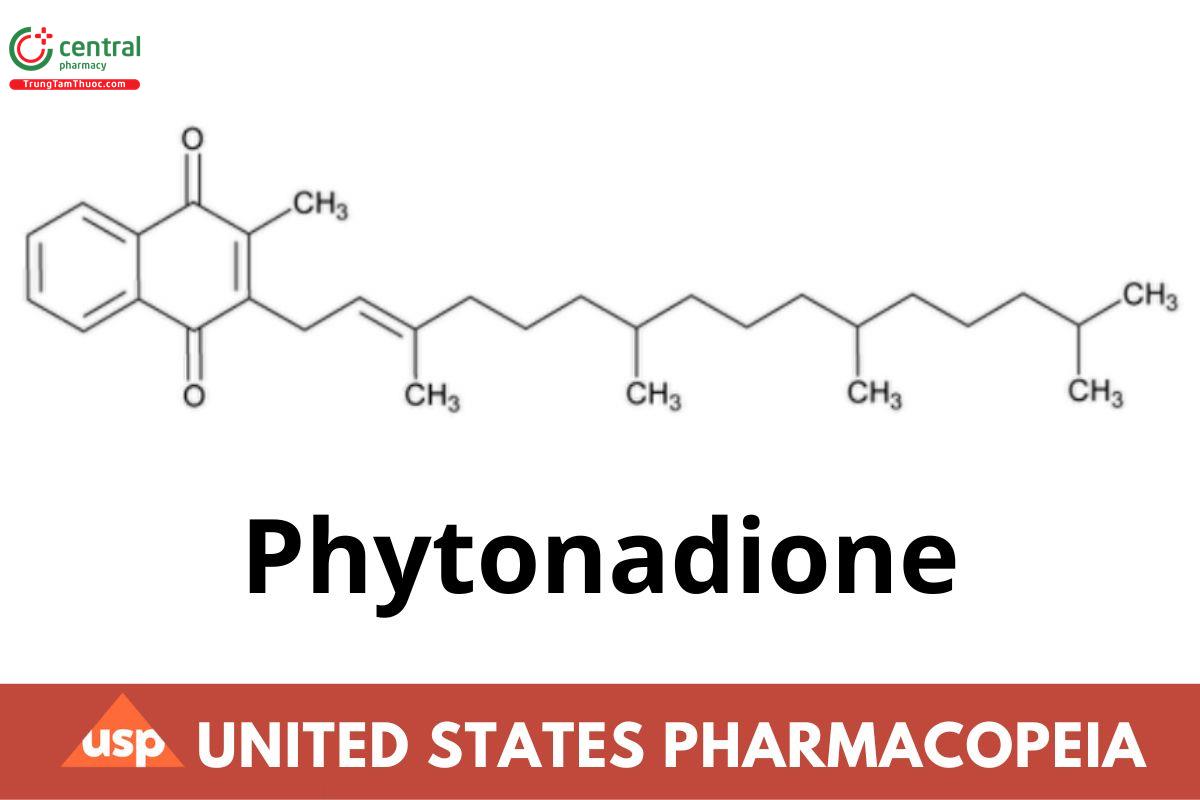
Phytonadione
If you find any inaccurate information, please let us know by providing your feedback here

Tóm tắt nội dung
This article is compiled based on the United States Pharmacopeia (USP) – 2025 Edition
Issued and maintained by the United States Pharmacopeial Convention (USP)
Change to read:
2S (USP41)
C31H46O2 450.70
2-Methyl-3-(3,7,11,15-tetramethylhexadec-2-en-1-yl)naphthalene-1,4-dione;2S (USP41)
Phylloquinone CAS RN®: 81818-54-4.2S (USP41)
1 DEFINITION
Phytonadione is a mixture of E- and Z-isomers containing NLT 97.0% and NMT 103.0% of phytonadione isomers (C31H46O2). It contains NMT 21.0% of the Z-isomer.
2 IDENTIFICATION
Change to read:
A. Spectroscopic Identification Tests 〈197〉, Infrared Spectroscopy: 197F (CN 1-May-2020)
Change to read:
B. Spectroscopic Identification Tests 〈197〉, Ultraviolet-Visible Spectroscopy: 197U (CN 1-May-2020)
Analytical wavelength: 248 nm
Sample solution: 10 µg/mL in n-hexane
Acceptance criteria: Meets the requirements. Absorptivities do not differ by more than 3.0%.
3 ASSAY
Procedure
[Note—Protect solutions containing phytonadione from exposure to light.]
Mobile phase: n-Hexane and n-amyl alcohol (2000:1.5)
Internal standard solution: 2.5 mg/mL of cholesteryl benzoate in Mobile phase
Standard solution: Prepare a 96-µg/mL solution of USP Phytonadione RS in Mobile phase. Pipet 10 mL of this solution and 7 mL of Internal standard solution into a 25-mL volumetric ask, and dilute with Mobile phase to volume.
Sample solution: Prepare as directed for the Standard solution, using Phytonadione instead of USP Phytonadione RS.
3.1 Chromatographic system
(See Chromatography 〈621〉, System Suitability.)
Mode: LC
Detector: UV 254 nm
Column: 4.6-mm × 25-cm; packing L3
Flow rate: 1 mL/min
Injection volume: 50 µL
3.2 System suitability
Sample: Standard solution
[Note—The relative retention times for the internal standard, (Z)-phytonadione, and (E)-phytonadione are 0.7, 0.9, and 1.0, respectively.]
Suitability requirements
Resolution: NLT 1.5 between (Z)-phytonadione and (E)-phytonadione
Relative standard deviation: NMT 2.0% for the ratios of the sum of peak areas of (Z)-phytonadione and (E)-phytonadione to the peak area of the internal standard
3.3 Analysis
Samples: Standard solution and Sample solution
Calculate the percentage of phytonadione isomers (C31H46O2) in the portion of Phytonadione taken:
Result = (RU /RS ) × (CS /CU) × 100
RU = internal standard ratio [sum of the peak areas of (Z)-phytonadione and (E)-phytonadione/peak area of the internal standard] from the Sample solution
RS = internal standard ratio [sum of the peak areas of (Z)-phytonadione and (E)-phytonadione/peak area of the internal standard] from the Standard solution
CS = concentration of USP Phytonadione RS in the Standard solution (µg/mL)
CU = concentration of Phytonadione in the Sample solution (µg/mL)
Acceptance criteria: 97.0%–103.0% of phytonadione isomers
4 OTHER COMPONENTS
Z-Isomer Content
[Note—Protect solutions containing phytonadione from exposure to light.]
Mobile phase, Internal standard solution, Standard solution, Sample solution, Chromatographic system, System suitability, and Analysis: Proceed as directed in the Assay, except calculate the percentage of Z-isomer in the portion of Phytonadione taken:
Result = [rZ /(rZ + rE )] × 100
rZ = peak area of the (Z)-phytonadione isomer from the Sample solution
rE = peak area of the (E)-phytonadione isomer from the Sample solution
Acceptance criteria: NMT 21.0%
5 IMPURITIES
Limit of Menadione
Sample: 20 mg of Phytonadione
Analysis: Mix the Sample with 0.5 mL of a mixture of 6 N ammonium hydroxide and alcohol (1:1). Add 1 drop of ethyl cyanoacetate, and shake gently.
Acceptance criteria: No purple or blue color is produced.
6 SPECIFIC TESTS
Refractive Index 〈831〉: 1.523–1.526
Reaction: A 50-mg/mL solution of Phytonadione in dehydrated alcohol is neutral to litmus.
7 ADDITIONAL REQUIREMENTS
Change to read:
Packaging and Storage: Preserve in tight, light-resistant containers. Store in a cool place.2S (USP41)
USP Reference Standards 〈11〉
USP Phytonadione RS

