
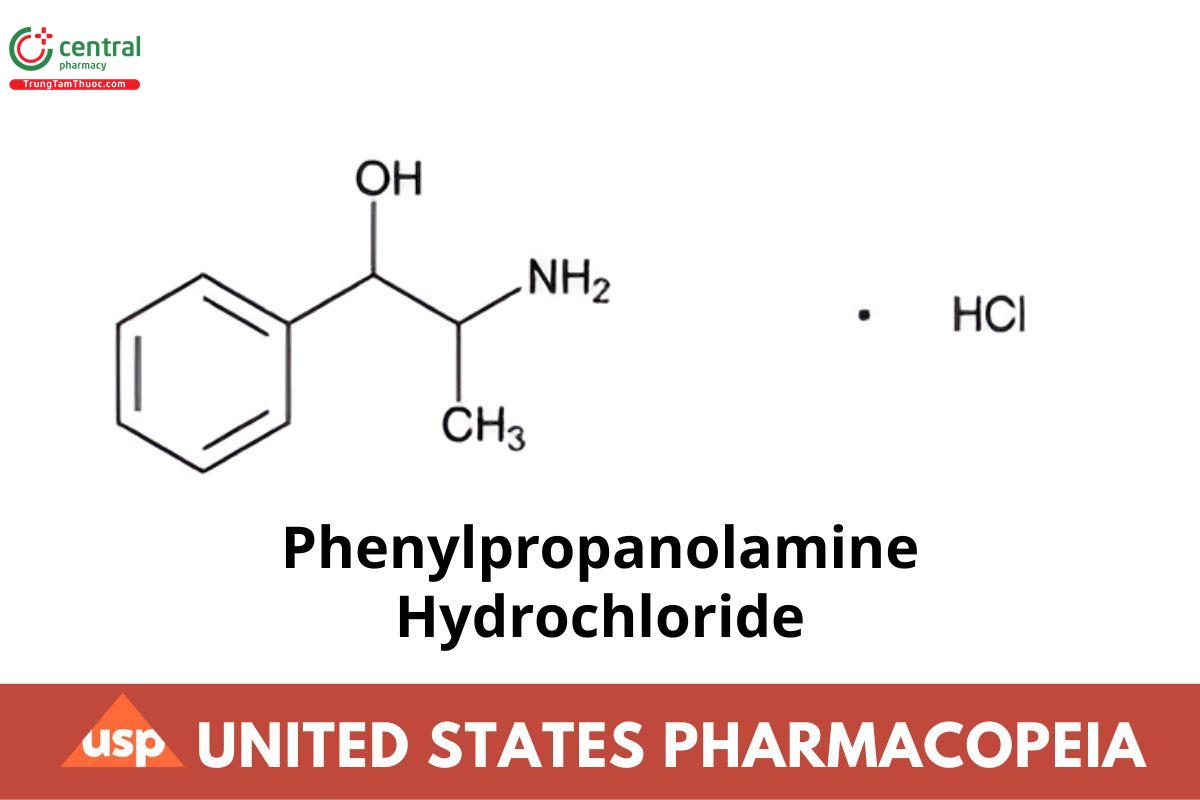
Phenylpropanolamine Hydrochloride
If you find any inaccurate information, please let us know by providing your feedback here

Tóm tắt nội dung
This article is compiled based on the United States Pharmacopeia (USP) – 2025 Edition
Issued and maintained by the United States Pharmacopeial Convention (USP)
C9H13NO · HCl 187.67
Benzenemethanol, α-(1-aminoethyl)-, hydrochloride, (R*,S*)-, (±);
(±)-Norephedrine hydrochloride CAS RN®: 154-41-6; UNII: 8D5I63UE1Q.
1 DEFINITION
Phenylpropanolamine Hydrochloride contains NLT 98.0% and NMT 101.0% of phenylpropanolamine hydrochloride (C9H13NO · HCl), calculated on the dried basis.
2 IDENTIFICATION
Change to read:
A. Spectroscopic Identification Tests 〈197〉, Infrared Spectroscopy: 197K (CN 1-May-2020)
Change to read:
B. Spectroscopic Identification Tests 〈197〉, Ultraviolet-Visible Spectroscopy: 197U (CN 1-May-2020)
Solution: 500 μg/mL
Medium: Water
Analytical wavelength: 256 nm
Acceptance criteria: Absorptivities, calculated on the dried basis, do not differ by more than 3.0%.
C. Melting Range or Temperature 〈741〉
Sample: Dissolve 1 g in 10 mL of water, add 10 mL of saturated sodium carbonate solution, and mix. Separate the precipitate by vacuum filtration, using a sintered-glass filter of medium pore size. Wash with three 5-mL portions of ice-cold water. Dry the crystals at 80° for 1 h.
Acceptance criteria: The Sample melts between 101° and 104°.
3 ASSAY
Procedure
Sample: 500 mg
Analysis: Dissolve the Sample in 50 mL of glacial acetic acid. Add 10 mL of mercuric acetate TS and 2 drops of crystal violet TS, and titrate with 0.1 N perchloric acid VS to a green endpoint. Perform a blank determination, and make any necessary correction. Each mL of 0.1 N perchloric acid is equivalent to 18.77 mg of phenylpropanolamine hydrochloride (C9H13NO · HCl).
Acceptance criteria: 98.0%–101.0% on the dried basis
4 IMPURITIES
Residue on Ignition 〈281〉: NMT 0.1%
4.1 Limit of Cathinone Hydrochloride
Diluent: Dilute hydrochloric acid (1 in 120)
Standard solution: 100 μg/mL of USP Cathinone Hydrochloride RS in Diluent
Sample solution: 100 mg/mL of Phenylpropanolamine Hydrochloride in Diluent
Instrumental conditions
Mode: UV
Analytical wavelength: Maximum absorbance at about 285 nm
Cell: 1 cm
Blank: Diluent
Analysis: Concomitantly determine the absorbances of the Sample solution and the Standard solution, using the Blank.
Acceptance criteria: The absorbance of the Sample solution is NMT than that of the Standard solution (NMT 0.10%).
4.2 Limit of Amphetamine Hydrochloride
Mobile phase: Acetonitrile, phosphoric acid, triethylamine, and water (50:8:5:950)
System suitability solution: 5 μg/mL each of USP Phenylpropanolamine Hydrochloride RS and USP Dextroamphetamine Sulfate RS in water
Sample stock solution: 250 mg/mL of Phenylpropanolamine Hydrochloride in water. Sonicate if necessary.
Sample solution: 100 mg/mL of Phenylpropanolamine Hydrochloride in water from Sample stock solution
Amphetamine standard stock solution: 2.5 μg/mL of USP Dextroamphetamine Sulfate RS in water
Standard solution: 1 μg/mL of USP Dextroamphetamine Sulfate RS and 100 mg/mL of Phenylpropanolamine Hydrochloride in water from Amphetamine standard stock solution and Sample stock solution
Chromatographic system
(See Chromatography 〈621〉, System Suitability.)
Mode: LC
Detector: UV 206 nm
Column: 4.6-mm × 25-cm; 5-μm base-deactivated packing L1
Flow rate: 1 mL/min
Injection volume: 5 μL
System suitability
Samples: System suitability solution and Standard solution
[Note - The relative retention times for phenylpropanolamine and amphetamine are 1.0 and 2.1, respectively.]
Suitability requirements
Resolution: NLT 15 between phenylpropanolamine and amphetamine, System suitability solution
Column efficiency: NLT 10,000 theoretical plates, System suitability solution
Relative standard deviation: NMT 3.0% for amphetamine, Standard solution
Analysis
Samples: Sample solution and Standard solution
Record the chromatograms, and measure the responses at the locus of the amphetamine peak.
Calculate the percentage of amphetamine hydrochloride in the portion of Phenylpropanolamine Hydrochloride taken:
Result = [rU/(rS − rU)] × (CS/CU) × (Mr1/Mr2) × 0.2
rU = amphetamine peak response from the Sample solution
rS = amphetamine peak response from the Standard solution
CS = concentration of USP Dextroamphetamine Sulfate RS in the Standard solution (μg/mL)
CU = concentration of Phenylpropanolamine Hydrochloride in the Sample solution (mg/mL)
Mr1 = molecular weight of amphetamine hydrochloride, 171.67
Mr2 = molecular weight of amphetamine sulfate, 368.49
Acceptance criteria: NMT 0.001%
5 SPECIFIC TESTS
Melting Range or Temperature, Class I〈741〉: 191°–196°
pH 〈791〉
Sample solution: A solution (3 in 100)
Acceptance criteria: 4.2–5.5
Loss on Drying 〈731〉
Analysis: Dry at 105° for 2 h.
Acceptance criteria: NMT 0.5%
6 ADDITIONAL REQUIREMENTS
Labeling: Label it to indicate that it is for veterinary use only.
Packaging and Storage: Preserve in tight, light-resistant containers.
USP Reference Standards 〈11〉
USP Cathinone Hydrochloride RS
α-Aminopropiophenone hydrochloride.
C9H11NO · HCl 185.65
USP Dextroamphetamine Sulfate RS
USP Phenylpropanolamine Hydrochloride RS

