
Phenylephrine Bitartrate
If you find any inaccurate information, please let us know by providing your feedback here
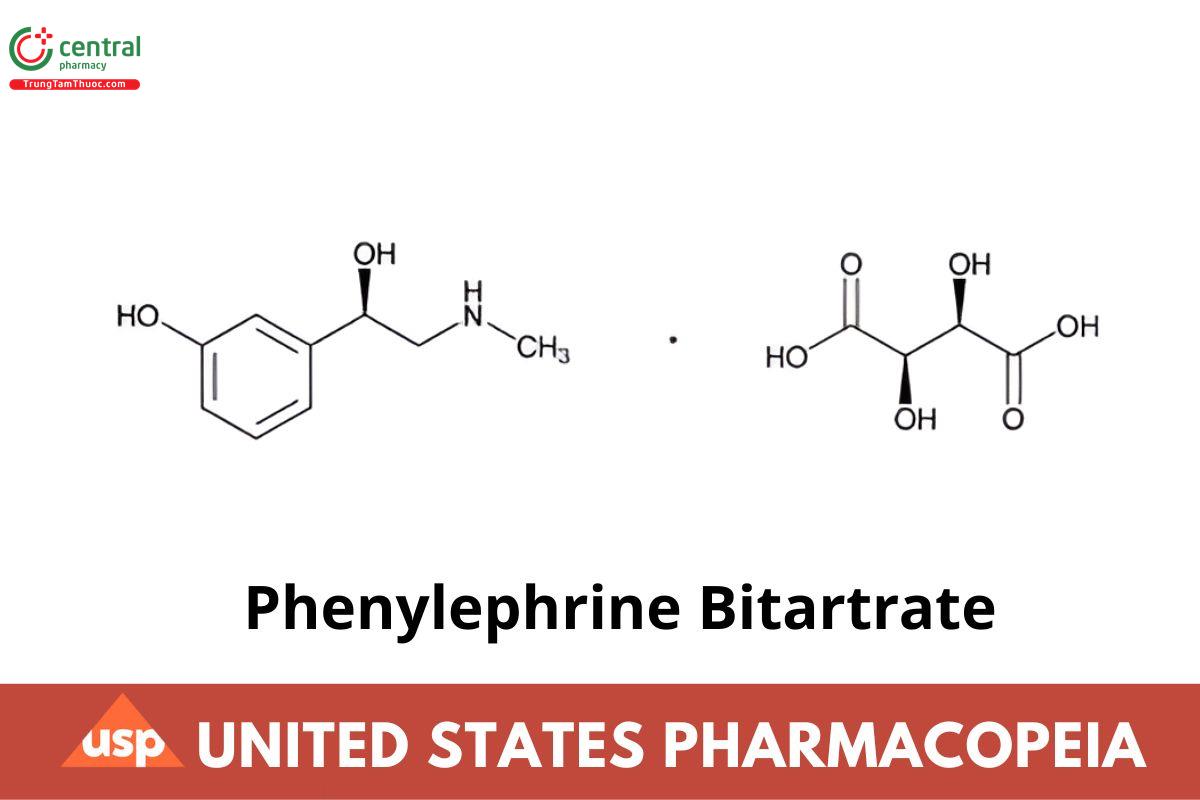

This article is compiled based on the United States Pharmacopeia (USP) – 2025 Edition
Issued and maintained by the United States Pharmacopeial Convention (USP)
C9H13NO2 · C4H6O6 317.29
Benzenemethanol, 3-hydroxy-α-[(methylamino)methyl]-, (2R,3R)-2,3-dihydroxybutanedioate (1:1) (salt);
(R)-(-)-m-Hydroxy-α-[(methylamino)methyl]benzyl alcohol hydrogen tartrate CAS RN®: 17162-39-9; UNII: 27O3Q5ML57.
1 DEFINITION
Phenylephrine Bitartrate contains NLT 98.0% and NMT 102.0% of phenylephrine bitartrate (C9H13NO2 · C4H6O6), calculated on the dried basis.
2 IDENTIFICATION
Change to read:
A. Spectroscopic Identification Tests 〈197〉, Infrared Spectroscopy: 197K (CN 1-May-2020)
B. Identification Tests - General, Tartrate 〈191〉
Sample: The alkaline filtrate from the test for Optical Rotation 〈781S〉, Specific Rotation
Acceptance criteria: The Sample responds positively to the test for Tartrate in Identification Tests - General 〈191〉.
C. The retention time of the major peak of the Sample solution corresponds to that of the Standard solution, as obtained in the Assay.
3 ASSAY
Procedure
Buffer: Dissolve 3.25 g of 1-octanesulfonic acid sodium salt monohydrate in 1 L of water, and adjust with 3 M phosphoric acid to a pH of 2.8.
Solution A: Acetonitrile and Buffer (10:90)
Solution B: Acetonitrile and Buffer (90:10)
Mobile phase: See Table 1.
Table 1
| Time (min) | Solution A (%) | Solution B (%) |
|---|---|---|
| 0 | 93 | 7 |
| 10 | 70 | 30 |
| 10.1 | 93 | 7 |
| 18 | 93 | 7 |
Diluent: Solution A and Solution B (80:20)
Standard solution: 0.6 mg/mL of USP Phenylephrine Hydrochloride RS in Diluent
Sample solution: 0.9 mg/mL of Phenylephrine Bitartrate in Diluent
Chromatographic system
(See Chromatography 〈621〉, System Suitability.)
Mode: LC
Detector: UV 215 nm
Column: 4.0-mm × 5.5-cm; 3-μm packing L1
Column temperature: 45°
Flow rate: 1.5 mL/min
Injection volume: 4 μL
System suitability
Sample: Standard solution
Suitability requirements
Tailing factor: NMT 1.9
Relative standard deviation: NMT 0.73%
Analysis
Samples: Standard solution and Sample solution
Calculate the percentage of phenylephrine bitartrate (C9H13NO2 · C4H6O6) in the portion of Phenylephrine Bitartrate taken:
Result = (rU/rS) × (CS/CU) × (Mr1/Mr2) × 100
rU = peak response of phenylephrine from the Sample solution
rS = peak response of phenylephrine from the Standard solution
CS = concentration of USP Phenylephrine Hydrochloride RS in the Standard solution (mg/mL)
CU = concentration of Phenylephrine Bitartrate in the Sample solution (mg/mL)
Mr1 = molecular weight of phenylephrine bitartrate, 317.29
Mr2 = molecular weight of phenylephrine hydrochloride, 203.67
Acceptance criteria: 98.0%–102.0% on the dried basis
4 IMPURITIES
Residue on Ignition 〈281〉: NMT 0.1%
Organic Impurities
Buffer, Solution A, Solution B, Mobile phase, and Diluent: Proceed as directed in the Assay.
System suitability solution: 1.0 mg/mL of USP Phenylephrine Hydrochloride RS and 0.9 μg/mL each of USP Norphenylephrine Hydrochloride RS and USP Phenylephrine Related Compound C RS in Diluent
Standard solution: 0.001 mg/mL each of USP Phenylephrine Hydrochloride RS, USP Norphenylephrine Hydrochloride RS, USP Phenylephrine Related Compound C RS, USP Phenylephrine Related Compound D RS, and USP Phenylephrine Related Compound E RS in Diluent
Blank: 0.8 mg/mL of l(+)-tartaric acid in Diluent
Sample solution: 1.56 mg/mL of Phenylephrine Bitartrate in Diluent
Chromatographic system
(See Chromatography 〈621〉, System Suitability.)
Mode: LC
Detector: UV 215 nm
Column: 4-mm × 5.5-cm; 3-μm packing L1
Column temperature: 45°
Flow rate: 1.5 mL/min
Injection volume: 4 μL
System suitability
Samples: System suitability solution and Standard solution
Suitability requirements
Resolution: NLT 1.5 between norphenylephrine and phenylephrine and NLT 1.5 between phenylephrine and phenylephrine related compound C, System suitability solution
Relative standard deviation: NMT 5% for norphenylephrine, phenylephrine, phenylephrine related compound C, phenylephrine related compound D, and phenylephrine related compound E, Standard solution
Analysis
Samples: Standard solution, Blank, and Sample solution Examine the chromatogram of the Blank for the peaks, and disregard any corresponding peaks observed in the chromatogram of the Sample solution.
Calculate the percentage of norphenylephrine as free base in the portion of Phenylephrine Bitartrate taken:
Result = (rU/rS) × (CS/CU) × (Mr1/Mr2) × 100
rU = peak response of norphenylephrine from the Sample solution
rS = peak response of norphenylephrine from the Standard solution
CS = concentration of USP Norphenylephrine Hydrochloride RS in the Standard solution (mg/mL)
CU = concentration of Phenylephrine Bitartrate in the Sample solution (mg/mL)
Mr1 = molecular weight of norphenylephrine as free base, 153.18
Mr2 = molecular weight of norphenylephrine as hydrochloride salt, 189.64
Calculate the percentage of phenylephrine related compound C as free base in the portion of Phenylephrine Bitartrate taken:
Result = (rU/rS) × (CS/CU) × (Mr1/Mr2) × 100
rU = peak response of phenylephrine related compound C from the Sample solution
rS = peak response of phenylephrine related compound C from the Standard solution
CS = concentration of USP Phenylephrine Related Compound C RS in the Standard solution (mg/mL)
CU = concentration of Phenylephrine Bitartrate in the Sample solution (mg/mL)
Mr1 = molecular weight of phenylephrine related compound C as free base, 165.19
Mr2 = molecular weight of phenylephrine related compound C as hydrochloride salt, 201.65
Calculate the percentage of phenylephrine related compound D in the portion of Phenylephrine Bitartrate taken:
Result = (rU/rS) × (CS/CU) × 100
rU = peak response of phenylephrine related compound D from the Sample solution
rS = peak response of phenylephrine related compound D from the Standard solution
CS = concentration of USP Phenylephrine Related Compound D RS in the Standard solution (mg/mL)
CU = concentration of Phenylephrine Bitartrate in the Sample solution (mg/mL)
Calculate the percentage of phenylephrine related compound E as free base in the portion of Phenylephrine Bitartrate taken:
Result = (rU/rS) × (CS/CU) × (Mr1/Mr2) × 100
rU = peak response of phenylephrine related compound E from the Sample solution
rS = peak response of phenylephrine related compound E from the Standard solution
CS = concentration of USP Phenylephrine Related Compound E RS in the Standard solution (mg/mL)
CU = concentration of Phenylephrine Bitartrate in the Sample solution (mg/mL)
Mr1 = molecular weight of phenylephrine related compound E as free base, 255.31
Mr2 = molecular weight of phenylephrine related compound E as hydrochloride salt, 291.77
Calculate the percentage of any individual unspeci
ed impurity in the portion of Phenylephrine Bitartrate taken:
Result = (rU/rS) × (CS/CU) × (Mr1/Mr2) × 100
rU = peak response of each unspecified impurity from the Sample solution
rS = peak response of phenylephrine from the Standard solution
CS = concentration of USP Phenylephrine Hydrochloride RS in the Standard solution (mg/mL)
CU = concentration of Phenylephrine Bitartrate in the Sample solution (mg/mL)
Mr1 = molecular weight of phenylephrine bitartrate, 317.29
Mr2 = molecular weight of phenylephrine hydrochloride, 203.67
Acceptance criteria: See Table 2. Disregard any peaks below 0.05%.
Table 2
| Name | Relative Retention Time | Acceptance Criteria, NMT (%) |
|---|---|---|
| Norphenylephrine | 0.9 | 0.2 |
| Phenylephrine | 1.0 | – |
| Phenylephrine related compound C | 1.2 | 0.1 |
| Phenylephrine related compound D | 2.9 | 0.2 |
| Phenylephrine related compound E | 3.1 | 0.1 |
| Any individual unsp |
5 SPECIFIC TESTS
Optical Rotation, Specific Rotation 〈781S〉
Sample solution: Prepare a solution of about 240 mg/mL of Phenylephrine Bitartrate in water. Make the solution slightly alkaline by adding concentrated ammonium hydroxide dropwise. Rub the wall of the vessel with a glass rod so that the base precipitates out. Filter the base under suction, wash with a little water and acetone, and dry at 105° for 2 h. Prepare and measure a 50-mg/mL solution of base precipitate in 1 M hydrochloric acid.
Acceptance criteria: −53° to −57°
pH 〈791〉
Sample solution: 10% w/v aqueous solution
Acceptance criteria: 3.0–4.0
Loss on Drying 〈731〉
Analysis: Dry at 105° to a constant weight.
Acceptance criteria: NMT 0.5%
6 ADDITIONAL REQUIREMENTS
Packaging and Storage: Preserve in tight, light-resistant containers. Store at controlled room temperature.
USP Reference Standards 〈11〉
USP Norphenylephrine Hydrochloride RS
3-(2-Amino-1-hydroxyethyl)phenol hydrochloride.
C8H11NO2 · HCl 189.64
USP Phenylephrine Bitartrate RS
USP Phenylephrine Hydrochloride RS
USP Phenylephrine Related Compound C RS
1-(3-Hydroxyphenyl)-2-(methylamino)ethan-1-one hydrochloride.
C9H11NO2 · HCl 201.65
USP Phenylephrine Related Compound D RS
(R)-3-{2-[Benzyl(methyl)amino]-1-hydroxyethyl}phenol.
C16H19NO2 257.33
USP Phenylephrine Related Compound E RS
2-[Benzyl(methyl)amino]-1-(3-hydroxyphenyl)ethan-1-one hydrochloride.
C16H17NO2· HCl 291.77

